A gas oven where the stone turns by itself
The Pizzaiolo Pro is an outdoor pizza oven that stands on a solid surface and runs on propane or butane from a bottle. Its round pizza stone rotates during baking, driven by a battery motor. This one point decides whether it comes into question for you.
It costs approx. €425 (Amazon page on 20 October 2026: €424.88); in the WMF shop it stood at €499 on the same day. WMF lists it under the article number 3200002835; the older number 0415700071 appears in the Amazon listing and, as model 04 1570 0071, on the instruction manual. The manufacturer is WMF Business Unit Consumer GmbH in Geislingen an der Steige, and for service the quick start guide refers to Groupe SEB in France. According to the rating plate, the oven is manufactured in China.
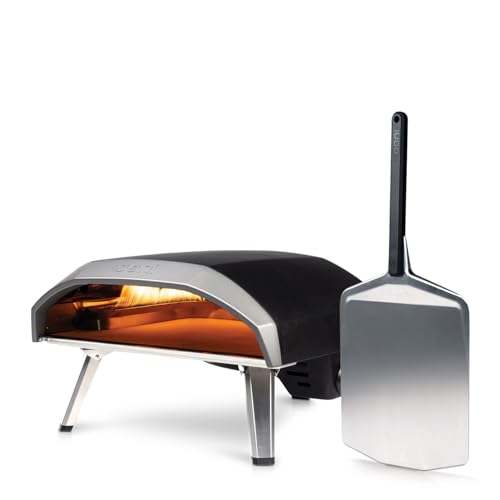
In our pizza ovens category it sits among the gas ovens. Far from all of them have a turntable; the Ooni Koda 16 and the BURNHARD Fat TONY, for example, bake on a fixed stone.
Housing, burner, stone: what the oven is made of
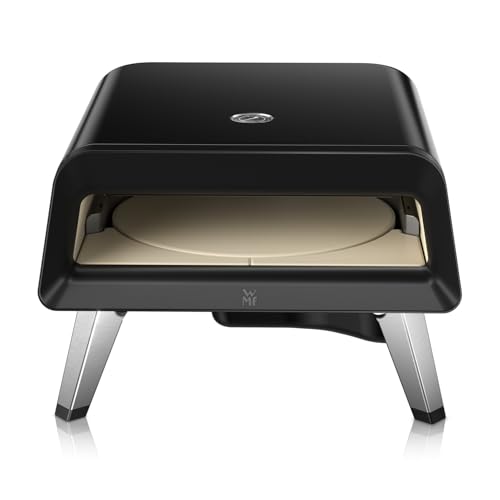
In the product photo the oven is matt black, with rounded edges, a wide, flat opening and angled, silver-coloured legs. It has no door. WMF justifies the always open front with heat circulation and writes on the product page of virtually no smoke, but strong heat radiation.
The housing is made of 1 mm thick steel with a triple-layer powder coating, the front lip below the opening of cast aluminium. According to WMF, both are resistant to corrosion and UV damage. The burner is made of solid cast iron and C-shaped; the rating plate gives a nominal heat input of 7 kW.
The pizza stone has a diameter of 40 cm (16 inches) and is made of cordierite. Strictly speaking there are three stones: the round one that rotates, and in front of it a two-part front stone, which you can see in the photo as a narrow strip in front of the circle. All three can be taken out. WMF reckons on one large pizza or two smaller ones per round.
For the dimensions WMF gives 62 × 33.86 × 55.11 cm (width, height, length) and a weight of 21 kg. Packed, the oven weighs 29 kg, and the carton measures 62 × 42.5 × 74 cm. The Amazon text deviates from this and states 37 × 55 × 62 cm and 23 kg. Amazon’s own data field, however, also shows 21 kg, so we go with WMF.
In the WMF shop the scope of delivery includes the oven, a large folding pizza peel, a 1 m gas hose and a gas pressure regulator. The oven arrives almost fully pre-assembled; to store it, you fold in the legs. The Amazon listing that we link to names only the oven and pizza peel in its scope of delivery. We cannot say whether hose and regulator are in the box there, especially as the manual itself says the regulator is supplied depending on the country. If in doubt, ask the seller before ordering.
In detail: what the turntable is for
A gas burner never heats a baking chamber evenly everywhere. Where the flame is closest, the radiation is strongest, and that is where the edge browns first. With a fixed stone you therefore turn the pizza with the peel, once or several times depending on the oven, so that every side has been at the flame once.
A turntable takes that off your hands. It carries every point of the edge round past the hottest zone, evenly, for as long as it runs. That is how every rotating-stone oven works. How even the result is on the Pizzaiolo Pro, none of us has seen, because we did not have the oven in front of us.
Operation according to the manual: you switch the rotation off for sliding the pizza in and for taking it out. Once the pizza is on the stone, you start the rotation with the start/stop button on the side of the oven. The reason is obvious: it is hard to set down a dough ball on a stone that moves away from under the peel.
The plate is driven by a motor that runs on 4 AA batteries of 1.5 V. The battery compartment is on the underside of the oven, and batteries are not included. The manual wants them replaced with new ones once a year and requires you to take them out if the oven stays unused for a longer time.
The stone may be loaded with 10 kg at most, otherwise the rotating plate’s motor is overloaded. A pizza will not get anywhere near that. But if you put heavy cookware on the stone, you should know the limit. When inserting, you also make sure the rotating stone and the front stone do not rub against each other; if they do, the manual advises changing their position slightly.
How long until the first pizza?
According to the instruction manual, the oven is fully heated about 15 minutes after lighting, to approx. 400 °C. The pizza itself then needs 90 seconds according to WMF.
The product page contradicts itself on this. The description text says 15 minutes heat-up time, the paragraph about the burner says 20 minutes, and as the maximum WMF states over 450 °C. Our assessment: plan with the longer of the two values, then you are prepared for each of the three statements.
Ignition is at the gas and temperature control, which has an integrated igniter. The sequence from the manual: control to off, open the gas bottle valve, wait 10 seconds. Then hold the control pressed for 5 seconds so that air can escape from the gas line through the burner, and turn it slowly anticlockwise until you hear a click and the burner lights. If it does not start, you wait 10 minutes before the next attempt.
For emergencies the oven has a match holder. If you have already tried to light it with the control, you wait 5 minutes so that the gas disperses. Then you put a match in the holder, light it and guide it over the oven opening to the burner. According to the quick start guide, you should not look directly into the oven while lighting.
On the control, the quick start guide marks the highest and the lowest temperature setting as well as off. You read the oven temperature on the integrated thermometer, which you should keep an eye on while preheating.
Gas: bottle, hose, consumption
The oven runs on butane (G30) or propane (G31) at 50 mbar, appliance category I3B/P(50). The rating plate lists Germany, Austria and Switzerland as destination countries, and the nozzle is 1.15 mm. If you operate the oven in a different country from the one where it was bought, the manual says to have it checked by an authorised service centre. For the bottle, WMF recommends standard propane bottles of 6 kg or 13 kg and a matching regulator. Which bottles exist and how deposit and exchange work is explained in our guide gas bottle for the grill.
For consumption, the rating plate has one figure: 509 g/h at nominal load. From that we calculated how long one filling lasts if the burner runs at full power the whole time. A 6 kg bottle then lasts just under 12 hours (6000 g divided by 509 g/h gives 11.8 h), a 13 kg bottle a good 25 hours. The quarter of an hour for heating up costs around 130 g by the same calculation. That is the worst case. On a low flame the burner draws less; by how much, we do not know.
Hoses up to 1.5 m at most are permitted, and the hose must be visible along its whole length. It must be neither twisted nor touch hot parts of the oven. If you replace it, the new one must be approved to EN 16436-1:2014+A3:2020 (a European standard that applies in the EU), and a new regulator to EN 16129:2013. If there are cracks or other damage, you replace the hose immediately.
You screw the regulator onto the bottle valve by hand until the nut stops. With a spanner the coupling nut can be damaged and the risk of accidents rises. The bottle stands upright with its valve closed.
The connections must be tight before the first lighting, before every use and after every bottle change. Checking is done with soapy water made of equal parts washing-up liquid and water: oven control off, apply the solution to all gas connections, open the bottle valve. If bubbles form, there is a leak there. Then shut the gas off immediately, tighten the connections, open the valve again and check a second time. If the leak remains, you must not use the oven under any circumstances and you contact customer service. Smoking and open flames are taboo during the check, and after use you always close the valve on the bottle.
Setting up and cleaning: what the manual says
The oven may only be operated outdoors. To combustible structures the manual requires at least 600 mm clearance at the sides and at least 900 mm at the back. Underneath belongs a stable, level surface covered with non-combustible, heat-resistant material; the manual gives tiles, flint and stainless steel as examples. The temperature under the oven is high, so it must not go on a table with a flammable tablecloth either.
If it stands in the immediate vicinity of a wall, the wall must be made of heat-resistant, non-combustible material or be covered with a suitable non-combustible, heat-insulating material. During operation you protect it from wind, in strong wind it stays off, and it is not moved while it is running.
The section on intended use contains a long series of further notes, from clothing (no loose items, no wide sleeves, no easily flammable synthetic fibres) through small children and pets to checking the burner at least once a year, because spiders and insects nest in it and can interrupt the gas supply. Read it in full before the first lighting.
For the stone, the wording of the manual applies: clean only with a slightly damp cloth and a hard brush. If you have cleaned it with water, you dry it for 2 hours at 60 °C in a conventional oven. It must not go in the dishwasher, and you never cool a hot stone with water. Acidic foods, vinegar, mustard or gherkins must not touch it, and you do not use it over an open flame. It is fragile and can burst if it tips over or falls. The three stones can only be taken out after they have cooled. Why moisture and rapid temperature changes make cordierite crack is explained in the guide cracked pizza stone.
On the interior the documents contradict each other. According to the product page, no cleaning is needed there because the pyrolysis effect cleans it by itself, and you wipe the outside with a damp cloth. The manual, by contrast, requires you to inspect and clean the inside thoroughly before lighting and to check that the burner outlets are clear. We would follow the manual.
Before any cleaning, the gas supply is cut off and the oven control is off. You clean the burner outlets regularly with a soft wire brush, the protective grille with a toothbrush. The burner itself you brush softly or blow out with compressed air, and blocked holes you clear with drain cleaner or wire.
Accessories, running costs and what remains open
To match the oven, WMF offers the Pizzaiolo Pro cover 60 cm (article number 3213000094), waterproof, UV resistant, with a drawstring and weighing 600 g. In the WMF shop it cost €59.99 on 20 October 2026, and the set of oven and cover €531.04. Compared with oven and cover bought separately, also in the WMF shop, you save €27.95 with the set. According to the manual, you should take accessories and spare parts only from the manufacturer. We found no base table from WMF, only retailer listings with that name.
Running costs add gas and, once a year, a set of batteries. What we looked for in vain in the WMF documents (product page, instruction manual and quick start guide, read on 20 October 2026):
- the baking area in square centimetres and the height of the oven opening
- where exactly the thermometer sits, what it measures and which range it displays
- the thickness of the stone
- how fast the plate turns and how long a set of batteries lasts
- which temperature belongs to the lowest and to the highest control setting
- whether stone, burner, motor and thermometer are available individually as spare parts, and at what price
- length and material of the pizza peel, material of the legs
- since when the oven has been on sale (the manual bears the print code 12/24)
An app or Bluetooth appears nowhere in the documents.
These three alternatives are worth a look
| Model | The difference | Price | Our rating | Choose this one if |
|---|---|---|---|---|
| WMF Pizzaiolo Pro (this one) | Gas, 7 kW, rotating stone Ø 40 cm with battery motor | approx. €425 | 8.3 | you do not want to turn the pizza yourself while baking |
| Ooni Koda 16 | Gas, L-shaped burner with 8.0 kW, no rotating stone, 18.2 kg | approx. €449 | 9.4 | you take over the turning with the peel and want the highest rating of this round |
| BURNHARD Fat TONY | Gas, 8 kW, thermometer for baking chamber and stone, pizzas up to 34 cm | approx. €499 | 8.6 | you want to read the stone temperature while preheating |
| cozze 17 Rotate | Electric with 2200 W, rotating stone Ø 42.5 cm, with door | approx. €520 | 8.3 | you want to bake without a gas bottle and have a power socket outside |
Prices are from our price boxes and they change. The rating is our editorial assessment; we measured nothing for it. The technical details on the three other ovens come from our own research at Ooni, Burnhard and cozze. The ranking pizza ovens shows all the ovens side by side.
When the Pizzaiolo Pro fits, and when another oven does
The first question is the turning. If you prefer to turn the dough ball yourself with the peel, the Ooni Koda 16 gets you a gas oven that costs approx. €449 in our price box and ranks ahead in our rating. If you specifically do not want to do the turning, for example because several people slide pizzas in one after another on pizza night, the Pizzaiolo Pro is the right one.
Then the size. With a 40 cm stone diameter, WMF reckons on one large or two smaller pizzas. For dough balls of around 34 cm, the BURNHARD Fat TONY for approx. €499 is enough too; it brings a thermometer for the middle of the stone, but no turntable.
Third, the fuel. If you do not want a gas bottle on the patio, you end up with the cozze 17 Rotate, with electricity and a rotating stone, which costs approx. €520 and requires a power socket.
Fourth, the space. With the clearances from the manual you need an area of around 1.8 m width and a good 1.4 m depth around the oven that is free of combustible structures, not counting the space in front of the opening where you stand with the peel. The calculation behind it: 62 cm width plus twice 60 cm, 55.11 cm length plus 90 cm. If you only have a narrow corner, check it beforehand with a folding rule.
For the budget, the gas bottle, the batteries and, if it stands outside between evenings, the cover from the accessories section come on top of the oven. Not sure whether it should be a gas oven at all? Then start at the Grill Finder.
The Pizzaiolo Pro is the wrong choice for anyone who wants to work with it. According to the manual it is intended only for private use outdoors, and for professional use (restaurant, kitchen, offices) WMF accepts no liability. It must not be installed in or on caravans or boats, and it is expressly not intended as a heater for cold patio evenings.