A pizza oven for the socket, with a stone on a turntable
The cozze 17“ Premium Rotate carries the manufacturer’s article number 90448. It plugs into a socket, draws 2200 W at 220 to 240 V and turns its round pizza stone at the press of a button. The manual names Millarco International A/S from Lystrup in Denmark as the manufacturer. On its own site, cozze presents itself as a former subsidiary of Millarco, which according to cozze is the largest wholesaler of tools, fittings and garden equipment in Northern Europe.
In our pizza ovens category it costs approx. €520 (Amazon page on 20 October 2026: €519.89).
Our sources are the German and English product pages at cozzebbq.com, the multilingual manual of 228 pages (the German part is on pages 12 to 19) and the Amazon catalogue. We did not have the oven itself here, and we baked nothing in it. Where we draw a conclusion from the photo or from materials science, we say so.
Casing, stone and control panel
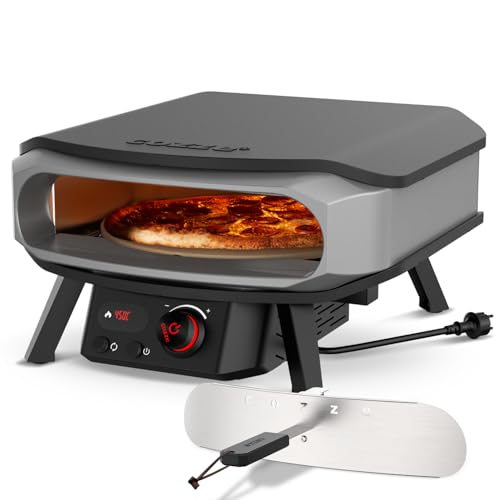
According to the product page the body measures 60.5 x 62.5 x 33 cm, and the manual gives the net weight as 26.4 kg. The casing is made of powder-coated, galvanised steel in grey and black. On the main photo it breaks down like this: on top a flat black hood with rounded corners, below it a grey front with a wide opening whose sides curve away, and four angled legs. The cable leaves at the back on one side and is 2 m long, with a plug.
Inside is a round cordierite stone, Ø 42.5 cm and 1 cm thick. The 17 inches in the name would convert to 43.2 cm, so the figure for the stone is slightly smaller and the more precise one. As the pizza size, the product page gives “Ø42.5 x H8 cm”. The page does not explain what exactly the 8 cm height refers to; the obvious reading is the height a pizza including its rim and toppings may have. The oven is supposed to heat up to 450 °C.
The manual labels the control panel under the opening with letters. A is an LED display, B a dial that can also be pressed, C the rotation motor button with a circular arrow and D the main switch with a power symbol. The manual also counts the oven door as E. On the photo the display and the two buttons sit on the left, the knob with a red ring in the middle.
Five parts appear in the manual’s parts list, one of each: the oven, the pizza stone, the oven door with the Cozze lettering and two small parts without a label, which according to the illustration are a retaining plate and a handle with a loop. The flat plate with a handle at the front of the product photo looks like a pizza peel. According to the parts list it is the door, with the letters C, O, Z, Z, E cut into it. The list does not include a pizza peel. The product pages contradict each other on this part: the German one says “Hitzeschild Inklusive” (heat shield included), the English one “Pizza door included”. We assume that the same part is meant. For assembly, the manual shows an Allen key, an open-ended spanner and M6 x 12 screws, with a person as a pictogram.
The rating plate says IPX4, that is protection against splashing water from all directions. cozze also names CE and LFGB, and the declaration of conformity lists the standards EN 60335-1 and EN 60335-2-6 as well as EU Regulation 1935/2004 on materials in contact with food (which applies in the EU).
In detail: what the rotating stone solves, and why it needs to reheat
In every small pizza oven the heat is unevenly distributed. At the opening heat escapes, further back it is hotter. With a fixed stone that means: slide the pizza in, lift it with the peel after half a minute, turn it a bit, put it back down. If you do that too late, you get one dark and one pale rim. A rotating stone takes this work off your hands, because every point of the rim passes the hot and the cooler spot at equal intervals. With it, cozze promises an “even, flawless pizza in just 2 minutes”.
You still have to operate the rotation. According to the manual you start it with button C after switching on, and you then place the pizza “with a pizza peel onto the hot, rotating stone”. So you put it down on a surface that is already moving. With a little semolina under the dough and a quick movement this is doable, but it is still unfamiliar the first time, which is our assessment.
The second point is the stone itself. Cordierite is a ceramic that expands little when heated and therefore tolerates temperature jumps better than fireclay. In our assessment one centimetre is little mass for an oven stone. Less mass heats up faster but stores less heat, and every cold disc of dough draws temperature from the stone. This fits what the manual says about baking: while the pizza is in the oven, you should reduce the temperature “to keep the base crisp without burning it”. Before each further pizza you set the heat to maximum for 5 minutes so that the stone heats up again.
The surroundings matter too, and cozze writes this in itself. Sustained wind lowers the interior temperature, and in a colder climate or at higher altitude baking takes longer. The door helps against this: if you use it while heating, it can shorten the heating time by 20 to 30 % according to the manual.
How long does an evening with six pizzas take?
Just under an hour, if you calculate with the manufacturer’s figures: at least 20 minutes of preheating, then 2 minutes of baking time per pizza and 5 minutes of reheating between two pizzas. For six pizzas that comes to 57 minutes, not counting the burn-off afterwards.
The calculation behind it is simple. On top of the 20 minutes of preheating, after which the stone reaches 400 °C according to the manual, each pizza adds 7 minutes, minus the reheating after the last one. For four pizzas that is 43 minutes, for ten 85 minutes.
With bigger groups you run into a limit that is easy to overlook. The oven is not supposed to run for longer than 2 hours with the door closed, otherwise there is a risk of overheating according to the manual. By our calculation you reach the two hours with the fifteenth pizza. If you are planning a garden party with twenty pizzas, you will have to pause in between.
Two things put the 2 minutes of baking time into perspective. The Amazon text expressly says “in just 2 minutes after preheating”, so the time only applies to a hot stone. And a thick dough or very wet toppings take longer in any oven than a thin pizza. You have to stay at the oven anyway: the manual requires that you do not leave it unattended during preheating and operation and that you do not move it while it is running.
Socket and location: what the setup spot must provide
For the power connection, the manual sets out a series of conditions. The oven may only be connected to an earthed socket, and it must run through a residual current device (RCD) with a rated residual current of no more than 30 mA. The supply voltage must match the rating plate, you must not exceed the maximum output of the socket, and you do not use it on a damaged socket. A damaged mains cable is replaced only by the manufacturer, its customer service or a similarly qualified person. You always pull the plug directly, never by the cable. You keep the cable away from hot surfaces, route it so that nobody pulls on it or trips over it, and check it regularly; if it is damaged, the oven stays off. You never immerse the cable, plug or oven in water or other liquids, and you do not spray any liquid into the oven.
2200 W at 230 V corresponds to just under 9.6 amperes. A typical household circuit is protected with 16 amperes. If a patio heater or a kettle is also connected to the same outdoor socket, the fuse can trip. That is general electrics and not a cozze figure.
The manual rules out an extension lead in principle, unless it meets its requirements: earthed, no longer than 4 metres, as short as possible, checked before every use and replaced if damaged, laid without a trip hazard, with dry connections. Together with the 2 metre cable, the oven may therefore stand at most 6 metres from the socket. On the cross-section, the German version is wrongly translated. It says “14-adriges Kabel” (14-core cable), the English original says “a 14-gauge cable with an earthed plug”. 14 gauge in the American AWG system corresponds to roughly 2.1 mm² of conductor cross-section. Extension leads common in Germany have 1.5 or 2.5 mm², and we would go for the thicker one.
On the location, the manual says: freestanding only, on a level, heat-resistant surface, in well-ventilated areas. You keep at least 60 cm clearance from combustible materials, 1.2 m above, and 60 cm at the sides and back. Walls, partitions and kitchen furniture nearby must be made of non-combustible material or clad with heat insulation, and fire protection regulations and all local laws apply. You keep 3 m free from pools or ponds. If you add the clearances at the sides and back to the casing, you need a free zone of a good 1.8 m width and around 1.2 m depth, not counting the space in front of the opening. A fabric parasol does not belong in the 1.2 m above.
There are separate rules for the door. In use it stays away from combustible materials, it does not go on combustible surfaces while hot until it has cooled down, and it does not lie on the oven while cooking. You do not leave lighters or lighter fluid near it.
Indoors or outdoors? The manual states in capital letters that the oven is “ONLY SUITABLE FOR HOUSEHOLD USE”. The product page calls it “ideal for any environment”, the Amazon text “outdoor kitchen compatible” for a patio or garden kitchen. An explicit approval for the kitchen in a flat is in none of these sources, but an explicit ban isn’t either. With the clearances above, a fitted kitchen is practically ruled out, because wall units would sit above the oven. Whether your balcony is an option depends on house rules and your tenancy agreement; what matters there is covered in our guide Grilling on a balcony.
Burn-off, brushing, drying: care and warranty
According to the manual you do all cleaning and maintenance only on the cooled oven with the mains plug pulled. After each use you “burn off” the oven for about 15 minutes so that excess food residue is reduced. cozze recommends cleaning and maintenance at least once a month. High-pressure steam cleaners and water jets are off limits.
For the outer surfaces the manual names “a mild detergent or caustic soda with hot water”, for stains a non-abrasive product and then rinsing. A second look is worthwhile here: in German, “Natronlauge” is a caustic solution of sodium hydroxide. Presumably baking soda is meant; we did not compare the English original of this passage. We would stick with the mild detergent. You clean plastic parts with a soft cloth and hot soapy water, without abrasive cleaners, degreasers or concentrated grill cleaners.
You brush the stone with the COZZE wire brush after the burn-off. If necessary, the cold stone may be rinsed with water, and it must be completely dry before the next use. In addition there is a separate list of precautions for the stone, given here in full: do not use over an open flame; avoid extreme temperature changes and do not put frozen food on the hot stone; it is fragile and can break if knocked or dropped; it stays hot for a long time after use and is not cooled with water while hot; dry completely after cleaning, for example 2 hours at 60 °C in the oven; store dry and warm. Why moisture and temperature jumps in particular make a stone crack is explained in our guide Cracked pizza stone.
For storage you always let the oven cool down, cover it only when it has cooled down completely, and keep it covered in a warm, dry place. In winter, pizza stones and accessories belong indoors.
This rule is also a warranty condition. cozze gives 2 years of warranty on all products, under eleven conditions. The oven must be used according to the user manual, cleaned and maintained regularly and stored covered. It must not be modified and must only carry original parts, must be properly assembled, connected to the right type of current and stand on a level, safe surface. Wooden parts, pizza stones and accessories are stored indoors in winter, the appliance does not stand near the sea, chlorinated pools or whirlpools and is for private use only. Excluded are expected wear and tear, vandalism, unusual weather events such as hail or storms, and environmental influences such as acid rain or salt in the air. The pizza stone expressly counts as a wearing part and is not covered by the warranty. For a claim you need proof of payment and the installation certificate; without them cozze regards the warranty as invalid.
What the manufacturer does not state
Neither the product pages nor the manual clarify these points:
- Number and position of the heating elements, separate top and bottom heat
- Rotation speed, rotation direction and motor power; whether the rotation can be stopped during baking (the manual only says button C controls “the opening and closing of the rotating rack”)
- Heat-up time to 450 °C
- Width and height of the oven opening
- Material of the interior, door and feet in detail
- Power consumption per baking session
- Automatic switch-off or overheating protection
- Replacement stone, spare parts and their prices
- A matching cover model, although covered storage is a warranty condition
- Country of manufacture
- The meaning of the Amazon part number 90865, which appears nowhere at the manufacturer
An upper limit for power consumption can at least be calculated. If the heating runs continuously at 2200 W, the evening with six pizzas including burn-off means 72 minutes of operation, so at most 2.64 kWh. Multiplied by your electricity price, that is the worst case; as soon as the temperature control switches the heating off, consumption is lower.
What else is worth considering?
| Model | The difference | Price | Our rating | Choose this one if |
|---|---|---|---|---|
| cozze 17“ Premium Rotate Electric (this one) | Rotating stone Ø 42.5 cm by button, 2200 W | approx. €520 | 8.3 | you want to bake at a socket and not turn the pizza yourself |
| Cozze 17 inch Electric Pizza Oven Black | same brand and output, without rotating stone, according to the Amazon title with oven riser | approx. €421 | 8.2 | you like turning the pizza yourself with the peel |
| Effeuno P134H | electric, without rotating stone | approx. €599 | 9.2 | the higher rating is worth the extra cost to you and turning does not bother you |
| Ooni Koda 16 | gas instead of electricity, according to the Amazon title 50 mbar and 40 cm stone | approx. €449 | 9.4 | there is no suitable socket where you will set it up |
The prices are guide values from our price boxes and change constantly. The rating is our editorial assessment based on the available data; we measured nothing.
When the Rotate fits and when another oven
If you have an earthed, RCD-protected outdoor socket and no desire to fiddle with the peel every thirty seconds, the rotating stone is the reason for this oven. The Rotate costs approx. €520, the Cozze 17 inch Electric Pizza Oven Black approx. €421, with the same stated output. In our comparison the two are almost level, at 8.3 against 8.2. If you trust yourself to turn the pizza, you save the money.
If your socket is too far away or the RCD protection is missing, the Rotate will not help you, not even with a longer extension lead. A gas oven is then the closer option. The Ooni Koda 16 costs approx. €449, but needs a gas cylinder with a pressure regulator, and there you turn the pizza by hand again.
The Effeuno P134H is the only oven in this selection that costs more: approx. €599 against approx. €520 for the cozze. It stands clearly higher in our rating at 9.2, but has no rotating stone. What puts it there is covered in its own review; we would take it if turning does not matter to you.
On top of the purchase price come items that are easily forgotten: a pizza peel, because none is in the parts list, and a cover, because the warranty requires covered storage. If you carry the stone indoors in winter, you need room there for a disc of a good 42 cm diameter.
The Rotate is the wrong choice for anyone looking for an oven to take along, for example for the barbecue spot in the park or a weekend at friends’. It is described for freestanding operation at a fixed spot with a socket, and with the weight from the technical section one person will not carry it to the car casually. If you only bake a single pizza a few times a year, you do not need the turntable either; the Grill Finder will then show you alternatives with a different fuel.