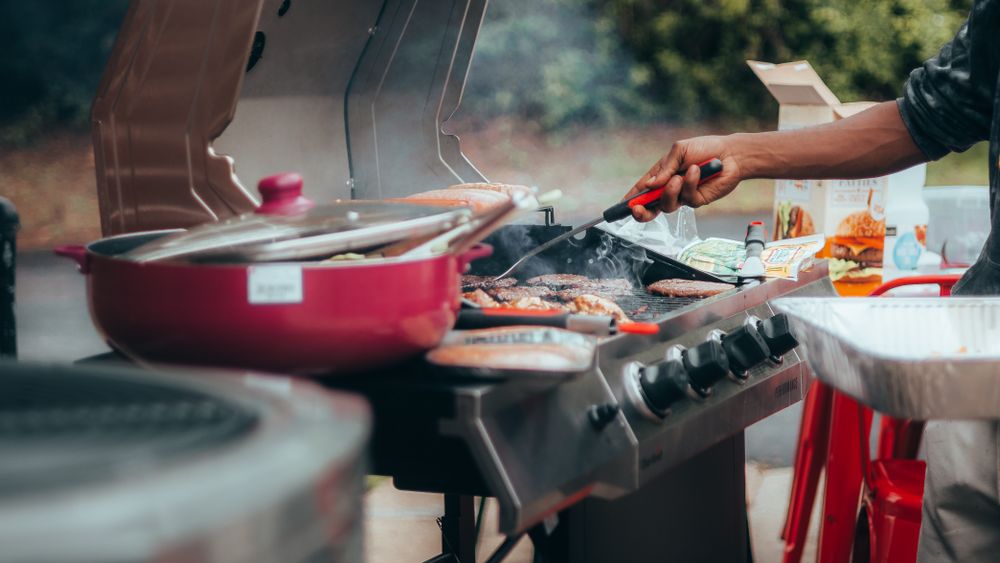
The short answer: Raw grill meat belongs in the cold at 0 to 4 °C until shortly before it goes on the grill. At an outside temperature of 20 to 30 °C, about 60 minutes unchilled is the upper limit, and noticeably less in strong sun. Transport it in a pre-chilled box, keep raw and cooked meat strictly separate and cool leftovers down again within two hours.
The critical zone for bacterial growth lies roughly between 5 and 60 °C, and that is exactly where a barbecue evening in high summer takes place. Salmonella and Campylobacter multiply many times faster at 30 °C than at 5 °C, without the meat visibly spoiling or smelling off. The decisive mistakes therefore happen not at the grate but before it: on the way back from the supermarket, in the boot and on the table next to the grill.
How cold does grill meat need to be stored?
At 0 to 4 °C, so in the coldest compartment of the fridge. In most appliances that is the bottom glass shelf directly above the vegetable drawer, not the door and not the middle shelf. The target temperature for the whole fridge is around 7 °C and below, but for raw meat, poultry and fish, 0 to 4 °C is the reliable guideline. A simple fridge thermometer tells you more than the dial setting, because the settings do not state a temperature.
How long something keeps depends heavily on the type. The more surface area and the finer the mince, the shorter the shelf life.
| Type of meat (raw) | Fridge storage time (guideline) | Note |
|---|---|---|
| Mince, minced pork (Mett) | use on the day of purchase | carries a use-by date in Germany, not a best-before date |
| Raw bratwurst, grill sausages | approx. 1 to 2 days | large surface area relative to volume |
| Poultry (chicken, turkey) | approx. 1 to 2 days | store packed separately, never let meat juice splash |
| Pork and veal | approx. 2 to 3 days | shorter when cut than as a whole piece |
| Beef in one piece | approx. 3 to 4 days | whole pieces keep the longest |
| Fish and seafood | on the day of purchase, 1 day at most | most delicate, best kept on ice |
| Meat you marinated yourself | approx. 1 to 2 days, covered | oil and spices do not extend the shelf life |
| Meat already grilled | approx. 2 to 3 days at max. 4 °C | cool quickly before putting away |
Printed dates beat any rule of thumb. If the pack says “use by”, that is a hard limit and not a best-before date: after it, the product no longer belongs on the grill even with perfect refrigeration. This mainly affects mince and poultry.
How long can grill meat sit outside in the heat?
At 20 to 30 °C about an hour, and noticeably less above that. The widespread two-hour rule applies to room temperature, not to a balcony at 33 °C. It is also crucial that the times add up: the 25 minutes in the shopping trolley, the 20 minutes of driving and the 30 minutes of waiting next to the grill are together already over the limit, even though each individual stretch seems harmless.
| Ambient temperature | Raw meat unchilled (guideline) | Grilled food and salads on the table |
|---|---|---|
| up to approx. 20 °C | max. approx. 2 hours | max. approx. 2 hours |
| approx. 20 to 30 °C | max. approx. 1 hour | max. approx. 1 hour |
| above approx. 30 °C or strong sun | under 1 hour, better kept chilled throughout | under 1 hour, covered and in the shade |
| closed car in the sun | not at all, not even briefly | not at all |
Practical consequence: only put out as much meat as will fit on the grate in the next twenty minutes, and fetch the rest in portions. A cover protects against insects, not against heat, and in the sun it even heats things up further. How much meat per person is realistic so that nothing stands around for hours is covered in Planning a barbecue party.
How do I transport grill meat to the barbecue spot?
In a pre-chilled, well-insulated box with frozen ice packs, packed so that raw meat cannot touch or drip onto anything else. A cool bag without ice packs is only a delay at 30 °C, not cooling. Which box realistically holds which temperature differs considerably.
| Box type | Cooling principle | Power needed | Realistically suited for |
|---|---|---|---|
| Polystyrene or folding box | insulation plus ice packs | no | short trip home, a few hours |
| Passive hard-shell box | thick insulation plus ice packs or ice | no | day trip, if pre-chilled and opened rarely |
| Thermoelectric box (Peltier) | cools around 15 to 20 degrees below ambient temperature, according to manufacturer specifications | yes, 12 V or 230 V | long car journeys, but too warm for raw meat at 35 °C outside |
| Compressor box | active cooling with adjustable temperature | yes | camping and multi-day trips with a reliable 4 °C |
The most important point in this table is often overlooked: a thermoelectric box cools relative to the surroundings. At 35 °C in the car it ends up at around 15 to 20 °C, right in the critical zone. For raw meat on a hot day, you need either a large quantity of frozen ice packs or a compressor box.
How to pack the box properly:
- Pre-chill the box an hour beforehand. An ice pack in the empty, closed box lowers the interior temperature before the food goes in. A warm box otherwise draws the cold out of the meat first.
- Spread ice packs on top and underneath. Cold air sinks, so a single layer on the bottom is not enough. Rule of thumb: plan for about a quarter of the internal volume to be coolant.
- Pack meat straight from the fridge. Do not warm anything up beforehand and do not leave anything “just for a moment” on the worktop. On long journeys you can pack sausages and steaks frozen, and they then help cool the box themselves.
- Raw meat at the very bottom, double-wrapped. A tight container or a second bag prevents meat juice from dripping onto salad, bread or fruit.
- Cooked food, salads and sauces on top and separate. If possible in a compartment of their own or a second box.
- Fill empty spaces. Empty air warms up fastest. Towels or additional ice packs are better than air.
- Carry the box in the passenger compartment. A boot in the sun gets noticeably hotter than the interior with air conditioning. On arrival, the box stands in the shade, not next to the grill.
- Drinks in a second box. The drinks box gets opened twenty times, the meat box as rarely as possible.
The same applies when shopping: meat, fish and dairy products go into the trolley last and straight home without detours. On hot days, a cool bag in the car is the precondition for the cold chain holding at all. You can find suitable cool boxes, thermometers and transport aids under Grill accessories compared.
Thawing without risk: fridge instead of worktop
Frozen meat thaws in the fridge, not on the worktop, not in the sun and not in a warm water bath. The reason: the surface is long at room temperature while the core is still frozen, and that is exactly when germs multiply undisturbed. In the fridge, the whole surface stays uncritical.
- Plan ahead. As a rule of thumb, allow about 10 to 12 hours per kilogram in the fridge. Steaks and sausages need one night, a whole chicken more like a whole day.
- Place in a dish with a high rim. The thaw water must be caught and must not drip onto food below.
- Put it on the lowest shelf and cover it. Store nothing ready to eat underneath.
- Pour away the thaw water. It is contaminated with germs and is not a marinade base, even if it looks rich.
- Clean everything that had contact. Dish, sink, chopping board and hands with hot water and washing-up liquid, then dry the surfaces.
- Use it promptly. Thawed meat should go on the grill within a day.
If you are in a hurry, the cold water bath is the only sensible shortcut: put the meat tightly sealed in a bag, place it in cold water, change the water every 30 minutes, then cook immediately. The microwave’s defrost setting also works, but only with immediate cooking through, because warm edge zones already form in the process.
Cross-contamination: boards, tongs and the marinade trap
The most common cause of complaints after a barbecue evening is not the raw meat itself but the route germs take onto something that nobody heats any more. Pasta salad, bread, coleslaw: everything that goes on the plate uncooked is the real risk.
These separations are not negotiable:
- Two boards, two knives. One set for raw meat, one for everything else. Coloured boards make the assignment unambiguous in the bustle.
- Two pairs of tongs. The tongs that put raw meat on the grill never take anything cooked off the grate.
- Two plates. The plate that carried the raw meat is not reused for the finished food but first washed hot.
- Never use leftover marinade as a sauce. Marinade that raw meat sat in goes in the bin or into a pot and is boiled vigorously for at least a few minutes. If you want to baste with it, set aside a clean portion beforehand.
- Do not wash poultry. Washing does not kill germs but spreads splashes over the sink, worktop and towel. Patting dry with kitchen paper is enough, and the paper goes straight in the bin.
- Wash your hands in between. After every contact with raw meat, with soap and for at least 20 seconds.
The second half of safety happens on the grate. Poultry needs a core temperature of at least 72 °C, and mince products and raw bratwurst must be cooked through completely, because with minced meat the germs are not only on the outside. Looking at the colour is not enough for this, but a probe thermometer is. The target values for all common types of meat are in the core temperature chart.
What do I do with leftovers from the barbecue?
Cool them down within two hours, pack them airtight and use them up within two to three days. On hot days, the two-hour deadline is more like one hour. Large pieces cool slowly, so it helps to cut them into smaller portions and put them in the fridge in shallow containers rather than in a tall pot.
When reheating, the rule is: once, and properly. Leftovers should reach at least 70 °C at the core for around two minutes, which works more reliably in a pan or oven than in the microwave, which heats unevenly. Reheating several times is the worst option, because the food passes through the critical zone again each time.
What will not be eaten within two to three days you can freeze, but only cooked and promptly after cooling. Raw meat that was already thawed does not go back into the freezer raw. The detour via the grill solves that: cook through, cool, freeze.
A special case is salads with mayonnaise, eggs or dairy products. They are more delicate than the meat and, after an afternoon in the sun, belong in the bin without exception, regardless of how they look or smell.
Conclusion: six rules for hot barbecue days
Think cold chain, not points in time. From the chiller cabinet to the grate, meat stays cold, and every interruption counts towards the total time.
0 to 4 °C is the target value. The fridge runs at around 7 °C and below, and meat goes in the coldest compartment.
One hour is the summer limit. At 20 to 30 °C, raw meat may be unchilled for about an hour, and for less above that. Add more in portions.
The box is pre-chilled and layered. Ice packs on top and underneath, raw meat tightly packed at the bottom, salads and cooked food above, drinks separate.
Raw and cooked never meet. Separate boards, tongs and plates, no uncooked leftover marinade, wash your hands in between.
Cool leftovers down quickly. Into the fridge within two hours in shallow containers, use up within two to three days, heat through only once.