The ft6 fire pot is a cast-iron Dutch oven from Petromax, a company based in Magdeburg. This page covers the version with three legs; in the same size Petromax also sells the ft6-t with a flat base. On Amazon the ft6 with legs costs approx. €75 (as of September 2026). In our Grill accessories category it is one of three Dutch ovens and has the highest overall rating there.
Our sources are Petromax’s product page, the 2025 catalogue, the care instructions for cast iron and the warranty terms, plus the Amazon catalogue. We retrieved everything on 24 September 2026, including the manufacturer pages of the products in the comparison table, and prices from the Petromax shop apply to that day. We have not cooked in the ft6. Where we calculate or infer something ourselves, we say so.
Cast iron, three legs, a lid with a rim
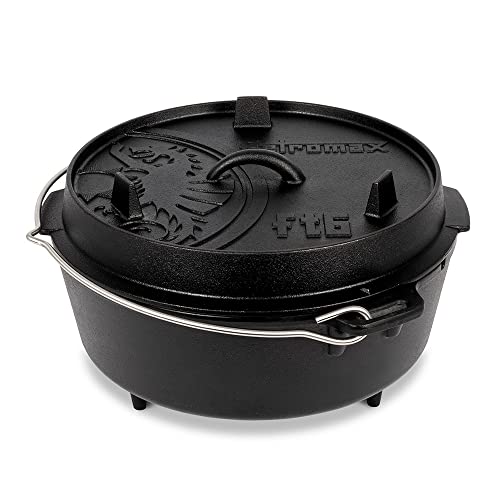
Pot and lid are cast iron, according to Petromax with a high share of scrap iron. The pot has no coating such as Teflon or PFA; the non-stick effect is meant to come from the patina, a layer of baked-on oil. The wall thickness is shown on the sectional drawing with which the 2025 catalogue presents the fire pots: a uniform 5 mm.
Under the pot sit three short legs. The catalogue explains them by the distance to coals or embers, the manufacturer text on Amazon by the fact that coals, briquettes or embers have room directly under the pot. According to the warranty terms the handle is stainless steel, and the catalogue gives it a notch for hanging. On the product photo it is a wire bail that sits in two lugs sticking out of the pot wall at the sides.
The lid has a raised rim so that embers and briquettes stay on top. On the upper side there are three legs of its own, on which it stands as a pan when turned over, tip-proof according to the manufacturer. There is also a thermometer port: through it you push a probe into the pot without lifting the lid and its embers. In our assessment every lift is also a chance for ash to slide from the lid into the food. According to Petromax, pot and lid fit together exactly so that the heat stays in the pot.
Petromax gives the envelope dimensions as 20 x 31.2 x 36.4 cm (height, width, depth). The pot is round; the depth being larger than the width is probably due to the two lugs that stick out at the sides. What fits inside is better described by the detailed dimensions: 302 mm diameter at the top rim of the pot, 251.3 mm at the base and 96 mm inner height. The lid is 68.5 mm high and 39 mm deep inside, and its base has a diameter of 276.64 mm.
Together, pot and lid weigh 9 kg, 9.7 kg packed. The Amazon catalogue lists a weight of 3.31 pounds, converted 1.5 kg. For a cast pot of this size that cannot be right; we go with the manufacturer’s figure.
In detail: embers under the pot, briquettes on the lid
On a fire, a Dutch oven has two heat sources. Embers under the pot heat the base, and the food sits on the base; if the embers are too strong, something burns there first. Briquettes on the lid heat from above, similar to the top heat in an oven, and the care instructions call this the oven function. That explains what the legs are for. Embers need air, and a pot sitting flat on them would smother them at the contact surface.
How many briquettes go where is shown by a table in the catalogue, sorted by pot size and temperature. For the ft6, at 200 to 225 °C there are 20 briquettes on the lid and 10 underneath, or 16 and 8 with Petromax’s own Cabix Plus. For 160 to 180 °C it is 12 on top and 8 underneath with Cabix Plus. In each of these rows there are more embers on top than underneath.
We consider a fourth row a misprint: regular briquettes at 160 to 180 °C, printed as 4 on top and 10 underneath. That would be 14 pieces and so fewer than the 20 Cabix Plus for the same temperature, even though regular briquettes at 200 to 225 °C need more than Cabix Plus (30 versus 24). Also, only in this row does the distribution tip towards the bottom. We therefore do not adopt it.
The product page works in grams. For a “small” Dutch oven the size of the ft6, about 500 grams of charcoal would be enough, for a large one with 12 litres about 2 kg, it says there, in each case without temperature and without cooking time. How that fits the briquette table is left open. According to the same page, you should spread the charcoal evenly around the pot. As fuel Petromax recommends charcoal and also names briquettes, chunks and coconut briquettes. How lump charcoal and briquettes differ in embers and burn time is explained by our guide Charcoal or briquettes.
Petromax promises that the pot releases heat calmly and evenly, without hot spots. In physical terms this has less to do with conductivity, since aluminium and copper conduct heat considerably better than cast iron. It is mainly down to mass: the thick, heavy wall stores a lot of heat and buffers fluctuations in the embers, for instance when one briquette burns down earlier than the others. The same physics has a downside, which we infer and have not measured: such a heavy pot takes time to get hot and still gives off heat when the embers are already gone.
Which version: with legs or flat base?
Petromax assigns the two versions itself: legs for the open fire, flat base for hob, grill and induction. For both the manufacturer gives the same RRP, and the Petromax shop sells them at the same price.
Capacity, inner height, diameter and lid are the same according to the manufacturer. The base is different. The ft6-t comes to 16 cm envelope height, 4 cm less than the ft6, and weighs 8.8 kg. The pot alone measures 142 mm in height with legs and 101 mm without legs.
Chapter 2.3 of the care instructions relates the hob types explicitly to cookware without legs. There is no ban for the ft6 there, and no approval either. On induction hobs the pot must, according to the same instructions, sit flat and stable, and on three legs it does not. We would therefore not put it on any hob.
Cheaper in the same shop is the Essential Line. Petromax sells the Essential ft6-t for €59.90, with the same capacity but reduced material thickness, and it weighs 7.55 kg. The Essential version always has a flat base. Legs for embers in this size exist only on the ft6 from the regular range.
Is the ft6 enough for goulash and for guests?
According to Petromax’s own recommendations, not for goulash, and for guests only in a small group. For stews, goulash and braised dishes the manufacturer advises 7.5 litres or more, and separately the same for larger groups. In the size range that starts at the ft9; the ft6 holds at most 5.5 litres in the pot.
The product page does state 4 to 8 people, but with an asterisk: a “can” figure that depends on appetite. Further down the same page Petromax becomes more specific. For a family of two adults and two children a pot of this size is usually enough, and the manufacturer text on Amazon speaks of a small dinner party. We read this as: for two adults and two children the ft6 is enough according to Petromax’s own size guidance. Conversely, for pancakes and other dishes that need a flat surface, Petromax recommends a pot of 5.5 litres or less.
The lid holds 1.5 litres, but as a flat pan and not as a second pot. Anyone who adds the two figures gets 7 litres, which exist nowhere as pot capacity. For bacon or a side next to the main dish, the pan is enough.
According to the manufacturer, the ft9 holds 2 litres more in the pot, and the lid is the same size; it is specified for 8 to 14 people. In the Petromax shop it costs €10 more than the ft6. In weight the jump is small: with a flat base the ft9-t weighs 9.43 kg, a good 600 grams more than the ft6-t. We do not have a review of the ft9 fire pot yet, so the table below shows the ft12 as the larger alternative.
What else comes into question: two pots and a tripod
| Model | The difference | Price | Our rating | Choose this one if |
|---|---|---|---|---|
| Petromax Feuertopf ft6 (this one) | 5.5 l in the pot, 1.5 l in the lid, 9 kg | approx. €75 | 9.0 | you cook for a family over embers or at a campfire |
| Petromax Feuertopf ft12 | 10.8 l in the pot, flat base, 13.91 kg | approx. €105 | 8.9 | you regularly cook for 14 people or more |
| BBQ-Toro Dutch Oven DO45P | 3.1 l in the pot, lid lifter included | approx. €45 | 8.4 | you rarely cook for more than four people and first want to find out whether ember cooking suits you |
| Grillfürst Dreibein für Dutch Oven | not a pot, but a frame for hanging, rated by Grillfürst for up to 60 kg | approx. €85 | 8.1 | you want to hang the ft6 by its handle over a campfire |
Prices and ratings come from our individual reviews; the prices are guide values and not up to date for the day. The details in the second column come from the pages of the three manufacturers Petromax, BBQ-Toro and Grillfürst. The rating is our editorial assessment, not a measurement result.
What is in the box and what comes extra
According to the scope of delivery, the box contains only the ft6 with lid. You lift the lid off with a lid lifter, per chapter 6 of the instructions, and Petromax has two of them in its range.
The prices in this paragraph are RRP from the 2025 catalogue. The FTDH lid lifter is 32 cm long and costs €11.99. The FTPLUS professional lid lifter holds the lid with a clamping mechanism and costs €24.90. The FT-PFLEGE care paste is €14.99, a polypropylene scraper €4.99, available as OS or as OS-Z, which is heat-resistant up to 120 °C. Petromax rates the SLX-C silicone trivet, at €14.99, for minus 40 to 230 °C.
The Einsteiger (beginner) set bundles the ft6 with legs, a lid lifter, the care paste and a scraper and costs €108.00 in the Petromax shop. Bought individually, the four parts would come to €120.96 there. The shop forms this sum from its own individual prices, not from the RRP in the paragraph before; compared with it, the set saves €12.96. According to Petromax, you can also use the lid lifter from the set as a poker to stoke the fire again. The warranty on the set covers only the pot, not the accessories.
Running costs arise mainly from fuel. Petromax’s Cabix Plus briquettes (article C-PLUS, 3,100 g) have an RRP of €11.99 and, according to the manufacturer, can be reused after extinguishing.
Cleaning, rust and safety according to the instructions
Before first use you remove the packaging, rinse the pot with hot water, then with cold, and dry it well. You do not have to season it, as it comes with a Seasoned Finish, a surface pretreated at the factory. Elsewhere the instructions say cast iron must be seasoned or oiled often so that its non-stick properties improve. We read both together like this: the factory layer is the start, and the patina grows with every oiling.
After cooking you let the ft6 cool, rinse it by hand with hot water only, dry it thoroughly and oil it. You do not use washing-up liquid, and according to the symbol page the pot is unsuitable for the dishwasher. Abrasive or caustic agents and metal pot scourers are also ruled out; against crusts, Petromax names its own scrapers or the scrub and scrub-xl ring cleaners. Chapter 7 warns with an exclamation mark against dropping the pot or pouring cold liquid onto still-hot cast iron, because the brittle material can crack.
For oiling you use the care paste, a neutral oil such as rapeseed or pumpkin seed oil, or vegetable fat. Petromax rules out olive oil because it cannot be heated as much as other fats. You never store the pot wet and untreated, and you store it dry. So that air reaches the inside, you can put thin cardboard, a piece of wood or the silicone trivet between pot and lid.
According to chapters 4 and 8 of the instructions, you brush off rust with a wire brush, oil the pot and then season it again, for small as well as heavy rust spots; the patina must be renewed if it has suffered.
In the oven it goes like this: remove labels and residues, clean the pot with hot water and a brush, dry it and let it dry for at least 2 hours. Then you coat it thinly with care paste or an oil with a high smoke point (from about 200 °C), ideally with a brush or cotton cloth. According to Petromax, rapeseed oil, sunflower oil or coconut fat, for example, are suitable; linseed oil is ruled out, as is olive oil. You wipe off excess fat thoroughly. The pot goes upside down on the rack of the oven preheated to 200 to 250 °C, and a baking tray on the bottom shelf catches dripping oil. You keep an eye on it throughout; the instructions require this, with an exclamation mark. Light smoke is intended. How long it takes depends on the product, according to Petromax: at least 30 minutes, and once it no longer smokes, the process is finished. You switch the oven off and let the pot cool slowly inside until you can take it out safely.
Because heated oil smokes, the instructions require a well-ventilated room for this, for example with an open window or a fan. They recommend an oven with an extractor or alternatively the grill in the garden, and also make the choice depend on the size of the product. With the ft6 we would first measure whether it fits upside down in your own oven. If your oven is not connected to an extractor, you move the seasoning outdoors anyway.
On a charcoal or gas grill you first preheat to a high temperature, and the grate must be clean. You coat the cleaned and dried pot thinly on the inside with rapeseed or pumpkin seed oil or the paste and place it upside down, stable and level, on the grate. If there is one, you close the grill lid, and with good ventilation the pot stays on for about 30 to 60 minutes. Then you switch the grill off and let the pot cool slowly without touching it while hot. For seasoning outdoors, chapter 8.2 sets out these rules:
- choose a well-ventilated spot outdoors, not near easily flammable materials or structures, and avoid excessively windy areas
- place the pot on a stable, fireproof surface, such as a grill, bricks or a metal stand
- keep a fire extinguisher, fire blanket or another suitable extinguishing agent nearby
- keep your distance from the pot and make sure no children or pets are nearby
- wear heat-resistant gloves and, if necessary, an apron against hot splashes
- handle hot oil carefully, without spilling or splashing anything
- keep an eye on the pot and be careful when taking it out of the fire or moving it
- let it cool completely before you touch or clean it
Safety
Cast-iron cookware gets very hot in use, the instructions warn. Chapter 3 applies to all Petromax cast-iron products and requires:
- work only with care and in good condition; the instructions call tiredness, illness, alcohol, and the influence of medication and drugs irresponsible
- check the pot for damage before use, do not use damaged cookware, and replace a defective part before the next use
- choose the right hob size and observe the load capacity stated by the manufacturer of your grill or cooker (a general rule; as explained above, we would not put the ft6 with legs on any hob)
- on sensitive surfaces, mind the weight: do not drop the pot but set it down carefully, and do not push heavy cookware, because that can scratch sensitive surfaces
- do not heat it empty, because it could overheat, and never leave it hot and unattended on a heat source
- do not put out burning fat with water but cut off the oxygen supply with a lid or a blanket and remove the ignition source; for burns, give first aid and seek professional medical help
- use utensils made of wood, heat-resistant plastic or silicone instead of metal, and do not cut directly in the pot with a knife; according to the instructions, metal utensils can damage the cast iron just as abrasive sponges or metal pot scourers can
- keep children and animals away, protect your hands with a heat-resistant cloth or protective gloves, and use a lid lifter
That the handles can get very hot is stated in chapter 6; on the ft6 these are the handle and the grip on the lid. Once taken off the fire, it goes on a heat-resistant surface, otherwise sensitive surfaces can be damaged. Petromax recommends the silicone trivet or the t300-e and t300 aramid pot holders for this. The symbol page adds the bans on microwave and freezer and the note not to use the pot as a cutting board.
What the warranty covers
On fire pots, meaning products made entirely of cast iron with a stainless steel handle, Petromax grants a voluntary manufacturer’s warranty against material and workmanship defects that runs for 25 years (warranty terms, as of July 2026). It applies to pots bearing the Petromax brand logo that were sold to end customers in Germany or Austria from 1 February 2026, and only in these two countries. The pot must have been bought through the official Petromax website or from a Petromax retailer. Petromax then repairs it or supplies an identical or equivalent new or reworked model; a refund of the purchase price is excluded. Petromax bears the costs of handling, including shipping there and back within Germany and Austria. The period starts with the first sale to an end customer, after repair or replacement the remaining time keeps running, and your statutory warranty rights against the seller remain unaffected. The precondition is always intended use in line with the operating and care instructions.
Whether a purchase on Amazon counts as a purchase from a Petromax retailer is not clear from the terms, and none of the Petromax pages we evaluated links to Amazon. If the warranty matters to you, ask Petromax customer service before buying or order directly through the Petromax website.
According to the terms, the following are excluded:
- improper use and normal wear
- commercial use, unless Petromax expressly advertises it
- failure to follow the operating and care instructions
- usual signs of use such as scratches, rust, discolouration and soot
- damage from drops, impacts, force or misuse
- damage from extreme temperatures, weather, storage not protected from the weather or direct sun
- damage from chemical or abrasive substances or acids
- cosmetic defects that do not impair function
- improper care or cleaning and omitted care
- improperly carried out repairs
- spare parts that do not meet the original standard
- fading and colour damage without effect on function
- other reasons that are not a material or workmanship defect
Rust after wet storage falls out twice over by our reading, as a sign of use and as omitted care.
What Petromax does not state
On these points we found nothing in any of the sources named above:
- in which country the pot is cast; only the company seat in Magdeburg is given
- a maximum temperature: the “MAX °C” symbol in the instructions has no number
- the individual weights of pot and lid
- whether the diameters of pot rim and base are measured inside or outside
- the height of the legs; the two pot heights differ by 41 mm by calculation
- a load capacity of the handle in kilograms, although Petromax calls it load-bearing
- the diameter of the thermometer port and which thermometers fit
- a heat-up time
- a burn time or a briquette consumption per hour
- the share of scrap iron in percent
- by how much thinner the wall of the Essential Line is
- since when the ft6 has existed
- whether Petromax sells individual spare parts such as lid or handle
Who is it suitable for?
Anyone who wants to cook hanging over a campfire needs a tripod in addition. Petromax itself describes, on the page of the beginner set, that the filled pot can be hung by its handle from a tripod. In its own shop there is a set of tripod and ft6-t for €263.00, which contains the pot with a flat base, and a grill tripod starter set with ft6 from €387.36. If you already have the pot, a single frame such as the Grillfürst tripod from the table is enough. Allow for the weight: filled to the brim, pot, lid and contents come to roughly 14.5 kg, if you take the contents as water at one kilo per litre.
For a side in its own pot next to the main dish, Petromax sells a set of ft3-t and ft6-t for €109.00, both however with a flat base.
If the pot is to go on trips more often, the BBQ-Toro DO45P from the table is the lighter choice. BBQ-Toro gives it as 5.8 kg and names 2 to 5 people.
The ft6 is the wrong choice for anyone who often braises with a lot of tomato or vinegar. Petromax declares the pot suitable for watery, alcoholic and fatty foods and dairy products, except acidic ones, and the care instructions require you to avoid acidic foods. Because these instructions apply to all of the manufacturer’s cast-iron products, the ft9 and ft6-t are no way out. In our assessment, anyone who cooks like this is better served by an enamelled pot, where a glaze separates the iron from the acid.