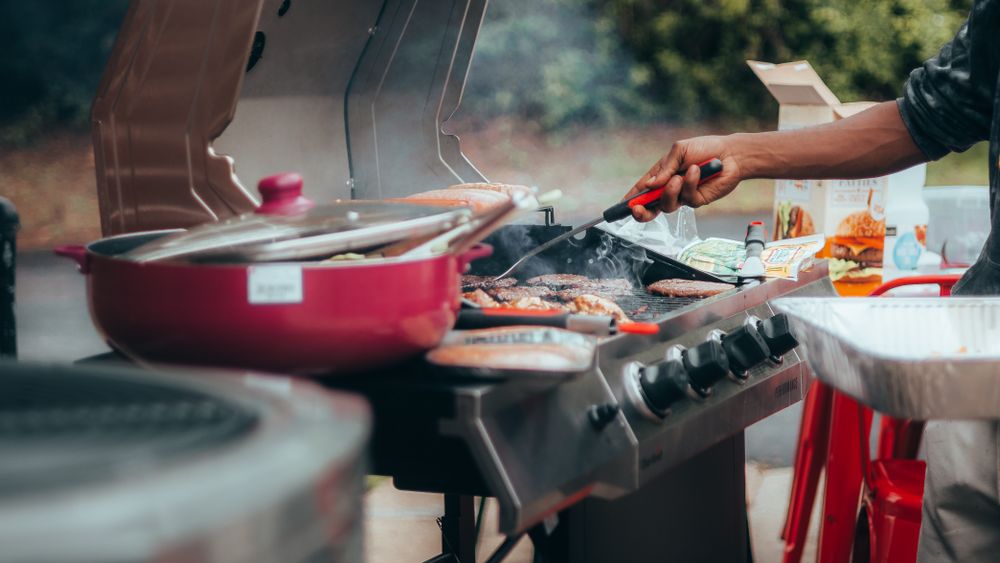
The short answer: Use minced beef with about 20 per cent fat, shape patties with a dimple in the centre and grill them directly at 230 to 280 °C. Unlike a steak, a burger has to be cooked through: at least 70 °C core temperature, because grinding spreads germs through the whole piece of meat. Salt only just before the patty goes on.
Burgers look like the simplest thing you can grill, and that is exactly why they go wrong so often. A patty is minced meat, and mincing changes two things fundamentally: it spreads germs from the surface throughout the mixture, and it destroys the structure that holds a steak together. Almost everything you need to know about fat content, shaping, heat and core temperature follows from those two points.
Which minced meat for burger patties?
Minced beef with around 20 per cent fat, ground coarsely if possible. In a burger, fat is not a flaw but a building block: it melts during cooking, keeps the crumbly structure juicy and carries a large part of the flavour. Lean mince loses water on the grill without any fat to replace it, and falls apart on the grate.
In Germany, the Leitsätze für Fleisch und Fleischerzeugnisse (the German guidelines for meat and meat products) regulate the designations: minced beef may contain at most 20 per cent fat, mixed beef and pork mince at most 30 per cent, and Schabefleisch or tartare considerably less. What lies in the supermarket as “burger mince” is usually at the upper end of the minced beef range.
| Meat / type | Fat content (guide value) | Suitability for patties | Note |
|---|---|---|---|
| Tartare, scraped beef | under 6 % | unsuitable | Turns dry and mealy on the grate |
| Minced beef, lean | approx. 8 to 12 % | poor | Needs added fat or bacon |
| Minced beef, standard | approx. 15 % | acceptable | Works, but stays borderline on juiciness |
| Minced beef, burger quality | approx. 18 to 20 % | very good | The standard for thick patties and smash |
| Chuck, ground yourself | approx. 20 to 25 % | very good | Robust beef flavour, ideal coarsely ground |
| Beef brisket, ground yourself | approx. 20 % | very good | Very aromatic, often mixed with chuck |
| Mixed mince (beef and pork) | up to approx. 30 % | good | Milder, cheaper, binds more easily |
| Minced pork | approx. 20 to 25 % | medium | Soft texture, must also be cooked all the way through |
| Minced poultry | approx. 5 to 15 % | medium | Very lean and tricky, target core temperature at least 72 °C |
| Minced lamb | approx. 20 % | good | Strong flavour, goes with mint and yoghurt sauce |
If you grind the meat yourself, work with well-chilled meat and a chilled plate. Warm fat smears in the grinder, clogs the plate and gives a pasty mass instead of individual crumbs of meat. A coarse plate of about 5 to 8 mm keeps the patty loose, while finer mince quickly turns compact like a meatball.
How do I shape patties that do not bulge?
Press lightly instead of kneading, work cold and put a dimple in the centre. The bulge appears because connective tissue and muscle fibres shrink when heated. That happens faster at the edge than in the middle, so the patty contracts at the rim and grows upward into a dome. The cheese slides off, the bun no longer closes, and the middle stays raw while the edge is long since done.
Three simple steps prevent this reliably:
- Press in a dimple. Use your thumb to press a shallow dent about one centimetre across and half a centimetre deep into the centre. It fills up during cooking, and the patty stays flat.
- Shape it wider than the bun. Patties shrink in diameter by roughly half a centimetre to one centimetre. Shape them slightly wider than the roll accordingly.
- Do not knead it to death. The longer you work the mixture, the more protein dissolves and binds. The result is a rubbery, sausage-like texture instead of loose crumbs of meat.
The second classic mistake is salt at the wrong moment. Salt dissolves muscle protein, which then sticks together. That is exactly what you want in a bratwurst mixture, but not in a burger patty. So salt only the outside, just before the patty goes on the grate, and do it generously. A burger patty needs no egg or breadcrumbs, as those are ingredients for meatballs. It is held together by fat, cold and the crust that forms in the first minutes.
Keep the meat cool until the last moment. Warm patties let fat escape during shaping, stick to your hands and tear when turned. If you stack them between sheets of baking paper and leave them in the fridge until they go on, you will have far less trouble on the grill.
Smash burger or thick patty?
Both work, but they are two different dishes with different equipment. Smash burgers rely on surface area and crust, thick patties on a meaty bite and juiciness.
| Criterion | Smash burger | Thick patty |
|---|---|---|
| Weight per patty | approx. 80 to 110 g | approx. 150 to 250 g |
| Thickness after shaping | ball, then flat under 1 cm | approx. 1.5 to 3 cm |
| Surface | Plancha, cast iron plate or heavy pan | Grate, preferably with an indirect zone |
| Temperature | approx. 250 to 300 °C plate temperature | approx. 230 to 280 °C direct |
| Total cooking time | approx. 2 to 3 minutes | approx. 6 to 14 minutes |
| Roast flavour | maximum, full-surface crust | Stripes and edges |
| Measuring core temperature | hardly possible, but cooked through safely | Essential, thermometer needed |
| Tolerance for error | high, hardly any grease fire | medium, fat drips into the embers |
| Typical problem | Patty sticks if turned too early | Bulging, raw centre, flare-ups |
A proper smash burger cannot be made on an open grate, because the meat falls through the bars. A cast iron plate, a plancha or a heavy pan on the grate is a basic requirement. You will find suitable plates, spatulas and thermometers in our grill accessories comparison.
This is how the smash process works:
- Shape balls. Roll 80 to 110 g of mince loosely into a ball each, without compressing, then chill.
- Heat the plate. Bring cast iron to about 250 to 300 °C. A drop of water must hiss and dance immediately.
- Place the ball on the plate and flatten it straight away with a wide, sturdy spatula within the first 30 seconds. Never press again after that.
- A sheet of baking paper between spatula and meat stops it sticking while smashing.
- Leave for approx. 60 to 90 seconds, until a dark brown crust appears at the edge and the rims turn crisp.
- Salt, then turn, taking the whole crust with it. The spatula goes flat under the patty, not in from the side.
- Add the cheese and cook for about another 45 to 60 seconds. It is done when no pink meat juice comes out any more.
- Straight onto the toasted bun, with no resting time. Smash burgers do not wait.
How hot should you grill, and for how long?
Directly at 230 to 280 °C for thin to medium-thick patties, with an additional indirect zone to finish thick patties. Too little heat is the more common mistake: the patty cooks through slowly without ever forming a crust, and ends up tasting boiled.
| Patty | Weight | Thickness | Zone and temperature | Guide time in total | Target core temperature |
|---|---|---|---|---|---|
| Smash | approx. 80 to 110 g | under 1 cm | Plate, 250 to 300 °C | approx. 2 to 3 min. | cooked through, reached safely |
| Standard | approx. 150 g | approx. 1.5 cm | direct, 230 to 280 °C | approx. 6 to 8 min. | at least 70 °C |
| Thick | approx. 200 g | approx. 2.5 cm | direct 230 to 280 °C, then indirect approx. 180 °C | approx. 8 to 12 min. | at least 70 °C |
| Very thick | approx. 250 g | approx. 3 cm | direct 230 to 280 °C, then indirect approx. 180 °C | approx. 10 to 14 min. | at least 70 °C |
| Minced poultry | approx. 150 g | approx. 1.5 cm | direct, 200 to 230 °C | approx. 8 to 10 min. | at least 72 °C |
Turn only once, when the patty releases by itself. As long as it sticks, no crust has formed yet, and pulling it tears off half the underside. A clean, hot and lightly oiled grate helps too. How to set up the two zones on charcoal, gas and kamado is covered in Direct vs. indirect heat, and the target values for other types of meat are in the core temperature chart.
Fat that drips from the patty ignites at once over open embers. Brief flare-ups are normal, a sustained grease fire is not. Never put it out with water, because the evaporating water throws burning fat metres away. The right way is to close the lid, throttle the air and gas supply and smother the flame. Details are in Preventing grease fires on the grill.
Why does a burger have to be cooked through?
Because grinding spreads the germs from the meat surface through all of the mince. In a steak, bacteria sit practically only on the outside, and that surface gets far above 100 °C when seared. That is why a steak may stay pink inside. A patty, by contrast, consists entirely of former surface, distributed through the whole volume. The middle therefore has to reach the killing temperature itself.
In concrete terms, that means at least 70 °C core temperature, held for around two minutes, measured with a probe thermometer inserted horizontally into the centre of the patty. For minced poultry the limit is at least 72 °C. The main concerns are EHEC or STEC in beef, and salmonella and campylobacter in poultry and pork. Colour is not a reliable indicator here: mince can still look slightly pink at a sufficient temperature, or turn grey early.
Pink patties are only a topic if you grind a single piece of meat yourself, fresh, clean and shortly before grilling, with cleaned equipment and an unbroken cold chain. Even then a residual risk remains, which everyone carries for themselves. For children, pregnant women, older people and the immunocompromised, one rule applies without exception: cook all the way through. Kitchen hygiene comes on top of that: a separate board and knife for raw mince, a clean pair of tongs for finished patties, washing your hands with soap after every contact, and in summer taking raw mince out of the cool box only just before it goes on.
Cheese and bun: assembling at the grate
Cheese goes on the patty in the last minute, after which you close the lid or place a metal dome over it. The trapped steam melts the slice in about 30 to 60 seconds without the meat cooking any further. Cheddar, Gouda, raclette and the classic processed cheese slices melt well because their fat-to-water ratio stays stable. Very firm, long-matured cheese, on the other hand, easily separates into fat and lumps.
The bun belongs on the grill too, cut side down, for about 30 to 60 seconds over medium heat. Toasting is not decoration: the browned surface forms a barrier against meat juices and sauce, otherwise the roll goes soggy from the bottom. A touch of butter on the cut side speeds up browning but also burns faster, so keep an eye on it. For assembly, the simple rule is: sauce on the bottom and top, lettuce as a moisture barrier over the bottom bun, then the patty with cheese, then onion, pickle and tomato. Putting tomato directly on the bread places the thinnest layer of water exactly where it does the most damage.
The most common mistakes when grilling burgers
- Mince that is too lean. Under 15 per cent fat the patty turns dry, however briefly you grill.
- Salted too early. Salt in the mixture makes the texture rubbery and sausage-like.
- Kneaded too long. Shaping loosely is enough, every extra minute compacts the meat.
- Pressed down on the patty with the spatula. With a smash, pressing belongs in the first 30 seconds. After that it only squeezes juice and fat into the embers and provokes flare-ups.
- Turned too often. Once is enough, and only when the patty releases on its own.
- Temperature too low. Without strong heat there is no crust and no roast flavour.
- Judged by colour alone. Brown on the outside means nothing with mince, you measure in the middle.
- Cold or dirty grate. Patties stick and tear, so clean, hot bars are a must.
Conclusion
A good burger from the grill comes down to four decisions. First, the meat: minced beef with around 20 per cent fat, coarsely ground, handled cold. Second, the shape: pressed loosely, with a dimple, wider than the bun, salted only just before it goes on. Third, the heat: 230 to 280 °C direct, turned once, with an indirect zone to finish thick patties. And fourth, the number that separates a burger from a steak: at least 70 °C core temperature, and 72 °C for minced poultry. If you let the thermometer decide rather than the clock, you get patties that are juicy and safe at the same time.