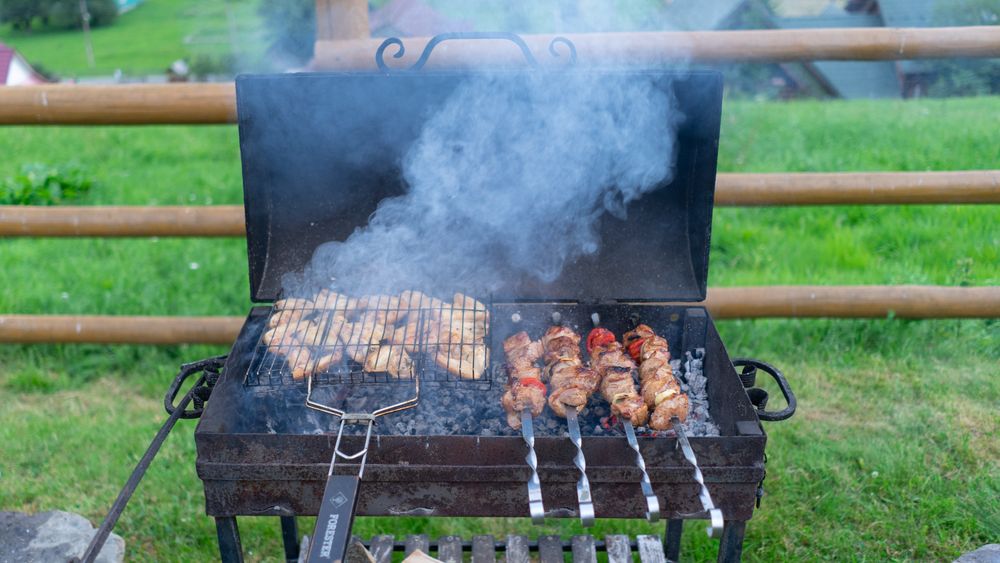
The short answer: Chicken almost always cooks indirectly at around 170 to 200 °C with the lid closed. The safety threshold is a core temperature of 72 °C at the thickest point. You take the breast off at 72 to 74 °C, while thighs and wings can go to 78 to 85 °C. A whole chicken takes approx. 60 to 80 minutes.
Chicken is the food with two opposing target values. The breast is lean, pale muscle meat and turns stringy above 75 °C. Thighs, drumsticks and wings are dark meat with connective tissue that only becomes tender well above the safety threshold. If you treat both the same, you get either a dry breast or sinewy drumsticks. On top of that there is the skin, which only gets crisp under conditions that are actually bad for the meat.
Do you grill chicken directly or indirectly?
About 90 percent of the time indirectly, with a short direct finish. The reason is the fat under the skin: it melts during cooking and drips. Over open embers it ignites at once, the flames leap up at the skin and char it within one to two minutes. By then the core of a thigh may be at around 45 °C. The result is black outside and raw inside, which with poultry is not just unappetising but a safety problem.
Indirect means the food does not sit over the heat source but beside it, and the closed lid distributes the heat like a fan oven. Dripping fat lands in a drip tray instead of the embers. How to set up the zones on charcoal, gas and kamado grills is covered in detail in Direct vs. indirect heat.
The only exception is thin, boneless, skinless pieces: skewers of diced breast or boneless thighs cook through in 10 to 14 minutes and can take direct heat at a medium setting if you turn them regularly.
How long does a chicken thigh take on the grill?
About 35 to 45 minutes indirect at 180 to 200 °C, depending on size and starting temperature. Times are only ever a planning aid, though: whether a piece is done is decided solely by the thermometer.
| Cut | Weight / thickness | Method | Grill temperature | Guide time | Target core temperature |
|---|---|---|---|---|---|
| Skinless breast fillet | approx. 180 to 220 g, 2 to 3 cm | briefly direct, then indirect | 180 to 200 °C | approx. 15 to 22 min. | 72 to 74 °C |
| Breast with skin and bone | approx. 250 to 350 g | indirect, skin direct at the end | 180 to 200 °C | approx. 25 to 35 min. | 72 to 74 °C |
| Whole leg (drumstick with thigh) | approx. 250 to 300 g | indirect | 180 to 200 °C | approx. 35 to 45 min. | 78 to 85 °C |
| Drumstick | approx. 100 to 130 g | indirect | 180 to 200 °C | approx. 30 to 40 min. | 78 to 85 °C |
| Boneless thigh | approx. 90 to 130 g | direct, medium heat | 200 to 230 °C | approx. 10 to 14 min. | 78 to 85 °C |
| Wings, whole | approx. 70 to 100 g | indirect, last minutes direct | 180 to 200 °C | approx. 25 to 35 min. | 78 to 85 °C |
| Skewers of diced breast | approx. 3 cm edge length | direct, turn often | 200 to 230 °C | approx. 8 to 12 min. | 72 to 74 °C |
| Whole chicken | approx. 1.2 to 1.5 kg | indirect | 170 to 190 °C | approx. 60 to 80 min. | breast 72 to 74, thigh 78 to 85 °C |
| Whole chicken, flattened | approx. 1.2 to 1.5 kg | indirect, finish direct | 190 to 210 °C | approx. 45 to 55 min. | breast 72 to 74, thigh 78 to 85 °C |
Three factors shift these values noticeably: meat straight from the fridge needs 5 to 10 minutes longer, every time you open the lid on a charcoal grill costs heat, and wind or cold clearly lengthen the cooking time on uninsulated grills. The target values for other types of meat are collected in the core temperature chart.
Why can a chicken thigh get hotter than the breast?
Because dark and light poultry meat are built differently. Thighs and wings are working muscle with more fat and considerably more connective tissue. At 72 °C this collagen is still tough and only above that does it slowly start to turn into gelatine. That is why a thigh tastes juicier and more tender at 82 °C than at 72 °C, even though technically it has been cooked for longer. In practice: it is safe from 72 °C, noticeably more tender from about 78 °C, and best around 82 °C. The link between collagen and gelatine is the same one that makes shoulder and ribs tender at low temperature, except that with chicken it happens in minutes instead of hours.
The breast has hardly any connective tissue and little fat. Its muscle fibres contract as the temperature rises and squeeze out water. Between 72 and 75 °C is the point where it is safely cooked and still juicy. At 80 °C it is dry, at 85 °C stringy. No technique repairs that, you can only slow it down: a brine beforehand, a lower temperature level at the start, or the skin as a protective layer.
With a whole bird you therefore cook to the breast and help the thighs along with more heat: turn the thighs towards the hotter side, flatten the chicken, or cover the breast with aluminium foil towards the end.
How do you get the skin really crisp?
Only if it is dry and gets enough heat at the end. Skin is mostly water, fat and collagen. As long as there is water in it, the surface stays at around 100 °C, and browning only starts well above that. Wet skin therefore turns tough and pale at any grill temperature.
The most effective step happens a day earlier: pat the skin dry, rub it with about 1 % salt of the meat weight and store the meat uncovered on a rack in the fridge for 4 to 24 hours. The salt penetrates, improves the water binding in the meat, and the cold, dry fridge air draws surface moisture out of the skin. A wet brine (about 60 g salt per litre of water, 2 to 6 hours) makes particularly lean breast juicier, but leaves wet skin that has to be dried afterwards.
Three rules apply at the grill. First: use only a very thin film of oil, and wipe off the marinade beforehand, otherwise the skin boils in the fat instead of browning. Second: the finish needs 200 to 230 °C and 3 to 5 minutes with your eyes on the food, not on the beer. Third: anything with sugar, honey, ketchup or BBQ sauce goes on only in the last 5 minutes, because sugar caramelises from about 170 °C and burns quickly above that. Which marinade suits this and how long chicken pieces should marinate is covered in the guide to marinating grilled meat.
Whole chicken: four methods compared
| Method | Guide time (1.2 to 1.5 kg) | Advantage | Disadvantage |
|---|---|---|---|
| Classic indirect on the grate | approx. 60 to 80 min. | Simplest setup, works on any lidded grill without accessories | The breast is done before the thighs are tender; the underside stays soft |
| Spatchcock (backbone removed, flattened) | approx. 45 to 55 min. | Most even cooking, largest crisp skin area, shortest time | Poultry shears needed, takes more grate space |
| Upright on a chicken holder | approx. 60 to 75 min. | Skin exposed all round, saves space on small grates, fat runs off | Can tip over; the often-cited steam effect of a can is practically negligible |
| Rotisserie | approx. 60 to 90 min. | Turns in its own juices, very even browning | Motor and mount needed, has to be balanced, drip tray essential |
Here is how to do the spatchcock version, which is the best choice in terms of effort against result:
- Remove the backbone. Lay the chicken breast side down and cut along both sides of the backbone with strong poultry shears. Keep the backbone, it makes good stock.
- Flatten. Turn the bird over and press firmly on the breastbone with the heels of both hands until it audibly gives way and the chicken lies flat.
- Dry and salt. Pat dry all over, rub with approx. 1 % salt of the weight, and add spices of your choice. Leave it uncovered on a rack in the fridge, at least 4 hours.
- Prepare the grill. Set the indirect zone to about 190 to 210 °C, with a drip tray under where the chicken will lie.
- Place it skin side up, close the lid and leave it alone for the first 30 minutes.
- Start measuring from minute 30. Put the thermometer into the thickest part of the breast and separately into the thigh, each without touching the bone.
- Give it the finish. When the breast reaches about 68 °C, pull the chicken briefly over the direct zone until the skin is golden brown. Brush on sweet sauce now.
- Take it off at 72 to 74 °C in the breast and at least 78 to 82 °C in the thigh.
- Rest for 10 minutes, loosely covered with foil. The core temperature still rises by about 2 to 3 °C during this, and the juices redistribute.
Which zone setup suits which grill?
| Grill type | Setup for approx. 180 to 200 °C indirect |
|---|---|
| Kettle grill 57 cm | Charcoal on two opposite sides or in baskets, drip tray in the middle, lower vent about half open |
| Gas grill, 3 burners | Outer burners on medium, middle burner off, food over the switched-off area |
| Gas grill, 2 burners | One burner on, food over the other, keep an eye on the lid thermometer |
| Kamado | Insert the deflector stone, set the lower air intake small, allow for sluggish control |
| Pellet grill | Set to 180 °C, the whole surface is indirect, turn it up to maximum for the finish or use the sear zone |
For a whole chicken the grill needs height under the lid, which is where flat folding units fail. A kettle grill with a diameter of 47 or 57 cm covers both zones and handles a bird plus side dishes. An overview is available at kettle grills compared.
Safety and hygiene with poultry
Raw chicken is the most critical food on the grill, because of salmonella and campylobacter. Both sit on and in raw meat and are only reliably killed by cooking it through completely. That is why there is one rule without exception: a core temperature of at least 72 °C at the thickest point, measured without touching the bone, because the bone distorts the reading. Pink poultry is not a doneness level, it is a mistake.
- Do not wash raw poultry. Splashes spread germs over the sink, taps and worktop, within a range of up to half a metre. Patting dry with kitchen paper is enough, and you throw the paper away straight afterwards.
- Separate tools. One board and one knife for raw poultry, another for everything that is ready to eat. The tongs you used to place the raw meat also belong in the sink afterwards, not on the cooked chicken.
- Marinade that has touched raw meat may only be reused if it has been boiled vigorously for at least 2 minutes. It is safer to set some aside before marinating.
- Keep the cold chain. At 25 to 30 °C in summer, raw poultry should not stay out on the terrace any longer than necessary. Take it out of the cool box only just before it goes on the grill.
- Wash your hands after every contact with raw meat, with soap and for at least 20 seconds.
Grease fires are the second real danger, because a chicken gives off a lot of fat. Burning fat is never put out with water: the water evaporates instantly and throws burning fat metres away. The right approach is to close the lid, reduce the air and gas supply and smother the flame. The details are covered under preventing grease fires on the grill.
Conclusion
Grilling chicken comes down to two numbers and one zone. The zone is indirect at around 170 to 200 °C, with a short direct finish at 200 to 230 °C for the skin. The numbers are 72 to 74 °C for the breast and 78 to 85 °C for thighs, drumsticks and wings. Everything else is preparation: dry, salted skin from the fridge, marinade wiped off, sugar only at the end, then a rest. You flatten a whole bird, measure at the breast and thigh separately, and rely on the thermometer instead of the clock.