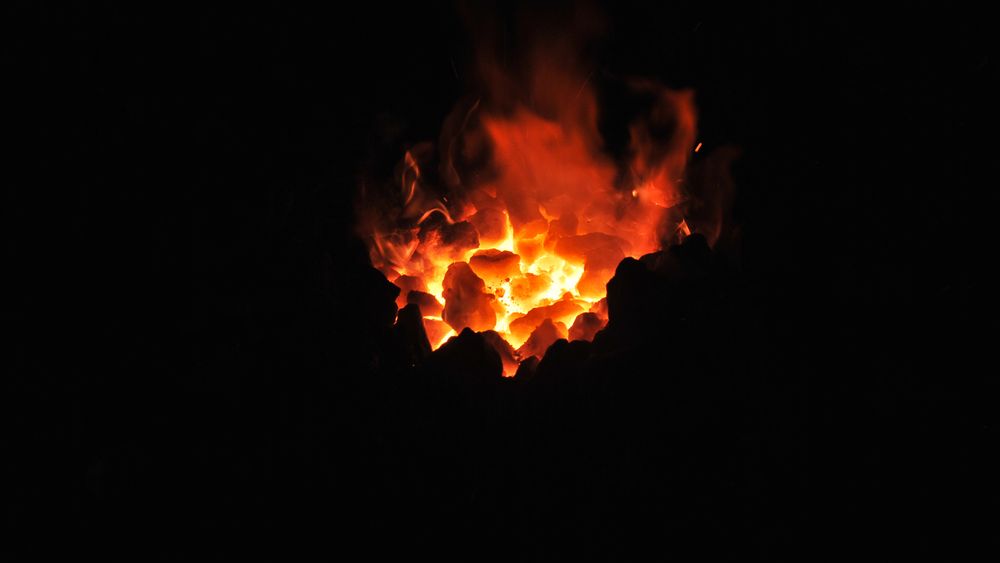
The short answer: A grease fire must never be put out with water, because the water evaporates instantly and causes an explosive flare-up. The right way is to close the grill lid and all vents to starve the fire of oxygen. Without a lid, a fire blanket, plenty of baking powder or a grease fire extinguisher (class F) will help. Preventing a fire by cleaning the drip tray regularly is more effective than any method of extinguishing it.
A grease fire is the most dangerous moment a barbecue evening can produce, and the most misunderstood. The reflex to put out burning fat with water is exactly the mistake that turns a small flame into a life-threatening flare-up. This guide explains how a grease fire starts, how you spot it early, how you put it out safely, and how you keep it from starting at all.
Why must you never put out a grease fire with water?
Because water on burning grease at temperatures of 200 °C and above evaporates instantly and expands to about 1,700 times its volume. This explosive expansion of steam carries fine, extremely hot droplets of fat upwards, creating a flare-up that can shoot up metres high and scatter burning fat widely.
This is not a theoretical danger but a classic among grilling accidents. If you panic and throw a splash of water, a glass or even a hose at burning fat, you risk severe burns to the face, arms and upper body, for yourself and for everyone standing nearby. This rule has no exceptions: no water, no lemonade, no other water-based liquid on burning fat or oil.
How do I put out a grease fire correctly?
The right approach is to take away the fire’s oxygen, not to drown it in liquid. The safe order of steps:
- Turn off the gas straight away (on gas grills), or stop supplying any more air.
- Remove the food with long tongs if you can do so without risk, but never reach into the flames.
- Close the lid and shut all vents completely. Without oxygen, the flame usually goes out within 1 to 2 minutes.
- Keep the lid closed, even if it smokes or sizzles. Opening it too early lets in fresh oxygen and reignites the fire.
- If there is no lid or the fire is already spreading out of the grill: throw a fire blanket over the area, or scatter plenty of baking powder or baking soda onto the flames. Both smother the flame chemically and physically without triggering the water explosion.
- A grease fire extinguisher of fire class F is the safest solution if one is within reach, as it is designed specifically for burning fats and oils. An ordinary powder or CO2 extinguisher works, but it can splash the hot fat; a grease fire extinguisher does not.
- If a fire cannot be brought under control quickly, or if people, buildings or vegetation are at risk: call the fire brigade straight away (112). Safety always comes before trying to save the grill yourself.
This overview shows at a glance which extinguishing agents are safe for a grease fire and which make the fire dangerous:
| Extinguishing agent | Effect on a grease fire | Rating |
|---|---|---|
| Water (even a small amount) | evaporates explosively, carries burning fat with it | never use it: risk of explosion |
| Grill lid + closing the vents | removes oxygen, smothers the flame in 1 to 2 min. | safe, first choice |
| Fire blanket | smothers the flame by cutting off oxygen | safe if there is no lid |
| Baking powder / baking soda (plenty) | smothers the flame, absorbs heat | safe as an immediate measure |
| Grease fire extinguisher (class F) | designed specifically for burning fat/oil | safest solution if available |
| Ordinary powder / CO2 extinguisher | extinguishes, but can splash hot fat | works, use with caution |
How do I spot a grease fire starting in time?
A grease fire almost always gives warning before it gets out of control. If you know the signs, you can step in before it becomes dangerous.
- Brownish, dense smoke instead of white coming from the drip tray or the area under the grate.
- Small flare-ups that do not die down even after you turn the burners down. Normal fat flames during grilling are short and disappear when you reduce the heat.
- A sharp, acrid smoke smell instead of an aromatic one.
- Visibly melted, darkened fat that collects in the tray or at the bottom of the bowl instead of draining away.
If you see any of these signs, move the food to a safe zone or remove it straight away, close the lid and reduce the ventilation. Stepping in at this early stage prevents most grease fires before they become a real emergency.
How do I avoid a grease fire in the first place?
Prevention is far more effective than any method of extinguishing. Most grease fires come from neglected cleaning, not bad luck.
- Clear old grease from the drip tray and burners before every grilling session. This is by far the most important single measure. Built-up old grease is the most common trigger.
- Do not leave food unattended, especially fatty meat such as sausages, marbled pork neck or marinated food.
- Do not oil or marinate excessively. Excess oil drips off and collects exactly where it can ignite easily.
- If short flare-ups occur, change zone (indirect instead of direct heat) rather than waiting to see whether it stops by itself.
- Empty the grease collection tray regularly, not only when it overflows.
- After every session, let the grill burn off briefly on high heat (on gas grills and some electric grills). This burns off smaller grease residues in a controlled way instead of letting them build up.
Why were some gas grills marked down by Stiftung Warentest because of grease fires?
Stiftung Warentest is Germany’s consumer testing foundation. On several of the models it assessed, the design of the drip tray did not reliably catch the dripping fat and lead it away. Instead of landing safely in a collection tray, the fat collected in hot spots inside the grill and ignited. On some units the flames burned for minutes before going out.
This is more than a footnote: it shows that a well-thought-out, easily accessible drip tray is a genuine safety feature and not just a matter of convenience. When buying a grill, it is therefore worth checking how easily the drip tray can be removed and cleaned. A model that you do not like cleaning will be cleaned less often, and that raises the risk.
Conclusion: put it out by smothering, not by drowning
The most important rule stays simple: water has no place near a grease fire. Lid on, vents shut, and if in doubt a fire blanket or baking powder, and you smother the flame safely. Better still is not getting that far: a clean drip tray prevents most grease fires before they start. If you want to run through the extinguishing order safely once, you can do so in the grill simulator before an emergency happens at your own grill. You can find models with a particularly accessible, easy-to-clean drip tray in the charcoal grill overview.