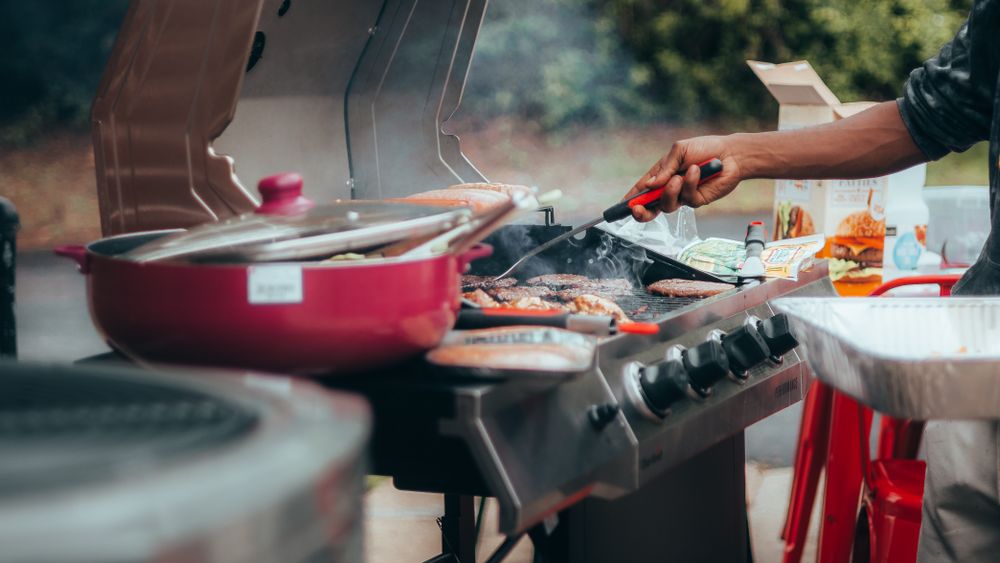
The short answer: Vegetarian food needs less heat than meat, but more patience when turning. Oil the food rather than the grate, put it on a cleanly brushed, well-preheated grate and turn it only when the crust releases by itself. Sugary marinades go on only in the last few minutes.
Most problems with vegetarian grilling have the same origin: meat brings fat and connective tissue with it, while halloumi, tofu and veggie burgers do not. What holds plant-based food together on the grate has to be created first, namely as a crust. Until that crust has formed, the food is fragile. After that it is surprisingly robust. If you wait for that point instead of nervously turning, you have done most of the job. Plain vegetables follow their own rules and are covered in Grilling vegetables. Here we deal with the protein side: cheese, soy products, seitan, mushrooms and everything that goes on the grate as a vegan substitute for sausage and burgers.
Why does halloumi stick to the grate?
Because protein briefly forms bonds on contact with hot metal and only releases again once the surface is browned through and dry. A grate that is too cool prolongs exactly this phase, because the water on the surface does not evaporate fast enough. That is why cheese sticks firmly to a lukewarm grate, but on a hot one only for one to two minutes.
Halloumi is still the easiest way in, because it does not run away. During production the curd is heated in the whey and processed without souring cultures. The pH stays high, the calcium framework in the casein stays intact, and this very framework keeps the slice in shape at 200 °C. Young semi-hard cheese or mozzarella is soured, loses this framework and runs straight between the bars. The same cause lies behind almost all sticking problems on the grill, described in detail in Food sticking to the grate.
How to get halloumi to work without sticking:
- Clean the grate and preheat it properly. Brush it only at around 200 to 220 °C, so that residues burn off and do not act as glue.
- Cut slices of 1 to 1.5 cm. Thinner than 1 cm dries out and tears when turned, thicker than 2 cm stays cool and squeaky inside.
- Pat the cheese dry. Halloumi sits in brine, and this moisture is the main reason for sticking.
- Oil the cheese, not the grate. A thin film of heat-stable oil applied with a brush is enough. Oil on the grate burns off before you put the food on and produces soot.
- Put it on and leave it. For 1.5 to 3 minutes, do not touch it, do not move it, do not check on it.
- Do the release check. If you can lift the slice with the spatula without resistance, the crust is ready. If it catches, give it 30 seconds more.
- Turn once, grill the second side for less time and serve immediately. Lemon juice, honey or maple syrup go on only at the plate.
Grilling times and temperatures at a glance
The values are guidelines for food at fridge temperature and a grill with a lid. In the end, the surface decides, not the clock.
| Food | Heat and zone | Guide time | Done when |
|---|---|---|---|
| Halloumi or grilling cheese, 1 to 1.5 cm | direct, approx. 200 to 220 °C | approx. 1.5 to 3 min. per side | golden-brown stripes, firm outside, soft inside |
| Feta or sheep’s cheese in a parcel | indirect, approx. 180 to 200 °C | approx. 15 to 20 min. | creamy soft, edge lightly browned |
| Firm plain tofu, pressed, 1.5 to 2 cm | direct, approx. 200 °C | approx. 4 to 6 min. per side | crust releases by itself, edges crisp |
| Smoked tofu, 1 cm | direct, approx. 200 °C | approx. 3 to 4 min. per side | clear sear marks, surface dry |
| Tempeh, 1 cm, steamed beforehand | direct, approx. 180 to 200 °C | approx. 3 to 4 min. per side | nutty aroma, edges dark brown |
| Seitan, 1.5 cm | direct, approx. 180 to 200 °C | approx. 2 to 4 min. per side | glossy crust, still springy under pressure |
| Vegan bratwurst | direct at medium heat, approx. 160 to 180 °C, turn often | approx. 8 to 12 min. | brown all over, hot inside, casing intact |
| Vegan burger patty | direct, approx. 200 to 230 °C | approx. 3 to 4 min. per side | firm crust, hot all the way through |
| Portobello or large button mushrooms | direct, approx. 180 to 200 °C | approx. 4 to 6 min. per side | gills dark, juice collecting in the cap |
| Corn on the cob, precooked | direct, approx. 200 °C | approx. 8 to 12 min., rolling | kernels glossy with brown spots |
| Legume patty, 2 cm | grill tray or plancha, approx. 180 to 200 °C | approx. 4 to 6 min. per side | dry, firm crust, holds when lifted |
Two rows need an explanation. Vegan bratwursts are generally precooked and only need to be warmed through, not cooked through. Too much heat makes the casing burst and the filling dry out, which is why the value there is lower than for meat sausage. For vegan patties the opposite applies: they need strong heat for the crust. The manufacturer’s instructions on the pack often give a target core temperature, usually in the region of 70 °C, and that is also the most practical target value.
How do you get tofu ready for the grill without it crumbling?
By drawing water out of it before it goes on the grate. A block of firm plain tofu is mostly water, and this water blocks two things: it stops marinade from getting in, and it cools the surface until nothing browns and it just steams. Pressed tofu is denser, absorbs flavour and gets the crust that holds it together.
- Drain the block and wrap it in a clean kitchen towel or several layers of kitchen paper.
- Weigh it down. A board with a pot or two tins on top is enough, around 1 to 2 kg. With too much weight the block breaks.
- Press for 20 to 30 minutes. Several tablespoons of water come out. Longer than an hour hardly adds anything.
- Cut into slices or triangles 1.5 to 2 cm thick. Thinner gets tough, thicker stays bland inside.
- Marinate. Oil as a flavour carrier, plus soy sauce, mustard, tomato paste, smoked paprika, garlic. At least 30 minutes, ideally overnight in the fridge.
- Drain and pat dry before grilling. Wet marinade on the surface first evaporates and delays browning.
- Optionally dust thinly with cornflour. This gives a much crispier crust and reduces the tendency to stick.
A trick from practice: freeze tofu once and thaw it again. The ice crystals break up the structure, the block becomes spongier, loses more water when pressed and soaks up marinade much better. Tempeh takes a different route. It is fermented and can taste slightly bitter, so it is worth steaming it in salted water or stock for 10 minutes before marinating. After that it takes up marinade like a sponge.
Why do vegan patties and veggie burgers fall apart?
Because they lack exactly what holds minced meat together: connective tissue and fat that melts when heated and binds the mass. Plant-based patties hold through starch, plant protein, methylcellulose or legumes, and this bond only becomes stable through the dry, firm crust. If you shake the patty after 60 seconds, you tear exactly this crust at the moment it forms.
Four points decide the result. First: put it on cold. A patty straight from the fridge keeps its shape longer than one that has sat in the sun for half an hour. Second: turn once, not four times. Third: do not press down with the spatula, as that squeezes out moisture and dries the inside. Fourth: for homemade patties made from chickpeas, lentils or beans, always plan in a binder, such as ground oats, breadcrumbs or cooked potato, and chill the shaped patties for at least 30 minutes before grilling. Even so, homemade patties belong on a grill tray rather than directly on the grate.
Grate, plancha, tray or wooden board: what do you put on what?
With vegetarian food, the surface is not an accessory detail but often the difference between a whole portion and a crumbled one.
| Surface | Suits | Advantage | Disadvantage |
|---|---|---|---|
| Directly on the grate | Halloumi, smoked tofu, seitan, portobello, vegan sausages and patties | real sear marks, maximum flavour, direct contact with radiant heat | small pieces fall through, anything soft sticks if the heat is too low |
| Grill pan or plancha | pressed tofu, patties, tempeh, halloumi cubes | closed surface, even browning, nothing falls through, clean separation from meat | no smoke contact from below, plate needs 10 to 15 minutes of preheating |
| Grill tray made of aluminium or stainless steel | legume patties, feta, marinated tofu with lots of sauce | catches marinade, prevents dripping into the coals, ideal as a dedicated vegetarian surface | more braising than grilling, hardly any roast aromas, the base soon goes soft |
| Cedar wood plank, soaked | firm tofu, grilling cheese in one piece, portobello | mild smoke aroma, nothing sticks, attractive to serve straight from the plank | soak the plank for 1 to 2 hours beforehand, indirect heat only, risk of burning over an open flame |
| Aluminium foil or grill mat | feta parcels, delicate leftovers, very small food | simplest solution against sticking and falling through | no sear marks, mats have a temperature limit according to the manufacturer |
If you grill vegetarian food regularly, a plancha and a grill tray will take you very far, because both solve the sticking problem and the separation from meat at the same time. An overview of the categories is at Grill accessories compared, and if you still lack the grill itself or yours is too small for two zones, the Grill finder helps you narrow it down.
Marinating and seasoning without a burnt crust
With plant-based food, fat is not just a flavour carrier but a functional part. It transfers heat into the surface, prevents sticking and carries fat-soluble aromas such as smoked paprika or garlic into the food in the first place. Use a heat-stable oil such as rapeseed or sunflower oil, as extra virgin olive oil smokes earlier. Use it sparingly: what drips into the coals comes back as a flare-up.
The second point is sugar. Maple syrup, honey, agave syrup, ketchup and practically every ready-made BBQ sauce contain plenty of it. Sugar caramelises from about 170 °C and burns bitter and black shortly above that. On a grate at 220 °C that takes less than two minutes. So the rule is: season and oil beforehand, and brush on sweet sauces only in the last 2 to 3 minutes or add them at the table. Soy sauce, miso and balsamic vinegar also contain sugar, though less.
You treat salt differently depending on the food. Tofu and tempeh can be salted early, as the salt draws out water and helps the crust. Halloumi and feta are already heavily salted and need nothing extra. Fresh herbs such as basil, parsley or mint burn in seconds over direct heat and go on after grilling.
Meat and vegetarian food on the same grill
On a mixed grill, the order decides. Vegetarian food goes on the freshly brushed grate first, while no fat or meat juice is on it yet. After that the grate is occupied, and every later vegetarian portion sits in whatever the meat has left behind.
For spatial separation, four steps are enough:
- Assign a fixed zone. Meat on the left, vegetarian on the right, permanently. How to set up two zones cleanly on charcoal, gas and kamado is explained in Direct vs. indirect heat.
- Never put it under the meat. On tiered grates and in kettle grills with an indirect set-up, fat drips downwards. Vegetarian food belongs on the upper level or clearly beside the meat, never beneath it.
- Separate tongs, separate spatula, separate boards. A second pair of tongs costs little and solves the issue completely. Coloured handles help when several people are at the grill.
- Grill tray or plancha as a physical separation. If guests eat vegetarian or vegan and care that their food has had no contact with meat, a dedicated surface is the only reliable solution. The grate alone is not enough for that, even when brushed.
If you want to change the grate in between: burn it off for 10 to 15 minutes at full heat with the lid closed, then brush it. This burns off residues more reliably than any cleaning when cold.
And two safety points that are particularly relevant on a mixed grill: dripping meat fat can ignite in the coals. Burning fat is never put out with water, otherwise the sudden evaporation flings burning fat metres away. The right way is: close the lid, shut off the air supply and the gas, and smother the flame. And regardless of what you are grilling, charcoal and gas grills never belong in enclosed spaces, garages or tents, not even for the embers to die down. The carbon monoxide produced is odourless and life-threatening.
The most common mistakes when grilling vegetarian food
- Turned too early. The most common mistake of all. As long as the food catches on the grate, it is not ready to turn. When it no longer catches, it is time.
- Cold or dirty grate. Charred residues from last time act like glue, and a lukewarm grate prolongs the sticking phase many times over.
- Tofu put on unpressed. It then only steams, hardly browns and tastes of nothing inside, because the marinade never got to the inside.
- Oiled the grate instead of the food. Oil on hot metal burns off immediately and leaves a sooty, sticky layer.
- Sweet marinade from the start. Sugar quickly burns bitter from about 170 °C. Brush it on only in the last few minutes.
- Vegan sausages grilled at full heat. They are mostly precooked and should only be warmed through. Too hot and the casing bursts and the filling dries out.
- Food that is too small put directly on the grate. Cubes, patties and mushroom slices belong on a plancha, tray or skewer.
- Everything put on at once. Cheese, tofu, sausages and patties need different heat. One after another in the right zone gives better results than a full grate.