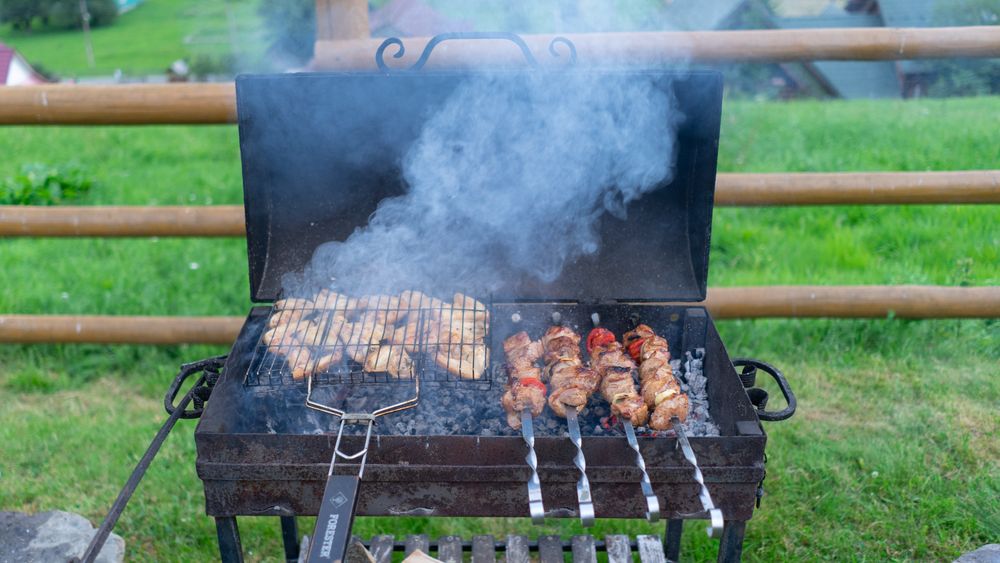
The short answer: Direct heat means the food sits right above the embers or the burner, cooks quickly and gets a strong crust, which is ideal for steaks and sausages. Indirect heat means the food sits beside it and cooks slowly in circulating warm air, as in an oven, which is ideal for whole chickens, roasts and pulled pork. Most grills can be set up for both methods at the same time with a simple zone layout.
If you only know one temperature zone, you can either sear or cook slowly, but not both. The difference between direct and indirect heat is therefore the most important basic technique at the grill, whether you cook with gas, charcoal or ceramic.
What is the difference between direct and indirect heat?
Direct heat means the food sits right above the embers or the switched-on burner, and the heat hits the surface directly from below: fast, intense, ideal for the crust. Indirect heat means the food sits beside the heat source while the closed lid lets the warm air circulate in the cooking chamber, much like a fan oven. The result is even, gentle cooking without direct flame contact.
| Feature | Direct heat | Indirect heat |
|---|---|---|
| Position relative to the heat source | Directly above | Beside it |
| Temperature at the food | Very high (250 to 400 °C) | Moderate (100 to 180 °C) |
| Cooking time | Minutes | Hours |
| Typical result | Crust, roasted aromas | Evenly cooked, juicy |
| Lid | Often open or closed briefly | Always closed |
| Risk | Burning on thick cuts | No crust without a final sear |
When should you use direct heat?
Use it for thin, quick-cooking cuts that are done within a few minutes and benefit from a strong crust: steaks up to about 3 cm thick, sausages, chops, burger patties, vegetable slices and fish fillets. The high heat triggers the Maillard reaction, the browning reaction responsible for roasted aromas and the characteristic crust.
You can find detailed instructions with times by meat thickness in the guide Grilling steak. The limit of direct heat: with cuts over about 3.5 cm thick or with fatty food, the outside often burns before the core reaches the target temperature. There you need either reverse searing or completely indirect heat.
When should you use indirect heat?
Use it for large, thick or fatty cuts that need hours to cook: whole chickens, roasts, ribs, pulled pork and anything that is baked rather than grilled, such as pizza or bread on the grill. Without indirect heat, these cuts would be charred on the outside long before the core is cooked.
Indirect heat is also the safer choice for very fatty food: if fat drips directly onto the embers or the burner, flare-ups are likely, which are sudden bursts of flame that blacken the food. With indirect placement, the fat drips into a drip pan instead of into the flame.
How do you set up a two-zone fire in a kettle grill?
Here is how to divide a classic kettle grill into a direct and an indirect zone:
- Light the charcoal (ideally with a chimney starter) and let it burn through completely.
- Pile the glowing charcoal on one half of the charcoal grate and leave the other half empty.
- Place a drip pan for fat on the empty, indirect side, directly under where the food will go.
- Put the grill grate on and position the upper vent over the indirect zone, which draws the circulating heat across the food.
- Place the food on the direct zone briefly for searing, or on the indirect zone with the lid closed for slow cooking.
- Control the temperature with the lower vents: more air = hotter, less air = cooler.
How does indirect heat work on a gas grill?
On a gas grill with at least two burners, you simply switch one burner off and leave the other running. The food sits over the switched-off zone, while the burner that is running circulates warm air in the closed cooking chamber. With three or four burners you have more flexibility: for example, you can leave the two outer burners running and switch off the middle one to create a larger indirect zone in the centre of the grill.
The big advantage over charcoal: switching between zones is instant and repeatable as often as you like, without adding charcoal. If you are still undecided between the two systems, you will find a comparison in the guide Gas or charcoal grill.
Zone setup in a smoker and a kamado
In a classic offset smoker, the separation is built in: the fire burns in a separate side chamber, and the smoke and heat travel through the cooking chamber, so food there is always automatically cooked indirectly. In most offset smokers, direct heat is only possible via an optional firebox flap or a separate grate directly above the fire chamber.
In a kamado (ceramic grill), a deflector stone or plate setter provides the separation: without a deflector you grill directly over the charcoal at very high temperatures, and with a deflector inserted the heat is shielded and distributed in the cooking chamber, which is perfect for low and slow cooking over many hours at a stable temperature.
Combination: reverse searing as a bridge between both methods
A third technique uses both zones one after the other: with reverse searing, the food first cooks indirectly at low temperature almost to the target value and is then seared briefly on the direct zone. The result combines the advantages of both methods: an even doneness plus a strong crust. This technique is especially recommended for thick steaks and larger roasts and is explained step by step in the guide Grilling steak. Pulled pork also cooks completely indirectly at its core, but follows the same zone principle.
Conclusion: two zones are half the battle
A grill that offers only one temperature zone forces you to compromise between crust and cooking through. Once you can set up direct and indirect zones at the same time, whether in a kettle grill with offset charcoal, in a gas grill with a burner switched off or in a kamado with a deflector stone, every item of food is cooked with the right method. The category Kettle grills shows an overview of versatile devices for this zone technique.