We have not handled the Master-Touch GBS E-5750, a Weber charcoal kettle grill with a 57 cm diameter, and have not grilled anything on it. The details here come from Weber’s German product page, user manual 69137, assembly instructions 54764 and the catalogue listing on Amazon, each with its source. All Weber shop prices on this page are as of 2 October 2026.
One grill, two item numbers
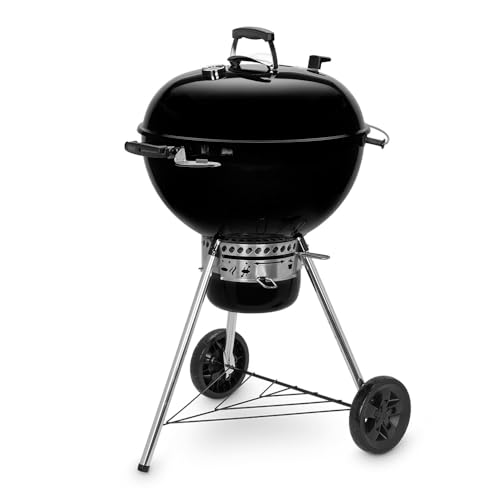
In the German Weber shop it is simply called Master-Touch Holzkohlegrill Ø 57 cm (charcoal grill), while the page title and web address call it Master-Touch GBS E-5750. The item number is 14701004, the only colour is black, and the price is €299.00 including VAT, plus shipping. Of the six Master-Touch models the shop lists, it has the lowest price.
Our buy link leads to Amazon, and there a different record appears: ‘Weber Master-Touch GBS E-5750 BLK EU’ with model number 14701053. Weber’s shop system still knows this number under the title Master-Touch GBS E-5750, but what is sold today is 14701004. The four Amazon bullet points fit the E-5750: hinged cooking grate with Gourmet BBQ System, charcoal grate made of solid steel, porcelain-enamelled bowl and lid, bottom rack. We therefore assume it is the same grill under an older or different item number. On weight, the sources are 3 kg apart: Amazon gives 39.68 pounds, converted 18.0 kg, Weber 21 kg.
Under this number there is no offer from Amazon itself on Amazon. On 5 October 2026, several marketplace sellers offered the grill, the cheapest from €328.75, around €30 more than in the Weber shop. We do not know whether these sellers are authorised by Weber.
Manual 69137 of 31 October 2018 covers four models together: E-5750, C-5750, SE E-5755 and SE C-5755. The assembly instructions apply to the same four. Weber no longer sells the C-5750 in Germany; its former product page redirects to the category.
Bowl, grate and chassis
Bowl and lid are made of porcelain-enamelled steel. The manual promises that this coating will never flake off, and explains why it does more than protect against rust: the surface reflects heat, so the heat circulates around the food like the fan in an oven. On the product page, Weber calls bowl and lid scratch-resistant and rust-resistant; the coating, it says, protects against rust-through, cracking and flaking and withstands high grilling temperatures.
The diameter is 57 cm. Weber gives the total cooking area as 2,342 cm² and allows for space for 6 to 8 people.
The food sits on a hinged grate made of coated steel, which the manual calls heavy-duty. Both sides can be folded up so you can add charcoal while grilling without lifting out the whole grate. In the middle sits a round insert that you remove when a piece from Weber’s Gourmet BBQ System is to go in; if it stays in, the grate is an ordinary cooking grate. The product page names a griddle, poultry roaster and pizza stone as examples, while the manual names a searing grate instead of the griddle; you have to buy all of them separately. When the grate is not in the bowl, you hang it on one of the curved hooks on the side of the bowl.
Below it lies the charcoal grate made of solid steel. According to the manual, it withstands the heat of any charcoal fire and neither burns through nor warps. Weber includes two charcoal holders, plus a measuring cup that Weber’s charcoal tables are based on.
Under the bowl hangs a large, removable aluminium ash catcher. Because it is fully enclosed, the manual says no ash is blown around. The thermometer is built into the lid.
The chassis consists of three rust-resistant aluminium legs, according to Weber 5 cm taller than on standard kettle grills, and two moulded all-weather rubber wheels of 20 cm. At the bottom sits a bottom rack. With the lid closed the grill measures 107 cm in height, 65 cm in width and 72 cm in depth; opened up, 118 cm in height and 76 cm in depth.
When grilling, you slide the lid to the side and hang it in the Tuck-Away holder on the bowl instead of putting it down somewhere. According to the manual, you must not use the holder as a handle for lifting or moving the grill. Lid and bowl handles are heat-resistant, the lid handle has a heat shield, and the product details mention a glass-reinforced nylon bowl handle. Two hooks for grill tools sit on the bowl handle.
For assembly there are the assembly instructions 54764: 20 steps in pictures, printed for 13 languages. If you prefer to see the steps in 3D, use the free BILT app. According to the illustration, a small spanner is included, but you need a screwdriver yourself; a Phillips one is drawn.
In Weber’s documents on the E-5750 we searched in vain for:
- measuring range and accuracy of the lid thermometer
- a maximum temperature
- the diameter of the cooking grate and the height of the grate level above the bottom
- the material of the bottom rack and charcoal holders
- colour and coating of the inside of the bowl
- the time until the charcoal is fully glowing
- charcoal consumption in kilograms per hour
- an assembly time
- country of origin and year of market launch
- pack size, shipping weight and EAN
- prices and part numbers of the spare parts in the manual
- a current warranty line for stainless steel components, such as the E-5755’s grate, and a statement on whether the manual or the product page applies where they differ
In detail: two vents, one fire
A kettle grill works like a small oven with a chimney. Fresh air flows in at the bottom through the bowl vent to the embers, the hot gases rise and escape at the top through the lid vent. The more air gets through, the more oxygen the charcoal receives and the hotter it gets in the bowl, until the charcoal has reached its peak temperature. Weber describes this last relationship in the same way in the manual.
On the E-5750, the lower vent is part of the stainless steel One-Touch cleaning system. Three blades at the bottom of the bowl have two jobs: when you move the handle back and forth, they push the ash into the catcher, and depending on their position they open or cover the openings in the bowl. Open, they let oxygen reach the embers; closed, they help extinguish them. At the top sits the lid vent made of rust-resistant aluminium; according to the manual, heat is led away from its handle so you can adjust it more easily.
The manual distinguishes three settings. For direct grilling, both vents are fully open. For indirect grilling or smoking at lower temperatures, you can close each of them up to halfway. If you close both fully, the oxygen supply is cut off and the charcoal goes out. As a guide value, Weber gives 260 °C under the lid when all the charcoal glows red during preheating.
Why even a half-closed top vent lowers the temperature although air could still get in at the bottom: the bowl is a flow-through system. What cannot escape at the top does not flow in at the bottom, so each of the two vents restricts the whole airflow. As we understand it, you therefore set roughly with the lower vent and fine-tune with the upper one, and Weber’s smoking instructions are built in exactly this way.
For smoking, the manual describes on page 6 specially shaped vent openings in the bowl that are meant to let through the right amount of air for low temperatures, and in the smoking instructions a smoking position on the One-Touch lever. The vent openings appear under the heading Special features. One page earlier, under the same heading, Weber states up front that a grill may have the features described there depending on the model.
The process: you prepare the grill as for indirect grilling, use long tongs to lift the flap of the grate and put 2 to 4 wood chunks or a handful of smoking chips onto the embers. Then you close the lid and push the One-Touch lever to smoking, if your lever has this position. As soon as the lid thermometer shows the smoking range, according to the manual 95 to 135 °C, you hold the temperature with the lid vent: open it further if you want it hotter, close it further if you want it cooler. According to Weber, you avoid resinous softwoods such as pine, cedar or poplar, and you never use wood that has been treated or exposed to chemicals. More on chips and chunks is in the guide Smoking on the grill.
Lighting, charcoal quantities and two zones
Before you light the fire, you clear out the bowl in a fixed order, as stated on page 7 of the manual:
- Open the lid and slide it into the Tuck-Away holder.
- Take out first the centre section, then the cooking grate.
- Take out the charcoal grate and push ash and charcoal remains into the catcher with the One-Touch lever.
- Squeeze the catcher’s lever together, remove the catcher and empty it.
- Open the One-Touch lever fully.
- Put the charcoal grate back in.
- Open the lid vent fully.
According to Weber, lighting is easiest with a chimney starter. The manual names the separately available Rapidfire, which we discuss individually in its large version. Without a chimney, you stack the charcoal into a pyramid and tuck firelighters in between. The fire is ready when the cubes are completely used up and the charcoal is covered with white ash. Weber deliberately left out instructions for lighter fluid: it is impractical and can give the food a chemical-like taste, and firelighter cubes are the better solution.
According to the manual, direct heat is intended for small, tender food that is done in less than 20 minutes. It lists hamburgers, steaks, chops, kebabs, boneless chicken pieces, fish fillets, seafood and sliced vegetables. You spread the charcoal evenly over the whole charcoal grate, and the cooking grate preheats for about 10 to 15 minutes with the lid closed. For one load in the 57 cm bowl, Weber’s table gives 30 Weber briquettes, 40 other charcoal briquettes, 1¾ measuring cups of beech charcoal (according to the table 0.98 kg) or 1¼ measuring cups of lump charcoal from mixed woods.
Indirectly you cook everything that needs 20 minutes or longer or would dry out or burn over the embers: roasts, bone-in poultry pieces, delicate fish fillets, whole chickens, whole turkeys and ribs, according to the list in the manual. The charcoal then goes on two opposite sides, either loose or in charcoal baskets, which the manual calls a char-basket and which belong on the charcoal grate before lighting. Two areas stay free: the vicinity of the lid and bowl handles, and the area directly under the thermometer and lid vent. A drip pan can sit in between. You insert the grate so that its flaps lie over the embers, and the food goes in the middle. You always put the lid on so that the thermometer does not sit over the charcoal, so that it is not exposed to direct heat.
The table for indirect heat calculates per side, with a base quantity for the first hour and a top-up for each further hour. For Weber briquettes that is 15 and then 4, for other charcoal briquettes 20 and then 7, for beech charcoal or mixed lump charcoal half a measuring cup and then a handful. A roast with a five-hour cooking time therefore needs 31 Weber briquettes per side, 62 in total. With other briquettes it would be 48 per side, 96 in total, a good half more.
According to the manual, 2.5 cm of air should remain between the food and the closed lid, which sets the limit for tall food.
Safety and cleaning according to the manual
Before the safety notes on page 2, Weber puts one sentence: anyone who ignores the notes marked DANGER, WARNING and CAUTION risks serious or fatal injuries or property damage from fire or explosion, and all of them are to be read before first use. We reproduce them here in full, sorted by situation rather than by warning level. You will find the note on the Tuck-Away holder above, under the lid holder. According to the cover page, you are meant to keep the manual itself.
Where the grill may stand
You use the grill exclusively outdoors in a well-ventilated area, never in garages, buildings, covered walkways or other enclosed areas. In enclosed or habitable spaces, with buildings, tents, caravans, motorhomes and boats given as examples, there is a danger to life from carbon monoxide poisoning, because toxic gases collect indoors. The grill is never to be used as a heater, and it is not suitable for installation in or on caravans and boats. It stands on a secure, level surface, never on a glass surface or a combustible surface, and never under a combustible structure. Nothing combustible may be within a radius of 1.5 m; Weber is thinking, for example, of (treated) wood on a terrace or veranda. Flammable gases and liquids such as petrol or alcohol have no place in the grilling area, and nor do other combustible materials. In strong wind the grill stays off. You keep power cables away from the hot surfaces and route them so they are not in the way.
When lighting
The charcoal always lies on the charcoal grate, never directly on the bottom of the bowl. You use neither petrol, methylated spirits, alcohol nor other volatile liquids for lighting or relighting; only firelighters complying with EN 1860-3 (a European standard that applies in Germany and the EU) are permitted. Weber advises against lighter fluid. Anyone who uses it anyway first checks the ash catcher: liquid can drip through the vent openings in the bowl, collect in the catcher and start a fire when lit, so it must be removed beforehand. Lighter fluid or charcoal soaked with it never goes onto warm or hot charcoal; you close the bottle immediately and put it at a safe distance from the grill. The grill goes into operation only if all parts are correctly fitted according to the assembly instructions, and only with the ash catcher fitted; according to Weber, improper assembly can be dangerous. You put food on only once the fuel is covered with a layer of ash.
While grilling
When grilling and cleaning, the grill is hot, you proceed with great care and never leave it unattended while in use. While it is in use, you do not move it. You keep children and pets away, and you do not wear clothing with wide sleeves when lighting and operating it. You never check by touch whether the cooking grate, charcoal grate, ash, charcoal or the grill itself are hot. Heat-resistant grill gloves with a contact heat resistance of level 2 or higher according to DIN EN 407 (a standard that applies in Germany and the EU) belong on your hands when you grill, adjust the vents, add charcoal, read the thermometer or open and close the lid. The grill tools need long, heat-resistant handles. You never use water, neither against flare-ups nor to extinguish the charcoal. Aluminium foil does not belong in the bowl because it disturbs the air supply; a drip pan catches the juices during indirect cooking. Weber also warns that alcohol and prescription and over-the-counter medication can impair the ability to assemble and operate the grill safely.
Extinguishing, ash, care
To extinguish, you close the lid vent and bowl vent and then the lid. You remove the ash only when all the charcoal has burned and gone out and the grill has cooled, and you may dispose of it only when it is completely extinguished. Hot charcoal never ends up where someone could step on it or where it poses a fire hazard. You store the grill only when ash and charcoal are completely extinguished.
For care, the manual has four rules on page 14. Before every use, you remove ash and old charcoal from the bottom of the bowl and from the ash catcher so the air can circulate, and only when nothing is glowing any more and the grill has cooled completely. Lacquer-like flakes on the inside of the lid are carbon from vaporised fat and smoke; you loosen them with a stainless steel grill brush and wipe the inside with a paper towel after grilling, while it is warm but no longer hot. If the grill stands in a harsh environment, you clean the outside more often, because acid rain, chemicals and salt water can cause rust; Weber recommends warm soapy water, then rinsing and drying thoroughly. Sharp-edged objects and abrasive cleaners stay away from every surface of the grill.
You brush the cooking grate after preheating, and oil belongs on the food, not on the grate. You check grill brushes regularly for loose bristles and wear and replace them as soon as loose bristles show up on the grate or in the brush. Weber recommends buying a new brush with stainless steel bristles at the start of each season. So the vent openings do not clog, you remove the ash regularly, and while grilling the lid vent and bowl vent stay open.
Warranty and accessories
According to the manual, Weber’s manufacturer’s warranty is voluntary and free of charge, and the two-year statutory warranty in the EU remains unaffected. The product page graduates it by component: bowl and lid 10 years against rust-through or burn-through, the One-Touch cleaning system 5 years for the same, plastic components 5 years excluding fading and discolouration, all other parts 2 years, normal wear and tear excluded in each case. The cooking grate therefore falls under the other parts, so 2 years.
It applies in Europe, the Middle East and Africa, only for the first purchaser, and is not transferable, except in the case of a gift or a promotion. Substantial defects are recognised, such as rust-through, burn-through or damage that prevents safe use; surface rust, dents and scratches count as normal wear. For the enamel, that means, as we read it: according to the manual it should never flake off, but a scratch in it would be wear and not a warranty case. According to the manual, the warranty can lapse in the event of damage from misuse, improper use, alteration, use for other purposes, wilful damage, neglect, improper assembly or installation and lack of regular maintenance, from insects and rodents, from salty air or chlorine sources such as swimming pools and whirlpools, from extreme weather such as hail, hurricanes, earthquakes, tsunamis, storm surges, tornadoes or severe storms, and from parts that are not original Weber parts. If you live on the coast or store the grill near a pool, you must clean and rinse the outer surface regularly.
In a warranty case, Weber repairs or replaces the part at its own choice, and where neither is possible, Weber may replace the grill with an equivalent or higher-value one. If Weber requests parts for examination, shipping must be paid in advance. Compensation extends at most to the purchase price, replaced parts continue only for the remaining term, and Weber does not have to retrofit later design changes to older grills.
There is no GBS insert in the box. For the centre section, the Weber shop lists eight items between €29.99 for a grate lifter and €159.99 for a 2-in-1 Dutch oven. Among them are a glazed pizza stone from the Weber Crafted range for €69.99, a poultry holder for €79.99, and a Sear Grate and Plancha, each for €64.99 individually or €84.99 together.
On the grill’s product page there are also the Rapidfire chimney starter (7416) for €24.99, a Rapidfire lighting set for €29.99, a charcoal rake (7649) for €23.99 and Premium grill gloves (6535) for €59.99. You look up spare parts there via a diagram; the manual contains an exploded drawing with 23 positions.
If you order in the Weber shop, shipping is free from an order value of €49 according to the shop, and returns too. Grill and chimney starter together cost €323.99 there. Charcoal and firelighters are a running cost on top.
What else comes into question?
| Model | The difference | Price | Our rating | Take this one if |
|---|---|---|---|---|
| Weber Master-Touch GBS E-5750 (this one) | Coated steel grate with GBS centre section, two charcoal holders, Tuck-Away holder | approx. €329 | 9.1 | a coated grate is enough for you and you want to hang the lid on the side |
| Weber Master-Touch GBS E-5755 | Stainless steel cooking grate, dimensions and cooking area the same according to Weber | approx. €379 | 9.0 | you want a stainless steel grate and the price gap at your retailer is small |
| Weber Original Kettle Premium 57 | Lid hook instead of Tuck-Away holder, no charcoal holders in Weber’s equipment list, 18 kg | approx. €249 | 8.7 | you buy directly from Weber and want to save €50 there |
| Napoleon NK22K-LEG-2 | Chrome-plated steel grate, air deflector in the centre of the bowl, charcoal trays only as an option | approx. €373 | 9.5 | you mostly grill directly and do not need Weber inserts |
Price and rating come from the data sheets of our reviews. The prices are guide values and may differ from the current offer; the rating is our editorial assessment based on manufacturer data. In the Weber shop the order is different: there the Original Kettle Premium, E-5750 and E-5755 cost €249, €299 and €349.
Coated steel or stainless steel: is the E-5755 worth it?
The manual separates the two by grate material: coated steel on the E-5750, stainless steel on the SE E-5755. Our assessment: at a surcharge of around €50 as in the Weber shop, the stainless steel grate is worth it if the grill is to stand outside for many years. From a gap of about €95, you are better off putting the money into a cover and chimney starter.
The two product pages give the dimensions and cooking area as the same. In the Weber shop the E-5755 costs €349, €50 more than the E-5750. On Amazon on 6 October 2026, only marketplace sellers offered the E-5755, from approx. €379, around €51 more than the E-5750 (approx. €329). The €95 threshold is the sum of the Premium cover (€69.99) and the Rapidfire chimney starter (€24.99) in the Weber shop.
A second point appears on Weber’s product pages. The E-5755’s advertises a setting for smoking and low-temperature cooking, while the E-5750’s speaks only of adjustable vents on the bowl and lid. Because the manual lists the smoking vent openings under the same heading as the reservation depending on the model, we would expect them possibly to be missing on the E-5750, and would clarify that with the retailer before buying. Smoking is nevertheless possible according to Weber’s instructions via the half-closed vents.
What the material means can be put in context without measurement. A coated steel grate is protected against rust as long as the coating holds; if it is damaged by scratches or wear, bare steel lies underneath. Stainless steel needs no protective layer because the material itself is corrosion-resistant. That is general materials science, and it says nothing about the durability of Weber’s coating. How cast iron, stainless steel and enamelled grates differ in everyday use is compared in the grill grate guide.
On the warranty, a look at the 2018 manual helps. Unlike today’s product page, it had a separate line for stainless steel components with 5 years against rust-through or burn-through, and counted a centre ring as part of the bowl and lid. If that line still applied, the E-5755’s stainless steel grate would be covered for longer than the E-5750’s coated grate with 2 years.
When the E-5750 fits and when another one does
Charcoal needs lead time. On top of the 10 to 15 minutes the grate preheats according to the manual comes the time until the charcoal is fully glowing. Whether a gas or electric grill suits you better is narrowed down by the grill finder; in our assessment that is the case if you want to grill spontaneously after work on weekdays.
Weber describes the Original Kettle Premium 57 with the same cooking area, likewise with One-Touch cleaning and a GBS-compatible grate made of coated steel. You hang its lid on the bowl with a hook instead of in a Tuck-Away holder, charcoal holders are not in its equipment list, and it weighs 18 kg. In our price box it is approx. €249, around €80 below the E-5750, and €50 below in the Weber shop. So it saves you money in both cases, and according to Weber it weighs 3 kg less.
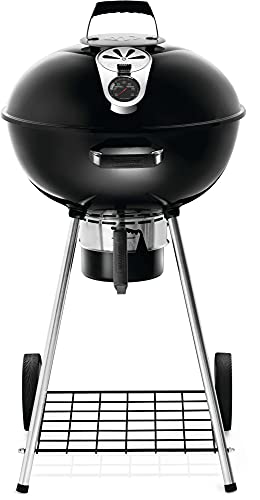
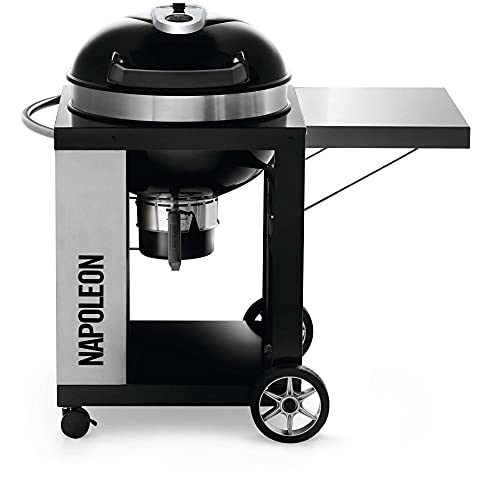
The Napoleon NK22K-LEG-2 has the highest rating of all kettle grills in our comparison. According to Napoleon’s instructions, an air deflector sits in the centre of its bowl, which lowers the burn rate there and is meant to bring more even temperatures; the grill can be run with or without it. For indirect cooking you take the deflector out and put the charcoal left and right in charcoal trays, which Napoleon offers only as an option. Its grate is made of chrome-plated steel. In our price box it costs approx. €373, around €44 more than the E-5750 from the marketplace sellers. If you rarely cook indirectly anyway, you hardly need the trays, and then in our assessment more speaks for it.
Weber includes a porcelain-enamelled charcoal ring and a stainless steel diffuser plate with the Master-Touch Premium E-5770, and its lid hangs on a hinge; in the Weber shop it costs €399, €100 more than the E-5750. In our assessment this surcharge pays off if smoking is the rule for you and not the exception.
If you regularly grill for more than 8 people, the next size up would be the one. In the FAQ of its Master-Touch category, Weber calls the 57 cm model the all-rounder for most families and recommends the 67 cm version for regular large parties or when large roasts and several indirect zones need room. In the Weber shop it is listed at €499, but it cannot be ordered there; only a ‘Notify me’ button appears.
The E-5750 is the wrong choice if you are looking for a grill for a rented holiday flat, a restaurant or the shared courtyard of a multi-occupancy building and are relying on the manufacturer’s warranty. According to the manual, it applies only to single private households, not to commercial or communal use and not in multi-occupancy buildings; Weber gives restaurants, hotels, resorts and rental properties as examples.