The short answer: A brisket cooks at a cooker temperature of 110 to 130 °C until the core temperature reaches about 90 to 96 °C and a probe slides in like soft butter. Allow roughly 1 to 1.5 hours per kilogram plus a buffer. Then let it rest for at least 1 hour, ideally 2 to 4 hours at above 60 °C.
Brisket is the beef breast, a muscle that carries the animal’s weight all day and therefore contains a lot of connective tissue. That is exactly what makes it the hardest cut of the BBQ trilogy. With pulled pork, the fatty pork shoulder absorbs almost every mistake, but with brisket every hour too many and every hour too few is punished immediately. The good news: if you can already do ribs and pulled pork reliably, you have the technique down. What is missing is a feel for the right end point and the discipline to keep the lid closed.
What is the difference between flat, point and packer?
A whole packer brisket consists of two muscles: the lean, evenly thick flat and the fatty, heavily marbled point, which lie diagonally on top of each other and are separated by a thick layer of fat. In shops you can buy either one of the two cuts on its own or the complete packer brisket.
| Cut | Raw weight | Fat content | Cooking behaviour | Suitable for |
|---|---|---|---|---|
| Flat | 2 to 4 kg | low, little marbling | cooks evenly, dries out quickly | clean slices, first attempt |
| Point | 1.5 to 3 kg | high, heavily marbled | very forgiving, takes longer | burnt ends, pulled beef |
| Packer (both parts) | 4 to 8 kg | mixed | two cooking zones in one piece | full range, large gatherings |
The packer is the most rounded in flavour, but technically the hardest task: the thin end of the flat is done while the thick point still needs hours. So always measure in the thickest part of the flat and go by that spot. Two probes at different points are not a luxury here, but the difference between control and guessing. Size also matters in practice: a 6 kg packer easily lies 50 centimetres long on the grate and fits in many kettle grills only diagonally.
How long does a brisket really take?
As a rule of thumb, allow 1 to 1.5 hours per kilogram at 110 to 130 °C, which puts a 5 kg packer at 8 to 14 hours. This range is not sloppiness but honest reality: two pieces of the same weight can differ by several hours, depending on how long the stall lasts and how fatty the meat is.
| Phase | Core temperature | Duration (approx.) | What happens |
|---|---|---|---|
| Putting on | 4 to 20 °C | 0 hrs | Seasoned meat goes on the grate, lid closed |
| Smoking phase | 20 to 65 °C | 4 to 6 hrs | Smoke settles on the meat, crust forms |
| Stall | 65 to 75 °C | 2 to 6 hrs | Evaporative cooling slows the rise |
| After wrapping | 75 to 90 °C | 2 to 4 hrs | Temperature rises quickly again |
| Target range | 90 to 96 °C | probing decides | Probe slides in without resistance |
| Resting phase | falls slowly | 1 to 4 hrs | Juices redistribute, never below 60 °C |
So plan backwards from the serving time and allow generously. A brisket that is done three hours early can easily be parked in a warming box. A brisket that is done two hours late ruins the evening. The clock is a planning aid; the thermometer makes the decision. For how the target values compare with other types of meat, see the core temperature chart.
How to proceed: from trimming to slicing
- Let the meat come up to temperature, about 60 minutes at room temperature, and pat it dry.
- Remove the silverskin and hard fat edges, and cut off loose flaps of meat that would only char in the smoke.
- Trim the fat cap back to 5 to 10 millimetres. Do not remove it completely, because this layer protects the lean flat from drying out.
- Season, classically with just coarse salt and coarse black pepper in equal parts. Beef has strong flavours of its own, and sugary rubs burn more easily over long cooking times.
- Set the grill to 110 to 130 °C indirect heat and place a water pan in the cooking chamber. The pan buffers temperature spikes and keeps the surface moist for longer.
- Add smoking wood. For beef, strong woods such as oak, hickory or mesquite work better than mild fruit woods. You can find details on dosage in the guide smoking on the grill.
- Put the meat on with the fat cap towards the heat source, so facing down with fire from below, facing up with heat from above.
- Do not touch it for the first four to six hours. Every time you open the lid you lose temperature and prolong the stall.
- Wrap as soon as the crust is dark and firm, usually at a core temperature of about 68 to 75 °C.
- Keep cooking to 90 to 96 °C and do the butter test in several places.
- Rest for at least 1 hour, then slice across the grain.
Why does the core temperature stand still for hours?
Because moisture evaporates from the surface of the meat and in doing so removes exactly as much heat as the grill supplies. This effect is called the plateau or stall, typically sets in at 65 to 75 °C and can last considerably longer with brisket than with pork shoulder, occasionally five hours or more.
This is not a defect in the grill and not a fault in the meat, but simple physics. The worst reaction is to turn up the temperature: you burn the crust without getting the core done any faster. You have two clean options. Either you sit out the stall and accept the longer cooking time, which gives the strongest crust. Or you wrap the meat and so stop the evaporation, which saves one to three hours depending on the piece.
Butcher paper or aluminium foil?
Butcher paper protects the crust, aluminium foil saves more time. That is the whole difference, and it is smaller than BBQ forums suggest. Uncoated butcher paper is breathable: some of the steam still escapes, the bark stays firm, and the time saving is more moderate. Aluminium foil seals tightly, drives the core temperature up fastest and noticeably softens the crust through the trapped steam. If you use foil, you can let the brisket dry off uncovered for another 20 minutes at the end to win back some texture.
Both methods work, and neither rescues a brisket that comes off the grill too early. Decide by priority: crust first means paper, deadline first means foil. In either case, wrap tightly so that no air pockets form, and put the probe back into the meat afterwards.
Resting and slicing: this is where the result is decided
With brisket, the resting phase is not an optional finishing touch but part of the cooking process. Allow at least one hour, better two to four hours, in a warming box or in a cool box preheated with hot water and padded with towels. During this time the fibres relax and redistribute the juices that would otherwise end up on the board at the first cut. Important for food safety: the core temperature must not fall below about 60 °C while the meat is held warm. If you want to park it for longer than four hours, you need a regulated warming source instead of a passive box.
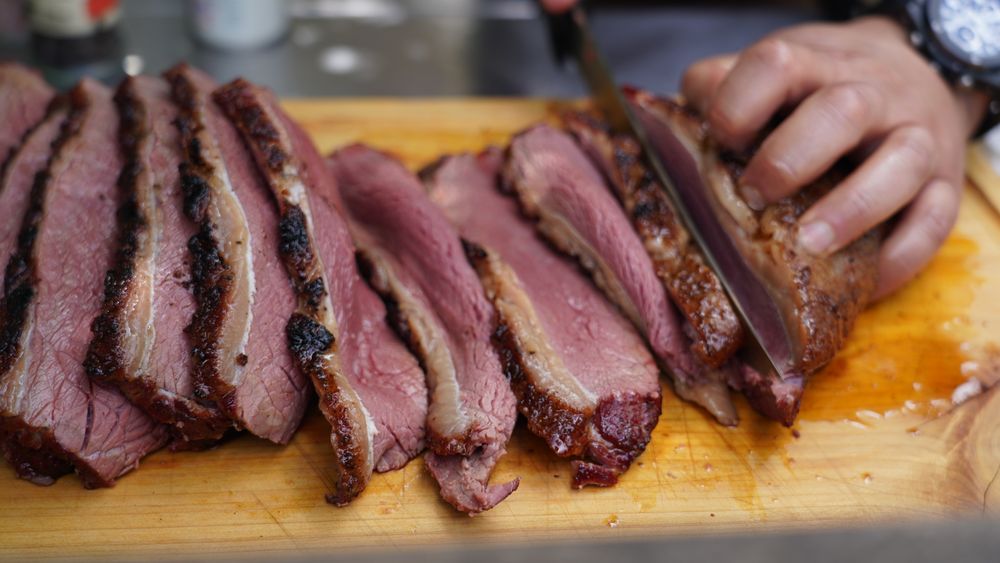
Slicing is where the most common beginner mistake happens. Flat and point have different grain directions, which sit at roughly a right angle to each other. If you cut the packer through in one direction, you inevitably catch one of the two parts along the grain, and it then tastes tough even though the meat was cooked perfectly. So separate the two muscles at the fat seam, turn the point by 90 degrees and slice both parts separately across the grain, about pencil-thick. Before cooking, make a small cut to mark how the fibres run, because afterwards it is hard to see under the dark crust.
What is behind it when a brisket goes wrong
| Symptom | Likely cause | Solution |
|---|---|---|
| Meat tough, despite 92 °C displayed | Probe was in fat or too close to the edge | Measure in several places in the thickest part of the flat, do the butter test |
| Flat dry, point juicy | Fat cap trimmed too far or cooker temperature too high | Leave the fat cap at 5 to 10 mm, keep the cooker below 130 °C |
| Slices fall apart when cutting | Cooked too long, above 98 °C | Take it off the grill earlier, determine the end point by resistance |
| Crust soft and mushy | Wrapped in foil and served without drying off | Use paper or let it dry off uncovered at the end |
| Bitter, harsh smoke flavour | Too much wood or a smouldering rather than cleanly burning fire | Fewer chunks, more air supply, thin blue smoke instead of dense white |
| Meat tastes bland | Seasoned too sparingly, salt does not reach the centre | Salt more generously, apply the rub several hours beforehand |
Who is a brisket worthwhile for?
For anyone who accepts time as an ingredient. A brisket ties up a whole day: 8 to 14 hours of cooking time, plus preparation and resting. Beef of this quality costs considerably more than pork shoulder, and the risk of failure is higher, because the lean flat has a narrower window between tough and dry than any cut of pork. That is exactly why the order pulled pork, then ribs, then brisket makes sense and is not just tradition.
Technically, brisket works in any appliance that holds 110 to 130 °C stably over many hours, so also in a kettle grill with a Minion ring or in a gas grill with a single burner on its lowest setting. It is more comfortable in an appliance with a large fuel capacity, because you do not have to add fuel every two hours during the night. Which designs are suitable is shown in the overview smokers compared, and if you are still undecided on the basics, the Grill Finder will give you suitable candidates in a few steps. For an introduction to the designs, the guide smoker for beginners is also worth reading.
Two safety notes to finish, because long sessions tempt people to ignore them: charcoal and gas must never be used in closed rooms, garages or courtyards without airflow, as both produce carbon monoxide. And if you keep the finished brisket warm for a long time, check the temperature with a thermometer rather than by feel. Whole beef is microbiologically less critical than poultry or minced meat, but a piece of meat that lies for hours at 40 °C in a cool box is no longer a pleasure but a risk.