What is behind item number 731004
Amazon lists the smoker under ASIN B006ZL146M with model number 731004. Weber Germany sells the Smokey Mountain Cooker Smoker Ø 57 cm under exactly this item number, so it is the same device. Weber describes it as the largest smoker in its own range. According to a Weber manual, the series has existed since 1981.
In the German Weber shop in September 2026 there were two Smokey Mountain models, this 57 and the 47 with number 721004, both only in black. According to our price box, the 57 costs approx. €599. Weber asked the same amount, €599.00 including VAT and plus shipping, in its own shop on 25 September 2026; the Amazon catalogue gave us no price the day before.
What we write about components and operation comes from Weber’s product, category and warranty pages and from two manuals. One is linked by Weber Germany on its manuals page: multilingual, valid for 37, 47 and 57 cm, printed 2014. The other was issued by Weber Australia and New Zealand in 2025. Where the two differ, and they do so often, both values are given here, the German one first.
The Smokey Mountain is built for low and slow: large cuts of meat that cook in smoke for many hours at low temperature, fuelled by charcoal. You can find the other smokers whose data we compare in the smoker overview.
Bowl, middle section, lid: the construction
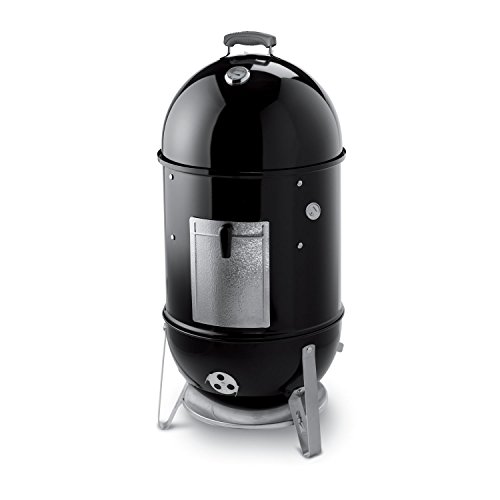
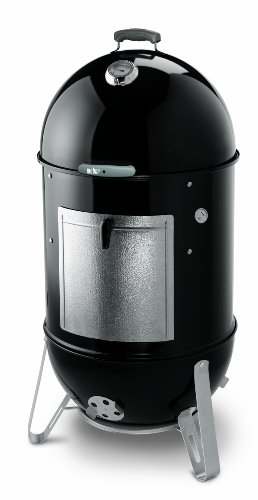
The product photo shows a round, upright body in three tiers. At the bottom the bowl stands on three legs, above it the cylindrical middle section with a large silver door at the front, on top the domed lid with handle and thermometer. The smoker has no wheels.
In the bowl lies the charcoal grate of solid steel, whose bars sit so close together, according to Weber, that shrinking coals do not fall through. The charcoal chamber stands on the grate. According to Weber it holds the fuel together so that it burns efficiently, and prevents ash from falling into the vent openings. Under the bowl hangs an aluminium heat shield, and the three legs are also made of rust-resistant aluminium.
The middle section is the cooking chamber. The water pan sits on its lower brackets, and above it two cooking grates lie one over the other, together 4,683 cm² of cooking area according to Weber. You add charcoal and water through the aluminium door while smoking. According to the exploded diagram in the manual, it sits on the middle section.
The lid contains a thermometer that shows the temperature inside. The two handles are made of glass-fibre-reinforced nylon, and Weber describes the lid handle as heat protection for the hands. For the cable of a core temperature probe, the smoker has a silicone grommet.
Bowl, lid, middle section and water pan are made of porcelain enamel. According to Weber, lid, bowl and middle section therefore retain heat, and the coating is meant to protect against rust-through, cracking and flaking and to withstand high grilling temperatures.
With the lid closed, the smoker is 123.2 cm high, 58.5 cm wide and 61 cm deep and weighs 35.38 kg, according to Weber. Besides the body and internal parts, Weber lists a measuring cup for briquettes and a cover as included. Assembly is not entirely tool-free: the legs are bolted on, and step 2 of the assembly instructions shows a screwdriver, a 7/16 inch spanner and six sets of bolt, nut and washers for this.
Weber’s product page contradicts itself in three places. According to the data table, the cooking grates are made of coated steel; according to the description text, they are chrome-plated. The table counts four rust-resistant aluminium vents, the introduction speaks of three vent openings, and nowhere in words does it say how the vents are distributed between bowl and lid; the exploded diagram shows a damper assembly on the lid and a vent assembly on the bowl. Third, the description text gives each grate a diameter of 57 cm. Two round grates of that size would come to a good 5,100 cm², about 420 cm² above the stated cooking area. Conversely, Weber’s area figure, spread over two equally sized round grates, gives about 54.6 cm each. That fits grates resting on brackets inside the 57 cm body.
We did not find the following details in any of the Weber sources mentioned:
- how many litres the water pan holds
- measuring range and accuracy of the lid thermometer
- a maximum temperature of the smoker
- a heat-up time to the target temperature (the Australian manual only gives a minimum waiting time)
- the distance between the grates and the interior height under the lid
- the sheet thickness of bowl, middle section and lid
- country of origin and place of production
- the duration of assembly
- a spare parts list for the 57 in the German Weber shop
In detail: water pan and vents
Between the embers and the grates, a water smoker has a pan of water. According to Weber, it catches dripping juices, creates steam, thereby brings moisture into the heat and stabilises the temperature.
Physics explains the last point. In an open pan, water does not get hotter than 100 °C at normal air pressure, any further heat goes into evaporation, and that takes a lot of energy: evaporating one kilogram of water needs about 2,260 kilojoules, a good five times as much as it takes to heat it from 0 to 100 °C. So as long as there is water in the pan, it absorbs heat from the embers and shields the grates from their direct radiation. In our reading, the pan therefore smooths out temperature peaks in the cooking chamber: if the embers get stronger, more water evaporates first. That works until the pan is empty.
An entry from the troubleshooting section of the German manual fits with this: if the temperature rises although the lower vents are closed, you check the water level and top up with hot water.
How full and how often, the manuals disagree. The German one has you fill the pan completely, check the water level every 3 to 4 hours and always pour in hot water. Why hot follows from the physics above: cold water first draws off heat until it is hot itself, and that heat is then missing in the cooking chamber. In the Australian one it is about three quarters full, checked every 2.5 to 3 hours, topped up with warm water. A warning from the German manual applies in both cases: do not pour water onto the hot coals, because steam and stirred-up hot ash can cause serious or fatal injuries.
You regulate the temperature itself through the air. Charcoal burns as strongly as oxygen reaches the embers: air flows in through the vents at the bottom of the bowl, and smoke escapes at the top of the lid. If all openings are fully closed, the oxygen supply is cut off, according to Weber, and the coals go out. The German manual sets 120 °C as the target, ideal for most types of meat; you should check the temperature every 15 minutes and adjust at the lower vents.
The Australian version gives 110 to 135 °C for most low and slow cooking and goes into detail on the start. All vents open, then let it warm up for at least 15 to 20 minutes. Once the temperature is reached, you close the vents about halfway and wait at least 15 minutes after every change. We read this waiting time as a consequence of the water buffer: what you change at the vents arrives at the thermometer with a delay.
How long does one load of briquettes last?
A burn time for the full chamber (approx. 330 briquettes) is given in no Weber source. The manuals work with quantities: for long smoking sessions the German one has you check the coals every 3 to 4 hours and add 18 to 20 briquettes, while the Australian one specifies 130 briquettes for 10 to 12 hours.
The German refuelling rule is in a place where you would hardly look for it: in the troubleshooting under “Temperature is too low” as point C. In the Australian version, refuelling is more sparing, only for cooking times of 12 hours or more and then, if needed, 5 to 10 briquettes, at the same checking interval.
Weber recommends charcoal briquettes as fuel. The manual does not recommend lump charcoal, nor Heat Beads brand briquettes. What distinguishes pressed briquettes from lump charcoal over long cooking times is explained in our guide Charcoal or briquettes.
Before lighting, according to the German manual, you take off the lid and remove the middle section, check that there is no ash in the bottom of the bowl and that the charcoal grate and charcoal chamber are correctly inserted, and open all lower vents. You pour the charcoal into the middle of the charcoal grate, distribute 4 to 5 firelighter cubes in it and light them with a long-necked lighter or matches. Once grey ash forms, you spread the coals evenly and add 3 to 4 logs of dry hardwood.
The Australian manual combines lit and unlit briquettes. The unlit ones go all around the inside of the charcoal chamber. The lit ones from the chimney starter are ready after 10 to 20 minutes, when they are mostly covered with grey ash, and are tipped as a pile into the middle of the charcoal grate with heat-resistant gloves, not on top of the unlit ones. According to the manual, the glowing charcoal supplies the heat for the start, while the unlit charcoal is a reserve that burns slowly along and sustains the heat over the cooking time. For normal cooking times of 6 to 8 hours, the manual calculates 50 unlit and 50 lit Weber briquettes for the 57; for the long variant, 80 unlit ones are added to the 50 lit ones.
For the 57, the cooking time table of the German manual, expressly as guide values and not as binding rules, includes these values among others:
- Beef brisket, 2.5 to 3 kg: 150 briquettes, 3 to 5 logs, 6 to 8 hours, 88 °C core temperature
- Pork shoulder, 2 to 4 kg: 150 briquettes, 3 to 5 logs, 8 to 12 hours, 88 °C
- Pork ribs on a fully loaded grill: 75 briquettes, 2 to 4 logs, 4 to 6 hours, until the meat comes away from the bone
- Turkey, 6 to 9 kg: 150 briquettes, 3 to 5 logs, 8 to 10 hours, 74 °C
Placing both manuals side by side reveals a gap. For 6 to 8 hours the Australian one manages with 100 briquettes, while the German table sets 150 for the beef brisket over the same period. We would plan the first long session with the larger quantity: you can slow down too much glow with the vents, whereas too little means opening the door and adding more.
Cleaning, care and safety according to the manual
After smoking, according to the German manual, you brush off the grates with a grill brush or crumpled aluminium foil, wipe over with paper towels and close all vents so the coals go out. According to this manual, you do not have to wash the grates thoroughly after every use.
The Australian manual is stricter. According to it, the grates should be free of old residue, fat and sauce every time you cook; you loosen stubborn residue with a wire brush, and after use you clean them with hot water, washing-up liquid and a nylon sponge.
Once a year a thorough clean is due, which according to Weber extends the service life by years. The German manual specifies four steps: let the smoker cool until the coals are completely extinguished; take out the cooking grates and charcoal grate; remove the ash; clean with mild detergent and water, rinse with clean water and dry all surfaces.
The safety chapter of the German manual is reproduced here in full, paraphrased and sorted by sequence. According to Weber, anyone who ignores the instructions risks serious or fatal injuries or property damage from fire.
When setting up:
- Use only outdoors, never in enclosed spaces: toxic fumes collect there that can cause serious health damage or death.
- Keep at least 1.5 m clearance from combustible material during operation.
- Do not use on a table and keep the smoker level.
- Do not use in strong wind.
- Use only if all parts are properly assembled.
- Before use, remove all deposits from the lower heat shield.
- Do not line the bowl with aluminium foil; it obstructs the airflow.
When lighting:
- Take off the lid to light the briquettes.
- Always put charcoal on top of the charcoal grate, never directly into the bottom of the bowl.
- Never use charcoal soaked in lighter fluid, and never put lighter fluid or charcoal soaked in it onto hot or warm pieces of charcoal.
- Never use lighter fluid, petrol, alcohol or other highly volatile liquids to light or relight, and never use or store them within 1.5 m of the smoker.
- If using an electric lighter, follow its operating instructions, keep electric cables away from hot surfaces and do not run them across walkways.
- Do not wear clothing with loose, flowing sleeves when lighting and using.
During operation:
- The smoker gets very hot and must not be moved during operation.
- Never leave infants, children and pets unsupervised near the hot smoker; keep children and pets away.
- Never check by touch whether the cooking grate, charcoal grate or smoker are warm.
- When smoking and adjusting the vents, protect your hands with barbecue gloves or oven gloves and use barbecue tools with long, heat-resistant handles.
- In case of flare-ups, put the lid on, do not use water.
- The by-products of combustion contain chemicals known to cause cancer or reproductive harm.
When extinguishing and cleaning:
- To extinguish, put the lid on and close all vents; do not use water, it destroys the porcelain enamel.
- Only empty the ash once the charcoal has burned out completely and is extinguished.
- Do not use sharp objects to clean the cooking grates or remove the ash, otherwise the surface suffers, and do not use harsh cleaners on the cooking grates or smoker.
Outside this chapter, the manual requires you to always protect hands and forearms with protective gloves. Weber’s product page repeats the instructions in short form, expressly calls the danger in enclosed spaces carbon monoxide poisoning and requires you to read the manual before use.
Warranty and spare parts
According to Weber’s German warranty page, bowl, lid and middle section are covered for 10 years against rust-through and burn-through. For plastic components 5 years apply, excluding fading and discolouration, and for all other parts 2 years. The grates fall under the other parts there; the 2014 manual likewise provided 2 years for cooking and charcoal grates against rust-through or burn-through.
The warranty is voluntary and comes in addition to statutory warranty rights. It applies in Europe, the Middle East and Africa, from the date of purchase and only for the first buyer, with an exception for gifts. It does not cover normal signs of wear such as surface rust, dents and scratches; substantial defects such as rust-through or burn-through, or damage that prevents safe use, are recognised. For a claim you need the form with a description of the damage, serial number, proof of purchase and pictures of the damage, so keep your proof of purchase. Weber recommends registering; it is not mandatory.
The 2014 manual contains two further restrictions. There the warranty applies only to individual private households, not to commercial use, for example in restaurants, hotels, holiday resorts or rental properties. And it lapses in case of misuse, modification, lack of care or improper assembly, damage from insects or rodents, from salty air or chlorine sources such as pools, from storms and when non-original parts are fitted. According to the manual, if you live on the coast or place the smoker near a pool, you must wash and rinse the outer surfaces regularly for the warranty to apply.
Weber USA lists spare parts for the 22 inch model, which corresponds to the 57: charcoal grate, lower and upper cooking grate, door, water pan and charcoal chamber.
These three smokers are the other options
One has the same design in a smaller size, the other two work on a different principle.
| Model | The difference | Price | Our rating | Choose this one if |
|---|---|---|---|---|
| Weber Smokey Mountain Cooker 57 cm (this one) | Water smoker, two grates, 4,683 cm² according to Weber | approx. €599 | 9.5 | you often smoke for many guests and the smoker can stay in place |
| Weber Smokey Mountain Cooker 47 cm | same design, according to Weber about a third less cooking area and weight | approx. €709 | 9.1 | 3,103 cm² is enough for you and you put the smoker away more often |
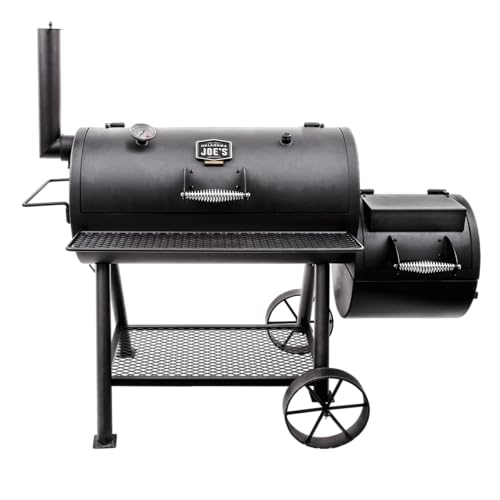
| Oklahoma Joe’s Highland | Offset: firebox at the side next to the cooking chamber (Amazon title: Side Fire Box) | approx. €469 | 8.9 | you would rather add fuel in a side firebox than look after a water pan |
| MasterBuilt Digital Elektro Smoker 40-Inch | electric, temperature and time on the digital panel (Amazon bullet point) | from €199 (Santos Grills) | 8.3 | there is a socket at the spot and you do not want to adjust vents |
The prices are the guide values from our respective reviews, recorded at different times; for the MasterBuilt, the cheaper of the two shops its review lists is shown. The offers behind the links may differ. That the smaller 47 is priced higher than the 57 in our listings is due to the offers recorded in each case and not to size: in the Weber shop the 47 was cheaper than the 57 on 25 September 2026. Compare both on the same day in the same shop before deciding on price. The rating is our editorial assessment and not a measurement result.
When the 57 suits you and when it does not
Weber itself divides the sizes like this: the 37 cm model for small city balconies (not listed in the German Weber shop), the 47 for regular rounds with family and friends, the 57 for anyone who wants to smoke large quantities such as pulled pork, ribs or brisket for many guests at once. According to Weber, the 47 has 3,103 cm² of cooking area, 1,580 cm² less than the 57, and weighs 23.58 kg, so 11.8 kg less. The extra area of the big one helps you if large pieces regularly lie on both levels.
When it comes to space, calculate more generously than the outer dimensions suggest. To the body with a diameter of 57 cm you add the 1.5 m minimum clearance on every side from the safety chapter. Taking both together, nothing combustible may stand within a circle of a good 3.5 m diameter, no hedge and no parasol.
You need time in one block. The cooking time table runs up to 12 hours for pork shoulder, and the checks continue the whole time: the thermometer every 15 minutes, water and charcoal every few hours. Over 12 hours that is 48 looks at the thermometer. If you would rather set the heat on a digital panel than adjust vents, charcoal and water yourself, an electric smoker such as the MasterBuilt 40-Inch suits you better. The panel does not take the supervision off your hands, though: you do not leave a running smoker alone, whatever it heats with.
Steaks are not the job of this smoker. Grilling without a water pan on the lower grate is technically possible according to Weber, but is not ideal for searing and does not replace a normal grill. If you want both, you need two devices.
On top of the purchase price come briquettes, firelighter cubes or a chimney starter, smoking wood and a core temperature probe, because the lid thermometer shows the temperature in the cooking chamber and not that in the meat.