An electric smoker with two model numbers
The Masterbuilt 40-Inch Digital Electric Smoker is an upright smoker cabinet. A heating element provides the heat, wood chips provide the smoke, and you set temperature and time on a digital panel. It does not need gas, and the manual expressly rules out charcoal briquettes or heating pellets in the electric smoker.
Our price box lists it at approx. €329.99 (as of September 2026), on Amazon under model number MB20077118. The German manufacturer page lists a “101 cm Digitaler Elektrosmoker” (101 cm digital electric smoker) with the number MB20075917, also at €329.99 (accessed 14 October 2026); dimensions, cooking area and equipment list match those of the UK page for MB20077118. The product page for MB20077118, on the other hand, could not be opened in the German shop section on 14 October 2026 (error 404). The shared manual names both numbers on its title page, so we treat both as the same unit.
The manual (code 9807190021 190416-NC) is available from the manufacturer only in English, French and Spanish. We translated all manual quotations in this text into German ourselves, and they are rendered here in English.
Design and technology according to the manufacturer
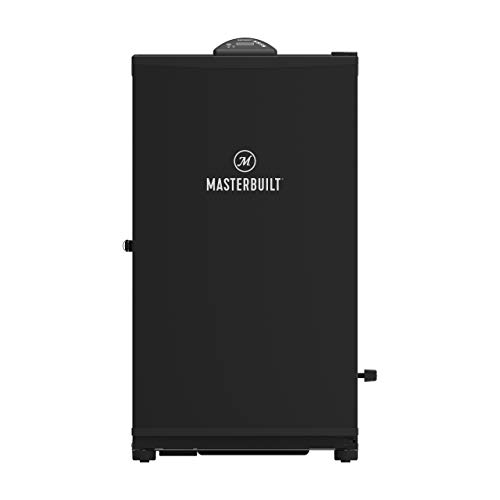
The product photo shows a tall, black cabinet with a door across almost the whole front; the control panel sits as a curved unit on top of the body. Masterbuilt gives 65.0 cm width, 105 cm height and 50.5 cm depth. The photo shows no side tables or other large attachments that would increase these dimensions.
Inside the cooking chamber there are four chrome-plated racks with a combined 6,300 cm² of smoking area (0.63 m²). As capacity the manufacturer lists 16 chickens, 4 turkeys, 8 pork butts or 8 racks of ribs; the German page translates pork butts as “Schweineköpfe” (pigs’ heads), but pork shoulders are what is meant. According to the manufacturer the body is fully insulated, a water pan is meant to add moisture and flavour, you regulate the amount of smoke aroma with the air damper, and a thermostat holds the temperature evenly.
The digital panel switches on and off and sets temperature and time, up to 135 °C at most. The LED display can be switched between °F and °C: press ON/OFF, then hold SET TIME and SET TEMP together for three seconds. Direct sunlight can make it hard to read, the manual says. When the set time runs out, the heating switches off. Before the first cook the manual requires a burn-in run; the procedure is in the FAQ above.
For assembly the manual allows approx. 25 minutes. You need an adjustable spanner and a Phillips screwdriver, and some steps may already have been done at the factory. If parts are missing or damaged, you should not take the smoker back to the retailer but call Masterbuilt customer service (EU 0031 4 7799920). Have the model and serial number ready; they are on the silver rating plate. The door can be adjusted: loosen the hex nut on the door latch, turn the hook clockwise, tighten the nut firmly again. Smoke still escapes through the gaps and blackens the interior, which the manual calls normal.
What Masterbuilt does not state, we collect here: power in watts, mains voltage and power consumption (the manual mentions the rating plate only for the model and serial number), heat-up time, fluctuation during operation and the minimum temperature, the material of the housing, door and seal (only the racks are described as chrome-plated), interior dimensions and rack spacing, smoking time per load, protection rating and approval marks, and a product weight. Amazon lists 73.85 pounds, converted roughly 33.5 kg. The scope of delivery is also open: the manual marks wheels, rear handle, meat probe, interior light, remote control and additional wire racks only with “if equipped”, and neither the manual nor the manufacturer’s page assigns which of them belong to this model. Whether a cover, thermometer or wood chips are included is equally undocumented.
In detail: how the smoke gets into the cabinet
An electric smoker separates heat and smoke. The heating element holds the temperature you set on the panel; the smoke is produced in a separate wood chip pan. Without chips there is, according to the manual, neither smoke nor smoke aroma, and the smoker is then just a heated cabinet.
You fill the chips into the wood chip loader, flush with its upper edge. Half a cup is the upper limit per load (“1/2 cup” in the manual, roughly 120 millilitres). If you turn the handle clockwise, the chips fall into the pan; afterwards you turn it back to the vertical position, and the loader stays inserted. To refill, you pull it out, fill it, insert it again and turn the handle again, without opening the door. You refill only once the previous chips no longer produce smoke. Loader and pan must be in place during operation, which according to the manual reduces the risk of flare-ups. After refilling, the temperature may rise briefly and stabilises after a short time; you should not change the setting meanwhile. So even with side access, a temperature spike cannot be avoided entirely.
Dry chips burn faster and smoke more intensely, while chips soaked in water for about 30 minutes burn more slowly and smoke less intensely. The manual lists wood chunks and wood pellets as prohibited.
If the chips do not smoke on a low setting, the manual advises going to 135 °C and, after 8 to 10 minutes or as soon as they smoulder, returning to the desired level. We conclude from this: the pan is heated along with the heating element, so the smoke depends on heating output and may fail to appear at a low setting.
If you open the door, the chips can flare up. In that case close the door and air damper immediately, wait until the chips have burned down, and only then open again. You are expressly not to spray them with water. The loader is hot, even if the handle is not.
You fill the water pan only once the smoker has reached the desired temperature, up to the fill mark, with water or liquids such as apple or pineapple juice. Fruit slices, onions and dried herbs may go into the water. For chicken and other moist foods the manual advises little or no liquid. As long as there is water in the pan, it raises the humidity in the cooking chamber in our view; once it runs dry, this effect is lost.
How long do ribs, brisket and pulled pork take?
The manual gives guide values: two racks of baby back ribs take four hours at 107 °C, a beef brisket at 121 °C one hour per pound, a pork butt for pulled pork at 121 °C twice two and a half hours.
If you wrap the ribs for the last 1.5 to 2 hours, that becomes 5 to 6 hours; the core temperature is 74 °C in both cases. For the brisket (2.7 to 5.4 kg) the table lists a core temperature of 82 to 88 °C. If you take a pound as 453.6 g, one hour per pound comes to roughly 6 to 12 hours. The pork butt (1.8 to 2.3 kg) needs 2.5 hours without and 2.5 hours with foil for pulled pork, up to a core temperature of 91 °C; sliced, it is 1 to 1 1/4 hours per pound at 107 °C up to 74 °C. A whole chicken (1.4 to 2.3 kg) is listed in the table at 107 to 121 °C and 45 minutes to 1 hour per pound, a turkey (3.6 to 5.4 kg) at 107 °C and 30 to 35 minutes per pound, both up to 74 °C. This is an excerpt; the table on page 25 of the manual contains more.
We would plan the times as a minimum. The manual itself says that below 18 °C outside temperature or above 1,067 m altitude more cooking time may be needed, and every opening of the door lengthens it. On top of that come 30 to 45 minutes of preheating before loading, no aluminium foil on the racks and enough space between the food and the smoker walls.
The rule not to leave the smoker unattended also applies to a twelve-hour brisket. In our reading, letting a brisket run overnight does not fit with that.
Placement, power and cable
An earlier version of this review advised keeping the smoker under a porch roof. That was wrong and has been corrected; the third point of the list below says why. On placement, pages 2 to 4 of the manual contain, among others, these rules; the warning list there goes further:
- The smoker is intended for outdoor use only, in a well-ventilated place.
- Never in enclosed areas such as patios, garages, buildings or tents, never in recreational vehicles or on boats.
- Never under overhead structures such as roofs, carports, awnings or porch roofs.
- At least 3 m clearance from overhead structures, walls, railings or other structures.
- At least 3 m clearance from all combustible materials such as wood, dry plants, grass, brush, paper or canvas.
- On level, non-combustible, stable ground such as soil, concrete, brick or stone, not on wood or combustible surfaces.
- The smoker must stand on the ground, not on tables or worktops.
- Keep a fire extinguisher within reach and do not leave the smoker unattended.
- Never use it as a heater: burning wood chips release carbon monoxide, which is odourless and can be fatal.
We read it this way: the spot is an open garden with the minimum clearance all around, no roof above, on level ground. A terrace under an awning and a corner against the house wall are therefore ruled out. Then there is the weather, because according to the manual the electric smoker must not be exposed to rain or water at any time. So it runs only on dry days under open sky.
Power: you may plug it in only once the smoker is fully assembled, and only into an approved earthed socket. In a thunderstorm it stays off. Cable, plug and control panel must not be immersed in water or other liquids. To disconnect, you first switch off the control panel and then pull the plug.
Because the socket is usually on the house wall and the smoker has to stand well away from walls, in most gardens you will need an extension cable. The manual allows it with conditions. The cable must be three-core and earthed, marked as an outdoor cable (suffix W and the label “Suitable for Use with Outdoor Appliances”) and at least as heavy-duty as the appliance. The plug connection stays dry and off the ground, the cable does not hang on hot surfaces or where someone could trip over it or children could pull on it. If heating up takes longer than 60 to 70 minutes, the troubleshooting table lists an extension cable among the possible causes and advises placing the smoker so that none is needed. The manual does not resolve the conflict between wall clearance and socket.
What else comes into question?
A buyer is most likely to weigh these three smokers against the Masterbuilt. All other models in the category are in our smoker overview.
| Model | The difference | Price | Our rating | Choose this one if |
|---|---|---|---|---|
| Masterbuilt 40-Inch Digital Electric Smoker (this one) | Electric, four racks with 6,300 cm² according to the manufacturer, up to 135 °C | approx. €329.99 | 8.3 | you have a free garden spot with a socket within cable reach |
| Char-Broil Digital Smoker 2.0 | Also electric, four stainless steel racks, core temperature probe according to Char-Broil | approx. €458 | 8.4 | less space around the unit is enough for you (manual: 92 cm to walls) |
| Pit Boss Pro Series V4P | Pellet smoker, with Wi-Fi and Bluetooth according to Pit Boss | approx. €449 | 8.7 | you want nothing to refill by hand and want to monitor via app |
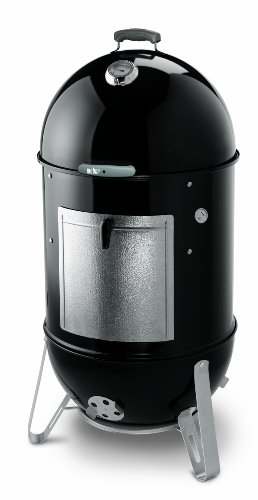
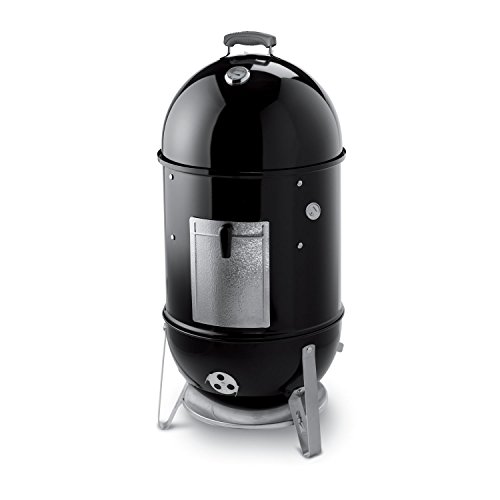
| Weber Smokey Mountain Cooker 57 cm | Charcoal water smoker without electricity, two racks with 4,683 cm² according to Weber | approx. €599 | 9.5 | you have no socket or want to control the temperature yourself via vents and coals |
The prices are guide values from the header lines of the respective reviews and change. For the Pit Boss we have no price box; its review text mentions around €849, while the €449 in the table comes from its header line. The rating is our editorial assessment based on the available data, not a measurement result. The table works as a first comparison, not as a substitute for the individual reviews.
The Char-Broil costs around €128 more by our guide values (€458 against €329.99). Its manual states an output of 800 watts and requires 92 cm clearance from walls and railings; it must not stand under a roof either. For the Masterbuilt it is 3 m. In our assessment, for small gardens that is the difference that counts.
The Weber is around €269 above the Masterbuilt, needs no electricity and has the highest rating of the three. Weber describes its area as 4,683 cm² on two racks, Masterbuilt gives 6,300 cm² on four. Whether both manufacturers measure the area the same way is not documented, so a numerical comparison remains uncertain. With the Pit Boss the contrast lies in the fuel: pellets are prohibited in the Masterbuilt, whereas in the Pit Boss they are the fuel.
When this smoker, when another
The decision is often made by the location alone. If you have no spot with the minimum clearance all around and a socket within cable reach, the Masterbuilt is out. On a balcony it is also out in our reading; what is legally possible there is explained in the guide Grilling on a balcony. Without a socket the Weber fits better, and with little space around the unit the Char-Broil with its 92 cm.
On temperature, 135 °C is the upper limit. Low and slow works with it, hot searing does not. If you want both, you need two units or a different type; an electric smoker with this upper limit does not replace a grill.
On monitoring: according to the manufacturer’s page the panel is intended for on/off, temperature and time, and Wi-Fi exists only on the sister model. Plan on your own meat thermometer; the guide Grill thermometer: probe, wireless or cable-free sorts out which designs exist. If you want to keep an eye on the cook from inside the house via an app, look at the Pit Boss.
The budget does not end at the purchase price. Wood chips, if needed an outdoor extension cable and a thermometer come on top. We could not find a manufacturer’s cover for the German market, but the manual requires storage in a dry place (see below).
Cleaning, storage and warranty
Before cleaning and storage the smoker must be cool to the touch, and the plug is pulled. It should be cleaned after every use, which according to the manual extends its service life and prevents mould and mildew. You clean the rack supports, racks, water pan and drip pan with mild washing-up liquid, rinse them and dry them thoroughly. You clean the wood chip pan and loader often so that no ash, residue or dust builds up. Cold ash goes into aluminium foil, is soaked with water and is disposed of in a non-combustible container. You simply wipe the interior, the glass in the door (if equipped) and the exterior with a damp cloth, without detergent, and dry them thoroughly. The smoker must not be cleaned with a water jet or water sprayer. The manual says nothing about the dishwasher. Check regularly whether moisture is causing rust or corrosion.
You should check and empty the grease tray often, before it is full, if necessary even during cooking. If grease runs out through the door and legs, the troubleshooting table lists three causes: a drip pan whose hole does not sit above the drain hole in the base, too much grease in the smoker, or a drain hose at the back that does not drain. The drip pan belongs only on the floor of the smoker, never on a rack.
The manufacturer’s product page recommends something different from the manual: hot water and apple cider vinegar in a 50 to 50 ratio, mixed in a spray bottle and applied with a soft sponge. That is hard to reconcile with the manual, according to which the interior is wiped without detergent and a water sprayer is ruled out as a cleaning tool. We would stick to the manual.
On storage the manual contradicts itself. Page 3 requires storing the smoker indoors when not in use, out of the reach of children; page 24 mentions a covered, dry area after cleaning. Both assume it has cooled below 45 °C, and hot ash must not remain inside. You must never move it during operation and should roll it only on smooth surfaces, never up or down stairs.
The warranty is, according to the manufacturer’s page for Europe, two years from the date of retail purchase. It applies only to the first buyer, the product must be registered, and you need proof of purchase to make a claim. Masterbuilt replaces or repairs the defective component at its own discretion and covers the shipping costs of warranty parts; labour is not covered. According to the manual, exclusions include transport and drop damage, incorrect assembly, normal wear, misuse and cosmetic damage to the enamel. In the manufacturer page’s general warranty text, which states one year, paintwork and rust are excluded; whether that also applies to the European rule, the page does not say explicitly. Anyone who buys from an unauthorised retailer loses the warranty. Statutory warranty rights remain in place according to the manufacturer.
Who is it for?
In the product description Masterbuilt addresses beginners and competition-tested professionals. In our assessment it suits beginners, because temperature and time are set digitally and only chips and the water pan are left for you; how designs differ for starters is covered in the guide Smokers for beginners. If you have not yet decided between electric, charcoal and pellets, the Grill finder narrows down the choice.
It is wrong for anyone who wants to earn money with it. The manufacturer’s page does not recommend commercial use and excludes it from the warranty; as examples it names restaurateurs, caterers, butchers, rental companies and food trucks. In its warning list the manual says both: the units are intended for commercial applications, for example in the kitchens of restaurants, canteens and hospitals and in businesses such as bakeries and butchers, but not for the continuous mass production of food. Further down in the same list it says the smoker is not intended for commercial use. We follow the warranty page.
Anyone who does not read English, French or Spanish is also at a disadvantage: the safety pages 2 to 4 with the clearance rules and the carbon monoxide warning exist only in these languages. And where children are meant to help: the manual permits use from age 8 only with supervision or instruction, and cleaning and maintenance by children only under supervision.