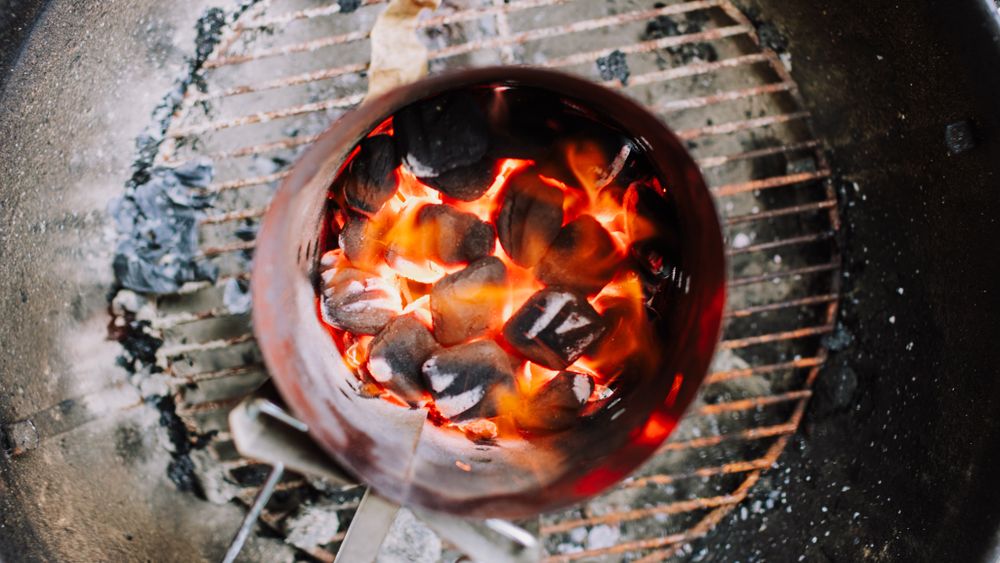
The short answer: Charcoal lights quickly and reaches higher peak temperatures, which is ideal for short, hot barbecues with steak and sausages. Briquettes burn more evenly and much longer, but a little cooler, which is ideal for long sessions such as pulled pork or spare ribs. The most reliable way to light either is a chimney starter, with no chemical lighters at all.
The choice between charcoal and briquettes affects your grilling result more than many beginners expect. Both are made from wood, but they differ fundamentally in how they are made, how they burn and what they are really suited for.
What is the difference between charcoal and briquettes?
Charcoal (lump charcoal) is made when lump wood is carbonised at high temperatures without oxygen. What remains are porous, irregularly shaped pieces of almost pure carbon. Briquettes, by contrast, are pressed from fine coal dust, often with a binder such as starch, into even blocks or pillow shapes. This difference in structure explains almost all the practical differences between the two.
| Criterion | Charcoal | Briquettes |
|---|---|---|
| Lighting time | Quick (10 to 15 min.) | Longer (15 to 25 min.) |
| Maximum temperature | Higher (up to approx. 900 °C in the embers) | Somewhat lower, but more constant |
| Burn time | Shorter (approx. 1 to 1.5 hrs) | Much longer (2 to 4+ hrs) |
| Evenness of heat | Fluctuating, depending on piece size | Very even |
| Ash | Low | Somewhat higher |
| Flavour | Stronger, depending on the wood | More neutral |
| Price per kg | Usually somewhat higher | Usually cheaper |
| Ideal for | Short, hot sessions (steak, vegetables) | Long sessions (pulled pork, ribs) |
Which is better for grilling steak?
Charcoal, because it reaches very high temperatures much faster, which is exactly the heat peak you need for a strong, quick crust over a short cooking time. The irregular piece shape does mean the heat is spread a little less evenly across the grate, but that hardly matters for a steak grilled for 3 to 4 minutes per side. You can find details on times and core temperatures in the guide Grilling steak.
Which is better for long grilling sessions?
Briquettes, because their pressed, even shape makes them burn much more steadily and for longer than loose pieces of charcoal. For low and slow dishes such as pulled pork or spare ribs, which have to cook for 6 to 14 hours at a stable 110 to 120 °C, temperature consistency matters more than short bursts of peak heat, and briquettes deliver that more reliably.
Many experienced grillers combine both fuels: a base layer of briquettes for long, stable heat, plus a little charcoal when you need to add heat quickly. The guide Direct vs. indirect heat explains how to set up zones for direct and indirect heat, and the pulled pork guide shows the complete schedule for long sessions.
What are coconut briquettes, and are they worth it?
Coconut briquettes are made from pressed coconut shells instead of wood. They are known for very high, exceptionally constant burning temperatures over an especially long time, with little ash. These properties make them particularly popular for kamado grills, whose thick-walled ceramic construction is designed for long, stable periods of heat anyway. The combination of a thick ceramic body and coconut briquettes can keep a load of fuel constant for many hours.
The downside: coconut briquettes are generally more expensive than classic wood briquettes. For occasional short barbecues the extra cost is hardly worth it, but for regular long sessions in a kamado it is much more likely to be.
How do you light charcoal or briquettes properly?
The chimney starter is the fastest and safest method, with no liquid or chemical lighters:
- Place one or two solid firelighter cubes under the chimney on the charcoal grate or a fireproof surface and light them.
- Put the chimney starter on top and fill it with charcoal or briquettes.
- Wait 15 to 20 minutes until the top layer is visibly glowing and a white-grey layer of ash forms.
- Carefully tip the glowing coals onto the charcoal grate of the grill, onto one half only if you want a two-zone fire.
- Put the cooking grate on and let it heat up briefly before you add the food.
Without a chimney starter, lighting with firelighter wool or paste takes a similar time, but it is less even and often produces more soot at the start. Most experienced grillers advise against liquid lighters based on methylated spirits or petrol, because they carry a risk of flash fires and can pass unburnt residues into the flavour if you start grilling too early.
How much charcoal or how many briquettes do you need?
As a rule of thumb, for a normal barbecue for 4 people you need about 1 to 1.5 kg of fuel for direct heat. For a long low and slow session with briquettes, plan on 2 to 3 kg as the base load, plus extra to top up as needed. Larger kettles and kamados need correspondingly more, and small tabletop grills much less.
It also helps to check the packaging: good-quality branded products often give approximate burn time guidelines per kilogram, which you can calibrate to your own grill through experience.
Conclusion: The choice follows the cooking time, not the flavour
The decision between charcoal and briquettes is less a question of taste than of cooking duration: short, hot barbecues with steak and sausages benefit from the quick heat of charcoal, while long low and slow sessions benefit from the consistency of briquettes. If you do both regularly, you are best off keeping a stock of both fuels, plus a chimney starter, which gets the fire going reliably and without chemicals in every case. The category Fuel & smoking wood gives an overview of all fuels and accessories.