Greek Fire sells a single briquette product: 10 kg of charcoal briquettes for grilling. The company behind it is Greek Fire CP GmbH, based in Hürth, and apart from the briquettes the shop only lists four gift vouchers (€10, €25, €50 and €100). On Amazon the 10 kg pack cost approx. €49.10 on 06.10.2026. In our category Fuels it sits alongside starch-bound charcoal briquettes and briquettes made from coconut shells.
The headline says “charcoal”, the manufacturer writes “grill charcoal briquettes”, and that fits better: pressed shapes, not loose lumps of charcoal. We have not lit any of them. What you read here comes from greekfire.de (researched on 05.10.2026), from the Amazon catalogue, which contains a single bullet line of listing text for this ASIN, and from the Amazon photo. For ember, smoke and burn time there is therefore either a statement from Greek Fire, attributed to them, or an inference from the construction, marked as such.
Hardwood sawdust, channel in the middle, according to the manufacturer without binders
As material the product page lists oak, beech and other hardwoods. On the About Us page Greek Fire is more specific about the raw material: hardwood sawdust, nothing else, no accelerants. The manufacturer calls this raw material sustainable and writes that it knows where the wood comes from.
On additives the product page says two different things. The product details say “without binders or additives”, the description says “without chemical and natural binders”. We read the second version as the more precise one: starch is a natural binder, and proFagus and Weber use starch to hold their briquettes together.
The About Us page describes the shape: elongated and pressed, with a continuous channel through the middle. According to Greek Fire the channel draws air through the briquette, so that it ignites through faster, holds its heat longer and leaves less ash at the end. Every briquette is said to be pressed to the same size and density.
The product page puts the carbon content at approx. 87% and the ash content at approx. 6%. For context: dry wood is roughly half carbon. A value around 87% therefore fits wood that has been carbonised, and the name charcoal briquettes.
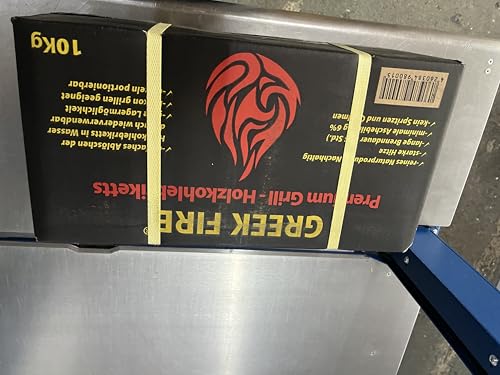
According to the product page it is delivered in sturdy 10 kg cartons that can be stacked; the About Us page speaks of a discreet sack. The photo in the Amazon listing shows a black carton with a red flame logo, the name Greek Fire, the line Premium Grill-Holzkohlebriketts and the label 10 kg, secured with two yellow straps. No briquettes are visible on it. The catalogue lists an item weight of 22.05 pounds, converted 10.0 kg, so the quantity without any visible allowance for the carton.
The carton also carries print. The photo is upside down, and the straps cover some word beginnings, but the rest is legible. On one side of the logo there are bullet points such as pure natural product, sustainable, strong heat, long burn time (the figure after it lies under the strap), minimal ash formation 6% and no spitting and smoking. On the other side it says that extinguishing the charcoal briquettes in water is easy and that the briquettes are also reusable, plus lines on storage options and on individual portioning, and a line about grilling (its beginning is covered).
In detail: ember up to 400 °C and what reaches the grate
The product details state an ember temperature of up to 400 °C, with no measurement method and no measuring point. The description speaks of peak temperatures of up to 400 degrees Celsius, the Amazon catalogue of “can be heated up to 400 degrees”; each time it is a maximum value.
What counts for grilling is the temperature at the grate, and it is lower than that of the ember. It depends on how far the food sits from the briquettes and how much air the ember bed gets; you control the distance to the ember with zones for strong and weak heat, and the air with the vents, as described in the guide Direct and indirect heat. A maximum value also says nothing about how long the ember holds it. The constant heat over hours and the less frequent topping up that Greek Fire promises are the manufacturer’s own claim.
As uses the home page names steak, fish and vegetables, so not only meat. Our guide counts fish fillets and vegetable slices among the food for direct heat, but they burn quickly if they sit close above very hot embers. In our assessment, more distance to the ember bed or the cooler zone of the grill helps with them.
The channel explains part of the manufacturer’s claims. It increases the surface where air reaches the wood, including inside the briquette. That fits with the faster ignition. It does not follow that the briquettes therefore stay hot longer, because more surface area first speeds up the burn. Uniform pieces, on the other hand, burn down at roughly the same rate, while loose charcoal in mixed sizes burns less evenly.
How long do the briquettes burn?
That depends on which page of greekfire.de you read: 4 to 6 hours in the product description, up to 6 hours in the product details, more than 6 hours on the home page.
For none of the three figures does Greek Fire state a quantity or a grill type; whether it means a single briquette, a load in the chimney starter or the whole carton stays open. We would plan with the lower value, because a burn time without conditions tends to describe the best case, and do a trial load with a clock before the first long evening, with a reserve within reach.
On weber.com Weber states up to three hours of strong ember for its briquettes. Greek Fire states more with 4 to 6 hours, but also has the higher price per kilo.
Lighting, smoke and safety
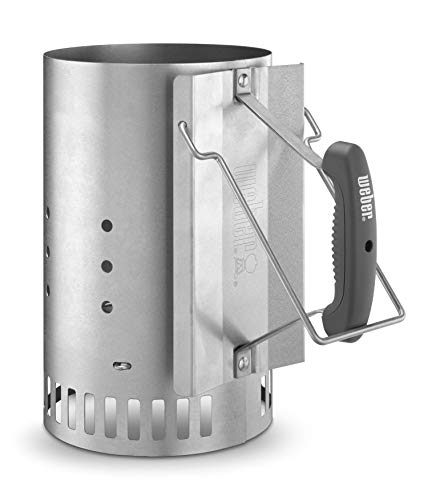
The manufacturer’s instructions consist of three steps. First: stack the briquettes loosely in the chimney starter or on the grate so the air can circulate. Second: wait until the surface is evenly ash-grey, 15 to 20 minutes according to the home page, then the heat is ready. Third: the ember holds evenly for hours, you have to add less and can concentrate more on the food.
There are three wordings on smoke. The product page writes “odourless and smokeless” and attributes this to production without binders. The home page is more cautious: “little ash, little smoke”. The Amazon catalogue says “smokeless and do not smell”. The home page is the more cautious version, “smokeless” the stronger claim; the first two wordings are on greekfire.de, and we do not know who wrote the line in the Amazon listing. On taste the product page says there is no impairment of the flavour of the food whatsoever. On the carton in the photo it says “no spitting and smoking”.
Greek Fire gives no safety notes; the three steps above are the whole instructions. As a general rule for charcoal: grilling with charcoal belongs outdoors, because even low-smoke charcoal forms carbon monoxide, a gas with no colour or smell. Ash and leftovers only go in the bin once they have cooled completely: under grey ash, embers often stay hot for hours. Liquid accelerants such as methylated spirits or petrol do not belong on charcoal, and briquettes are stored dry. If you grill on a balcony, check your tenancy agreement and house rules beforehand; they apply regardless of how much the briquettes smoke.
What 10 kg costs
The manufacturer sells the briquettes in its own shop for €29.90 including VAT, plus shipping. On 05.10.2026 it said “Currently unavailable” there, and the shop gives November as the expected return, without a year. The Greek Fire pages we checked nowhere link to Amazon; whether the goods there match those from the manufacturer’s shop (batch, packaging, seller, also the print on the carton in the photo) therefore cannot be verified. Because Amazon prices fluctuate, the amount on the listing page is what counts when you buy.
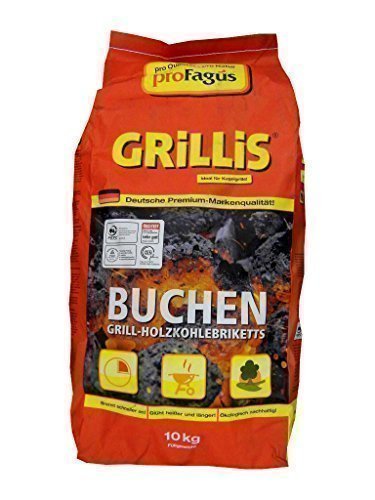
Calculated per kilo, using the Amazon price for Greek Fire and the prices from our price boxes for the others: Greek Fire €4.91, proFagus Grillis €3.00, Weber €3.75, McBrikett €3.13. Calculated for 10 kg, Greek Fire costs €49.10, proFagus €30, Weber by calculation €37.50 and McBrikett by calculation €31.25. Greek Fire is thus €19.10 above proFagus, €11.60 above Weber and €17.85 above McBrikett. At the manufacturer shop price, without shipping, it would be €2.99 per kilo.
What the premium over proFagus and Weber buys according to the manufacturer’s claims: a briquette without a starch binder and a longer stated burn time than Weber.
These three briquettes are the other options
| Product | Type and quantity | Price | Our score | Choose this if |
|---|---|---|---|---|
| Greek Fire Premium Grillkohle 10 kg (this one) | according to Greek Fire hardwood sawdust without binders, elongated with a central channel, 10 kg | approx. €49.10 | 8.9 | you want briquettes without a starch binder and accept the highest price per kilo in this selection |
| proFagus Grillis Sommerhit Briketts 10 kg | according to proFagus beech charcoal pieces bound with starch, 10 kg | approx. €30 | 9.4 | you want to look up the plant, seals (DINplus and PEFC according to proFagus) and wood origin, and accept starch in the briquette |
| McBrikett KOKOKO EGGS 8 kg | coconut shells instead of wood, egg shape, 8 kg | approx. €25 | 9.1 | you want to grill entirely without wood as a raw material |
| Weber Grillbriketts 8 kg | according to Weber carbonised wood with starch and water, pillow shape with grooves, 8 kg | approx. €30 | 8.5 | you want the wood species listed and can live with a shorter stated burn time |
The prices are guide values from our data sheets and change without notice. The scores are our editorial assessment based on manufacturer claims and price, not measurement results.
What Greek Fire does not state
On greekfire.de and in the Amazon catalogue (title and bullet) there is no information on these points as of 05.10.2026:
- Length, diameter and weight of a single briquette, number of pieces per 10 kg
- Proportions of oak, beech and the other hardwoods, country and region of the wood, production site
- Carbonisation of the shavings and the production process in detail
- The DIN standard behind the “DIN certification” (which applies in Germany), registration number, seals such as FSC or PEFC
- Quantity per grill session, consumption per hour
- Suitability for kettle grill, kamado, smoker, Dutch oven or tabletop grill (the carton in the photo has a partly covered line about grilling)
- Calorific value, moisture content, measured values for smoke and odour
- Reuse of partly burnt leftovers
- Storage notes and shelf life (the carton only mentions a storage option)
- Founding or market launch year of the company
The measuring point of the 400 °C, the conditions of the burn time and safety notes are described in the sections above.
When Greek Fire suits you and when another fuel is better
First the time budget. Getting the coals fully lit needs lead time: the manufacturer’s time figure ends at the ash-grey surface, after which the food still has to cook. If you want to be fed within an hour after work, factor in the 15 to 20 minutes of start-up time.
Then the style of grilling. Greek Fire names steak, fish and vegetables as uses, so short cooking times at strong heat. How briquettes and loose charcoal differ for other jobs is explained in the guide Charcoal or briquettes. For low and slow over many hours, the trial load with a clock from the burn time section helps more than any manufacturer figure, plus a reserve within reach.
Occasional grillers with little storage space are poorly served by Greek Fire: the manufacturer offers only this one pack size, and a 10 kg carton is a lot of material for a few sausages a year.
If you have to rely on a fixed date, for example at a party, order early and check the delivery date on the Amazon listing page.
At approx. €49.10, for the same quantity our choice would be the proFagus briquette: higher score (9.4 versus 8.9), lower price. The only argument against it is that it is bound with starch. If doing without binders matters to you, Greek Fire remains the choice over proFagus and Weber, and if the price drops close to €30, our calculation changes.