A bag of 8 kg briquettes, listed on Amazon under the number 17594, approx. €30 (as of September 2026). In our Fuel category it sits alongside proFagus, McBrikett and Greek Fire.
The manufacturer information comes from weber.com and was read on 14.10.2026: the product page of the 8 kg bag, Weber’s six-step lighting instructions and the pages of the other briquettes in the Weber range. The Amazon catalogue is added to that. We have not lit any bag. What is written below about embers and burn time is therefore either a statement from Weber or an inference from how a briquette is built, and each is marked as such.
Which bag is behind the Amazon number 17594
The Amazon catalogue lists the item as “Weber 17594 Grillbriketts 8 kg Beutel”. The manufacturer given there is “Weber Spain”, the country of origin is Spain, and the description is in Italian: “WEBER BRICCHETTI CARBONE KG.8 17594”, plus the line “Nuovi, meno fumo, più rapidi”, in English: new, less smoke, faster. Weber Germany lists the 8 kg bag under the number 17591 and gives the European Union as the country of manufacture.
The 17594 appears on none of the Weber pages we checked (Germany, Spain, Italy and Great Britain), and the German product pages do not link to Amazon. We therefore cannot prove that the Amazon bag has the same recipe and presentation as bag 17591. All manufacturer information in this text applies to bag 17591.
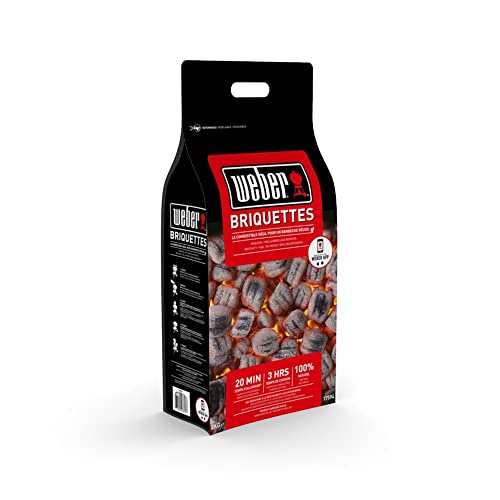
The catalogue photo shows a black bag with a red front panel. Printed on it are BRIQUETTES, the figures 20 MIN, 3 HRS and 100 % and a French advertising line, and the briquettes pictured have grooves. We cannot read a German line on the photo. Which presentation Amazon actually ships can only be settled by looking inside the box.
Two more catalogue values. The item weight is 8220 grams for a quantity of 8 kg, and the 220 grams are presumably the bag. And Amazon lists the shape as “block”, whereas Weber speaks of a pillow shape; we read this as a rough catalogue category.
What the briquettes are made of and where the wood comes from
Weber calls the briquettes charcoal briquettes made of carbonised wood, starch and water. Carbonised means turned to charcoal. We read this as meaning that charcoal is the starting material and is only then pressed into a briquette; Weber does not describe the process. The starch holds the charcoal crumbs together and burns along with them in the embers. According to Weber, the briquettes consist of 100 % natural ingredients and are made without the use of chemicals.
According to Weber, they are pressed at 50 tonnes so that the briquettes burn cleanly and produce less dust. The figure describes a pressing force, not a pressure. How much pressure results depends on the area the press acts on, and we do not know that. All that follows from the 50 tonnes is that the press is powerful, not that this briquette would be denser than one from another manufacturer.
Weber gives the briquettes an extra-large pillow shape with two grooves, which are meant to improve air circulation and speed up lighting. Weber contrasts the rectangular pillow shape with the egg shape of other manufacturers: the heat-producing surface is said to be significantly larger as a result. Our assessment: more surface area generally makes a briquette easier to ignite and makes it burn down faster. That Weber at the same time promises slow, even burning is a question of the density and size of the individual briquette.
Weber lists individually which wood is in them: hornbeam, beech, oak and birch from Poland and Ukraine, plus fruit woods from the same countries and raw material from agricultural plantations. In addition there is wood from Namibia (acacia, mopane and others), which according to Weber comes from FSC-certified management. Production takes place in the European Union. Weber lists two certifications: FSC (Mix) and DIN CERTCO.
In detail: lighting, embers and burn time
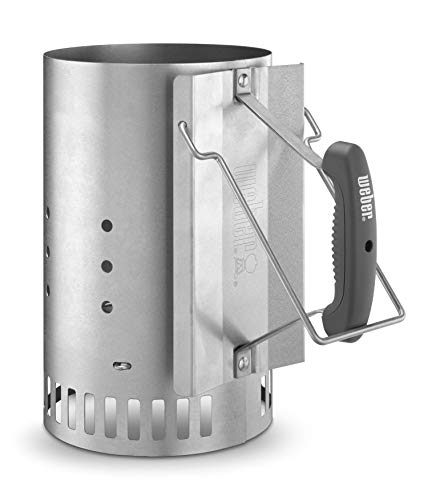
Weber’s instructions are written for the kettle grill of 57 cm. For that you need about 2 kg of briquettes, which corresponds to one large Weber chimney starter. Three firelighter cubes go on the charcoal grate and are lit, with the full chimney starter standing above them. Weber calls firelighter cubes the safe alternative to liquid lighters. We list a large Weber model in the category as the Weber Rapidfire large chimney starter.
A chimney starter is a metal cylinder with a grate. The flame underneath heats the air, which rises and draws fresh air in from below. This chimney effect brings the briquettes to a full glow before they go into the grill. Weber writes that they ash over quickly, safely and evenly this way, and that smoke production is lower than with other lighting methods.
With a full chimney starter, according to Weber, ashing over for up to 20 minutes is enough. You are meant to recognise the moment by the top layer of briquettes: slightly whitish, but not yet fully covered in ash. Then the briquettes go carefully into the grill and are spread evenly over two charcoal baskets or the charcoal grate. While grilling, the vents on the lid and bowl are meant to be open.
The product page also lists “Ready to grill in just 20 minutes” as a feature, without a condition. That is a different statement from ashing over in the chimney starter, because transferring and spreading still follow. In addition there is Weber’s warning to put food on only once the briquettes carry a layer of ash (wording further below). We therefore read the 20 minutes as the time until transfer and would allow more until the first food goes on. Weber supplies no figure for this. By way of comparison: in a general guide to the chimney starter, Weber writes that after 15 to 30 minutes the charcoal has a white layer of ash; this applies to charcoal in general, not to these briquettes.
On ember duration the same thing is stated in three places: “up to three hours of strong embers” in the description, “Burn time: 3 hours” in the feature list and a duration of up to three hours in the instructions. “Up to” is an upper limit. Weber gives the three hours in the grilling step of the instructions for the 57 cm kettle grill, where about 2 kg were specified beforehand, but does not explicitly link them to this quantity. A temperature and a measuring method are missing.
How long a fill lasts depends in principle on the quantity and on the air. Vents opened wide give the embers a lot of oxygen, and what gets a lot of oxygen burns down faster. If you close the vents partly, you lengthen the ember duration and lower the temperature. Weber’s instructions specify open vents for grilling, and the ember duration is given there without a condition. Our guide Charcoal or briquettes sets briquettes and lump charcoal side by side, and if a fill does not ash over fully, the causes in the guide Charcoal will not light properly help.
Is the 8 kg bag worth it, or are 3 or 4 kg enough?
Per kilo yes, at least in the Weber shop: there a kilo in the 8 kg bag costs €2.50, in the 4 kg bag €2.87 and in the 3 kg bag €3.16 (as of 14.10.2026, each plus shipping).
Behind that are the bag prices of €19.99 (8 kg, item 17591), €11.49 (4 kg, item 17590) and €9.49 (3 kg, item 17705). Shipping is free from an order value of €49, otherwise it costs €4.90. For a single order the 8 kg bag therefore comes to €24.89, around €3.11 per kilo. On 14.10.2026 it was marked as out of stock in the Weber shop, with a “Notify me” button instead.
On Amazon the bag costs approx. €30, which is €3.75 per kilo and around €10 more than in the Weber shop. Whether the bag at Amazon is the same as in the Weber shop remains open.
How quickly a bag is empty depends on the grill. If you take the 2 kg per fill from Weber’s instructions as a basis, an 8 kg bag works out arithmetically (our division) to four fills, and one fill costs about €7.50 at Amazon.
If you want no wood in the briquette, you will find coconut briquettes in the Weber range: 4 kg for €12.99 (€3.25 per kilo, item 18401). According to Weber they consist of coconut shells, candle nut shells and tapioca starch from Indonesia and contain no wood.
Which other briquettes come into question?
| Product | Type and quantity | Price | Our rating | Pick this if |
|---|---|---|---|---|
| Weber Grillbriketts 8 kg (this one) | according to Weber carbonised wood, starch and water, pillow shape with two grooves, 8 kg | approx. €30 | 8.5 | you need lighting time and ember duration as a manufacturer figure and can live with starch as a binder |
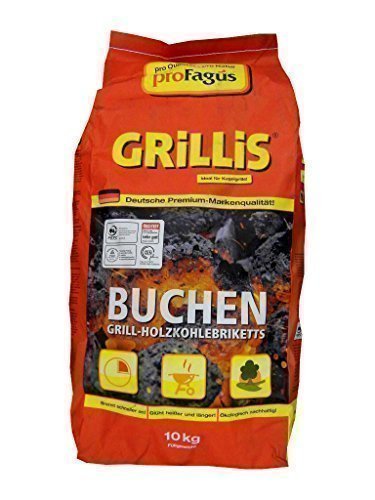
| proFagus GRiLLiS 10 kg | according to proFagus beech charcoal, bound with food-grade starch, 10 kg | approx. €30 | 9.4 | you want 2 kg more for the same bag price (around €3.00 per kilo) and can do without the manufacturer’s minute and hour figures |
| McBrikett KOKOKO EGGS 8 kg | according to McBrikett coconut shells in egg shape, 8 kg | approx. €25 | 9.1 | you want to grill entirely without wood, at around €3.13 per kilo |
| Greek Fire Premium Grillkohle 10 kg | according to Greek Fire hardwood sawdust, without binder, 10 kg | approx. €49 | 8.9 | you are looking for briquettes without a starch binder and pay around €4.91 per kilo for it |
We calculated the prices per kilo from the guide prices in our data sheets, and these guide prices change without warning. The rating is our editorial assessment based on manufacturer information and price; none of the four figures contains a measurement of our own of embers or burn time. At the same bag price of approx. €30, proFagus supplies two kilos more than Weber, and Weber has the lowest rating in this table.
Bag, storage and safety notes in their exact wording
Weber fills the briquettes into a waterproof, resealable bag made of recycled material with a zip closure and carry handle. Inside it is laminated with aluminium, which according to Weber prevents moisture from getting in. Weber gives the dimensions as 64.5 cm high, 17 cm wide and 28.5 cm deep. Damp briquettes generally light worse, so the sealed bag is not a mere packaging detail.
On 14.10.2026 the product page of the 8 kg bag carries the following notes. We reproduce them in full and in their original wording (translated from German), ordered by topic:
- “For outdoor use only.”
- “Do not burn or let briquettes burn out in enclosed spaces, only outdoors. Risk of carbon monoxide poisoning.”
- “Do not use highly flammable liquids, e.g. methylated spirits or petrol, for lighting or relighting!”
- “Do not breathe in the smoke when lighting.”
- “Keep sensitive people away from the smoke.”
- “Only put food on the grill once the briquettes / charcoal have a layer of ash.”
- “Always wear heat-resistant grill gloves when operating your grill.”
- “You will find instructions and further information in the user manual of your grill.”
- “Keep out of the reach of children.”
- “Store in a dry place and protect from heat and open fire.”
- “Always store separately from heat-generating appliances and other fuel containers.”
- “Closed grill: put the lid on the grill and close all openings of the bowl and the lid.”
- “Open grill: wait until the embers have gone out and are cold. Only then dispose of them.”
Two remarks from us, expressly as our reading. In our view, “heat-generating appliances and other fuel containers” covers heaters and gas bottles; Weber gives no examples. And relighting is expressly included in the ban on liquid lighters: if the embers have gone out, the same rules apply for the second start as for the first.
What Weber does not state
On these points we found nothing on the Weber pages and in the Amazon catalogue on 14.10.2026:
- a calorific value in MJ/kg and a density as a figure (Weber speaks of “high calorific value” and “very high material density”)
- ash, carbon and moisture content as well as the starch share in percent
- weight, dimensions and number of the briquettes in the bag (the 64.5 x 17 x 28.5 cm belong to the bag)
- an ember or grate temperature
- an explicit link between the three hours and the quantity and grill type, measuring method
- an ash-over time without a chimney starter and the condition behind “Ready to grill in just 20 minutes”
- dust and smoke as a measured value (“less dust” and “clean combustion” stand there without a figure, “meno fumo” only in the Italian Amazon description)
- a shelf life or storage period, also for opened bags
- the shares of the individual woods and of the plantation raw material
- certificate numbers and the standard checked behind FSC and DIN CERTCO
- the exact production site (Weber Germany: European Union, Amazon: Spain)
- a quantity for grills other than the 57 cm kettle grill and a statement on tabletop grills, kamados, smokers and grill carts
- a statement on the balcony
- warranty, guarantee or recall notes
- whether the Amazon bag 17594 has the same recipe as bag 17591
The most serious point, in our view, is the missing explicit link between the three hours and the quantity. Without it, the figure can be transferred neither to your grill nor to another briquette.
Who the Weber briquettes suit, and when another fuel is better
The Weber briquettes suit a clearly defined case: a kettle grill of around 57 cm, a chimney starter to hand, grilling evenings of up to three hours. For that, Weber has written down the quantity and lighting method and states times that you have to read as upper limits (up to 20 minutes to ash over, up to three hours of embers); the time until the first food goes on you have to allow for yourself, as Weber gives no figure for it. That is the advantage over proFagus, where minute and hour figures are missing.
Whether 8 kg suits you is decided by your consumption. One bag lasts for four fills. If you use fewer than four full fills per season, you keep an opened bag for which Weber names no storage period. In that case the 4 kg bag from the Weber shop (€11.49) is the better choice, even if its price per kilo is higher.
If you have to plan the quantity by number of pieces, these briquettes are the wrong choice. With a Dutch oven you set the heat via the number of briquettes on the lid and pot, and for that you would need to know what a single briquette weighs. Weber does not say. It is similar with searing steaks, where the ember temperature matters: for the Premium charcoal Weber gives a temperature, for the briquettes none.
Weber does not have tabletop grills, kamados and smokers in view in the instructions. A tabletop grill holds less than a 57 cm bowl, so you have to scale the 2 kg down yourself, and for kamados and smokers the information from the respective grill manufacturer also applies.
If you look mainly at the price per kilo, Weber via Amazon is not in front: in the table two of the three alternatives are cheaper per kilo. If you want no wood in the briquette, take McBrikett, if you want no starch binder, Greek Fire. You stay with Weber if you light according to Weber’s instructions anyway and need the manufacturer times as a planning basis.