A sheet-metal cylinder, a cone-shaped grate at the bottom, two handles on the side, no cable: there is not much more to the large Rapidfire chimney starter from Weber. It brings charcoal or briquettes to glowing embers before they go into the grill, and costs approx. €24 (as of September 2026). In our Fuel category it is one of two lighting devices; the rest there is charcoal, briquettes, pellets and smoking chips.
Weber advertises that lighting works “completely without lighter fluid”. You still cannot do entirely without a lighting aid: firelighter cubes or some newspaper belong under or in the chimney starter.
Our information comes from Weber’s German and British product pages, the single-page instructions, Weber’s support centre, guide pages and a brochure from the manufacturer, and the Amazon catalogue. We have not handled the chimney starter. Where Weber’s sources contradict each other, and that happens several times here, the figures are shown side by side.
Item 7416 and its dimensions
Weber lists the large Rapidfire under item number 7416. The same number appears in the Amazon catalogue as the model, so the price box behind our listing is this chimney starter and not the small one with number 7447. The supplier in Germany is Weber-Stephen Deutschland GmbH in Ingelheim.
Weber gives the size as 32 cm height, 20.5 cm width and 32.5 cm depth. Under “packaging size” the same page shows exactly the same three values. Amazon lists 12.5 × 12.7 × 8.1 inches, converted 31.8 × 32.3 × 20.6 cm, so within a few millimetres of Weber’s figures.
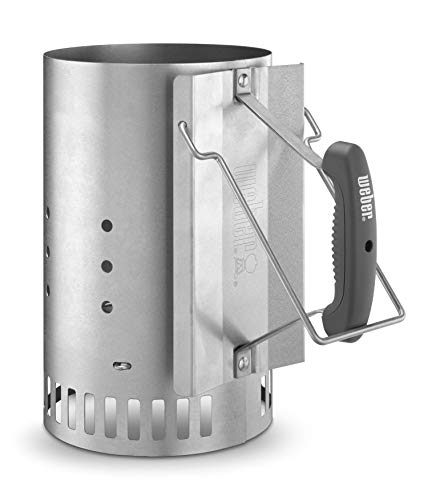
The product photo shows a round cylinder. A flat plate is attached to its side, and in front of it, on a wire bracket, hangs the dark grey handle, which sticks out noticeably. We read the photo as meaning that cylinder and handle together make up the depth. We do not calculate a volume from such envelope dimensions, especially since Weber itself gives one.
The Amazon record also has a second size field with 19 × 19 × 30.5 cm, which fits neither Weber nor the inch values next to it. We go by Weber. The weight comes from the same record: 3.01 lb, around 1.4 kg.
What the Rapidfire is made of
The cylinder is made of aluminised steel. Amazon writes “aluminised”, Weber’s page for the lighting set “aluminium-coated”; each time it means sheet steel with an aluminium coating. In principle, such a coating protects the steel underneath from rust as long as it remains undamaged.
With the handles Weber is more precise than with the rest. The side one is thermoplastic, the upper one wire, and to pour out you take, according to the German product page, the thermoplastic handle in one hand and the wire handle in the other. The British page calls the second handle a folding helper handle (“flip-up helper handle”) with which you pour out the coals with both hands. A heat shield also sits on the side handle, which according to Weber UK reduces heat transfer to the handle. Reduces, not prevents.
At the bottom lies a cone-shaped grate. The German product page credits it with making the briquettes light quickly and evenly; the British page supplies the reason: the cone shape enlarges the surface of coal that the flame reaches. Below it, according to Weber UK, is a large, ventilated chamber for the lighting aid. In the photo you can see a ring of rectangular slots at the base and, higher up in the wall, a vertical row of small holes.
In detail: how the chimney draught glows the coal through
A chimney starter works like a short chimney. The flame under the grate heats the air in the tube, warm air is lighter than cold air and rises, and fresh air flows in at the bottom. Weber describes it as the hot air being “drawn upwards by a resulting negative pressure”. How strong this draught is depends on the height of the hot air column and its temperature difference from the outside air. In the tube the coal lies tightly packed and high, so the glow travels from the bottom to the top through the whole fill. On a flat heap in the grill this column is missing, and the fire creeps sideways only slowly.
That is where Weber’s advice to ensure “maximum ventilation” comes from. If you block the slots at the base, you take away the chimney starter’s draught. The page on Weber briquettes also says that smoke development with the chimney starter is lower than with other lighting methods.
Charcoal and briquettes behave differently in the chimney starter. According to the product page, briquettes need “a little more time to glow”, release less heat and burn out later in return. That fits the design: a briquette is pressed from coal dust and binder and is denser than a naturally grown piece of charcoal, so oxygen reaches its core more slowly. What else separates the two fuels is covered in the guide Charcoal or briquettes.
How long the glowing through takes, Weber answers in five places in five different ways:
- Product page of the chimney starter: charcoal approx. 20 minutes, briquettes approx. 40 minutes
- Brochure “Rat & Tat” (2019), chimney starter completely full: Weber charcoal approx. 15 minutes, Weber briquettes approx. 20 minutes
- Page on Weber briquettes, also a full chimney starter: starting to glow takes up to 20 minutes
- Guide article on the chimney starter: 15 to 30 minutes until a white ash layer forms
- Support centre: about 10 to 15 minutes, depending on the weather
The two short briquette values apply to Weber’s own briquettes in a brim-full chimney starter. For briquettes from other manufacturers we would plan with the longest figure, that is, 40 minutes.
Whether the fill is ready is in any case better shown by colour than by the clock. Step 3 of the instructions (below) ties it to the ash layer on the top briquettes. The briquette page wants the upper layer “slightly whitish” but not yet completely covered with ash, and the support centre is satisfied if the topmost coals turn a little grey.
Is one full Rapidfire enough for a 57 cm kettle grill?
Yes. For a kettle grill of 57 cm, Weber reckons with about 2 kg of briquettes and expressly adds that this corresponds to a large Weber chimney starter.
According to the British Weber page, the Rapidfire can hold 6 litres, around 2.5 kg of standard charcoal briquettes, and the Amazon text gives the same values. The German product page is vaguer. There the cylindrical container offers room for enough charcoal “to fill your kettle grill with”, and it should be filled “at most to the brim”.
A brim-full chimney starter therefore covers the 57 cm grill with some reserve, although Weber gives both values rounded. With loose charcoal the same fill weighs less, because the pieces lie irregularly and are lighter than pressed briquettes.
For the 47 cm grill Weber gives no quantity. The support centre gives a rule that works for any grill size: fill to the top, and for less food use less coal. For a 47 cm grill that means, in our view: fill according to the amount on the grate rather than reflexively to the brim.
What Weber’s instructions prescribe
The German instructions are a single sheet headed “Warnings for the Rapidfire chimney starter”. It describes the procedure in three steps:
- “Place one to two firelighter cubes on the charcoal grate of the grill” and light them. If there are no cubes, “if necessary push 2 crumpled sheets of newspaper into the chimney starter from below”.
- “Place the chimney starter, filled with the required amount of charcoal briquettes, over it.”
- As soon as the top briquettes “are covered with a white-grey layer of ash”, lift the chimney starter by both handles with grill gloves and “carefully spread the glowing briquettes on the charcoal grate for the direct or indirect grilling method”.
There are also fourteen warnings. We reproduce them in full and verbatim; we added the numbers:
- “Intended for outdoor use only.”
- “Do not use petrol, lighter fluid or alcohol in the chimney starter.”
- “Do not use impregnated charcoal.”
- “Always wear grill gloves when handling the chimney starter.”
- “Only use the chimney starter if it stands firmly and level on the charcoal grate.”
- “Do not use the chimney starter in strong wind.”
- “Do not wear loose clothing with wide sleeves when lighting or using the chimney starter.”
- “Do not use the chimney starter for cooking or warming up food.”
- “When emptying the hot pieces of coal from the chimney starter, watch for glowing sparks.”
- “Do not use the chimney starter with a table-top grill or small, portable charcoal grill.”
- “Only use the chimney starter if the grill stands on a safe, level, fireproof surface.”
- “Always keep children and pets away from the chimney starter.”
- “Only use the chimney starter to light charcoal briquettes for charcoal grills.”
- “Only place the chimney starter on a surface that is not fireproof once it has cooled down completely.”
Two handling points appear elsewhere. According to the support centre, before lighting you take out the cooking grate, because the chimney starter belongs on the charcoal grate beneath it (point 5). And the briquette page advises resting the metal handle of the full chimney starter on the rim of the grill.
Point 13 speaks only of charcoal briquettes. According to the product page, however, the chimney starter is suitable “for both charcoal and grill briquettes”, and it gives a separate time for each. We therefore do not read a ban on loose charcoal into the instructions.
Weber is also inconsistent on the cubes: one to two according to the instructions, three according to the briquette page and brochure, two to three according to the page for the lighting set. Even the position changes. The instructions and support centre put the cubes on the charcoal grate under the chimney starter; Weber’s guide article places firelighter cubes, wood-wool lighters, newspaper or kitchen paper in the lower part of the chimney starter. When in doubt, we go by the instructions, because they are the document that belongs to the product.
What a fill costs
According to the product page, the Rapidfire works best with firelighter cubes. In the Weber shop on 1 October 2026, two packs were listed in the Lighting category: 48 pieces for €4.79 (item 17612) and 22 pieces for €4.49. That puts one cube at around 10 or around 20 cents, depending on the pack.
According to Weber, the 48 cubes are made of wood, including pine, larch, fir and spruce from Poland, and are “free of additives”. Newspaper, which the instructions name as an emergency solution, costs nothing.
The bigger item is the coal anyway: for the 2 kg that Weber assumes for the 57 cm grill, our benchmark figures for the GRiLLiS (approx. €30 for 10 kg) give around €6, and for the Weber grill briquettes (approx. €30 for 8 kg) around €7.50 per fill.
What sits next to the Rapidfire in our catalogue
We do not list a second chimney starter. Next to the Rapidfire there are therefore an electric device that can replace it and two types of briquette you fill it with.
| Product | Type and quantity | Price | Our rating | Choose this if |
|---|---|---|---|---|
| Weber Rapidfire chimney starter, large (this one) | Chimney starter made of aluminised steel, 6 litres according to Weber UK | approx. €24 | 9.1 | you want to light around 2 to 2.5 kg of coal at once |
| Looftlighter Original | electric lighter, according to the Amazon catalogue an “electric grill and stove lighter” | approx. €99 | 8.8 | you have a socket at the grilling spot and want to manage without a chimney starter and cubes |
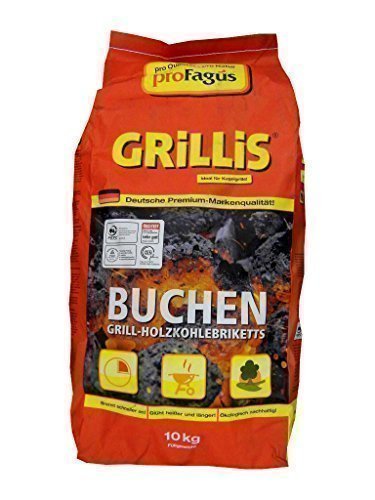
| proFagus GRiLLiS briquettes 10 kg | Beech charcoal briquettes, bound with starch according to proFagus, 10 kg | approx. €30 | 9.4 | you already have a chimney starter and are looking for the fuel in a large bag |
| Weber grill briquettes 8 kg | Charcoal briquettes, 8 kg, up to 3 hours of grilling time according to Weber | approx. €30 | 8.5 | you want to take over Weber’s minute and quantity figures without converting |
The prices are the benchmark figures from the data sheets of the respective pages; at the retailer they change constantly. The rating is our editorial assessment based on manufacturer information and price; we have not measured anything ourselves on any of the four products. Self-lighting briquettes are missing here on purpose; you will find the reason in the questions below.
What Weber does not state
Our search on 1 October 2026 covered Weber’s German and British websites including the shop and warranty page, the instructions, the support centre and the Amazon catalogue. The following turned up nothing:
- a weight from the manufacturer itself
- the diameter of the cylinder
- the thickness of the sheet metal, the material of the cone grate and the type of aluminising
- a temperature up to which the metal and the thermoplastic handle are rated
- a fill quantity in kilos for loose charcoal
- how long the embers last after transferring
- notes for rain and wet conditions; the support centre only mentions that firelighter cubes also burn in the rain
- minimum distances from house walls, flammable objects or people
- care instructions for the individually sold chimney starter
- a warranty period specifically for the chimney starter
- handle, heat shield or grate as a spare part
- a list of what is in the box
- the country of manufacture
- a launch date; Amazon lists 9 February 2008 as the release date
What we miss most is the temperature limit for the plastic handle. When pouring, a chimney starter full of embers hangs from it, and your hand holds it.
When the large Rapidfire fits, and for whom it does not
First the grill decides. For the 57 cm grill the quantity question is answered above; for smaller grills Weber offers the small Rapidfire chimney starter (dimensions and price in the questions below).
Then the waiting time. For sausages after work we would fill in loose charcoal, for a long evening briquettes.
If you only have a gas grill, you do not need the chimney starter at all: point 13 restricts it to charcoal grills.
You should also plan a place where the hot chimney starter can stand after pouring out until it has cooled down completely, because before that, according to point 14, it must not go on any surface that is not fireproof. If you do not yet own a charcoal grill, choose it first in the Grill Finder; we would buy the Rapidfire only afterwards, in the size that suits that grill.