What is behind the name Original
On this page the device is called Looftlighter Original, as our catalogue lists it. The manufacturer Looft Industries does not use this name for any of its devices. Today it sells the Looftlighter Classic and describes it in the EU shop as the original electric fire starter. In the manual the device is called Looft Air Lighter 1, and in the warranty section of the manual Looft Lighter I.
Looft does not prove that our ASIN B000WYY65Y is exactly this device: no manufacturer page links to an Amazon ASIN, and Looft sells directly through its own shops. We still assume it is the same device. The Amazon listing is called Looflighter Elektrogrill- und Herd-Feuerzeug (spelled that way, without a t, in the catalogue) and gives model number 70018, part number 9995500 and dimensions of 19 x 3 x 2.2 inches, so around 48.3 x 7.6 x 5.6 cm. Looft gives 49 x 7 x 7 cm for the Classic, so the order of magnitude fits. The American Amazon page for the same ASIN is titled Looftlighter Classic.
Looft Industries gives 2004 as its founding year, when Richard Looft invented the Looft Lighter. According to the company page, the occasion was a failed barbecue for his daughter’s ninth birthday in 1997, at which the chicken tasted of lighter fluid. The company page describes the first experimental set-up like this: charcoal in a toaster, plus a vacuum cleaner blowing in reverse. A few years later, according to the same page, Richard Looft stood in the port of Stockholm in front of a container with 5000 units of his invention, ready to ship around the world, and according to Looft the device is now sold in more than 30 countries. According to the manual, it is made in China.
We have not handled the device and have not lit anything with it. Our basis is the Looft shops for the EU, the USA and the United Kingdom, including the company, warranty, Q&A and tips pages (as of 6 October 2026), the multilingual manual Looft Air Lighter 1 Operators Manual, the Amazon catalogue entry and the product photo.
Will the Amazon device run on your power socket?
Manufacturer sources cannot settle this. Looft builds a 230 volt version with 1800 watts for Europe and a 120 volt version with 1500 watts for North America, and the Amazon listing names neither voltage nor wattage, only the model number 70018.
The manual lists the two versions under separate headers (Europe: 1800 W, 230 V, 50 Hz; North America: 1500 W, 120 V, 60 Hz). According to the manual, the Looft lighter is not a dual-voltage device, so each device is built for exactly one voltage. On the title page of the manual, the Europe line shows symbols for TÜV SÜD, GS, CE, a double square (the usual mark for protection class II) and separate disposal of electrical devices; we have not seen a test certificate. The North America line, by contrast, shows an ETL mark, which does not apply in Germany. As a general rule, a 120 volt device does not belong on a 230 volt socket, and a plug adapter does not change the voltage.
Before you order: look for the voltage information in the Amazon listing and check who is delivering. If it says 120 volts or nothing at all, ask the seller.
Technical data, and where Looft contradicts itself
The European version has 1800 watts at 230 volts and 50 hertz. According to the EU product page, the mains cable is 3 m long. For weight, three figures stand side by side: 2 pounds (around 0.9 kg) in the Amazon catalogue, 2.6 lbs (around 1.2 kg) on the US site and 1 kg in the EU shop, which is the authoritative one for the EU version.
On temperature, Looft contradicts itself. The manual gives 650 °C for Europe and 1200 °F for North America; converted, that is the same temperature, so the manual is consistent in itself. The EU shop’s product page and its comparison table, however, give 700 °C. The US site has three values: 1100 °F in the data, 1200 °F after 60 seconds in the promotional text and 1300 °F on the comparison page, which by our conversion is around 593, 649 and 704 °C. Our range for the EU version: 650 to 700 °C.
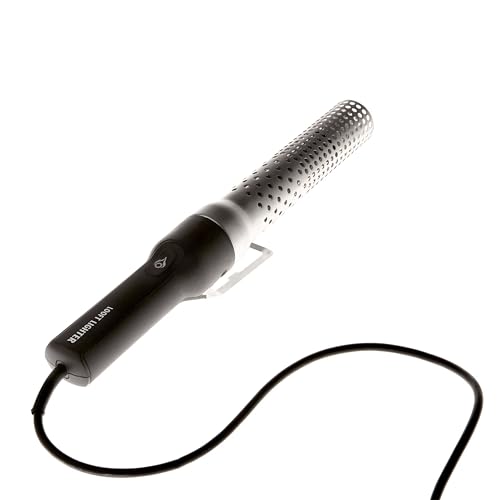
The product photo shows a silvery, perforated tube at the front, behind it a black handle with a round button and the cable at the rear end; a transparent holder sits between the handle and the tube. The handle bears the lettering Looft Lighter. Looft describes an on/off switch and a stand with a bottle opener; the US site puts the opener in the base. According to the EU shop, the Classic comes with the device and the operating instructions. After use, according to the US product page, the safety housing cools down within seconds. You are better off treating the tip like a hot component.
The following are missing from the Looft pages and the manual that we reviewed:
- Materials of the housing, tube, stand and cable (only an aluminium heat shield is documented)
- Overheating and tip-over protection for the Classic (the circuit breaker is listed only for the Pro and the X)
- Ingress protection rating (IP)
- Noise level, speed and motor type
- Time until the hot air is available, and breaks for cooling down
- The temperature of the tip after use (Looft says only that the safety housing cools down in seconds)
- Distances to combustible materials, balcony use, wind influence and carbon monoxide
- A relation between grilling time and the amount of charcoal
- Information on individual charcoal and briquette brands and on compatibility with self-igniting briquettes
- Spare parts for the Classic apart from the carry case
- The year of market launch (the Amazon catalogue gives only the date of its listing, 6 November 2016)
- How damp the cloth may be for cleaning (the tips page says “damp”, the manual wants no moisture)
- A warranty note on a melted heat shield on the German tips page (it appears only on the US site)
In detail: How a jet of hot air lights charcoal
Our explanation of the principle: charcoal does not catch with a flame the way wood does, it smoulders. One spot has to get hot enough and get air, and then the embers spread from there. With a chimney starter, a firelighter under the charcoal and the draught in the shaft do this. The Looftlighter brings heat and airflow in one jet, generated electrically.
The manual (German part, page 25) gives the procedure in three steps:
- Build a pile of charcoal, wood chips or logs, touch it with the tip and press the button.
- When there are sparks or embers, pull the tip back a few centimetres so the heat can spread.
- Keep it aimed at the same spot for about 60 seconds.
All of Looft’s times are self-reported without measurement conditions. The US product page states them most precisely: hold the tip to the charcoal for about 10 to 15 seconds, then carry on for at least one minute and for another 3 to 5 minutes until charcoal or briquettes are ready to grill. The 10 to 15 seconds are therefore the time to the first sparks, not to charcoal that is burning through. The German Q&A says: start in 60 seconds, grilling after about 5 minutes. 60 seconds plus 3 to 5 minutes gives 4 to 6 minutes, which fits.
Looft’s tips page gives four tips. Do not press the tip onto one large lump of charcoal, but hold it where two pieces meet. Start with small pieces. After lighting, keep holding it on the same spot and listen for the sound Looft calls the swoosh. And to heat up with the lid closed, hold the tip to the vent hole and press the button.
Which charcoal the Looftlighter handles
The EU shop names charcoal, briquettes and logs. Looft recommends lump charcoal with larger pieces, with fewer sparks and a more even temperature. According to Looft, briquettes consist of charcoal powder bound with corn starch. The lighting time can be somewhat longer, the corn starch smokes when lighting, and more densely compressed briquettes burn longer. How charcoal and briquettes differ beyond lighting is covered in our guide Charcoal or briquettes.
The places of use that Looft names are wide ranging; the list is in the FAQ below. Gas and electric grills are not on it: there is no charcoal to light there.
Safety and care according to the manual
We give the notes in paraphrase; the manual itself is authoritative (German part, pages 21 to 26). It covers electricity, moisture, children and explosion risk. According to the manual, anyone who does not follow the safety notes risks electric shock, fire or serious injury.
On electricity and moisture:
- The plug must fit the socket and must never be modified.
- Avoid body contact with earthed parts such as pipes, radiators, cookers and refrigerators, otherwise the risk of electric shock rises.
- Do not use the cable for carrying, pulling or unplugging, and keep it away from heat, oil, sharp edges and moving parts. Damaged or tangled cables increase the risk of electric shock.
- Outdoors, use an extension cable approved for outdoor use. This point is on page 23 of the German part; it is missing on page 5 of the English part.
- Do not expose the device to rain or moisture, because of the risk of fire and electric shock. Water getting in increases the risk of electric shock.
- Store it indoors and do not leave it lying outside; the tips page adds: dry and cool.
On surroundings and person:
- Keep the work area clean and well lit, because clutter and darkness lead to accidents.
- Do not use it in an explosive atmosphere, for example near flammable liquids, gases or dusts.
- Keep children and bystanders away while the device is in use.
- Stay alert and do not use the device when tired or under the influence of drugs, alcohol or medication.
- Do not become careless out of habit: according to the manual, a fraction of a second is enough for serious injury.
On use, care and delivery:
- Unplug before making adjustments, changing accessories and storing.
- Store unused devices out of the reach of children; anyone unfamiliar with the device or the instructions must not operate it.
- Watch for misalignment, blocked moving parts, breakage and other defects.
- Do not use it if the device is not fully assembled or parts are missing or damaged.
- Do not modify the product and do not make accessories that are not recommended; such interventions count as improper use.
- On delivery, check for transport damage and do not throw away the packaging until the device has been checked and successfully put into operation. For missing or damaged parts, the manual names Looft support as the contact.
For cleaning, the German tips page says: wipe with a damp cloth from time to time, use no cleaning agents. The manual at the same time wants the device not exposed to moisture. Our recommendation, which does not come from the manual: unplug first and wring the cloth out well.
Price, warranty and accessories
On Amazon on 6 October 2026, only marketplace sellers offered the Looftlighter, from approx. €99. In Looft’s EU shop the Classic costs €79.99 on 6 October 2026, and shipping is free over €100. The Amazon offer is therefore around €19 above the price in the Looft shop.
According to Looft, the warranty for the Classic lasts three years from the date of purchase and covers workmanship or material defects (EU product page and manual p. 22); according to the warranty page, devices made in 2017 or earlier only get two years. According to the manual, excluded are defects outside normal use and malfunctions caused by improper use, misuse, negligence, alteration, modification or repair; it applies only to the original retail purchaser and is not transferable. According to the warranty page, it applies only to private or household use, requires use in line with the instructions and lapses on any alteration of the product. Scratches, normal wear and the natural fading of colours and materials are excluded. There is also the condition that you bought from an authorised retailer; whether a purchase through Amazon counts is addressed in the FAQ.
As an accessory, the EU shop lists the carry case Case for Looftlighter for €29.99, waterproof according to Looft, with a strap and fitting the Classic and Pro.
Running costs are electricity and charcoal. We calculate the electricity costs ourselves: 1800 watts is 0.03 kilowatt hours per minute at full load. At an assumed electricity price of 35 cents per kilowatt hour, one minute costs around 1 cent, and even five minutes of continuous operation would come to around 5 cents.
What else is worth considering?
| Model | The difference | Price | Our rating | Choose this if |
|---|---|---|---|---|
| Looftlighter Original (this one) | Hot air lighter with 3 m cable, voltage of the Amazon listing unclear | approx. €99 | 8.8 | you have a power socket at the grill spot and want to save the wait at the chimney starter |
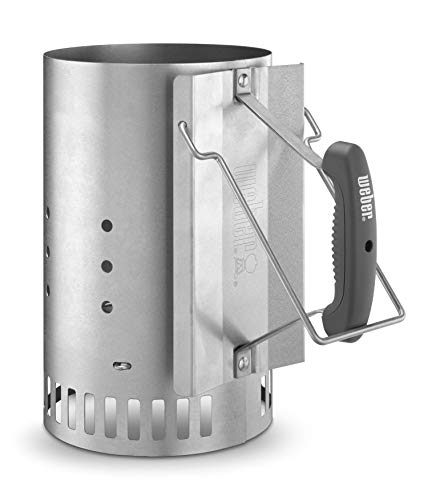
| Weber Rapidfire large chimney starter | Chimney starter without electricity | approx. €24 | 9.1 | you have no power at the grill spot or want to spend little |
| proFagus Easy-Lite 3.3 kg | Briquettes instead of a device, 3.3 kg pack | approx. €10 | 8.7 | you only grill occasionally for a small group |
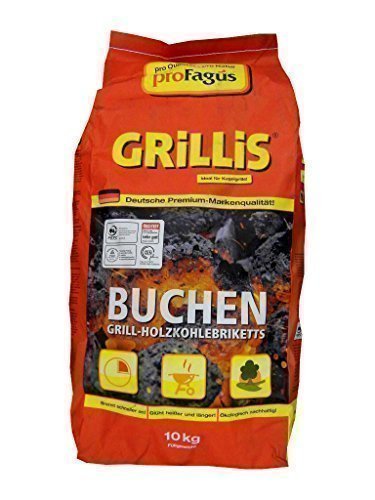
| proFagus Grillis Sommerhit briquettes 10 kg | Fuel instead of a lighter, 10 kg | approx. €30 | 9.4 | you need 10 kg of briquettes at once and solve the lighting separately, for example with a Looftlighter |
The prices are guide values from our individual reviews, not daily prices. The rating is an editorial assessment, not a measurement result, and a fuel can only be compared roughly with a lighter. More lighters and fuels are in the category Fuel, and an overview is in our Best fuel list.
When the Looftlighter, when a chimney starter or briquettes?
The power socket decides first. According to Looft, the Classic is a device with a 3 m cable. Our calculation: 1800 watts at 230 volts is around 7.8 amperes, and a usual 16 ampere circuit can carry that, as long as no other large consumers are connected to it. Without power at the grill spot, the Weber Rapidfire large chimney starter remains.
The Weber Rapidfire costs approx. €24, the Amazon offer for the Looftlighter approx. €99, so the premium is around €75. In return, Looft calculates about 5 minutes to grilling for itself and 15 to 25 minutes for the charcoal chimney. Our assessment: if you light up well ahead anyway, you will hardly notice the minutes saved; if you start on a whim and have guests waiting, you will.
If you only grill occasionally for a small group, you need no device at all. A small pack of briquettes such as the proFagus Easy-Lite 3.3 kg costs approx. €10; how to light them is on the pack. The Looftlighter is paid for once and then lights charcoal and briquettes, for example the proFagus Grillis Sommerhit briquettes 10 kg, as far as Looft’s statements on briquettes in general apply. The lighting instructions on the briquette pack take precedence.
If you want to be sure of the 230 volt version, order the Classic from Looft’s EU shop.
The Looftlighter does not solve the balcony problem either: it takes the flame away from lighting the charcoal, not the glowing afterwards, and whether charcoal is allowed on your balcony is governed by house rules and your tenancy agreement. We would buy it if a power socket, a 230 volt offer and regular grilling come together.