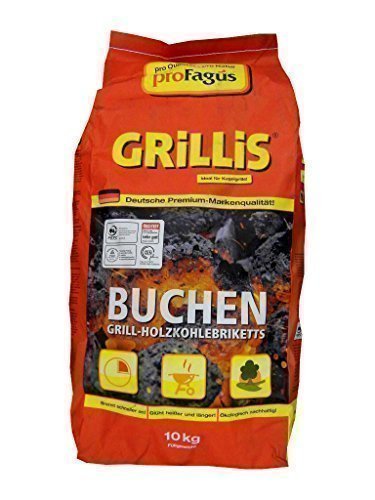
Ten kilos of beech barbecue charcoal briquettes, made by proFagus in Bodenfelde in Lower Saxony. On Amazon the bag costs approx. €30 (as of September 2026). The manufacturer calls the product GRiLLiS, with two small i’s, and that is what it is called in this text too. In our Fuel category, it sits alongside coconut briquettes, pellets, smoking chips and firelighters.
The product details for the GRiLLiS come from profagus.de, from the Amazon catalogue and from the online shop that the address shop.profagus.de redirects to. According to its legal notice, this shop is operated by TPS-Printing GmbH, and its product pages name proFagus as the manufacturer. What we write about the three comparison products, we read on the respective brand’s own pages. We have not lit a single bag. What you read below about embers and burn time is therefore either a statement from proFagus or an inference from how a briquette is built.
GRiLLiS and DER SOMMER HIT: two products in one Amazon title
The catalogue title on Amazon ends with “Briketts Grillis Sommerhit Grilli”. That puts two different goods in one line. At proFagus, DER SOMMER HIT is loose beech barbecue charcoal, according to the manufacturer coarse-grained and without hard-to-ignite small particles and dust. GRiLLiS are briquettes.
Which of the two is sold under the ASIN B00XK8S0LK is shown by the product image: an orange bag with the GRiLLiS lettering, below it “Buchen Grill-Holzkohlebriketts” (beech barbecue charcoal briquettes) and the quantity 10 kg. As item weight, the catalogue lists 23.15 pounds, converted 10.5 kg, which fits the quantity plus packaging.
This design is older. For 2026, proFagus shows the GRiLLiS in a new design, and which version Amazon ships, or whether the briquettes have changed along with the design, is clear from neither the catalogue nor the manufacturer’s information. The manufacturer image shows the new 3 kg and 7 kg bags. They carry the prints “Premium Buche” (premium beech) and “Aus nachhaltiger Waldbewirtschaftung” (from sustainable forest management), plus a flash reading “X-tra LANG” that promises an extra long burn time.
What a GRiLLiS briquette is made of and how it becomes solid
A GRiLLiS briquette is made from charcoal that has already been carbonised. For this, proFagus uses charcoal pieces smaller than 2 cm and mixes them with food-grade starch. The briquettes are then baked for three hours at 80 °C and in this way gain, as the manufacturer writes, their firmness.
Nothing can carbonise any more at 80 °C. Charcoal only forms at several hundred degrees with the air excluded, and by that point this step lies long behind the material. In our understanding, the three hours serve to dry and harden the blank. That fits a starch binder: starch gelatinises with water and heat and holds the charcoal crumbs together after drying. In the embers it later burns along with the rest.
For the wood, proFagus names two sources on its sustainability page: regional beech wood from the thinning of certified forests and untreated residual wood from the wood-based materials industry. All of it comes, according to the manufacturer, from within a radius of no more than 150 km around the plant, and proFagus says it does not use tropical wood. The product page in the online shop, by contrast, speaks for the GRiLLiS only of untreated beech wood from PEFC-certified German forests.
Carbonisation in Bodenfelde takes place in the retort process, which proFagus also calls the Degussa process. The company chronicle gives the year 1936 for this: back then Degussa introduced the “Reichert Produktionsprozess” (Reichert production process). In a retort, the wood carbonises in a closed vessel, and the gases and vapours that escape can be captured instead of drifting into the air as with a charcoal pile. proFagus bases a figure on this: over 99.9% of the beech wood used is utilised as material or for energy.
In detail: why a briquette is ready later and glows for longer
Loose charcoal consists of grown, porous pieces of varying size. There is a lot of air between them, and because edges and thin pieces catch fire quickly, the heat rises early. In return, small pieces burn down faster than large ones, and the bed of embers becomes uneven over time. Our guide Charcoal or briquettes sets the two fuel types side by side in detail.
A briquette reverses this. The compacted crumbs lie closer together than in a grown piece of charcoal, so oxygen reaches the core more slowly. A briquette generally takes longer to ash over, and afterwards it releases its heat more evenly. The advertising on the older bag in the Amazon image argues the opposite for the start: there it says “Brennt schneller an!” (lights faster) next to “Glüht heißer und länger!” (glows hotter and longer). It is different with the burn-down: what proFagus writes about it today matches the construction. According to the manufacturer, the GRiLLiS develop very hot embers and burn evenly over hours. For its whole range, proFagus attributes this to the wood. Beech wood, it says, ensures a long burn time, even heat development and a long-lasting bed of embers thanks to its high density.
Our assessment of this: for loose charcoal, this argument holds directly, because there the wood determines how dense the piece of charcoal becomes. In a briquette that is reshaped from crushed charcoal, the density depends more on the press and the binder than on the tree the crumbs come from.
proFagus ties the start of grilling to a feature rather than a time, namely the white layer of ash on the briquettes (you will find the exact wording further down under the safety notes). In its general barbecue tips, the manufacturer allows about 30 to 40 minutes for charcoal to be completely covered by a grey-white layer.
Pressed briquettes are generally the same size, and that matters most in a Dutch oven. There you regulate the heat via the number of briquettes on the lid and under the pot, and that only works if one briquette gives off roughly as much heat as the next. With loose pieces of different sizes, this calculation does not add up. How many briquettes you need for which pot and how to arrange them is covered in our Dutch oven guide. With indirect grilling, the embers lie to the side, the food next to them and the lid stays closed, and then how long the embers last without topping up matters more than how hot they get in the first quarter of an hour.
Which seals are on the bag
The current manufacturer image of the new 3 kg and 7 kg bags shows three marks: TÜV Rheinland certified, DINplus and PEFC certified. A Naturland seal is not among them. The shop page of the 10 kg bag does not mention the TÜV; it lists the DINplus seal and the PEFC-certified wood.
proFagus explains DINplus like this: the “plus” stands for a particularly low ash content and a particularly high carbon content. The base standard that DINplus builds on for barbecue charcoal is DIN EN 1860-2 (which applies in Germany and the EU), with requirements for barbecue charcoal and barbecue charcoal briquettes. On its product page, proFagus describes the GRiLLiS as briquettes “welche die DIN-Norm sogar übertreffen” (which even exceed the DIN standard).
proFagus states that it has held the PEFC certificate since September 2012. PEFC certifies the origin of the wood from sustainably managed forests and the chain up to the finished product; about embers and ash, the mark says nothing. Charcoal products with the TÜV seal are, according to proFagus, regularly monitored by TÜV Produkt und Umwelt GmbH. According to proFagus, the production of the briquettes is certified to DIN EN ISO 9001, issued by Dekra. This standard evaluates a company’s quality management, that is, processes and controls, and not any property of the individual briquette.
Stiftung Warentest (Germany’s consumer testing foundation) examined barbecue charcoal and briquettes for issue 4/2024. The overview on test.de is dated 21.03.2024 and lists two products from proFagus: “Profagus Der Sommerhit” and “Profagus Grillis Bio Buchen Grill-Holzkohlebriketts”. Grades and ranking sit behind a paywall; we have not seen them and therefore leave them out. What was examined was thus an organic version of the GRiLLiS, and whether it corresponds to the 10 kg bag without the organic label, which this page is about, remains open.
Is the 10 kg bag worth it, or are 3 or 7 kg enough?
Per kilo, yes. In the online shop, a kilo of GRiLLiS costs €2.50 in the 10 kg bag, €2.71 in the 7 kg bag and €2.83 in the 3 kg bag, each plus shipping.
Behind this are the bag prices as of 24.09.2026: €8.49 for 3 kg, €18.99 for 7 kg and €24.99 for 10 kg. Only on the page of the 7 kg bag does the shop mention a special composition that is meant to make the grill glow for even longer. If that is true, the price per kilo compares two different products for the middle bag.
Amazon, with the 10 kg bag, comes in at around €3 per kilo, so roughly 50 cents above the shop. In the shop, however, shipping costs are added, the amount of which we have not looked up, and for a single bag the lead of around €5 can shrink or disappear entirely as a result.
Three other briquettes that come into question
| Product | Type and quantity | Price | Our rating | Choose this if |
|---|---|---|---|---|
| proFagus GRiLLiS 10 kg (this one) | Beech charcoal, bound with food-grade starch, 10 kg | approx. €30 | 9.4 | you barbecue for a long time or work with a Dutch oven and want wood from the region |
| Weber Grillbriketts 8 kg | according to Weber, carbonised wood from several wood types, starch and water, pillow shape with grooves, 8 kg | approx. €30 | 8.5 | you are fine with a wood mix and are willing to pay €3.75 per kilo |
| McBrikett KOKOKO EGGS 8 kg | according to the manufacturer, briquettes made of coconut shells, egg shape, 8 kg | approx. €25 | 9.1 | you want to barbecue entirely without wood, at a good €3.10 per kilo |
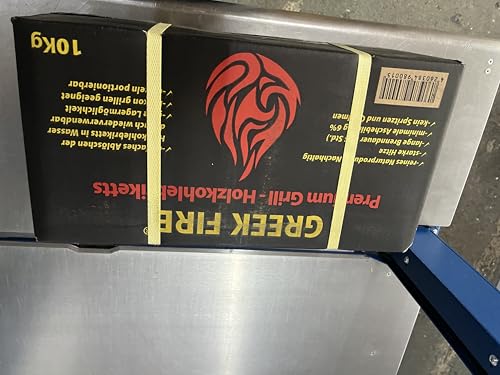
| Greek Fire Premium Grillkohle 10 kg | according to Greek Fire, made from hardwood sawdust, without binders or additives, 10 kg | approx. €49 | 8.9 | you are looking for briquettes without a starch binder and, at around €4.30 per kilo, are willing to pay the most for it |
The per-kilo prices in the last column are calculated from the guide prices in our data sheets, and these guide prices change without warning. The rating is our editorial assessment based on manufacturer information and price, and none of the four numbers contains a measurement of our own of embers or burn time.
Safety notes verbatim
You will find them on the product page of the 10 kg bag in the online shop, next to the manufacturer’s product safety information. We reproduce them in full (in the original German, with our translation):
- “Wichtig: Beginnen Sie erst mit dem Grillen, wenn die Buchen Grill-Holzkohlebriketts mit einer weißen Ascheschicht bedeckt sind.” (Important: only start barbecuing once the beech barbecue charcoal briquettes are covered with a white layer of ash.)
- “Kinder in sicherem Abstand zum Grill halten.” (Keep children at a safe distance from the barbecue.)
- “Nicht in geschlossenen Räumen verwenden.” (Do not use in enclosed spaces.)
- “Tüten keinen extremen Temperaturen aussetzen. Bitte trocken lagern.” (Do not expose bags to extreme temperatures. Please store dry.)
- “Achtung! Keine entflammbaren Flüssigkeiten, wie z.B. Benzin, Spiritus etc. zum Anzünden oder Wiederanzünden verwenden, sondern nur spezielle, DIN EN 1860-3-geprüfte Grillkohle-Anzünder.” (Caution! Do not use flammable liquids such as petrol, methylated spirits etc. for lighting or relighting, only special barbecue charcoal lighters tested to DIN EN 1860-3.)
- “Nach dem Entzünden des Grills keine zusätzlichen Anzündhilfen einsetzen.” (After lighting the barbecue, do not use any additional lighting aids.)
In addition, there is a separate warning: “Achtung! Keine leicht brennbaren Flüssigkeiten, wie z.B. Spiritus oder Benzin, zum Anzünden oder Wiederanzünden verwenden!” (Caution! Do not use highly flammable liquids such as methylated spirits or petrol for lighting or relighting!)
Two of these sentences have to be read together. For relighting, the manufacturer permits only the standardised barbecue charcoal lighters, and after lighting, no lighting aids at all should be added. We understand it like this: as long as the barbecue is burning, you place fresh briquettes against the existing embers and do not help along with anything, not even to make the new ones catch faster. Only when the embers are completely out do you light anew, and then by the same rules as the first time. DIN EN 1860-3 is the standard (which applies in Germany and the EU) for lighting aids used to light solid fuels in barbecue appliances.
Not from the manufacturer’s notes but a general rule for clearing up: ash goes in the bin only once it has cooled completely, because under a grey layer, embers often stay hot for hours. A metal bucket with a lid is a safe interim place for it.
What the manufacturer does not state
On these points, we found nothing on 24.09.2026 on profagus.de, in the online shop or in the Amazon catalogue:
- a lighting or ashing-over time in minutes specifically for the GRiLLiS
- a burn time in hours
- an ember or maximum temperature in °C
- ash and carbon content in percent
- the share of starch in the briquette
- size, shape and weight of an individual briquette
- the ratio of beech wood from the forest to residual wood from the wood-based materials industry
- a quantity recommendation per barbecue session or per grill size
- a shelf life or storage time
- dimensions, material and resealability of the 10 kg bag
- information on smoke, smell and sparks
- what the special composition of the 7 kg bag consists of
- notes on extinguishing the embers and disposing of the ash
- warranty or return conditions
- manufacturer texts and model number in the Amazon catalogue; both fields are empty there
In our view, the missing number of hours weighs heaviest. proFagus bases its recommendation for long barbecue evenings on precisely the burn time, and without a figure the GRiLLiS cannot be compared on this with the Weber briquettes, for which Weber states a grilling time of up to three hours.
Who the GRiLLiS suit, and when another fuel is better
proFagus itself separates its two fuels by grilling time and quantity. For small quantities and short grilling times, the manufacturer recommends the charcoal DER SOMMER HIT, and for the rest the briquettes: “Wenn lang und viel gegrillt wird und/oder größere Grillportionen aufgelegt werden, empfiehlt sich dagegen die Verwendung von GRiLLiS.” (If you barbecue for a long time and a lot and/or put on larger portions, we recommend using GRiLLiS instead.) As uses, proFagus names Dutch oven, kettle grill and smoker on its home page; in the online shop, the 10 kg bag is listed for long, indirect grilling.
For a barbecue sausage after work, they are the wrong choice. If everything is meant to be eaten within an hour, a good part of that goes on waiting for the white layer of ash, and according to proFagus, the briquettes burn for hours afterwards.
If you only barbecue a few times a year and have no dry place for ten kilos: we would then reach for the 3 kg bag from the shop and accept the higher price per kilo.