On the Master-Touch GBS Premium E-5770, the lid hangs on a stainless steel hinge according to Weber. The technical details on this page come from Weber’s German documents. These are the product page with item number 17301004, user manual 69151 and assembly instructions 54806, both from October 2018, and an information brochure from April 2019. You can find the other kettle grills whose data we compare in the kettle grill overview.
Why this page does not link to an Amazon listing
Amazon does have an entry “Weber E-5770”, but on 2 October 2026 it had no price and therefore no offer. The offer this page used to link to is listed by Amazon as model 14501001; Weber assigns item number 17301004 to the E-5770.
Under number 14501001, Weber sells the 22-inch Master-Touch Charcoal Grill in the USA. It has a Tuck-Away holder into which you slide the lid sideways, a coated steel grate, a warming rack and legs that Weber USA states are 2 inches taller. The three dimensions in the Amazon catalogue, 42, 24 and 29.5 inches, are exactly the values Weber USA gives for this model with the lid closed. The six bullet points on the Amazon page also describe a side lid holder, plus a warming rack and room for up to 13 burgers from the Weber burger press. Hinge, charcoal ring, diffuser plate and iGrill holder, that is, everything Weber uses to describe the E-5770, appear in none of them.
The weight also differs. Amazon reports 37.25 pounds, which converts to about 16.9 kg and thus a good 7 kg less than Weber Germany states for the E-5770.
In the Weber shop the E-5770 costs €399.00 (as of 1 October 2026); we use this value as a guide price.
What the E-5770 has that the E-5750 and E-5755 lack
In the German Weber shop it is simply called Master-Touch Premium charcoal grill Ø 57 cm, listed only in black. The designation GBS Premium E-5770 appears in the web address, in the manual and in the brochure, which introduces it in April 2019 as the new Master-Touch. The product page names Weber-Stephen Deutschland GmbH in Ingelheim as manufacturer; design and construction come from Weber-Stephen Products LLC in Palatine, Illinois, according to the manual.
The Weber shop lists six Master-Touch models on 1 October 2026. Of these, only the Master-Touch with a 67 cm diameter costs more than the E-5770, at €499.
According to Weber’s product pages, three features of equipment separate it from the E-5750 and the E-5755, which we also cover. First, the lid: on the E-5750 and the E-5755 you slide it sideways into the Tuck-Away holder. Second, Weber lists the charcoal ring and diffuser plate as part of the scope of delivery for the E-5770, while they do not appear on the pages of the other two. And third, only for the E-5770 does Weber mention a holder for the separately available iGrill thermometer. It also differs from the E-5750 in the cooking grate: the one on the E-5770 is stainless steel, as on the E-5755, while the E-5750 has a coated steel grate.
The cooking area stays the same; Weber gives the same value for all three. The legs of the E-5750 are also 5 cm taller than on standard kettle grills according to Weber, just like on the E-5770. An earlier version of this page attributed taller legs to the E-5770 than to the E-5750, and also a Tuck-Away holder. Both were wrong.
It weighs 24 kg, the other two 21 kg each. Closed it is 7 cm lower than the E-5750 and E-5755, but opened it is 23 cm taller than the E-5750. The difference with the lid open is presumably explained by the hinge, on which it swings upwards.
Bowl, grate, ventilation and chassis
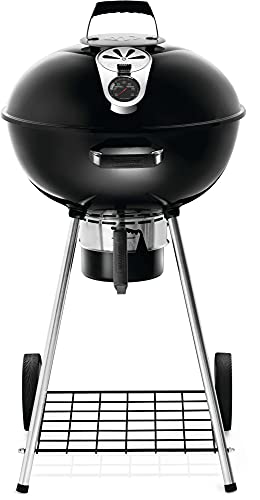
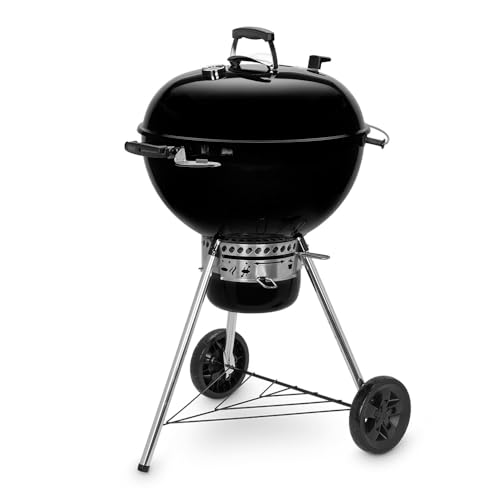
Bowl and lid are made of porcelain enamelled steel. According to the manual, the surface reflects heat, and the heat circulates around the food like the fan air in an oven. The product page says the enamel is resistant to rust, flaking and scratches and withstands high grilling temperatures. According to Weber, the hinge is newly developed, so you never have to put the lid down anywhere while grilling. With the lid closed, the grill measures 100 x 65 x 76 cm (height, width, depth), and 141 cm in height when open.
Grilling takes place on a hinged stainless steel grate. Both sides fold up so you can add charcoal, and the round insert in the middle can be removed. Into the opening you place inserts from Weber’s Gourmet BBQ System, for example a poultry roaster or a pizza stone according to the manual, both available separately. On curved hooks the grate can be hung on the side of the bowl. Weber puts the cooking area at 2,342 cm² and counts on room for 6 to 8 people.
Under the cooking grate sits the charcoal grate made of solid steel. According to the manual, it withstands the heat of any charcoal fire and neither burns through nor warps. Two charcoal holders are included, as is a measuring cup for briquettes.
You control the air at two points: at the bottom it flows in via the One-Touch blades, at the top it escapes through the lid vent. The lid vent is made of rust-resistant aluminium and has a handle that, according to the manual, gets less hot. The three blades at the bottom are bowl ventilation and ash sweeper at once: when you move the One-Touch lever, they sweep the ash into the large, removable aluminium catcher. The One-Touch system itself is made of stainless steel. There is a thermometer in the lid.
According to Weber, the bowl rests on three rust-resistant aluminium legs and two moulded rubber wheels of 20 cm, with a mesh floor under the bowl. Two hooks for grill tools hang on the bowl handle. Lid and bowl handles are heat-resistant according to Weber, and the product page also lists a bowl handle made of glass-reinforced nylon. A removable base for Weber’s iGrill thermometer is part of the scope of delivery.
The product page contains a contradiction of its own. Its list of what is included names the charcoal grate, bowl and lid, thermometer, bottom grate, ash catcher, One-Touch system, the leg assembly with spring clip and retaining pin, and the measuring cup. The charcoal ring, diffuser plate and the two charcoal holders are missing from it, while the description and feature list of the same page include them. This list is not displayed at all, however; it appears only in the source code. Because the manual describes smoking with ring and plate step by step, we assume both are included. We would still have it confirmed when buying.
What Weber does not state for the E-5770, we have collected here:
- a maximum temperature
- measuring range and accuracy of the lid thermometer
- the sheet thickness of bowl and lid
- the diameter of the removable grate centre section
- the capacity of the ash catcher
- the height of the cooking grate above the floor
- whether the two charcoal holders are baskets or rails
- how long the charcoal in the chimney starter takes to be ready for grilling
- how long one fill burns for direct grilling
- the country of origin
- packaging dimensions and shipping weight
- how long spare parts remain available (the manual shows an exploded drawing with 26 items, but without part names in the text)
- the item number of the matching cover
In detail: charcoal ring and diffuser plate
On a kettle grill, the embers lie under the food. For a steak that is intended. For a pork shoulder that is supposed to cook for many hours at low temperature, it is the problem: the radiation from the charcoal hits the meat directly from below, and a flat spread of embers soon burns down. The usual workarounds are to push the charcoal to the edge or to lay it out as a snake that slowly glows through from one end to the other.
Weber includes a third way with the E-5770. The charcoal goes into a porcelain enamelled charcoal ring in the middle of the bowl, and a stainless steel diffuser plate lies flat on top. According to Weber, it deflects the heat away from the food so that the temperature stays evenly low during smoking. Physically, the plate is a heat shield: it intercepts the radiation from the embers, and the hot air flows around its edge and spreads out under the lid. A water smoker works on a similar principle with its water pan, except that there the water also absorbs heat.
The procedure is in the manual on pages 13 and 14. You place the charcoal grate in the lowest position, the ring on top of it, and fill in 45 to 50 Weber briquettes, at most up to the top edge of the ring. You open the One-Touch lever fully, light three Weber firelighter cubes in the middle and wait about 15 to 20 minutes. Then you place 2 to 4 wood chunks or a handful of smoking chips at the edge of the embers. The diffuser plate goes flat on the ring, and the lid stays open until the charcoal is covered with ash. You place a disposable drip tray on the plate, the cooking grate goes into the top position and preheats for 15 minutes. Finally you move the One-Touch lever to the smoking position. The lid thermometer shows a smoking range of 95 to 135 °C, and within this range you hold the temperature with the lid vent. According to the manual, one fill lasts for 6 to 8 hours of cooking time.
Weber’s information brochure for the grill, on page 5, works with other set-ups and values, each with the bowl ventilation on smoking or middle and the lid vent half open. For long smoking it lays out a double snake of about 40 briquettes, which is supposed to burn for 6 to 20 hours at 90 to 130 °C. For low and slow it uses two Minion rings of 44 briquettes at 120 to 170 °C for 4.5 to 7.5 hours, and for baking about 30 fully glowing briquettes for 170 to 180 °C and 1 to 2 hours. The range for the double snake is wide. We would start with the manual values and treat the brochure as a variant.
More on chips, chunks and smoker boxes is in the guide smoking on the grill. For the diffuser plate, Weber expressly recommends briquettes instead of lump charcoal in the brochure. We suspect the reason is that pressed briquettes are the same size and glow more evenly and for longer than lump charcoal, which matters with a single fill over several hours.
Lighting, direct and indirect heat
Before every lighting, the manual gives an order of steps on page 7. Open the lid, take out the cooking grate, first the centre section, then the grate. Take out the charcoal grate and push the ash into the catcher with the One-Touch lever. Release the catcher by squeezing its lever, and empty it. Then open the bowl ventilation fully via the One-Touch lever, put the charcoal grate back in and open the lid vent fully at the top. Before the very first grilling, the charcoal should also glow strongly for at least 30 minutes with the lid closed, so that production residues burn off.
The easiest way, according to Weber, is to light with the separately available Rapidfire chimney starter, which we also review separately as a large model, or with a pyramid of charcoal and firelighter cubes. The charcoal is ready when it is covered with white ash and the cubes are used up. Weber has deliberately left out instructions for liquid lighter: the manual considers it impractical because a chemical aftertaste is possible, and advises firelighter cubes. If you use it anyway, according to the warnings you never add it to warm or hot charcoal, you close the bottle immediately and put it away from the grill, and you remove liquid that has dripped through the bowl ventilation into the ash catcher before lighting.
Direct heat is intended for small, tender food with less than 20 minutes of cooking time. The manual lists burgers, steaks, chops, skewers, boneless chicken pieces, fish fillets, seafood and vegetables. For this the charcoal lies evenly spread, the ventilation is fully open at top and bottom, and the grate preheats with the lid closed for 10 to 15 minutes.
Whatever needs 20 minutes or more you cook indirectly: roasts, bone-in poultry, whole fish, chicken, turkey, ribs. The charcoal goes on two opposite sides, neither close to the handles nor under the thermometer and lid vent, with a drip tray in between if needed. You place the hinged grate sides over the embers so you can add more. The manual also says the thermometer should not sit above the charcoal; because the lid cannot be rotated on its hinge, on the E-5770 this means the charcoal does not go under the thermometer side. If you use Weber’s Char-Basket charcoal baskets, you place them on opposite sides of the charcoal grate before lighting.
Per side, the table for the 57 cm bowl calls for 15 Weber briquettes for the first hour and 4 for each additional hour, for other briquettes 20 and then 7, and for beech or mixed charcoal half a measuring cup and then a handful per hour. For a roast that needs four hours, that would be 27 Weber briquettes per side according to this table, 54 in total.
Control is done through the air. More air means higher temperature, up to the maximum temperature of the fuel. For indirect grilling and smoking you close both vents halfway each; fully closed, the charcoal goes out. There should be 2.5 cm of space between the food and the closed lid. How to set up two zones in general is explained in the guide direct and indirect heat.
Safety, siting and cleaning according to the manual
From the warnings we pick out those that matter most when setting up and grilling. You never operate the grill in buildings, garages, covered passageways, tents, caravans, motorhomes or boats: according to the manual, in enclosed spaces there is a danger to life from carbon monoxide poisoning, and it does not serve as a heater.
Nothing flammable may be within 1.5 m, expressly including (treated) wood of a terrace or veranda. Weber also requires a safe, level surface, never glass or a flammable surface, no flammable structure above the grill and no strong wind. The word balcony does not appear in the manual. Whether yours meets these conditions and whether your tenancy agreement and house rules allow charcoal there, you clarify yourself.
You wear grill gloves with contact heat resistance level 2 or higher according to DIN EN 407 (applies in Germany and the EU) when grilling, when adding charcoal, when adjusting the vents, when reading the thermometer and when opening or closing the lid. You light only with firelighters conforming to EN 1860-3, never with petrol, methylated spirits or other volatile liquids. During operation you never leave the grill unattended, do not move it, and keep children and pets away.
According to the manual, you never use water, neither against flare-ups nor to extinguish the charcoal; you extinguish by closing the lid vent and bowl ventilation and then the lid. Aluminium foil does not belong in the bowl, because it disturbs the air supply. Before you take the lid off the hinge, you open it so the hinge springs are relieved. The full warnings are in manual 69151 on page 2.
On cleaning, page 15: you remove ash and old charcoal from bowl and catcher before every use so that air can circulate, and only when nothing is glowing any more and the grill has cooled completely. You brush the grate after preheating; according to Weber, it is the food that gets oiled, not the grate. You replace the brush as soon as loose bristles appear on the grate or brush; Weber recommends a new one with stainless steel bristles for every grilling season. Lacquer-like flakes on the inside of the lid are, according to the manual, carbon from vaporised fat and smoke; you loosen them with the brush and wipe the lid, warm and not hot, with a paper towel. On the outside you wash with warm soapy water, rinse and dry thoroughly, more often in harsh environments because acid rain, chemicals and salt water promote rust. Sharp-edged objects and abrasive cleaners are off limits.
Warranty, accessories and running costs
According to the product page, Weber graduates the warranty by component: bowl and lid 10 years against rusting through or burning through, the One-Touch cleaning system 5 years for the same, plastic components 5 years, excluding fading and discolouration, all other parts 2 years. Ordinary wear is not covered. Weber’s warranty page also counts surface rust, dents and scratches as such and recognises substantial defects such as rusting through or burning through. The 2018 manual differs and lists bowl, lid and centre ring at 10 years and stainless steel components at 5 years. Which version applies in a dispute, we do not know; we go with the more recent product page.
According to the manual, the warranty can lapse in the event of damage from misuse, improper use, modification, neglect, improper assembly, lack of maintenance, insects and rodents, salty air or chlorine sources such as pools and whirlpools, extreme weather such as hail, storms or earthquakes, and through the fitting of non-original parts. If you live on the coast or store the grill near a swimming pool, you must clean and rinse the outer surface regularly. In a warranty case Weber repairs or replaces the part, if necessary with an equivalent or higher-value grill, compensates at most up to the purchase price and covers a replacement part only for the remaining term. You pay shipping costs for parts you send in up front. The two-year statutory warranty (Gewährleistung) remains unaffected by all of this.
Chimney starter and GBS inserts are not in the box. As additions, Weber places the Premium cover at €69.99 beside it on the product page, as well as the Rapidfire chimney starter for €24.99, a Rapidfire lighting set for €29.99, a charcoal rake for €23.99, the Char-Baskets charcoal baskets for €29.99, a grill brush for €9.99, a spare rib holder for €34.99 and silicone grill gloves for €27.49, all Weber shop prices from 1 October 2026.
Calculated for the start: grill, cover and chimney starter together cost €493.98 in the Weber shop. When you buy the grill, Weber deducts 10 per cent on the matching cover in the basket, which is €7.00, so €486.98. Shipping is free from an order value of €49, and so are returns. Briquettes and firelighter cubes are added with every fire, in the amounts from the tables above.
What else comes into question?
| Model | The difference | Price | Our rating | Choose this if |
|---|---|---|---|---|
| Weber Master-Touch GBS Premium E-5770 (this one) | Hinged lid; ring and plate for smoking included | approx. €399 | 9.1 | you often cook in the smoking range of 95 to 135 °C |
| Weber Master-Touch GBS E-5750 | Tuck-Away holder, coated steel grate, ring and diffuser plate not on Weber’s product page | approx. €329 | 9.1 | you mostly put on food with under 20 minutes of cooking time |
| Weber Master-Touch GBS E-5755 | Stainless steel grate and setting for smoking, lid in Tuck-Away holder | approx. €379 | 9.0 | the stainless steel grate is enough for you and you lay charcoal snakes yourself |
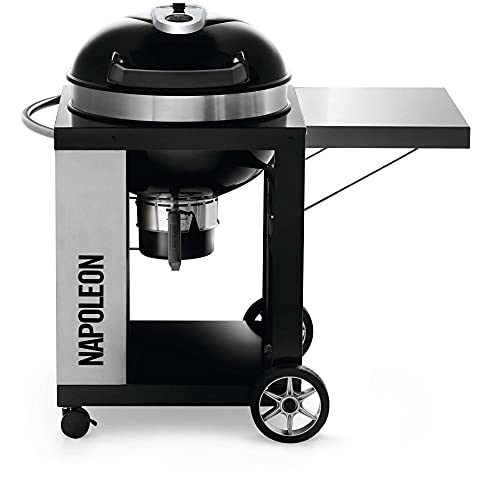
| Napoleon NK22K-LEG-2 | Chrome-plated steel grate, charcoal trays for indirect cooking only as an accessory | approx. €373 | 9.5 | you are not looking for a Weber and will buy accessories later if needed |
The prices are the guide values from the data sheets of our reviews and may differ from the current offer; for the E-5770 it is the price in the Weber shop. In the Weber shop, by contrast, the E-5770 is more expensive than the E-5755: there the E-5750, E-5755 and E-5770 cost €299, €349 and €399 on 1 October 2026. The rating is our editorial assessment, not a measurement result.
When the E-5770 fits and when another one does
The reason to choose this grill is the ring and diffuser plate. If you regularly cook shoulder or ribs at low temperature, you have both without extra purchases. If you mostly grill directly over the embers, the two parts sit in the shed, and in our assessment the E-5750 is then the more sensible choice, €100 cheaper in the Weber shop.
In between, €50 cheaper in the Weber shop, is the E-5755 with a stainless steel grate and, according to Weber, a setting for smoking and low-temperature cooking. It is enough if you prefer to lay the charcoal for long cooking times as a snake yourself.
If you often grill for more than 8 people, the Master-Touch with 67 cm would be the next step up, which Weber designs for 8 to 10 people. According to Weber it has a larger stainless steel grate that, besides GBS, also takes square Weber Crafted accessories. It is not yet in our catalogue.
If hinge, ring and plate do not matter to you, the E-5750 from the table is the cheaper choice.
The wrong choice is the E-5770 for a grill that several parties share in a yard, or for a rented holiday flat, at least as far as the manufacturer warranty is concerned. According to the manual, it applies only to individual private households, not to commercial or municipal use, multi-unit buildings, restaurants, hotels, resorts or rented properties.