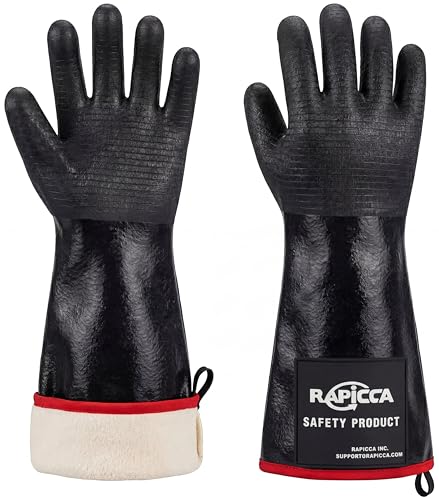
The RAPICCA 43 cm grill gloves are black gloves with a neoprene coating and a long cuff. The supplier is RAPICCA INC. from Gardena, California, which also runs its own online shop. There, this model differs from its siblings by two details at the end of the name: “17in 932°F”. On Amazon the pair costs approx. €30 (as of September 2026). In our grill accessories category there is exactly one other grill glove, the silicone MOESTA-BBQ HeatPro.
We have not worn the gloves. What is written here about material, size and heat protection comes from the product pages and product photos in the RAPICCA shop and from the Amazon catalogue. Where we calculate or infer, it says so.
Neoprene outside, cotton inside
The outer skin is a flexible, waterproof coating of neoprene, a synthetic rubber. RAPICCA lists what it is meant to resist: heat, grease, oil, water, stains and even chemical liquids. In the product photo it gleams black, with fine transverse grooves running across the fingers and palm.
On the lining, RAPICCA’s own statements contradict each other. The product page text describes a double-layer, soft cotton lining that insulates against heat, while the manufacturer text on Amazon says only “double-layer insulated lining”. One of the product images in the shop, however, is labelled “Double Layer Kevlar”, followed by the description of the cotton lining. Kevlar is DuPont’s brand name for an aramid fibre. Text and image therefore contradict each other: according to the text both layers are cotton, according to the image Kevlar is in there too. On the outside, the product page and the Amazon text agree, both name neoprene; the image labels only the lining.
The glove has five separate fingers. According to RAPICCA the palm is insulated and textured so that wet or greasy meat does not slip away. The manufacturer chose the wide cut on purpose: the glove fits loosely to keep the hands cool, and the cotton lining is meant to preserve dexterity.
At the cuff edge the photo shows the light-coloured lining, edged with a red hem; on one of the two gloves a small loop hangs there. According to the Amazon catalogue, the package contains two pieces, so one pair.
In detail: what 932 °F without a time says
932 °F is exactly 500 °C. RAPICCA puts a number on the heat protection with this one figure; no contact time is given. But it is precisely the time that matters, because a glove only slows heat down. If you touch a hot grate, the heat travels through the coating and lining to the skin; the only question is the speed. For a brief tap almost any material is enough. Holding a cast-iron grate for ten seconds is a different task.
For polychloroprene, the chemical name of neoprene, the usual continuous-use temperature is about 100 to 120 °C. We therefore do not read the 500 °C as a temperature the coating withstands over time.
For the question of time there is the EN 407 standard (which applies in the EU) for protective gloves against thermal risks. For contact heat it defines four performance levels with test temperatures of 100, 250, 350 and 500 °C. A level counts as achieved if it takes at least 15 seconds for the temperature on the inside to rise by 10 degrees. Tested gloves carry a pictogram with six digits, the second of which stands for contact heat. RAPICCA’s 500 °C therefore matches the test temperature of the highest level. But the 15 seconds belong to the level, and that is why the temperature alone says little. The “Safety Product” label that sits on the second cuff in the product photo is not a standard mark. Our guide to grill accessories essentials recommends gloves for which the manufacturer states both temperature and contact time.
Whether a glove manages the time depends mainly on the air in its lining. Still air conducts heat poorly, water about twenty times better. A wet lining therefore loses much of its effect, and hot liquid that runs inside keeps its temperature right against the skin. Here we see the advantage of the waterproof outer layer over cotton or leather: meat juices and washing-up water do not reach the lining as long as the layer is intact and nothing runs over the cuff edge.
Pressure works in the same direction. If you grip a hot grate firmly, you squeeze the lining between hand and metal, and the insulation disappears with the air. That is our deduction from thermodynamics. It fits RAPICCA’s reasoning for the wide cut, because where the glove does not sit tight, an air cushion remains.
Which size do you get under this ASIN?
XL. In the RAPICCA shop, B0748DJGV9, the ASIN of this listing, is the item number of the XL size, and Amazon enters “Size 10/XL-43.2CM” in the size field. On the same product page, a second variant is listed: an M with the item number B07PLXD1XD.
How large XL turns out is hard to judge in advance. No size chart with hand circumference or hand length appears in any of our sources, and the cut is deliberately wide. Our assessment: with medium-sized hands, a wide XL leaves a lot of play at the fingertips, and that costs precision as soon as you want to pick up something small. For sausages and skewers, tongs are the better tool anyway.
RAPICCA also covers small hands on a page of its own titled “17in 932°F Female M size for small hands”. Title and details there say 17 inches, while the description text speaks of a “14In long sleeve”. If you order the M, check beforehand which length the listing states.
17 or 14 inches, 932 or 700 °F
Besides the version discussed here, the RAPICCA shop lists four more neoprene gloves that differ in length and heat rating:
- 17 inches with 700 °F (about 371 °C) and a single-layer cotton lining, item number B07FF3SMWS
- 14 inches (about 35.6 cm) with 932 °F, item number B0748DCDGC
- 14 inches with 700 °F and a single-layer lining, item number B07FDYRKXY
- 14 inches with 450 °F (about 232 °C) in size XL
On the lining, the product pages record a difference: two layers for this version, one for the 700 °F models. A second layer is additional material in which air rests, and that fits the higher heat rating.
The 14-inch range is 3 inches or 7.6 cm shorter than this version with its 43.2 cm. For the long version, RAPICCA justifies the length by saying the sleeve protects the arm as well as the hand; of the short one the manufacturer writes that it protects most of the arm. What the figure measures is described differently by the sources: in RAPICCA’s text it is the length of the sleeve (“sleeve”, “Hülse” in the German Amazon text), while in the item dimensions of the Amazon catalogue it is the length of the whole glove.
We assume the overall length. That leaves a good deal less above the wrist, and our guide sets 15 cm of cuff as the lower limit there, for kamado and deep kettle grills happily more. If you reach into a deep kettle grill or a smoker with your arm, take the longer range. If you only touch the lid handle and grate on a gas grill, in our assessment 14 inches will do too.
Smoker, deep fryer, brew kettle: what RAPICCA intends the glove for
According to the product page, the glove is meant for more than the grill. RAPICCA names beer brewing, deep-frying turkey and dyeing yarn. It is meant to protect the hands at smokers, grill flames and fire, and the manufacturer also recommends it as camping equipment. The manufacturer text on Amazon adds, among other things, chicken from the rotisserie, dipping chicken into hot water, the fire pit and the wood oven in a fireplace.
What most of these examples have in common is that something is hot and at the same time wet or greasy. At the grill that means, as we read it: the glove is made for the food itself. Lifting a pork shoulder out of the smoker, pulling a chicken off the spit while it is hot: for such grips a waterproof surface with grooves is suitable, while a cotton glove soaks up fat and meat juices.
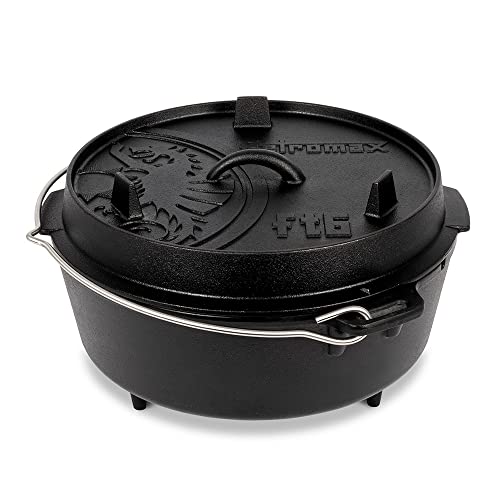
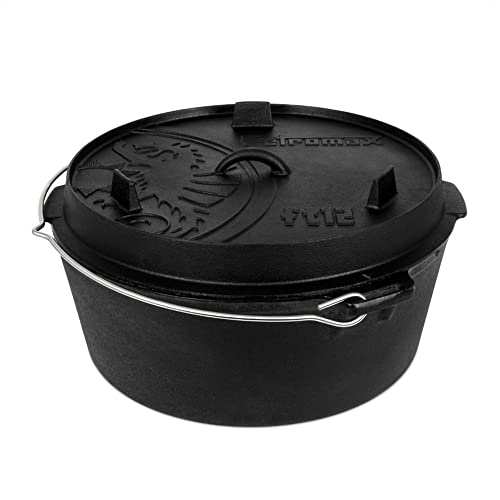
Hot metal is a different case. Tipping out a chimney starter by the handle or lifting a Dutch oven by its bail: here everything depends on the contact time from the detail section. For the lid of its fire pot ft6, on which embers or charcoal can be placed, Petromax recommends its own lid lifter. With it the hand stays completely away from the lid and the embers.
Washing and the cold-water check
RAPICCA describes cleaning in one sentence on the product page: rinse in the sink, wash with a little soap and hang to dry. In the German manufacturer text on Amazon the instruction reads: “Simply put on the gloves, wash them with a little soap and hang them to air dry”. According to that wording, you wash them while wearing them.
If water has nevertheless run into the lining while washing, do not put the gloves on again until it is completely dry inside: water in the lining displaces the air that is supposed to insulate there.
The only explicit safety note we found at RAPICCA is in the Amazon text on taking food out of boiling water or steam, and it is in brackets: “please perform a cold water test to check for possible defective gloves”. Our suggestion for this check: put the glove on, hold it in cold water up to just below the cuff edge, take it off and check the inside of the lining for damp spots. If one lets in water, it no longer belongs near a pot of boiling water or hot oil, because there you only notice the tear once the lining is hot and wet. Repeat the check before every use with hot liquid.
Two alternatives and a Dutch oven from our accessories comparison
| Model | The difference | Price | Our rating | Choose this one if |
|---|---|---|---|---|
| RAPICCA 43 cm grill gloves (this one) | Neoprene outside, waterproof, 17 inches, size XL | approx. €30 | 8.9 | you handle wet and greasy meat by hand at the smoker |
| MOESTA-BBQ HeatPro heat-resistant gloves | Silicone instead of neoprene, machine-washable according to MOESTA | approx. €60 | 8.4 | you put grill gloves in the washing machine after use |
| Rösle Premium grill tongs 44 cm | 44.2 cm 18/10 stainless steel, dishwasher-safe according to Rösle | approx. €30 | 8.8 | distance from the grate matters more to you than insulation on the hand |
| Petromax fire pot ft6 | no protection, but a cast-iron Dutch oven with 5.5 l | approx. €75 | 9.0 | you do not have a Dutch oven yet and want to cook over embers |
Prices and ratings come from our individual reviews; the prices are guide values as of September 2026 and will change. What is in the second column comes from the manufacturer texts in the Amazon catalogue. The rating is our editorial assessment from comparing manufacturer data; no measurements of our own are behind it.
What RAPICCA does not state
We did not find an instruction manual or a data sheet. The shop and the Amazon catalogue are also silent on these points:
- a test standard: neither a rating under EN 407 for heat nor under EN 388 for mechanical risks, that is cut and puncture resistance
- a CE marking as personal protective equipment
- a melting or decomposition temperature of the neoprene coating and its behaviour on prolonged contact with embers
- a size chart with hand circumference and hand length, for XL as for M
- washing machine and dryer, water temperature and drying time
- conformity with EU law for materials in contact with food; the statements refer to the US agency FDA
- the weight of the pair; the 400 g in the shop is listed there across the board for all RAPICCA products
- a manufacturer warranty (for returns in the shop see the frequently asked questions)
- country of origin and place of production
- single replacement gloves, should one start to leak
- since when this model has existed
Who it suits, and when to choose something else
The RAPICCA suit you if you would rather grab food than turn it. Of the two grill gloves in our comparison, they are the cheaper. The MOESTA-BBQ HeatPro cost €30 more, and in our assessment that premium is worth it only for those who find washing in the sink too fiddly.
This listing is wrong for anyone with small hands, because only XL comes under the ASIN; for them the M variant from the size section is the right item. The MOESTA from our comparison does not help then either: the listing we discuss there is, according to the Amazon title, size XXL 11.
The RAPICCA are equally unsuitable if you need a glove with proven protection time against contact heat, for example because you often work with your hand near embers or glowing cast iron. Then you specifically look for a model marked to EN 407.
If you mainly turn food on a gas grill, a long pair of tongs is enough in our view. The Rösle Premium grill tongs cost about as much as the RAPICCA (both around €30) and, according to Rösle, have a 30 cm long handle that keeps your hand at a distance above the grate.