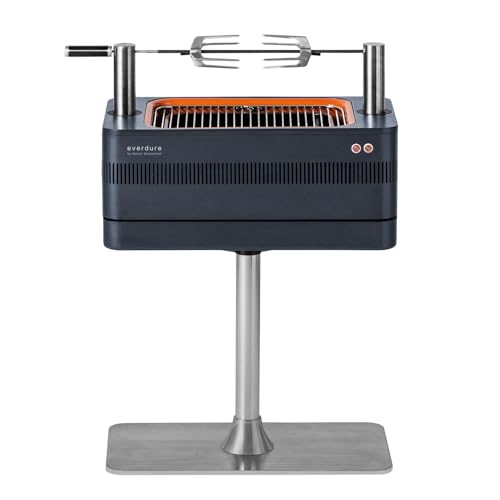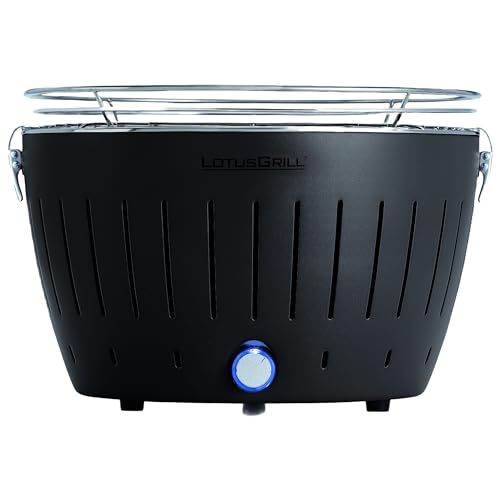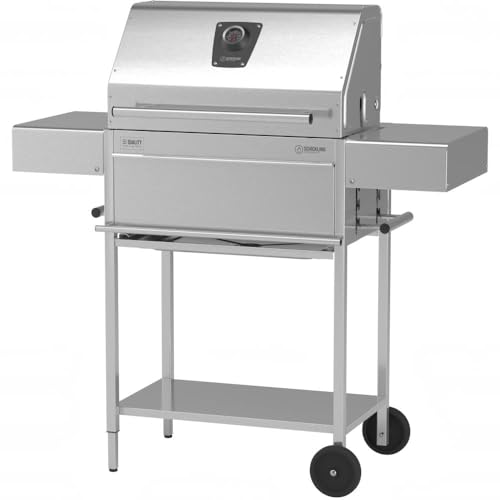
The Everdure HUB II is a charcoal grill that lights its charcoal with electricity. You pile the charcoal on a round grate in the middle of the charcoal tray, press a button, and a coil underneath heats until the charcoal burns. Around this ignition, Everdure has built a grill cabinet with a motorised rotisserie.
In our charcoal grill category, at approx. €2,503 (Amazon, as of 24 September 2026) it is the most expensive unit. Amazon and the German Everdure site list it under the model number HBCE3BEU. On everdure.com, the name HUB II belongs to the variant E2HUB1B in matt black; for it Everdure lists different castors than the German spare parts list (more on that under construction).
Construction: a grill cabinet with two grates
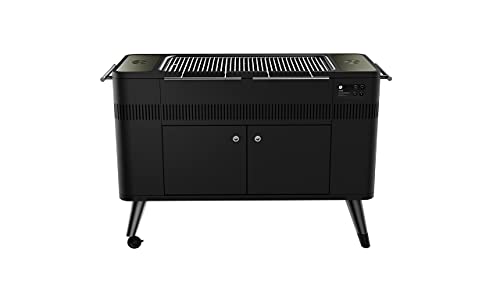
In the product photo, a rectangular black cabinet stands on angled legs, with two handles projecting from the narrow sides. The two grates lie side by side on top, the control panel sits at the front right, and below it two doors close off the storage space. Together the grates come to 3270 cm² of cooking area, as stated on everdure.com.
They are chrome-plated, with heat-insulated handles that point forward and rest in notches on the front edge. You can take them out completely or fold them up to add charcoal. Everdure advises putting them on only once the charcoal is lit and spread out, and warns: even when the handles stay cool, the grate surface gets hot. Small food must be wider than the gaps between the bars, otherwise you lay it crosswise so it does not fall through.
Below the grates is a porcelain-enamelled grill tray, and in it the removable charcoal tray made of black enamel. A stainless steel insert protects the ignition coil. The cabinet serves as storage and, according to everdure.de, also for keeping food warm; a shelf inside runs on telescopic runners, and the spit and forks have their own compartment.
The manual gives the dimensions as 1387 mm long, 590 mm wide (measured front to back, everdure.com calls this depth) and 900 mm high, with fully extended rotisserie columns adding 320 mm. everdure.com arrives at almost the same values (591 mm depth with grates in place, 1223 mm height with extended columns), while the German Everdure site gives 1365 mm for the long side without and 1375 mm with columns, and 487 mm depth. We work with the manual’s values because two sources support them. For weight, the figures range from 77 kg net (everdure.com) through 78 kg (everdure.de) to 80 kg (Amazon catalogue). According to the manual, at least two people should lift the body out of the box.
On the castors, the sources contradict each other. everdure.com lists four lockable castors for the variant E2HUB1B. The spare parts list for the HBCE3BEU shows two lockable castors on castor legs and one foot each at the front and back, and the product photo shows it that way too: a wheel on the left, a foot on the right.
According to the German manual, the box contains the grill housing, the lid with lid handle and two lid brackets, two upper covers, charcoal grate and charcoal tray, two brackets and a heat shield for the ignition coil, left and right cooking grate, the rotisserie spit with its forks, four standing legs, and screws and washers for assembly. A Phillips screwdriver and an adjustable spanner are enough as tools.
In detail: how the heating coil lights the charcoal
Everdure markets the system as Fast Flame Ignition. The manual puts it more soberly: the charcoal is heated to a certain temperature over an ignition coil; the ignition needs no flame. The principle is the same as with an electric grill lighter, except that here the coil is permanently built in, directly under the charcoal grate.
According to the manual, you pile the charcoal on the grate, at most 20 mm above its rim, and press the left button. A tone and an LED signal that the coil is running. After a few minutes, according to the English Everdure quick guide, smoke rises first, then flames come. The ignition timer is set to 7 minutes, after which the coil switches off. If charcoal and coil get too hot beforehand, an overheating protection cuts off the coil, and the timer runs on to the end. You should not restart it afterwards, Everdure writes, because the heat of the coil would hinder the natural ashing of the charcoal.
The quantity is limited. The manual allows no more than 1.8 kg of fuel at a time, and during operation the charcoal should reach at most the upper rim of the charcoal tray. An English-language Everdure quick guide from 2025, by contrast, gives 1.2 kg for the HUB and HUB II. For the German model the German manual applies; if you want to respect both limits, stay under the smaller figure. Our guide charcoal or briquettes explains which type of charcoal suits what.
How long it takes before you can put food on, the Everdure documents answer differently. The German quick guide gives just under 9 minutes of ignition time at the maximum quantity, everdure.de advertises “ready to use in 10 minutes”, and everdure.com less than 10 minutes. The detailed manual is more cautious: after about 10 to 15 minutes, a large part of the charcoal should be partly or fully glowing, depending on weather and fuel. We would plan with that range. Then you spread the embers in the tray with a metal tool, mix in fresh charcoal if needed, and put the grates on.
The manual gives the unit 1450 W at 220 to 240 V and 50 to 60 Hz. everdure.com gives the same 1450 W for the heating coil, 1400 W elsewhere, and the German Everdure site 1800 W. For the socket the contradiction hardly matters: a standard household socket fused at 16 A carries about 3.7 kW at 230 V, and all three values are well below that.
On lighting without the coil, the Everdure sources directly contradict each other. Safety note 22 of the German manual forbids fuels soaked in accelerant, accelerants of any kind and grill lighters, and states: “This appliance is designed exclusively for the electric ignition of charcoal.” According to the same note, accelerants can cause considerable damage to property and injury to people. The warning follows: “Never use alcohol or petrol to light or relight! Do not use firelighters either!” The FAQ on everdure.com, by contrast, allows lighting the charcoal with natural firelighters in the unit or in a chimney starter and then transferring it. For the HBCE3BEU we stick to the German manual. If power is missing or the coil fails, it leaves no permitted way to light the HUB II.
Can you cook with the lid closed on the HUB II?
No Everdure document describes it. You can hook the supplied lid on at the back while grilling; according to everdure.de it serves as a windshield. In the FAQ on everdure.com, Everdure itself asks how you tell the cooking time when the HUB II has no lid. Indirect cooking is still possible, but open, through the distribution of the charcoal.
Under a closed hood, hot air flows around the food from all sides; open, the heat comes almost only from below. On the HUB II you therefore control it through the charcoal and, on the spit, additionally through the height of the columns. For large pieces the spit remains.
The quick guide describes two methods. For searing steaks and vegetables, you spread the charcoal evenly in the tray once it is fully lit and has formed ash, and then put the grate on. For finer meats and fish, Everdure recommends the indirect method: the charcoal goes to the sides, part of the tray stays free, and the food lies above it. everdure.com adds that charcoal piled at different heights gives zones of different heat.
On temperature, the quick guide prints a hand test: hold your hand about 15 cm above the grate and count. If you can bear it for 2 to 4 seconds, the table gives 220 to 260 °C, the searing level. At 5 to 7 seconds it is 170 to 220 °C, meant for chicken or the rotisserie, and at 8 to 10 seconds 150 to 170 °C for slow cooking. The figures are Everdure’s table values. If you want to know more precisely, you need a grill thermometer of your own.
The rotisserie: columns at the press of a button
Everdure promotes the rotisserie as Rotiscope Technology. Two columns extend from the body on the left and right, electrically and without steps, as long as you hold the up or down button. Retracted, they disappear completely into the housing. The motor sits in the right column and starts via the right button on the control panel, which, like the ignition button, responds with a tone and an LED. According to the manual you may load it with at most 40 kg, and everdure.com gives the same limit. Four Cliplock forks hold the meat on the spit, and a lock prevents you from retracting the columns completely while the spit is hooked in.
The limit applies to the motor. The manual also advises paying attention, when buying meat, to a size that suits the grill. In practice, in our assessment, that means the piece must be able to turn freely between the columns and above the embers.
For cooking on the spit, the quick guide recommends slow preparation over moderate, constant and even heat. You choose the height to suit the food and make sure the embers underneath are even. If the heat is too great, the meat burns on the outside before it is cooked inside.
On flare-ups, the quick guide has six notes that belong together, so here they are all. Never leave the grill unattended for more than 5 minutes. According to Everdure, dripping meat juice brings the smoke aromas and should not be prevented entirely; but if too much flammable liquid hits the hot charcoal, flames are very likely to flare up. So watch where the juice drips, and keep an area free under the food where it can drip off without hitting the charcoal. Set the spit high enough that flaring flames do not reach the meat; according to Everdure they burn off quickly and die down. Season with a dry rub instead of oily marinades. And if the flames flare dangerously high: motor off, take off the spit with the food using heat-resistant gloves, let the flames burn off on their own and put the spit back only when it is safe again; then switch the motor back on.
Power, siting and care: what the manual requires
The German manual has 29 safety notes, plus its own sections on siting, cleaning and maintenance. Read all of them before the first ignition, also because two places in the German version are mistranslated.
Power
The mains cable is 1.5 m long and is pulled out of the unit on the right side. During setup it goes to the socket first, because only then can the columns extend and the coil be switched on. During operation you always pull it out completely: if it stays fully or partly coiled, according to safety note 6 it can overheat and be damaged. You should not pull it too far either, otherwise, according to the manual’s troubleshooting section, the internal connection can be interrupted.
The cable must touch neither hot surfaces nor glowing charcoal. All electrical connections must be dry and protected from moisture, and you pull the plug neither with wet hands nor by force. After grilling and before any cleaning or maintenance the plug comes out and the cable is fully retracted. A damaged cable may be replaced only by the manufacturer, an authorised customer service or a suitably qualified person. A timer switch that lights the grill by itself at a fixed time is ruled out by the manual: if the unit is covered or wrongly sited at the time, there is a fire risk.
Siting
According to safety note 1, the HUB II is intended exclusively for outdoor use. The manual expressly excludes garages, sheds, carports and other enclosed places, as well as installation in or use on vehicles such as boats, trailers or motorhomes. Combustibles must be at least 250 mm away at the sides and rear, and at least 1500 mm above the grilling surface, and the grill must not go under flammable or heat-sensitive surfaces. Note 29 is even clearer: do not grill under roof overhangs, canopies or close to branches and shrubs. The ground must be level and load-bearing and withstand up to 80 °C above the ambient temperature. The four feet stay on; the grill is not built in.
Because charcoal produces carbon monoxide when it burns, the manual requires a well-ventilated place where no gases can collect, and air flow and combustion must not be obstructed during operation. The warning box beside the unit data adds: place nothing on or directly against the unit, and keep chemicals, flammable material and spray cans away. The supervision rule from the rotisserie section applies to all grilling according to note 16. Before every grilling session you also check whether grilling is currently permitted in your area given the weather; in great heat and drought there can be grilling bans according to the manual, and you always observe the general fire protection rules of your country or region.
Who may operate the grill is regulated by note 4. People with physical, sensory or mental limitations (children included) and people without experience with such devices are not intended users unless they are supervised, have been instructed in safe use and understand the dangers. Children must be supervised and must not play with the unit. Unsupervised children and pets should not be nearby while the grill is in use, heating up or cooling down, and while grilling both keep a safe distance. The manual also requires an appropriate safety distance from anyone wearing highly flammable clothing, such as nylon, during operation.
For partly enclosed locations the manual allows three variants: walls with at least one permanent opening at floor level but no roof; a roof with at most two walls; or a roof with more than two walls if at least 25% of the total wall area is completely open and at least 30% of the remaining wall area is open and unobstructed. On balconies at least 20% of the total side, rear and front wall area must be and remain open and unobstructed.
The second and third variants fit poorly with note 29, which excludes canopies. We would follow the stricter rule and not put the HUB II under a patio roof.
On the translation errors: in the siting principle the German text says combustion products should not be quickly dispersed by the wind. The English original says the opposite: the combustion gases should be carried away quickly by wind and natural convection. And the introduction to the safety notes speaks of connection to the gas supply, meaning the power supply.
Cleaning and care
After grilling, the charcoal burns out by itself. The manual prohibits extinguishing with liquid in the grill, and you may move the grill only once nothing is burning any more. Note 25 ends with the sentence that the grill must not be moved by lifting, although the same manual requires lifting the body in pairs when unpacking. We therefore apply the ban to the assembled grill. Burning out takes time, because according to the manual the charcoal can glow for a very long time, and Everdure asks you to allow for that. Afterwards ash and remaining fuel go into a non-combustible container, ideally a metal bucket; if not everything has cooled yet, you pour a little water over it. You dispose of the waste safely according to the fuel section of the manual and local regulations. Note 27 draws two limits: dispose of nothing before it is completely extinguished, and never in places where someone could step on it or there is a fire risk.
You scrape off residues while the grill is still warm. For the inside of the housing you take the grates out, wearing protective gloves because surfaces can still be hot. According to the manual you clean the inside of the charcoal tray with some water, mild detergent and a sponge or mild scouring sponge, and hard-to-clean spots with a wet sponge and some baking soda. Abrasives are excluded. Ash and fuel residues must be removed completely after every use, from the tray as well as from under the charcoal grate and the heating element; for this cleaning the manual requires that they are extinguished and cold.
The ignition coil is more work. The manual describes the steps precisely: take off the charcoal grate, carefully turn the coil upward, take out its holders, remove and clean the heat shield, then clear the recess around the coil thoroughly of ash and dripped oil. All parts must sit correctly again before the next grilling. According to safety note 14, this is exactly how you prevent grease fires. If it burns anyway, you take the food off if possible and let the fire burn out; according to the manual most fat burns off quickly as soon as it touches the charcoal.
You clean the outside only once the grill has cooled, is comfortable to touch and is disconnected from power. Painted and plastic surfaces get a mild household cleaner and a clean cloth, not scouring pads and harsh cleaners. Thinners and similar solvents are forbidden, as is cold water on hot surfaces; afterwards you dry off. You wipe the rotisserie columns with a soft cloth to remove oil and dust, and no water may run down them into the grill. You never immerse the grill itself in water. You may immerse only grates, charcoal grate and the other removable parts.
The grates discolour over time from the heat; according to Everdure this is a natural process and not a defect. After cleaning you can rub them with a little cooking oil so they do not rust. You wipe the spit with water and detergent. The Cliplock forks you first soak in hot water and then clean the same way; you may rub the dry spit thinly with cooking oil. According to everdure.com neither grates nor spit nor forks belong in the dishwasher.
At the start of the season the manual requires four steps: wipe all outer surfaces with a clean cloth, check that ash and oil have been removed from the charcoal tray and under the ignition coil, check all fastenings for tightness and retighten if needed, and check the pull-out cable with plug for function and damage.
Spare parts, running costs and what Everdure leaves open
For the HBCE3BEU, everdure.de provides a spare parts list dated 2019, with part numbers. The heating element carries the number 16040100003, the mains cable with EU plug 16040300001, and the switches for columns and heating element are numbered too. For some items “NA” stands instead of a number: upper pole holder, pole unit left and right, round guide rod, square tube bracket, position switch, control box cover, switching power supply and electrical control box. Among them are the column units and the control box with power supply. Our advice: before buying, ask the retailer how they would replace a defective control box. As representative for Germany, Austria and Switzerland, everdure.de names montargo GmbH of Fuldatal; the international site everdure.com is operated by Shriro Holdings Ltd.
What costs money on an ongoing basis is mainly charcoal; heat and burn time can vary greatly with fuel and weather according to the manual. We estimated the electricity for ignition ourselves from the power rating and timer duration: at most about 0.17 kWh per ignition, with the higher value from the German Everdure site about 0.21 kWh. Columns and motor are not included in that.
These details are missing from all the manufacturer documents we read (manual, quick guide, spare parts list, everdure.de and everdure.com):
- the maximum temperature at the grate (no source describes a thermometer)
- burn time of a charcoal load and consumption per hour
- how many people the cooking area is enough for
- the dimensions of the individual grates, the spacing of the grate bars and the distance between the columns
- material and wall thickness of the outer body; for a stainless steel housing or a double wall we found no evidence
- the material of lid, spit and forks
- power consumption and speed of the rotisserie motor
- ingress protection (IP) rating and protection class
- what the thermostat in the manual’s parts list is for
- country of manufacture and market launch
- whether the internationally listed variant E2HUB1B is identical to the HBCE3BEU
- warranty duration and warranty terms for Germany
- whether and for how long spare parts are available
- price and item number of the matching cover in Germany
Earlier versions of this page described app control via Bluetooth and a fan that regulates the temperature. No manufacturer source mentions either for the HUB II, so we removed them.
What else comes into question?
Three alternatives from our catalogue, each for a different reason:
| Model | The difference | Price | Our score | Pick this one if |
|---|---|---|---|---|
| Everdure HUB II (this one) | Spit up to 40 kg on columns that extend electrically | approx. €2,503 | 9.4 | you often grill on the spit and have a socket at the grilling spot |
| Everdure FUSION | also electric charcoal ignition, spit only up to 15 kg according to the English Everdure quick guide | approx. €384 | 8.9 | you want the push-button ignition but have little space or budget |
| Schickling Willy L Classic | double-walled lid with vent sliders | approx. €663 | 8.7 | you want to cook indirectly under a closed lid |
| Schickling Walter XL Basic | stainless steel grill cart without power, grill lid and rotisserie only as an extension according to Schickling | approx. €475 | 8.5 | you want to grill open first and buy lid or spit later |
Prices are guide values, as of September 2026, and change. The score is our editorial assessment from the data comparison; we did not measure anything on any of the four grills.
Who the HUB II suits, and when another grill
You have to want the premium: the Schickling Willy L costs approx. €1,850 less, the Walter XL Basic approx. €2,040 less and the Everdure FUSION, which also lights its charcoal electrically, approx. €2,130 less. According to the English Everdure quick guide you can use the FUSION with or without a stand; there you set the height of its spit by hand in three steps.
If you want to cook under a closed lid, look at the Willy L. Schickling describes its lid on Amazon as double-walled, with two vent sliders on the back, and the manufacturer also lists a thermometer with a scale of 0 to 500 °C. The sliders regulate how much air reaches the embers, and as a rule the less air, the slower the charcoal burns.
If you also want to grill with split wood, you end up at Schickling as well. The manufacturer names split wood in its Amazon descriptions for the Willy L and Walter XL, and neither needs power. For the HUB II the manual provides for lump charcoal.
Work out the footprint beforehand. Unit length plus the manual’s minimum side clearances give just under 1.9 m of free width, depth plus clearance to the rear a good 0.8 m. You add the space where you yourself stand in front of the grill.
The HUB II is wrong, in our view, for anyone who often moves the grill around or wants to grill on a covered balcony. With the weight given above and, according to the German spare parts list, only two castors, it is not a grill to push around, and for a roof over the grill note 29 applies, which we gave priority to under siting. If you are still undecided between grill types, the Grill Finder asks you the most important points.