A 17-inch oven for the socket, with a riser in the package
Based on the title and data, the Amazon listing is the 17-inch Standard Electric from Cozze, manufacturer item number 90356, type COZ-EL1-PI-17-1-EU. It bakes at 2200 W at 220 to 240 V and 50 to 60 Hz, without gas and without wood. On Amazon the listing runs as a bundle: besides the oven and pizza stone, a steel oven riser is in the box. Cozze itself does not have such a package in its range, and the ASIN does not appear anywhere on the manufacturer’s pages. The assignment to model 90356 therefore rests on the title and technical data; we have no confirmation of it from Cozze.
The instructions name Millarco International A/S from Lystrup in Denmark as the manufacturer. According to its own company page, Cozze was founded in March 2021, originally as a subsidiary of Millarco, a wholesaler in Northern Europe, and advertises with “Designed in Denmark”.
In our pizza ovens category it is listed at approx. €421 (Amazon page on 20 October 2026: €421.20). Our sources are the German and English Cozze product pages, the shared instructions for the 13-inch and 17-inch versions (German part on pages 14 to 24), the manual of the Cozze pizza oven stand and the Amazon catalogue. We did not have the oven here, and we baked nothing in it.
Housing, stone and opening in numbers
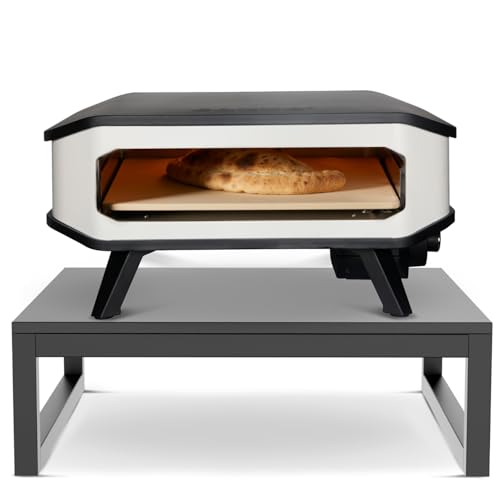
According to the product page, the oven measures 60.5 × 60.5 × 30.5 cm and, according to the instructions, weighs 21.2 kg net. The housing is made of powder-coated, galvanised steel, available in white and black. The product photo we use shows a light front under a black top, framed by a black frame, with slanted black feet underneath. Whether this is the black version from the Amazon title cannot be said with certainty from the picture alone.
Inside sits a square cordierite pizza stone, 42.5 × 42.5 cm and 1 cm thick. For pizza size Cozze states Ø 42 cm. The opening at the front is 44.5 cm wide and 10.5 cm high.
Something follows from these three measurements for your accessories, and this is our own deduction: a pizza peel must be narrower than 44.5 cm and still carry a pizza of up to 42 cm. There is little room at the sides. If you want to use the full size, buy the peel by this measurement and not by the inch figure. Pizzas with a lot of toppings or a baking dish also run up against the 10.5 cm opening height.
The oven is operated through two elements, which the instructions label with letters. A is an LED display that works as a digital thermometer. B is a control knob that you press to switch on and off and turn to set the temperature; the display then flashes three times to confirm. The instructions use C for the pizza oven door. The German product page calls the same part “Hitzeschild” (heat shield), the English one “Pizza door”; we assume it is a single part. None of our sources mentions a pizza peel in the scope of delivery. The power cable is 2 m long and has one plug.
On approval: according to the declaration of conformity, the oven has carried the CE mark since 2022, and the EC type examination was carried out by TÜV Rheinland LGA Products GmbH in Nuremberg. The standards listed are EN 60335-1, EN 60335-2-78, EN 60335-2-36 and EN 62233 as well as Regulation 1935/2004/EC for materials in contact with food, and Cozze also mentions an LFGB check (the German food and feed code). The declaration describes the appliance as an “electric pizza oven for outdoor use”.
In detail: why the stone takes longer than the air
To preheat, according to the instructions you insert the door and set 350 to 400 °C. After about 3 to 5 minutes the oven has reached the temperature. The stone is only ready after around 20 minutes.
The gap between the two times is physics. Air stores hardly any heat and so becomes hot quickly, whereas a centimetre of ceramic has to be heated right through before it can give enough heat to a cold dough base. If you slide the pizza in after only five minutes because the display says so, you bake on a stone that is not yet that far along in its depth. Cordierite expands little when hot and is therefore used for oven stones that are meant to withstand rapid temperature changes. That does not make it insensitive; the limits are given further down under care.
According to the instructions, the oven bakes best at around 400 °C. Cozze specifies the procedure like this: after about 40 seconds you take the pizza out, turn it a quarter and slide it back in. The door stays in the oven, and you do not adjust the temperature. The instructions do not explain in detail why it is turned; the usual reason is that heat escapes at the opening and the rear part of the stone stays hotter. Without turning, the pizza would get a dark and a light edge.
The weather plays a part too, and Cozze writes that itself: in a colder climate or at higher altitude baking takes longer, and persistent wind lowers the interior temperature. An electric oven has a fixed reserve for this. The heating cannot deliver more than 2200 W, whereas a gas oven can be turned up further if needed. A spot sheltered from the wind is therefore, in our assessment, worth more than a higher dial setting.
There is a limit for long evenings. With the door in, the oven should not run longer than 2 hours to avoid overheating. After 20 minutes of preheating, that leaves 100 minutes for baking. That is enough for a family evening; a garden party with many guests needs a break.
What does the oven riser do, and do you still need a table?
Yes, you still need a table. The riser lifts the oven by 20 cm; with the oven on top you reach a total height of around 50 cm based on the outer dimensions. On the ground that would be a working height for kneeling. Only on a stable, heat-resistant table does it become a comfortable height.
According to the Amazon text, the riser measures 20 × 60 × 60 cm and is a “sturdy steel stand, powder-coated and with a load capacity of up to 80 kg”. The Cozze page gives neither load capacity nor material. After deducting the 21.2 kg of the oven, the Amazon figure leaves almost 59 kg of reserve, enough for a dough bowl and peel. In the product photo the riser is a flat plate on two side brackets, and the oven stands on it with its feet. That the housing at 60.5 cm is minimally wider than the plate at 60 cm does not matter here, because the feet carry the load and not the body.
Cozze sells a pizza oven stand separately, 60 × 60 × 20 cm, “suitable for all Cozze pizza ovens”. The dimensions match the riser from the Amazon package. That it is the same part is likely, but not proven. The description text on the stand page evidently belongs to a different product; only dimensions and fit are usable there.
If it is this stand, its own manual applies. It describes it as a mobile unit for a pizza oven, plancha or grill, for outdoor use only and for private use only. It should be protected from direct water exposure, stand level and not be moved during cooking. When a pizza oven stands on it, nothing combustible may be within 1 m behind, above and to the sides. At the sides and rear that is more than the 60 cm from the oven instructions; when in doubt we would stick to the larger distance. For care the manual names clear water or neutral cleaners, never oven cleaner; then dry it, store it under cover or under a protective cover when not in use, and remove the cover every 1 to 2 weeks so that no rust forms.
Socket, cable and location according to the instructions
The oven goes only on an earthed protective-contact socket; plug adapters are excluded. It should be supplied through a residual current device (RCD) with a rated residual current of 30 mA at most. The supply voltage must match the rated voltage on the rating plate, and you must not exceed the wattage of the connection. You do not operate it on a damaged socket. A damaged power cable may only be replaced by the manufacturer, its customer service or a qualified person. To disconnect, always pull the plug, never the cable. You route the cable away from hot surfaces and away from walkways so that nobody pulls on it or trips over it, and you check it regularly; if it is damaged, the oven stays off. You never immerse the cable, plug, probes and oven in water, and you do not spray any liquid into the oven.
By calculation, the oven draws just under 9.6 A at 230 V. Household circuits in Germany are usually fused at 16 A. If a patio heater or a kettle is also connected to the same outdoor socket, the fuse can trip. This calculation is ours; Cozze only requires that you do not exceed the power of the connection.
The instructions generally exclude an extension lead unless it meets their requirements: only on an earthed socket, only a 14-gauge cable with an earthed plug that is suitable for outdoor pizza ovens, no longer than 4 m and as short as possible, checked before use and replaced if damaged. The cable must not be a trip hazard, and the connections stay dry. Together with the oven’s own power cable, that makes at most 6 m between the oven and the socket. 14 gauge corresponds in the American AWG system to a good 2 mm² of conductor cross-section; for extension leads sold here we would therefore reach for 2.5 mm².
For the location, the instructions require free-standing use on a level, heat-resistant surface, outdoors and in a well-ventilated area. Garages, buildings, covered walkways, tents, other enclosed areas and the space under combustible structures are excluded. You keep at least 60 cm distance from combustible materials; above the oven it is 1.2 m, and 60 cm at the rear and sides. You set it up on or near walls, partitions or kitchen furniture only if these are non-combustible or suitably clad, and fire safety regulations apply to that. Keep 3 m clear of water such as a pool or pond. You do not move the oven during use, and all local laws and regulations apply in addition. What your tenancy agreement and house rules have to say about a balcony is in our guide Grilling on a balcony.
There are separate rules for the door. In use it stays away from combustible materials, when hot you do not put it on flammable surfaces, and while baking you do not put it on top of the oven. Lighters or lighter fluid have no place next to it, because after use it radiates heat in all directions. During operation you wear heat-resistant gloves, and components sealed at the factory stay untouched.
Burn-off, brushing, storing: care and warranty
The oven is cleaned only when cooled down and with the mains plug pulled. After each use you let it “burn off” for about 15 minutes, and Cozze recommends cleaning and maintenance at least once a month. High-pressure steam cleaners and water jets are excluded. According to the instructions you clean the outer surface with a mild detergent or baking soda in hot water, for stubborn dirt with a non-abrasive scouring powder, and then rinse with water. For plastic surfaces Cozze names a soft cloth and hot soapy solution, without abrasives, degreasers or concentrated grill cleaner.
You brush the stone down after burn-off with the COZZE wire brush. The cold stone may be rinsed with water, after which it must be absolutely dry. The instructions have a separate list for it, given here in full: do not use over an open flame; do not put frozen food on the hot stone; do not cool it with water; it is sensitive to impact; after cleaning with water, dry it completely, for example 2 hours at 60 °C in the oven; store dry and warm. Why moisture and temperature jumps cause cracks is explained in our guide Cracked pizza stone.
Before moving, cleaning or storing, you let the oven cool down and only then cover it. It is stored covered in a warm and dry place.
According to the instructions, the warranty runs two years, on all Cozze products, under these conditions: use according to the instructions, no modification of the appliance, correct assembly, maintenance and frequent cleaning, covered storage, pizza stones and accessories indoors in winter, the right type of current, a level surface, original parts only, no permanent placement by the sea or at chlorinated pools, and private use only. Excluded are wear, vandalism, unusual weather such as hail or storms, acid rain, and chlorine or salt in the air. The pizza stone counts as a wear part and is not covered by the warranty. Modifications void the warranty. You keep proof of payment and the installation certificate, and in case of a fault you contact the local retailer. How to get the oven and stone through the winter is described in our guide Winterising your grill.
What the manufacturer does not state
These points remain open after the product page, instructions and Amazon catalogue:
- Power, number and position of the heating elements, and whether top and bottom heat can be controlled separately
- Minimum temperature and step size of the controller, and whether it reaches the 450 °C the product page advertises (the instructions recommend 400 °C at most)
- Baking time per pizza in minutes; the instructions only describe turning after about 40 seconds
- Electricity consumption in kWh
- Material of the interior and door
- Weight of the riser and the working height with it
- Packaging dimensions and scope of delivery of the Amazon bundle from the manufacturer’s point of view
- Replacement stones with confirmed fit for model 90356
- A matching cover, although the warranty requires covered storage
- Country of manufacture and market launch of the 17-inch electric oven (the only clue: CE mark since 2022)
These three alternatives are worth a look
| Model | The difference | Price | Our rating | Choose this one if |
|---|---|---|---|---|
| Cozze 17-inch Electric Pizza Oven Black (this one) | fixed stone 42.5 × 42.5 cm, riser in the package | approx. €421 | 8.2 | you bake at the socket and have a table for the riser |
| cozze 17 inch Premium Rotate | rotating stone by button instead of turning by hand | approx. €520 | 8.3 | you do not want to turn the pizza yourself with the peel |
| cozze 13 inch Electric Pizza Oven | same instructions and power, smaller size | approx. €295 | 8.3 | you mostly bake for two and have little space |
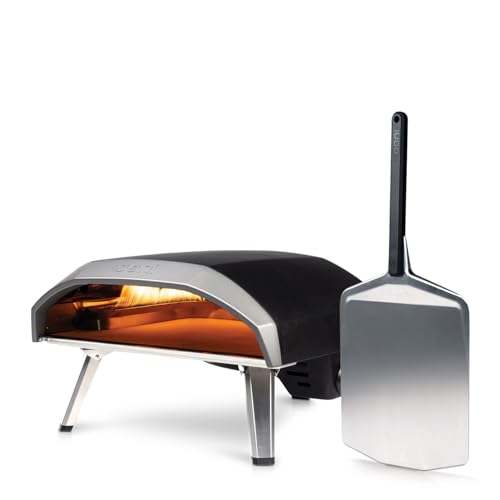
| Ooni Koda 16 | gas instead of electricity | approx. €449 | 9.4 | there is no earthed, RCD-protected socket at your spot |
The prices are guide values from our price boxes and change constantly. The rating is our editorial assessment of the available data; we did not measure anything on any of the four ovens.
When the 17 inch Standard fits and when another oven does
The starting point is the socket. If there is an earthed outdoor socket with RCD protection in the garden or on the terrace, no more than 6 m from the spot, the oven is an option. If either is missing, you first have to book an electrician, and then, in our assessment, the oven only pays off if you need the socket anyway.
Against the Rotate it comes down to a single question: do you want to turn the pizza yourself? The Rotate costs approx. €520, this oven approx. €421, and in our rating the Rotate is hardly higher at 8.3 against 8.2. If you reach for the peel every 40 seconds without it bothering you, you save the money.
The 13-inch oven costs approx. €295 and is also at 8.3 in our rating. For one pizza per person with two people, we would prefer it. The 17-inch oven is worth it if you bake large pizzas to share and want to use the riser in the package anyway.
The Ooni Koda 16 costs approx. €449 and, at 9.4, is the overall winner of our category. For that it needs a gas bottle with a pressure regulator instead of a socket. Where the landlord prohibits gas on the balcony, it is ruled out; in a garden without a power connection it is the obvious choice.
On top of the purchase price come items that are in no package: a pizza peel matching the opening dimensions from above, a cover because of the warranty condition, possibly an outdoor extension lead up to 4 m and a heat-resistant table for the riser. If you carry the stone indoors in winter, you need space there for a plate with a 42.5 cm edge length.
This oven is the wrong choice for anyone whose only spot with a socket is under a pergola with a wooden roof, under a fabric awning or in an open garage. These are exactly the places the instructions exclude, and the socket does not change that. If you do not yet know which fuel suits your own spot, you will find a preselection in the Grill Finder.