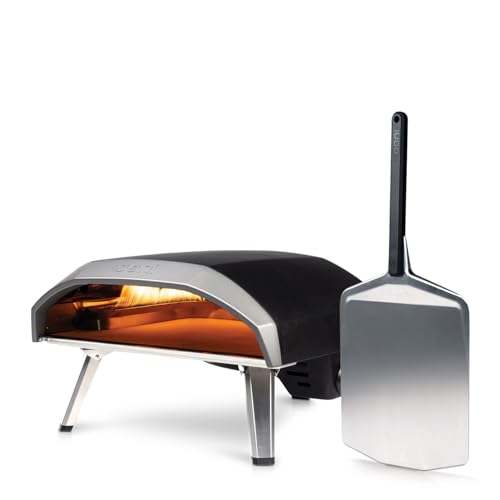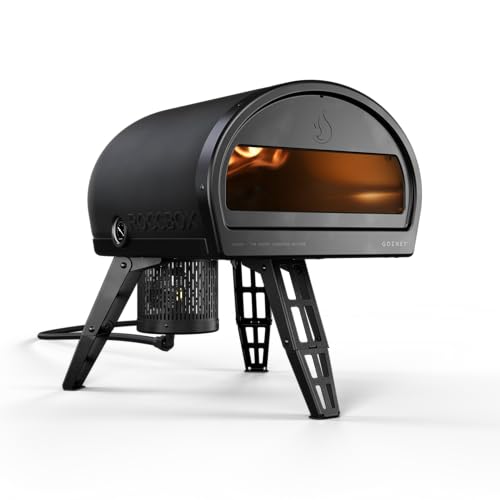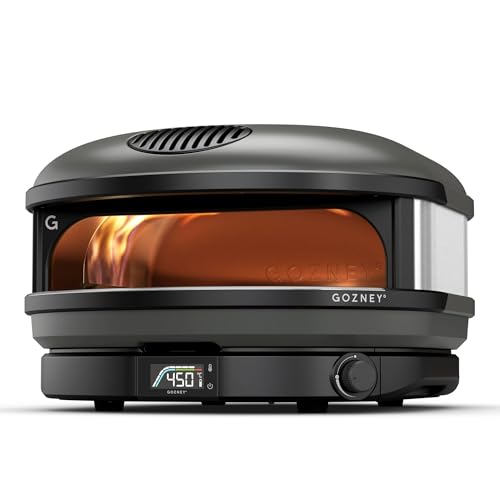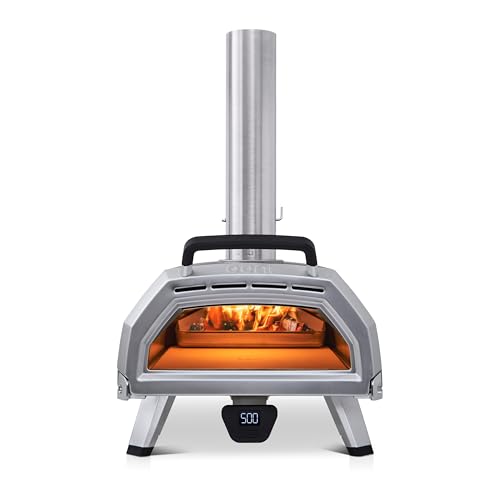
The Ooni Karu 16 is an outdoor pizza oven for pizzas up to 16 inch that burns wood or charcoal; gas works only with a separately bought burner. We have not handled it and have not baked anything in it. This text compares data: Ooni’s assembly manual, Essentials Guide and gas burner manual, the archived Ooni product page from 11.02.2025, the Ooni pages from 06.10.2026, the Amazon catalogue (retrieved 05.10.2026) and the data sheets of our own reviews. We mark our own calculations and assessments.
Is the Karu 16 being discontinued?
On 06.10.2026, Ooni no longer lists the Karu 16 as a product in its EU shop: the product page redirects to the oven overview. The Karu 2 Pro page calls the Karu 16 its predecessor.
A German-language Ooni address for the oven returns a 404 error, and ooni.com, uk.ooni.com and au.ooni.com redirect to the Ooni Karu 2 Pro. The landing page of the Karu 16 in the EU shop can still be opened, but its buy button leads to the redirected product page. The navigation of the multi-fuel ovens lists only the Karu 2 Pro, Karu 2 (both 2nd generation) and Karu 12 (1st generation), while Ooni’s warranty list still includes the Karu 16.
The archived product page from the Internet Archive dated 11.02.2025 shows the oven as sold out, at a price of €799.00 and with a reference to the Karu 2 Pro as the latest step in the Karu line. Our price box lists it at approx. €559 (Amazon catalogue, retrieved 05.10.2026).
That the ASIN belongs to the Karu 16 is shown only by a number, because none of the Ooni pages reviewed has an Amazon link: the Amazon catalogue lists the part number UU-P0E400 (model year 2022) under B095CJ5KSD, and the same number appears in Ooni’s assembly manual.
Build and technology
Ooni describes the material as powder-coated carbon steel and brushed stainless steel of grades 304, 409 and 430. The housing is fully insulated, in Ooni’s words for better fuel efficiency and heat control.
Unpacked, the oven measures 81.5 x 50 x 83.7 cm according to Ooni and weighs 28.4 kg. The Amazon catalogue assigns its 83 cm to the height, 81 cm to the length and 50 cm to the width and gives 63.93 pounds, which converts to 29.0 kg. Three folding legs with non-slip feet carry it; they must be fully unfolded before lighting.
Baking is done on two cordierite stones, each 1.5 cm thick. The replacement stones on Ooni’s accessories page, valid for the Karu 16 and Karu 2 Pro, measure 42.5 x 42.5 cm (front) and 20 x 42.5 cm (rear), together 62.5 x 42.5 cm. Ooni gives 425 mm as the cooking surface and 145 mm as the opening height of the oven chamber. Pizzas fit up to 16 inch.
At the front sits a lowerable full-glass door with ViewFlame technology, which is meant to reduce soot on the glass; according to Ooni it does not keep it permanently clear. The door hangs with hooks on pins and is additionally fixed with two hinge screws (Allen key). The manual forbids leaning on it or placing weight on it.
On top sits a chimney with a quick-release fastener. Its cap keeps rain out when the oven stands outside without a cover. Inside the chimney is a baffle, and there is an opening in the roof; both regulate the draught.
The fuel sits in a tray with a grate; the holes in the grate bring in air and let ash fall through. Topping up is done from the back: the fuel hatch sits at the rear, is removed for this and hung on the rear draught protection plate. The gas burner also goes in from the back, after the draught protection plate and hatch have been removed.
The digital thermometer is not fitted in the door. Its holder is attached at the front of the oven floor, and the cable leads to a socket holder under the oven.
According to Ooni, the box contains the oven body, glass door, stones, chimney, chimney cap, fuel tray with grate, draught protection plate, fuel hatch, thermometer with holders and the Essentials Guide, plus three AAA batteries, an Allen key and a Phillips screwdriver. The gas burner and pizza peel are not included. The assembly manual counts ten steps, from unfolding the legs to opening the roof opening and baffle before lighting; screws should be tight but not overtightened.
In detail: fuel, heat and timing
Ooni’s fuel table in the Essentials Guide (estimated values, depending on weather and ambient temperature) gives up to 500 °C for wood, 250 to 300 °C for charcoal alone, up to 500 °C again for charcoal with wood, and 250 to 500 °C for gas. Our assessment: among the solid fuels, only wood reaches 500 °C, alone or combined with charcoal. According to this table, pure charcoal belongs in the lower range.
The wood should be dry, untreated and hard, beech or oak for example, up to 23 cm long and 7.5 cm thick. According to Ooni, resinous wood such as pine or spruce can change the flavour; treated or varnished wood is ruled out. To start, the Essentials Guide recommends four to eight small pieces, after which you add a little and often, as soon as the wood is mostly embers but flames are still visible. The manual sets upper limits: at most 0.5 kg of fuel at once, at most 1.3 kg in the tray. The German version wrongly writes food instead of fuel there; the English one is authoritative.
For high heat, the baffle and roof opening should be fully open; a closed baffle reduces draught and flames. According to Ooni, the simplest temperature control is the amount of fuel. If the temperature rises above 500 °C, you should stop adding fuel and remove the hatch until normal temperatures are reached again. The oven must not exceed 550 °C, and you should not let it run on a high setting for a long time without baking.
According to Ooni, smoke when lighting is normal. Persistent smoke points to incomplete combustion caused by too little air or unsuitable fuel, and soot is part of the deal with solid fuels.
The thermometer measures the air temperature in the oven, not that of the stone. As a general rule, the base of a pizza cooks through contact with the stone, the top through hot air and the radiation from flame and oven roof, and an air temperature reflects only part of that. Ooni therefore additionally recommends the digital infrared thermometer for the stone temperature, which is not included. At the centre of the stone, at least 400 °C should be reached when baking.
On timing: 500 °C after 15 minutes is in Ooni’s table, the troubleshooting section of the Essentials Guide gives 20 minutes, and with too little heat or low outside temperature another 10 to 15 minutes are added. For a pizza night we would therefore allow up to 35 minutes of lead time (20 plus 15, our own calculation) rather than the 15 in the table.
Before the first bake, both manuals call for 30 minutes. According to the Essentials Guide, the empty oven runs on its highest setting for this, cools down completely and is wiped out with dry paper towels; this removes oils and coating residues from manufacturing. The assembly manual adds that the fuel must glow red during this. A Neapolitan-style pizza is done in 60 seconds with a lively flame, says Ooni; it should be turned every 20 to 30 seconds.
Placement and safety
This is about fire and carbon monoxide, so we reproduce the assembly manual’s lists in full and do not pick out any single point. The safety disclaimer of the assembly manual (German version p. 34 to 35) has 22 points. They are given here in Ooni’s order and numbering, with Ooni’s figures but in our words; the text of the manual is authoritative.
- Use only outdoors, at a sufficient distance from buildings, never inside a building, a garage or in the immediate vicinity of a covered area. At least 1 m from objects with combustible surfaces at the sides and rear, and 3 m at the front and above the oven. Set up on a sturdy, level, stable, non-combustible surface, away from combustible materials, petrol and flammable vapours or liquids.
- Observe local laws that prescribe distances between garden cooking appliances and structures or restrict open flames in dry periods and periods of danger.
- Do not install or use in or on boats, motorhomes or camper vehicles.
- Never use in strong or gusty wind.
- The oven is not a heater and must never be used as one.
- Toxic fumes can accumulate and lead to suffocation.
- The Karu 16 is an open-fire appliance, and fire turns towards air sources. Flames can escape at the back where the fire is, above the hatch when the lid is open, out of the front of the oven when the door is open, and out of the top of the chimney. Ooni recommends gloves during operation.
- Keep away from the openings of the oven and warn other people nearby.
- Improper installation, adjustment, modification, care or maintenance can lead to injury or property damage. Use the oven only fully assembled and with parts firmly tightened.
- Inspect the oven regularly.
- With wood and charcoal, add the kindling little by little to reach the desired temperature; too much kindling enlarges the fire and endangers the person and the oven.
- With the gas burner: if the flame goes out, shut off the gas supply, remove door and hatch and wait 5 minutes before relighting.
- Burn risk to the hands: wear heat-resistant protective gloves at all times, never place hot objects on or near combustible surfaces, do not touch metal parts while the oven is running, and touch only the plastic handles to open the door and lift the fuel hatch.
- Never leave the oven unattended, not even in operation with the hatch or door open (the English and German versions differ slightly here). Watch out for hazards such as dry leaves and decking that can catch fire from flying sparks.
- Keep all electrical cables away from the oven.
- Use only by responsible adults.
- Always keep children, pets and combustible objects away from the oven.
- While baking or as long as the oven is hot, do not remove any parts and do not move the oven.
- Do not place lighters or flammable liquids next to the oven, because it radiates heat in all directions.
- The oven stays hot after the visible flames have gone out: let it cool for at least two hours and do not cover it immediately after use. Before putting it away, all flames and glowing embers must be gone from the burner.
- The approximate operating temperature ranges from 120 °C to 550 °C.
- With intended use and compliance with the safety guidelines, Ooni calls the oven safe and harmless; the user is responsible for safe operation and appropriate care.
The warning page of the manual (English p. 3, German p. 35) works with pictograms. Three of its notes are already given above: the appliance gets very hot and is not moved during operation, it does not belong indoors, and children and pets stay away. Four more are added:
- To light or relight, no methylated spirit and no petrol, only firelighters conforming to EN 1860-3.
- Do not operate in closed or habitable spaces such as houses, tents, caravans, motorhomes and boats: danger to life from carbon monoxide poisoning.
- Put food on only once the fuel is covered with a layer of ash.
- A pictogram marks the areas where fire can escape from the oven.
On the same German page are three notes on regulations: a safe, level base, heating up before first use (see timing above) and, for charcoal, the standard DIN EN 1860-2 (applies in Germany). In its safety box on p. 1, the Essentials Guide adds, among other things, that sharp edges are possible inside and outside and that any modification to the oven violates Ooni’s terms, voids the warranty and can be dangerous.
On clearance, Ooni gives two values: in one place the Essentials Guide names 3 m all round, in another 1 m all round and 3 m above. If in doubt, we would plan with the larger figure. The guide also recommends a spot sheltered from the wind.
Our assessment on the balcony: a spot under a roof, against a house wall or under an awning does not fit these requirements. The 3 m apply above the oven; measuring from its top edge and taking Ooni’s 83.7 cm as the height (the Amazon catalogue gives 83 cm), a ceiling above an oven standing on the floor would have to be higher than 3.8 m (our own calculation), and higher still with a table. The guide Grilling on a balcony covers the legal position and house rules.
According to the assembly manual, lighting goes like this: remove the chimney cap, open the baffle and roof opening, fit the door, remove the hatch, lay in a layer of charcoal or a small stack of wood and light it with a gas burner hand torch or a natural firelighter. Only when the fire is burning do you slowly add fuel, after which the hatch goes back on. The door stays on during this; the fuel goes in through the rear opening.
Gas burner, accessories and running costs
Gas is not part of the oven. There is a gas burner from Ooni for it: 7.3 kW (25,000 BTU), 0.5 kg of gas per hour, to be used only with the chimney fitted. Regulator and hose are included (except in countries with a 30 mbar regulator), a gas bottle is not. On the archived Ooni page from 20.11.2025 the burner costs €119.00, and the variant for Germany with 50 mbar is shown there as sold out. On 06.10.2026 the product page redirects to the gas burner category, which lists only the set for the Karu 2 Pro. For choosing the bottle there is the guide Gas bottle for the grill.
The manual strongly recommends checking the burner and connections thoroughly for gas leaks before use, never with an open flame, always with soapy water, at every connection and after a long period of non-use. If you smell gas, according to the manual you switch off the appliance and extinguish open flames; if the smell persists, you move away and call the gas supplier or fire brigade. The manual has its own safety pages (p. 1, 2 and 8); only the points that bear on the purchase are given here. To convert from solid fuels to gas, the oven must first cool down. On the bottle, two Ooni documents read as contradictory: the Essentials Guide recommends the large Ooni Modular Table especially for anyone who wants to store a gas bottle on the lower shelf, while the gas burner manual forbids storing liquefied gas under or near the oven when it is not connected for operation. We would follow the burner manual and not store the bottle under or next to the oven when it is not in use.
On 06.10.2026, Ooni still lists three accessories for the Karu 16. The cover (€50.00) is made of aluminium and polyester, has an elastic hem and an adjustable strap, weighs 0.24 kg and, according to Ooni, is 100 percent waterproof. Two replacement stones cost €60.00, and a deformed burner grate you reorder through ooni.com, according to Ooni. The fuel pack (€40.00) contains natural wood wool firelighters with paraffin wax and oak logs, kiln-dried to 15 to 20 percent moisture and sized for the fuel tray.
Oven, cover and one fuel pack together cost €649 (559 plus 50 plus 40, our own calculation from our price box and the Ooni prices of 06.10.2026), without a pizza peel and infrared thermometer. If the gas burner is added at the archive price of €119, that makes €768, in each case without a propane bottle.
Cleaning, storage and warranty
After baking, you let the fire burn out by itself and remove no ash until the oven is completely cold. According to the manual, the two hours from point 20 also apply before you move or clean it. Water for extinguishing or cooling is off limits, because according to the manual it can cause damage and injury.
A run at the highest temperature burns off flour and food residues. Before any cleaning the oven must cool down completely, and warm parts are never exposed to moisture. Inside, you wipe out with a dry paper towel if needed; outside, when cold, with a damp cloth, then dry completely. According to the Essentials Guide, stainless steel stains can be removed with a common stainless steel cleaner. Ooni calls colour changes (patina) after many heating cycles normal and without consequence for performance; the burner grate can also deform from 537 °C without performance suffering.
According to the Essentials Guide, discolouration of the stone is normal. It is cleaned by a run at maximum temperature, stubborn residues are removed with the Ooni oven brush; it is not dishwasher-safe, and after cooling it can be turned over. The guide Cracked pizza stone explains why stones crack. You clean the glass of the door only when the oven is completely cold: soot with a paper towel or dry cloth, more thoroughly with warm soapy water once the glass is completely cold. According to the Essentials Guide, during baking you may wipe the pane with oven gloves and a dry paper towel. That fits point 13 of the safety list only to a limited extent, since metal parts are off limits there while the oven is running; we would clean the pane only when cold.
The oven may stand outside, especially with the Ooni cover. In storms, heavy rain, snow or long cold and wet spells, Ooni recommends storing it indoors and taking the stone out; before storing, the oven must be cold and dry, and the grate is cleared of ash with a hard brush.
Ooni gives a voluntary manufacturer warranty of one year as standard (status of the warranty page: 05.09.2024); statutory consumer rights remain unaffected. The list of the five-year extended warranty also includes the Karu 16, provided it is registered with Ooni within 60 days of purchase, and the product page ties this free extension to purchase on ooni.com. According to the terms, the warranty applies only to private use and only in the country of purchase.
What Ooni does not state
These details are missing from the Ooni pages, the three manuals and the Amazon catalogue that we evaluated for the Karu 16:
- A statement on whether Ooni has discontinued the Karu 16 (there are only the redirects, the missing entry in the navigation and the term predecessor on the Karu 2 Pro page)
- The reason why the approx. €559 in our price box is below Ooni’s archive price of €799 (as of 11.02.2025)
- Carton dimensions and shipping weight
- Market launch (Amazon gives only the model year 2022; the assembly manual carries the file date March 2022, the Essentials Guide the copyright 2023)
- Country of manufacture
- Material thickness of housing, door and legs, the assignment of the steel grades 304, 409 and 430 to the components, and the type of glass of the door (for the Karu 2 Pro, Ooni speaks of borosilicate glass)
- Number of pizzas that fit at once, and pizzas per hour
- Recovery time between two pizzas (for the Karu 12, Karu 2 and Karu 2 Pro it is in Ooni’s comparison table)
- Heat-up time per fuel, separately for wood, charcoal and gas
- Wood consumption per hour and the type of fuel behind the 2.2 kg for 10 pizzas
- Maintenance intervals for the oven itself beyond the care notes of the Essentials Guide (for the gas hose, the burner manual gives at least two years)
- Measured values for smoke development, noise and heat distribution in the oven chamber (Ooni says only in words that the stone gets hotter towards the flame)
- Variants with their own ASIN (colour, edition, bundle); the Amazon catalogue lists the oven in black
- Availability and price of the Karu 16 gas burner in the EU shop (archive status 20.11.2025: €119, variant for Germany sold out; the product page redirects on 06.10.2026)
- An explicit statement on whether the five years of warranty also apply after a purchase from Amazon
- The period for which Ooni continues to supply stones, cover and fuel pack for the Karu 16
On our side, the availability of the Karu 16 at Amazon and the prices of pizza peel and infrared thermometer remain open.
What else is worth considering?
| Model | The difference | Price | Our rating | Choose this if |
|---|---|---|---|---|
| Ooni Karu 16 (this one) | Wood or charcoal out of the box, pizzas up to 16 inch, gas only with a separate burner | approx. €559 | 9.2 | you want to bake pizzas up to 16 inch over a wood fire and set the oven up permanently |
| Ooni Koda 16 | Gas-only oven, 18.2 kg according to Ooni | approx. €449 | 9.4 | you do not want to tend a fire and move the oven more often |
| Ooni Karu 2 Pro | Connect thermometer with Bluetooth, app and food probe according to Ooni | approx. €799 | 8.6 | you want to monitor core temperatures by app |
| Ooni Karu 12 | Pizzas up to 12 inch, 12.0 kg according to Ooni | approx. €299 | 9.0 | you mostly bake for one to two people and want to carry the oven |
The prices are guide values from the price boxes of our reviews; for pages with two shops, the price of the highlighted shop (for the Koda 16, Santos Grills). The rating is our editorial assessment based on manufacturer data and not a measurement result. For the Karu 2 Pro, Ooni asks €799 in its own shop on 06.10.2026; the table carries the approx. €799 from the price box of its review (on 21.10.2026 only from marketplace sellers on Amazon, Amazon itself did not offer it); check the current price before buying. More ovens are shown in the comparison of the best pizza ovens 2026.
Decision guide: when the Karu 16, when another oven?
Fuel decides first. The Koda 16 runs on a gas bottle, costs €110 less in our price boxes (559 minus 449 euros, our own calculation) and weighs 10.2 kg less according to Ooni (28.4 minus 18.2 kg); with the Karu 16, topping up in small amounts comes on top. If you are also looking after guests during the pizza night, you are in our assessment better served by gas.
If less area is enough for you, the Karu 12 comes into question: in our price boxes it costs €260 less (559 minus 299 euros), bakes pizzas up to 12 inch instead of 16 and, according to Ooni, weighs less than half of the Karu 16. If you mostly bake for one to two people, the Karu 16 is in our view bigger and heavier than you need.
We would choose the Karu 2 Pro if you want to monitor core temperatures by app or care that Ooni still lists the oven in its shop. According to Ooni it is roomier than its predecessor, has a larger fuel tray and a larger door made of borosilicate glass, plus the Connect Digital Temperature Hub with Bluetooth; the Karu 16 has only the display thermometer for the air temperature. On the cooking surface the two are close together: Ooni gives 43 cm for the Karu 2 Pro and 425 mm for the Karu 16, so a 5 mm difference in width (our own calculation). On internal height, the Karu 2 Pro product page gives two values, 14.5 cm and 13.7 cm, while the Karu 16 appears in Ooni’s archive table at 145 mm; a clean height comparison is therefore not possible. In our assessment, the difference lies in the thermometer, fuel tray and door. In our price boxes the Karu 2 Pro stands at approx. €799, above the Karu 16 at approx. €559; the caveat on this price is given in the paragraph under the table.
According to Ooni’s product page, the five years of warranty depend on purchase on ooni.com, and the Karu 16 can no longer be found there as a product. As long as Ooni does not confirm that it applies to Amazon purchases, anyone buying from Amazon should in our assessment therefore reckon without it.
Our assessment: the Karu 16 is wrong for anyone who wants to bake pizza spontaneously. A wood fire demands preheating, topping up and supervision, and afterwards the oven may be moved or cleaned only after two hours of cooling time. If you first want to find out whether your own oven is worthwhile at all, try the route via a pizza stone on your existing grill, which the guide Pizza on the grill describes; the Grill finder narrows down grill type and fuel.