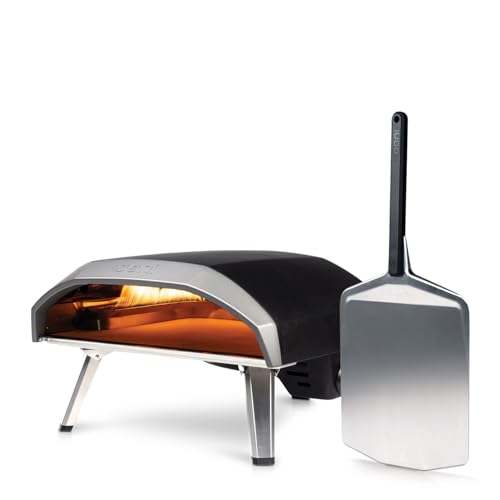
The Koda 16 is Ooni’s gas oven for pizzas up to 40 cm in diameter, and it belongs outdoors. Behind our Amazon link is a bundle of oven and pizza peel; what exactly is in it is covered in the FAQ at the end. In our price box, Santos Grills comes first at approx. €449.
First generation, large format
On its own site, Ooni now lists the oven as “Koda 16 1st Generation”. Alongside it, the manufacturer sells the Koda 2 Pro, which it describes as a further development of the Koda 12 and Koda 16. The Koda 16 is still available in the Ooni shop, in several versions for different gas pressures.
According to the rating plate, the manufacturer is Ooni Limited, based in Broxburn, Scotland. By its own account, the company was founded in 2012 by Kristian Tapaninaho and Darina Garland. On the product page, Ooni writes that the Associazione Verace Pizza Napoletana recommended the Koda 16 for home use. The AVPN is the Naples-based association that sets the rules for Neapolitan pizza.
Among the pizza ovens in our comparison, the Koda 16 has the highest score at 9.4, just ahead of the Gozney Roccbox at 9.3.
Construction and ignition
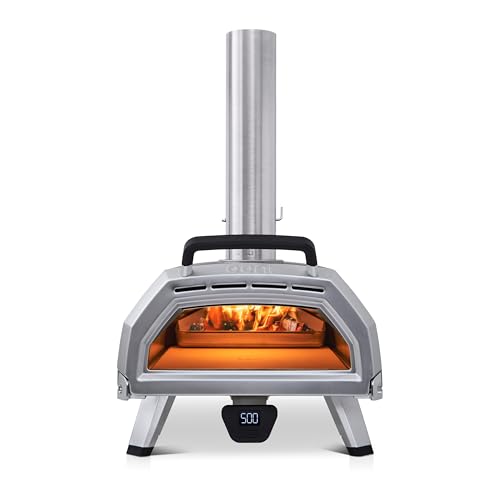
The oven body is powder-coated carbon steel. The inner part, base and legs are stainless steel, and the front and rear nose pieces are aluminium. Ooni states 18.2 kg. The dimensions table on the product page is sloppy: it lists 63, 58 and 37 cm, writes “width” twice and gives metres instead of centimetres for two values. In the product photo the oven is clearly wider than it is tall, so we read the 37 cm as the height.
The legs are foldable tripod legs, and the assembly illustration shows three. Ooni lists the setup as: unpack, unfold the legs, insert the pizza stone, connect, all in under 5 minutes. The parts list has two items, the oven with the code BG07-100A and the stone baking board, as the manual calls the pizza stone. The match holder, which the manual later describes as supplied when it covers lighting, is not listed separately. The oven has no door; the front is open in the photo.
It is controlled with the dial, which Ooni calls a precision control dial. It sits on the side, which according to Ooni keeps you at a distance when lighting, and the gas ignition is built in. The manual describes lighting like this: control knob to OFF, slowly open the bottle valve anticlockwise, then push the knob in and slowly turn it anticlockwise until it clicks and the burner is lit. Then you hold it pressed for 5 seconds.
After several unsuccessful attempts, a match is allowed. You put it in the match holder, light it and guide it through the oven opening to the burner, then you press the knob and slowly turn it to HI. The burner should light immediately. The same rule applies to every failed attempt, with the knob as with the match (with the match, when the burner does not ignite within seconds): knob to OFF, wait 5 minutes for the gas to dissipate, and only then try again. You keep your face and hands as far from the appliance as possible when lighting.
If the burner does not light at all, the troubleshooting section lists five possible causes, each with a remedy: no gas flow (check whether the bottle is empty), union nut and regulator not fully connected (tighten the nut by hand a further half to three quarters of a turn, until it stops and without tools), an obstructed gas flow (clean the burner tube), a burner that is no longer connected to the valve (reconnect it), and incorrect assembly (recheck the assembly steps).
If the flame goes out during operation, a flame failure valve cuts the gas supply automatically. A built-in thermometer, by contrast, appears neither on the product page nor in the manual, and no display is visible in the photo. For the Koda 16, Ooni recommends its Digital Infrared Thermometer, which costs €50 in the Ooni shop (as of 25.09.2026).
In detail: stone and L-burner
The rating plate table in the manual states 8.0 kW, and the section on use says each burner has this output. The Koda 16 has one. Ooni states that the oven reaches up to 500 °C in 20 minutes and bakes a Neapolitan-style pizza in 60 seconds.
The two figures are linked. In a stone oven the pizza cooks from two sides at once: the stone it sits on heats the base, while the topping and crust get their heat as radiation from the flame and the dome and via the hot air beneath. With a one-minute baking time, both sides have to be done at the same time. If the stone is not yet heated through, the base stays pale while the cheese is already browning on top. Preheating is therefore mainly for the stone.
The stone is cordierite and 15 mm thick; as a spare part it measures 520 × 425 mm. In the shorter direction, that leaves a combined 25 mm of stone beside a 40 cm pizza. Cordierite expands little when heated and therefore copes with temperature swings better than many other ceramics; it can still crack. Our guide cracked pizza stone explains what usually causes that. More mass stores more heat. A thicker stone takes longer to heat through but loses less temperature when a cold pizza is slid in.
Ooni calls the burner L-shaped and writes that it distributes heat more evenly; a 40 cm pizza bakes in it “in a single turn”, and the Amazon text says “only turn once”. Turning is needed at all because the side facing the flame browns faster than the side facing away. An L has two legs, so the flame comes from two directions instead of one. This does not make the heat entirely even, otherwise the one turn would not be needed either, and how often you end up turning also depends on the dough and flame height.
An infrared thermometer measures the surface you point it at, in the Koda 16 that is the stone and not the air under the dome. For the base of the pizza that is the more meaningful figure; it says little about the heat from above.
What Ooni leaves open
Our sources are Ooni’s product page, the pages on spare parts, accessories, the Koda 2 Pro and the company, the warranty terms, the CE manual, whose file name points to October 2020, and the Amazon listing for the bundle. None of them states:
- a gas consumption. The rating plate table even has a heading for it, in Danish, but no value.
- a control range. Only the maximum temperature is given.
- a separate baking time for 40 cm pizzas. Ooni’s minute applies to the Neapolitan-style pizza.
- how far the temperature drops when baking several pizzas in a row and how long the oven takes to cool down.
- the interior dimensions of the cooking chamber and the height of the opening.
- the burner material and the type of insulation.
- country of origin and year of market launch.
- the length of the hose on the 50 mbar version. Only the upper limit is documented.
- spare parts for burner, regulator, ignition and flame failure device. In the Ooni shop, only the replacement stone and the cover are documented.
Can the Koda 16 go on the balcony?
Not on the balcony of an apartment complex. The English part of the manual rules out using the oven, fryer or broiler on or under the balcony or deck of a rented or owned apartment. This sentence is missing from the German translation.
The same section only permits use outdoors, not in a building, garage or other enclosed area. The oven should neither stand nor be used under unprotected combustible overhead cover, and the text requires at least 3 m to any structure and any combustible material, worded as applying to a “grill, fryer or broiler”. Ooni’s product page puts it more briefly: with the exception of the Volt and Volt 2, all Ooni ovens are made for outdoor use.
The German version is more concise and badly translated in two places. It gives a minimum clearance of 609 mm at the side and 914 mm at the back, measured up to the area where combustion takes place; the English original means 610 and 915 mm to combustible components. It requires 0.5 m to adjoining walls. In addition, the appliance is supposed to be installed “in a room with sufficient ventilation”, with a permanent supply of fresh air. Deriving permission for indoor use from that would be wrong; the original and the product page require outdoors. We would plan with the stricter value in each case, so in the garden with the 3 m.
Connecting the gas and checking for leaks
The 50 mbar version is intended for Germany. It comes with the hose and regulator pre-assembled, whereas the 30 and 37 mbar versions lack both. This matters because the manual only permits the pressure regulator and hose supplied with the appliance. The hose must comply with EN 16436 and should be no longer than 1.5 m, the regulator with EN 16129. Gas lines and hoses must also meet the applicable national requirements, be inspected at regular intervals and replaced if necessary. Before you turn on the gas, you inspect the hose: if it shows cuts, wear or abrasion, you replace it before use.
The bottle always stands upright and needs a collar that protects the valve. For its size, Ooni sets maximum dimensions, 350 mm diameter and 400 mm height. Common propane bottles are above that: the liquefied gas supplier Progas gives 47.5 cm height with cap for its 5 kg steel bottle and 57.4 cm for the 11 kg bottle. The manual itself also gives 17.9 inches height for a 20 lb bottle in the assembly section, around 45 cm. How Ooni meant the upper limit cannot be clarified from this; we would ask Ooni customer service before buying which bottle fits the 50 mbar version.
Under the heading “LP gas bottle warning” come four points: do not store spare bottles under or near the appliance, never fill the cylinder above 80 per cent, use a bottle with an overfill protection device (OPD), and the note that ignoring this risks a fire with fatal or serious injuries. How to determine the fill level of a bottle is covered in our guide gas bottle for the grill.
When connecting, the bottle valve and control knob are at OFF. You check the valve connections, the connection and the regulator assembly, remove deposits and inspect the hose for damage. Tighten by hand only, until it stops. You do not use a wrench: according to the manual it can damage the quick coupling with union nut and contribute to a dangerous situation.
You need to look closely at the turning direction, because the manual covers several connection types and is not consistent here. For the quick coupling with union nut it says “clockwise”, for the screw-in POL regulator “anticlockwise”. As a general rule for propane bottles in Germany: their valve connection W 21.8 × 1/14 has a left-hand thread. So you tighten the regulator there anticlockwise and loosen it clockwise. Then you open the bottle valve fully, anticlockwise.
Ooni requires a leak check before every use, including on a new appliance, even though the gas connections are checked before shipping. The procedure:
- Remove all packaging material and mix a solution of one part washing-up liquid and one part water; to apply it you need a spray bottle, a brush or a cloth.
- Set the control knob to OFF and open the bottle valve anticlockwise.
- Apply the soap solution to all gas fittings. If bubbles form, there is a leak there.
- If there is a leak, immediately turn the gas supply to OFF, tighten the leaking fitting, turn the gas back on and check again.
- If gas still escapes: gas supply to OFF and contact customer service.
The section on connecting the bottle is stricter: if you find a leak while connecting, you close the bottle valve and only use the oven again once your liquefied gas dealer has repaired it on site.
During the check you do not smoke, and you never check with an open flame. If you smell gas at any point, you stop operation immediately: gas supply off, extinguish any open flame, and if the smell persists, keep away from the appliance and call the gas supplier or the fire brigade immediately. After baking, you turn off the gas at the bottle. To disconnect, you set the control knob to OFF, close the valve, release the regulator from the bottle valve by hand and fit the dust cap on the valve outlet.
Operation and care according to the manual
You never leave the oven running unattended. If there is a fire, you keep away from the appliance and call the fire brigade immediately; you do not try to put out an oil or grease fire with water. A five-point warning is added: keep the supply hose away from heated surfaces; bear in mind that alcohol and prescription or over-the-counter medication can impair the ability to assemble and operate the appliance properly; always keep children and pets away; do not move the appliance while it is in use; and never use it as a heater.
Under the heading “Safety practices to avoid injury” follows a longer list. Ooni introduces it with “including, but not limited to”, so it expressly leaves room for further caution. Here it is in full, with all eleven points:
- Only repair or replace parts of the oven if the manual expressly recommends it. All other maintenance is carried out by qualified personnel.
- Children must not be alone or unsupervised where the oven is used, and must never sit, stand or play at the oven.
- Clothing and other combustible items must never come into contact with the burner or a hot surface before they have cooled. The fabric can ignite and cause serious injuries.
- Wear appropriate clothing, never loose clothing or open sleeves. Some synthetic fabrics are highly flammable and do not belong on the body when baking.
- Do not heat unopened food containers, because the pressure can make them burst, and always pay close attention to what you are doing when lighting the burner.
- Do not touch the outer casing, stone baking board or the immediate surroundings during operation; they become extremely hot and can cause burns.
- No extremely fatty meat and nothing else that intensifies a flashback.
- Keep the area around the oven free of combustible materials such as liquids, rubbish and vapours from petrol or charcoal lighter fluid.
- Do not obstruct the flow of combustion and ventilation air.
- Never use the oven in extremely windy conditions.
- It gets hot under the oven. It does not belong on any table with a combustible tablecloth, plastic or other combustible material.
According to the product page, the Koda 16 cleans its interior itself: turn it to full heat and let the food residues burn off. Before cleaning, the manual requires that the gas supply and control knob are at OFF and that the burner and oven have cooled; in our reading, that applies to everything you do by hand afterwards. Before every lighting you check and clean the interior so that oil that built up during the last bake does not ignite.
You check the burner outlets for blockages before cooking and clean them regularly with a soft wire brush. At least once a year you inspect the burner, because spiders and insects can nest in it and disrupt the gas flow.
For the stone, the manual has six rules, here in full:
- Do not use the stone over an open flame.
- Avoid extreme temperature swings; do not put frozen food directly on the hot stone.
- The stone is fragile and can break if it is knocked or dropped.
- It is very hot in use and stays so for a long time afterwards.
- Do not cool the stone with water while it is hot.
- After cleaning with water, dry it before the next use, for example in a conventional oven at 60 °C for 2 hours.
Ooni sells a replacement stone for the Koda 16, at €60 on 25.09.2026.
What else is an option?
| Model | The difference | Price | Our score | Choose this one if |
|---|---|---|---|---|
| Ooni Koda 16 (this one) | L-shaped burner, pizzas up to 40 cm, thermometer only as an accessory | from €449 | 9.4 | you want to bake pizzas over 34 cm |
| Ooni Koda 12 | Pizzas up to 30 cm, 9.2 kg according to Ooni | from €284 | 9.0 | you rarely bake larger than 30 cm or often load the oven into the car |
| BURNHARD Fat Tony | measures in the baking chamber and stone according to Burnhard, pizzas up to 34 cm Ø | from €499 | 8.6 | you want to read the temperature without buying a thermometer separately |
| WMF Pizzaiolo Pro | 40 cm Ø stone rotates via battery drive, thermometer built in | approx. €425 | 8.3 | you do not want to turn the pizza yourself with the peel |
The prices follow the price box on each page: “from” appears where several shops are linked, and refers to the shop the page highlights. They change constantly. The technical data for the Fat Tony and Pizzaiolo Pro come from the product pages at Burnhard and WMF, retrieved on 25.09.2026. The score is our editorial assessment based on manufacturer data, not a measurement result.
When the Koda 16 fits, and when another oven does
Pizza size first. For the smaller Koda 12, Ooni states 15 minutes to 500 °C and a 10 mm thick stone. That the Koda 12 gets hot faster fits the thinner stone, which has less mass to heat through.
According to Burnhard, the BURNHARD Fat Tony also has 8 kW and an L-shaped burner, plus a measurement in the centre of the pizza stone. Burnhard states a maximum temperature of over 650 °C. In return, it stops at a pizza diameter of 34 cm, 6 cm less than the Koda 16.
On the WMF Pizzaiolo Pro, the cordierite stone rotates by itself, driven by AA batteries, which according to WMF are not included. On temperature, WMF commits only to “over 450 °C”.
If you are willing to spend more anyway, also look at the Koda 2 Pro; what sets it apart from the Koda 16 is in the FAQ.
For the budget, accessories count too. If you add Ooni’s infrared thermometer to our price box price, you arrive at around €499, as much as the Fat Tony costs in our catalogue. For the cover made of waterproof, breathable polyester, Ooni asks €45; on 25.09.2026 it was not available there. The gas bottle comes on top as well, because Ooni’s scope of delivery lists only oven, stone, hose and regulator.