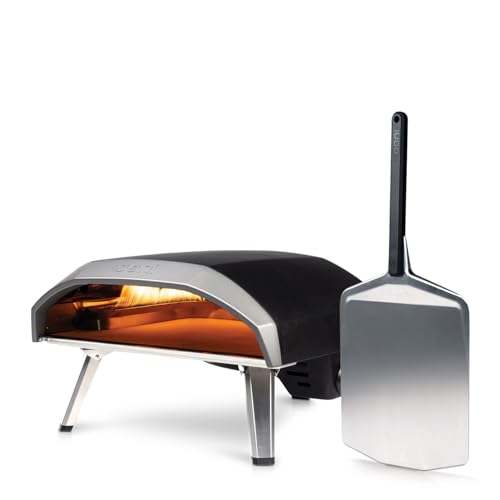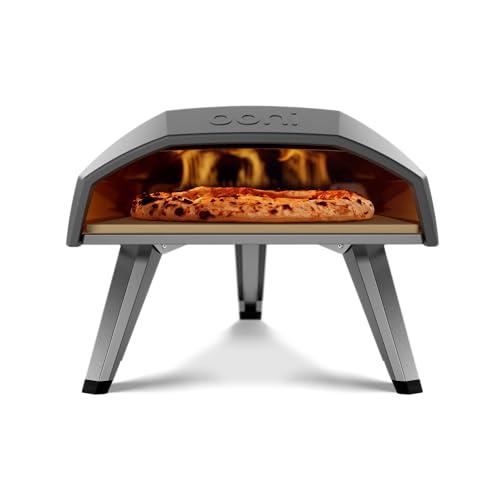
The Ooni Koda 12 is a gas-powered pizza oven for outdoors, built for pizzas up to 30 cm. Ooni now lists it as the 1st generation of its Koda range. We have not had the oven in our hands and have not baked anything in it. What is written here comes from Ooni’s German product page and the warranty pages (retrieved 21.10.2026), the English Essentials Guide for the Koda 12 in the AUG21 version, the Amazon catalogue and the data sheets of our own reviews. We translated the guide ourselves. Our own calculations and ratings are marked.
What the Koda 12 is, and which version is in the offer
Ooni gives 500 °C as the maximum temperature and 60 seconds for a 30 cm Neapolitan-style pizza. For this style, the guide specifies a stone temperature of at least 400 °C.
Our price box lists the Koda 12 at Santos Grills at approx. €284 (in stock on 21.10.2026). At Amazon it was currently unavailable that day, so Santos Grills is the only way to buy in our price box. On Ooni’s product page the manufacturer contradicts itself on the scope of delivery: the description speaks of a base package with pizza peel and protective cover, while the “What’s included” list names only the oven, pizza stone, and hose and gas regulator, the latter with a restriction.
This restriction is the real crux when buying. Ooni builds the Koda 12 for three gas pressures, 30, 37 and 50 mbar, plus separate versions for France (37 mbar) and Switzerland (50 mbar). Ooni assigns the 50 mbar variant to Germany, article number UU-P06B00. Only with this one are the gas hose and regulator pre-fitted in the box. With 30 and 37 mbar, according to Ooni you have to buy an Ooni hose and a gas regulator separately.
The Amazon offer that our price box links to is, according to the catalogue, the “Koda 12 (37 mBar)” with model number UU-P19C00. Under exactly this number Ooni lists the version “37 mBar (France)”. In line with this, Amazon’s product description says that regulator and hose are not included. We did not check which version Santos Grills ships. Before ordering, we would ask for the article number and insist on UU-P06B00, because for country-specific connections even the guide only refers to the manual for the respective country.
Housing, stone and controls
The oven body is made of powder-coated carbon steel. The inner part, base and legs are stainless steel, and the front and rear nose are aluminium. According to the guide, the housing is fully insulated so that it retains heat.
Baking is done on a cordierite stone 10 mm thick. It is not in the oven when you unpack it. According to the guide, setup takes two steps: unfold the legs, insert the stone. The legs can be folded in again for transport and storage, and their feet have caps that keep the oven stable and protect the surface from scratches.
In the product photo the oven opening at the front is open, no door is visible, and the flames rise up the back wall of the cooking chamber. Even so, Ooni’s materials table has a line “the visor borosilicate glass” that cannot be assigned to any component. Based on the photo and the guide, we assume an oven without a glass door.
It is operated by a single gas control knob. It ignites the oven and regulates the flame between minimum and maximum. You check the flame through a viewing hole, and in case you have to light it with a match, there is a holder for it on the oven. A flame safety device, called Flame Safe Device in the guide, is built in.
Ooni gives the set-up dimensions as 62 cm length and 39 cm width. The third figure, 29 cm, is also labelled “width” on the product page and, going by the photo, probably means the height. These are all external dimensions including legs and noses; the area of the stone cannot be inferred from them. For weight, two values appear on the same page: 9.2 kg in the table and 9.25 kg in the description text.
In detail: why the pizza has to be turned in the Koda 12
The guide requires you to turn the pizza every 20 to 30 seconds so that rim and topping bake evenly. It supplies the reason too: the side closest to the flame browns fastest.
Why this is so follows from the design and applies to any oven where the flame burns on one side of the cooking chamber. A pizza receives its heat in two ways. From below, the hot stone conducts heat into the dough. From above and from the side, the flame and the heated ceiling radiate onto rim and topping. Radiant heat falls off markedly with increasing distance from the source, so the part of the rim facing the flame gets more heat than the opposite side. If you turn the pizza in steps, every spot on the rim moves close to the flame once. With a baking time of 60 seconds, by our calculation that is one to two turns per pizza.
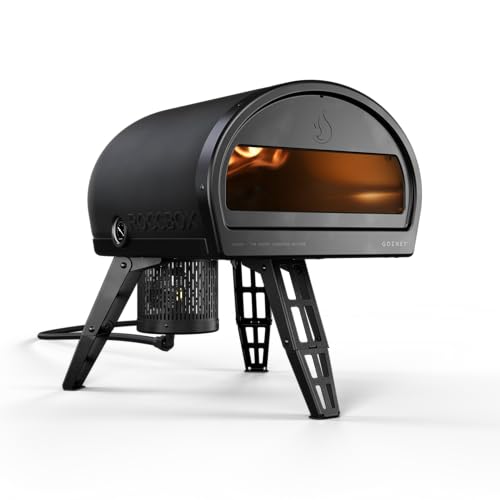
The stone also does its share from pizza to pizza. Every cold disc of dough draws heat out of it, and how much heat a stone stores depends on its mass. The Koda 12 has a 10 mm thick stone, the Koda 16 one of 15 mm, the Gozney Roccbox one of 19 mm. In our assessment the thinner stone heats through faster and also loses temperature faster when several pizzas follow in quick succession. None of us has measured this on this oven.
You cannot read off the 400 °C stone temperature on the Koda 12, as Ooni mentions no built-in thermometer anywhere. An infrared thermometer is among the accessories. Such a device measures the surface you point it at, that is the stone and not the air in the cooking chamber, and that is precisely the more telling value for the pizza base.
The guide sets one limit on idling: the oven should not burn for a long time without baking in it.
How long does the Koda 12 need to be ready to bake?
Ooni gives two figures. The product page promises 500 °C after 15 minutes, while the Essentials Guide plans 20 minutes of preheating and, at low outside temperatures, an extra 5 to 10 minutes. We would allow 20 to 30 minutes.
On the very first lighting, burning in is added. The guide prescribes letting the oven run for 30 minutes the first time before anything goes in.
The guide describes the lighting itself step by step. You push the control knob in and turn it slowly anticlockwise from the 12 o’clock to the 9 o’clock position, which should take at least three seconds. After lighting, you keep the knob pressed for another five seconds and then release it. Ooni describes the ideal flame as a blue flame with yellow tips.
What else is worth considering?
| Model | The difference | Price | Our rating | Choose this if |
|---|---|---|---|---|
| Ooni Koda 12 (this one) | Gas, pizzas up to 30 cm, 10 mm stone, 9.2 kg | approx. €284 | 9.0 | you bake for a small group and often take the oven with you |
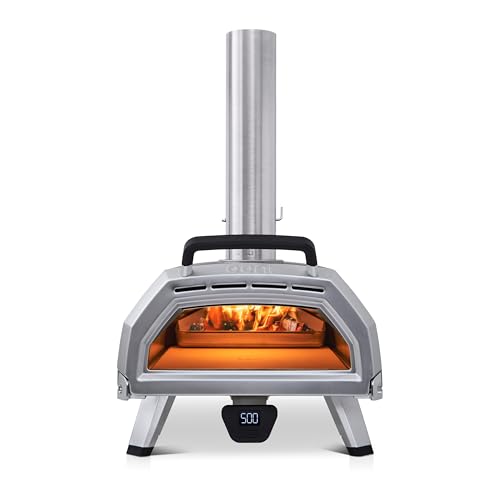
| Ooni Koda 16 | L-shaped burner with 8.0 kW, pizzas up to 40 cm, 18.2 kg | approx. €449 | 9.4 | you want bigger pizzas and the oven mostly stays in one place |
| Gozney Roccbox | also 30 cm, but 19 mm stone and built-in thermometer | approx. €447 | 9.3 | you want to read the temperature on the oven |
| Enders PACO Rotate | Stone rotates by motor, needs mains power | approx. €174 | 8.5 | you do not want to turn by hand and have a socket nearby |
The prices come from our price box, for the Koda 12 (21.10.2026) and for the Koda 16 from Santos Grills, and they change constantly. The rating is our editorial assessment based on the data sheets; nobody has measured it.
When the Koda 12 fits and when another oven does
First, pizza size. In the Koda 12 you bake one 30 cm pizza after another. At 60 seconds per pizza, the bottleneck is more likely the topping than the oven, and in our assessment that is enough for four or five people. If you want 40 cm pizzas, you end up with the Koda 16, which is in our price box at Santos Grills at approx. €449 (Koda 12: approx. €284). According to Ooni, a 40 cm pizza there needs just a single turn.
Then the turning. If reaching for the peel every half minute bothers you, the Enders PACO Rotate is the opposite position. Its 30.5 cm stone rotates by motor, but it needs power at the place of use. In our price box it stands at approx. €174 (Koda 12: approx. €284), and Enders includes a 50 mbar regulator with hose.
The Gozney Roccbox is the choice for anyone who wants to see the temperature instead of measuring it with an extra device. It also bakes up to 30 cm and is in our price box at approx. €447 (Koda 12: approx. €284).
On weight the Koda 12 is ahead, as far as we have manufacturer figures: the Koda 16 weighs 18.2 kg according to Ooni, the PACO Rotate 11 kg according to Enders. With its folding legs, the Koda 12 is the oven in this table you are most likely to take to friends or to the campsite. There, however, it needs the same surface as at home; the rules for that are below under setup.
For your budget, add a propane bottle to the oven, for the 37 mbar version a hose and regulator, and the accessories you need. Ooni names as suitable a 30 cm pizza peel, an oven cover, an infrared thermometer, a pizza turning peel, an oven brush and the cast iron series. Without peel and turner you will get the pizza neither in nor turned.
The Koda 12 is wrong for anyone who wants to run the oven on a small balcony right against the house wall. The guide requires one metre of distance from buildings, and on many balconies that is hard to meet. The guide itself says nothing about balconies; what house rules and tenancy law say about it is in our guide Grilling on a balcony.
Setup, gas and safety according to the Essentials Guide
According to the guide, the Koda 12 is built exclusively for outdoor use. Because it involves gas and an open flame, we give the instructions in full, translated from the English by us. The safety manual that the guide itself refers to is not linked on Ooni’s site.
The safety instructions:
- Fully unfold the legs before use.
- The oven is intended for outdoor use only.
- Do not use in strong wind.
- Read the Koda 12 safety manual carefully and keep it for later.
- Stay with the oven while preheating and baking, never leave it burning unattended.
- The oven is designed for up to 500 °C; if it gets hotter, switch off the flame and let it cool down.
- If a roaring noise comes from the burner, turn off the gas for 5 minutes and relight.
- Incorrect lighting can lead to overheating and damage, so follow the instructions exactly.
- Keep children and pets at a safe distance and supervised at all times.
- The oven gets hot; do not touch the outer shell during operation.
- There may be sharp metal edges inside and outside, so handle with care.
- Any modification to the oven violates Ooni’s terms, voids any warranty and may endanger you or others.
- When lighting, do not look directly into the oven opening, as flames can shoot out at the first firing.
- If the flame has gone out, close the gas supply immediately for at least 5 minutes, and only then relight.
- The gas hose must not be tangled, must lead away from the oven and must not run underneath the oven.
For the place of use:
- The oven works best sheltered from the wind.
- At least 1 m distance from buildings and structures.
- Unfold the legs before lighting.
- Surface of wood, stainless steel or stone.
- The surface must bear more than 15 kg.
- Glass and plastic tables are not recommended.
- Do not expose the oven to moisture and never cool it with water, as this damages it.
- If it does stand in the wind, the wind must blow into the oven from behind.
For the gas:
- Before every bake, check the connections at bottle, hose and regulator for a firm fit and tightness.
- Before every use, do a leak test: apply leak detection spray or soapy water to the connections between bottle and oven.
- If bubbles form, turn off the gas immediately and check the connections; if bubbles keep forming, close the gas and have the regulator serviced.
- Never bake with a device that failed the leak test.
- Before lighting, check all connection points and the hose itself with soap solution or leak detection spray.
- Remove the regulator from the bottle when the oven is not in use.
- If you smell gas, close the valve on the bottle and extinguish open flames; if the smell persists, keep your distance and call the fire brigade.
- The bottle must be full and stand upright.
- To reset the regulator, disconnect it from the bottle for 5 minutes.
How to judge bottle sizes, pressure regulators and fill level in general is explained in our guide Gas bottle for the grill.
Cleaning, care and what the warranty excludes
The care instructions from the guide, in full:
- To clean the interior, run the oven at maximum temperature for 30 minutes so that food residue burns off; after cooling, wipe the inside with dry kitchen paper.
- Wipe the inner shell with dry kitchen paper before every bake.
- Wipe the outer shell with a damp cloth and dry it immediately.
- No abrasive cleaners and none with aggressive chemicals.
- Remove food residue from the burner tube with a wire brush every 3 months.
- The stone is not dishwasher safe.
- For stubborn stains, let the oven cool down completely and turn the stone over.
- The stone may discolour; this does not affect its function.
- The stainless steel in the interior discolours over time.
What is usually behind it when a baking stone cracks is explained in our guide Cracked pizza stone. How to handle dough and heat on a stone in general is in Pizza on the grill.
Ooni’s warranty terms exclude these cases, here without omission:
- Wear and tear to a reasonable extent
- Discolouration or tarnishing from heat
- Surface rust
- Water damage
- Excessive contact with salty air, sea spray and moisture
- Severe storms and natural disasters
- User error
- Minor deformation or warping from prolonged heat exposure, provided it does not impair use
- Use of the product with the wrong fuels
- Use of the product outside the country in which it was bought
- Improper use of the product
The warranty is also limited to the country in which you bought the oven. A condition is that you use it according to the operating instructions, and anyone who modifies it loses it entirely. Ooni never refunds more than the original purchase price. It is a voluntary manufacturer’s warranty, and according to the terms your statutory rights remain unaffected.
What is missing from Ooni’s documents
We looked for this information on the product page, in the Essentials Guide and in the warranty terms, without finding it:
- Nominal heat input in kW and gas consumption in grams per hour
- Shape, position and material of the burner
- Baking surface of the stone in centimetres; only the 10 mm thickness and the 30 cm pizza size are documented
- Internal height of the cooking chamber and dimensions of the oven opening
- Distances to combustible materials beyond the one metre to buildings
- Hose length and regulator type of the 50 mbar version
- Suitable gas bottle size and consumption per evening
- Spare parts specifically for the Koda 12; the page only links to spare parts in general
- Year of market launch, country of origin and country of production
- A German-language CE safety manual on ooni.com