Gas pizza oven with a motor under the stone
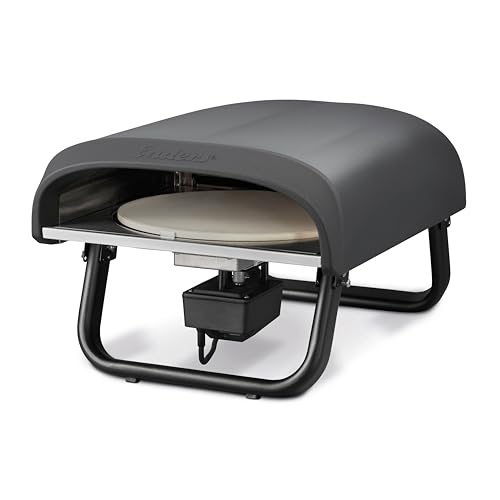
The Enders PACO Rotate (item number 31316) is a pizza oven for liquefied gas from Enders Colsman AG in Werdohl. It has one burner, a round cordierite stone 30.5 cm in diameter and an electric motor that turns the stone while baking. Enders calls this the SELF ROTATING PIZZA function. The product photo shows it well: a flat, dark hood with a wide front opening, the round stone inside, a black box for the drive on an axle underneath, and legs made of bent tube.
The price is approx. €174 (as of September 2026). Enders’ recommended retail price is €229, which is €55 more.
Why turn it at all? In a gas oven with a fixed stone, the flame burns in one spot, and the heat is not spread evenly everywhere. Anyone baking pizza there pushes it along with the peel now and then. The motor takes over that pushing along.
Construction and technology
The burner is made of stainless steel, delivers 4 kW and is infinitely adjustable: the control knob is set between the highest and the lowest level. At full output, the oven uses 291 g of gas per hour according to the manual. It is approved for propane G31 and butane G30, in Germany as appliance category I3B/P(50) with 50 mbar and a nozzle of 0.9 mm diameter, checked against DIN EN 498:2012 (a standard that applies in Germany and the EU).
Ignition is by piezo in the control knob, without a battery. According to the manufacturer, an ignition safety device is built in. The housing is powder-coated and double-walled insulated, the panel is made of cast aluminium, and a thermometer sits at the side of the housing. Set up, the oven measures 65 x 39 x 31 cm (W x D x H) and weighs 11 kg. The legs fold in, which makes transport and storage easier; you should only set the appliance up once they have locked into place.
The stone is removable, which Enders justifies with easier cleaning. The manufacturer gives the cooking surface as 730 cm². That is its figure and fits the diameter of 30.5 cm; we do not derive it from the outer dimensions: the 65 x 39 cm describe the hood including legs, not the round stone.
The manual lists the housing, pizza stone, motor, axle, control knob, gas pressure regulator, lighting aid and four M4x6 screws as the scope of delivery. Assembly takes a Phillips screwdriver. According to the manufacturer’s site, the regulator has a hose rupture protection (EFV). The gas cylinder is missing from the parts list; the manual advises getting advice from a specialist retailer when buying or renting. Colour: black.
In detail: what a rotating stone changes
A pizza stone stores heat and releases it to the dough from below. Cordierite is the usual material for this, because the ceramic tolerates temperature changes better than many other stones. That is general materials knowledge, not a manufacturer’s statement: for the stone, Enders gives only the material and the diameter.
If the stone turns, the pizza travels through all zones of the cooking chamber. The spot that is closest to the flame at any moment changes, and the heat the dough takes up overall evens out. That is our inference from the construction. We have not measured it, and Enders does not back it up with figures either. The pizza does not need to be touched while it bakes, only supervised: the manual forbids leaving the oven unattended during operation.
The motor connects to the mains, 220 to 240 V at 50 to 60 Hz. The appliance has protection rating IPX4, the mains plug IP44. IPX4 means protection against splashing water from all directions, not against jets of water or immersion. The manual also requires distance from moisture and splashing water.
A side effect of the rotating stone appears in the manual as a warning of its own: hair, jewellery, cords and the like must not come near the rotating pizza stone, because they can wind around it. If you have long hair or wear an apron with ties, you should sort that out before the first bake.
How hot does the PACO Rotate get?
Enders does not say. Neither the manufacturer’s site nor the manual gives a maximum temperature. The only documented figure is the preheating time: approx. 10 to 15 minutes at full output, depending on temperature and wind.
Before the first bake, the manual requires you to run the heating element for at least 20 minutes without food on the highest setting, until no more smoke can be seen. After that, normal operation begins.
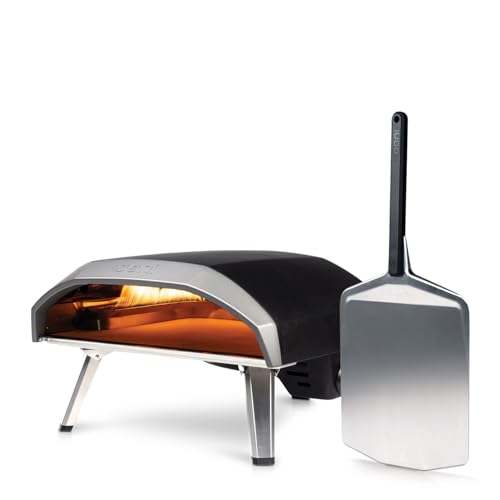
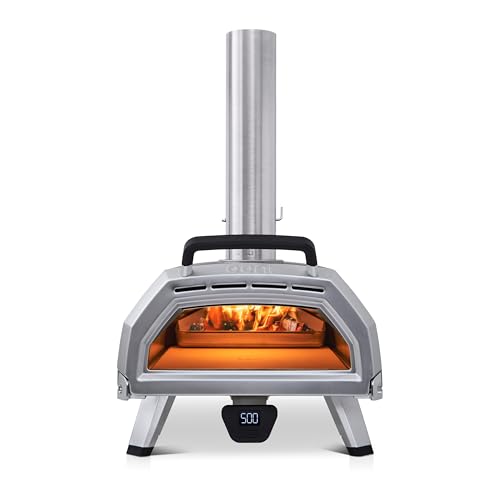
If you compare ovens by degrees, the PACO Rotate therefore gives you nothing to go on. For comparison: Ooni gives up to 500 °C after 20 minutes of preheating for the Koda 16. For the PACO the figure is missing, and we do not invent one. 4 kW is less than the 6.2 kW of the LIKAYA; that is subtraction. What the difference means in degrees or baking time cannot be read from it.
Collected together, what Enders does not state for the PACO Rotate: the maximum temperature, the baking time per pizza, the measuring range of the side thermometer, the rotation speed and adjustable speed of the motor, the thickness of the stone and the burn time per gas cylinder. For the motor output, the manual prints “4 watts”. That looks like a misprint, because the burner delivers 4 kW. We therefore do not state a motor output. The manufacturer also says nothing about balconies; more on that in the FAQ.
Gas, electricity and siting: what Enders prescribes
For gas, electricity and location, the manual applies, not our summary. So here is what it prescribes, point by point in its order.
On gas: the oven may only be operated with a pressure regulator set at the factory for liquefied gas (DIN EN 16129, a standard that applies in Germany and the EU). When connecting, no ignition source or open fire may be nearby. The gas hose must not be kinked or chafe and must stay accessible along its whole length. The union nuts have a left-hand thread and are tightened only hand-tight at the cylinder, without tools. Then comes the leak check with standard leak detection spray or soapy water (1 part soap to 3 parts water); bubbles indicate a leak. A check with an open flame is strictly prohibited according to the manual. Before every use, the hose and regulator must be checked for cracks and damage. The cylinder valve is open only during operation. The cylinder must be protected from strong sun, and its temperature must not exceed 40 °C. It is not stored in the house, not below ground level (cellar, shaft, underground car park) and not in unventilated places. Liquefied gas is heavier than air.
On electricity: the oven may only be connected to a properly installed earthed socket, and the appliance must run through a residual current device (RCD) with a trip current of no more than 30 mA. The cable must not run across paths and must not touch the hot oven. After baking, you first switch off the main switch on the front and only then pull the mains plug.
On location: Enders permits the oven only for baking outdoors, not indoors and not commercially. It needs a level, stable surface and a spot sheltered from wind. The manual gives the distance to combustible materials twice with different values: page 5 says 0.5 m, page 14 says 1 m. We go with the stricter value, at least 1 m. Nothing may be above the oven below a height of 2 m, neither objects nor parts of buildings. The oven is not pushed into or built into a structure and is not moved during operation. The front opening must not be covered with aluminium foil or similar, because that leads to overheating. Grease deposits must also be removed regularly.
The oven must not be operated with charcoal or similar fuels. Accessible parts can get very hot, children stay away, and protective gloves are part of the routine.
Cleaning, care and storage
Cleaning is done after every use. The inside of the cooking hood and the pizza stone are cleared of residues, with mild detergent if needed, then rinsed with water. The oven must be completely dry before the next use. That contradicts what is said about pizza stones in many places (only brush off dry); for the PACO Rotate, the Enders manual applies.
Abrasive and chlorine-containing cleaning agents are not permitted, nor are flammable, solvent-based, stainless steel or oven cleaners. Oil never belongs on the valves.
Repairs to gas-carrying and electronic parts may only be carried out by authorised specialist staff.
The oven is stored frost-free and dry, covered with a weather cover and only once it has cooled down completely. The legs fold in for this.
These three alternatives are worth a look
| Model | The difference | Price | Our rating | Choose this if |
|---|---|---|---|---|
| Enders PACO Rotate (this one) | Motor rotation, 4 kW, stone Ø 30.5 cm | approx. €174 | 8.5 | you have a power socket where the oven will stand and do not want to push the pizza along yourself |
| Royal Gourmet Gas Pizza Oven Compact | 4 kW, stone Ø 30 cm, plate turned by hand | approx. €160 | 8.0 | you bake without electricity and do the turning yourself |
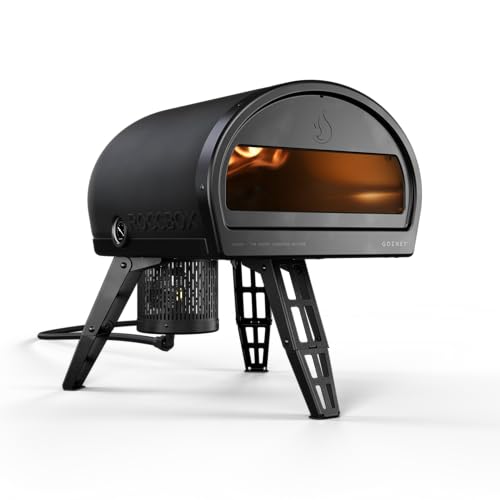
| LIKAYA NeroSpin Gas Pizza Oven | 6.2 kW, turntable, stone Ø 30.5 cm | approx. €300 | 7.7 | you want more burner output and are willing to pay approx. €300 |
| Ooni Koda 16 | 40 cm oven, up to 500 °C according to the manufacturer | approx. €449 (at Santos Grills) | 9.4 | you want to bake larger pizzas and can spend over €400 |
Prices are guide values as of September 2026 and change. The rating is our editorial assessment from the data comparison, not a measurement result, and is not suitable for predicting baking results. The Royal Gourmet costs approx. €160, the Ooni approx. €449, the PACO Rotate approx. €174.
You can find more models in the overview of all pizza ovens.
When the PACO Rotate fits and when it does not
Start with the power socket. The motor needs electricity, and the manual requires an earthed socket and RCD for it. Enders describes the motor as switchable. How best to turn the stone without the motor, the manufacturer does not say. If you have no power where the oven will stand, you end up with the Royal Gourmet: it costs approx. €160 against approx. €174 for the PACO Rotate, the plate is turned by hand according to the Amazon listing, and no socket is needed.
Then the space. At least 1 m from combustibles, nothing within 2 m above, sheltered from wind, outdoors. On a small balcony with an awning or roof overhang, that is quickly not met. Whether your balcony is allowed at all can only be answered by your house rules. The oven weighs 11 kg and has folding legs, so it can be carried, just not during operation.
Gas costs extra. The regulator and hose come with the oven; you have to buy or rent the cylinder yourself. How big the cylinder should be and how to store it is explained in our guide to the gas bottle for the grill. Its figures apply to gas grills in general, not to this oven.
On output: if you want figures, take the Ooni Koda 16 (up to 500 °C after 20 minutes according to Ooni). If you simply want more reserve in the burner, look at the LIKAYA with 6.2 kW. Whether 4 kW is enough for your type of dough cannot be answered from the manufacturer’s data. For the dough itself, you will find the basics in the guide Pizza on the grill.
And if you do not yet know whether a pizza oven is the right thing at all, the Grill Finder helps you narrow it down.
Who is it for?
The PACO Rotate is meant for a fixed spot outdoors with electricity, where a pizza oven is actually allowed to stand. The manual gives approx. 30 cm as the largest pizza and a maximum load of 1 kg; with a stone of Ø 30.5 cm, that leaves hardly any rim.
It is wrong for anyone who wants to bake 16-inch pizzas, for camping without a power source, and for anyone who wants to leave the oven to children: according to the manual, the appliance is not intended for children and people with a reduced ability to operate appliances.