A 12-inch gas oven from Dachau, rotated by hand
The operating manual gives the appliance’s full name as “LIKAYA NeroSpin Pizzaofen 12” Black Edition“. The seller is Fraikin Retail GmbH, based in Dachau, which lists the oven in its own shop at likaya.net; in the Amazon catalogue it appears as the model “NeroSpin 12”. It has been listed in the manufacturer’s shop since 28 October 2025, in exactly one version. There is no other colour, no more powerful burner variant and no successor there. This text is based on the manual, version 1.1 from January 2026.
The NeroSpin is built for liquid gas and for pizzas up to 30 cm. Under the pizza sits a round cordierite stone on a turntable, and you rotate it yourself while baking.
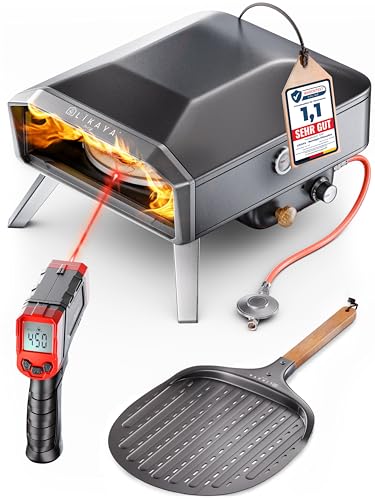
The product photo shows a box-shaped, dark hood with a wide, flat front opening on three angled legs. On the right side sit a round display and a control knob, and the gas hose leaves behind it. The image also shows a tag on the hood with a grade of “1.1 very good”. Who awarded this grade and for what cannot be determined from the manual or the product page. For our assessment it therefore plays no role.
We list the NeroSpin at approx. €300 (Amazon page on 20 October 2026: €299.99). In our overview of all pizza ovens, that puts it between the Enders PACO Rotate and the Ooni Koda 16 on price.
Burner, gas and ignition
According to the technical data in the manual, the burner delivers 6.2 kW. In the Amazon text, LIKAYA describes it as an L-shaped high-performance burner that is meant to spread heat into the corners. Such a burner usually runs along the back wall and one side wall, rather than burning in just one spot. At full load the oven consumes 443 g of propane or 451 g of butane per hour according to the data table.
For Germany, Austria and Switzerland it is designed as appliance category I3B/P(50): butane and propane at 50 mbar, with a 1.05 mm nozzle. Next to it, the table lists three categories for other markets with 28 to 37 mbar and nozzles between 1.13 and 1.2 mm. For you in Germany, only the 50 mbar row counts.
Butane or propane bottles of 2 to 15 kg are approved, with a pressure regulator to EN 16129 and a hose to EN 16436. The manual gives 5 and 11 kg as examples. You buy or rent the bottle yourself; what matters when doing so is covered in our guide to the gas bottle for the grill.
Ignition is by piezo. You open the bottle valve, press the piezo igniter button and turn it, and the burner lights. An automatic flame failure device is built in. Such safeguards shut off the gas if the flame goes out, for example because of a gust of wind. You control the heat with the gas control knob on the oven, and the side temperature display for the interior is there for monitoring.
Stone, rotation knob and what is in the box
The pizza stone is made of cordierite and measures 12 inches, that is 30.5 cm in diameter. For the thickness, the manual prints “1.2 mm thick”. A pizza stone just over a millimetre thick would be more of a tile, so we assume a misprint and state no thickness here.
Rotation is by a knob through a full 360 degrees. The manual describes the procedure like this: immediately after sliding the pizza in, slowly rotate it with the knob. The manufacturer’s shop speaks of a manual turntable. No motor does this for you, so the oven needs no electricity.
The manual lists the following as included: the oven, the cordierite stone, a pizza peel, a laser infrared thermometer, a gas hose with pressure regulator 100 cm long, a black carry bag with a white LIKAYA logo, and the operating manual. According to the product page the peel is perforated, made of aluminium and has an acacia wood handle. Not in the box: the gas bottle.
Amazon lists the oven at approx. 56 × 49 × 32 cm and approx. 15.0 kg, and the shop data also give 15,000 g as shipping weight. Whether these dimensions describe the assembled oven or the packaging, Amazon does not say; LIKAYA gives no dimensions of its own. How big the cooking chamber is inside cannot be read from this. You unfold the three legs before use until they lock into place; according to the manual the oven may only be run with the legs fully locked.
In detail: why the stone has to rotate, and what the two thermometers show
A gas oven with a burner on the rear and side wall does not heat evenly everywhere. The zone near the flame receives more radiant heat from above, the edge on the opposite side less. If the pizza stays in the same spot for 90 seconds, the side near the flame becomes darker than the other. With ovens that have a fixed stone, you therefore lift the pizza with a peel and set it down again turned. With the NeroSpin the stone rotates together with the pizza, which stays put. That is our inference from the design; LIKAYA does not back up the effect with measurements.
The price for this: your hand stays on the knob for the whole baking time. That is no disadvantage compared with turning with the peel, but it is one compared with a motor, as the Enders PACO Rotate has.
The second point concerns the stone as a heat store. A dough round laid on cordierite at 400 °C draws heat out of the surface. After every pizza the stone is therefore below its starting temperature. The manual allows for this and advises continuing to heat for 5 minutes after each pizza so that the stone holds its temperature.
And then the two displays. According to the manual, the side temperature display refers to the interior, so it measures the air in the oven. The infrared thermometer, by contrast, measures the surface the laser dot points at. For the manual’s target value, approx. 400 °C at the stone, the infrared device is the right tool. In general, infrared readings depend on how strongly a surface radiates heat; two different devices therefore do not necessarily show the same number on the same stone.
Does the NeroSpin reach 450 or 400 degrees?
The sources contradict each other. The manufacturer’s shop and product title speak of up to 450 °C, the Amazon description of up to 400 °C. The manual works only with a target value: stone at approx. 400 °C, reached after at least 30 minutes of preheating.
We would plan with 400 °C, because that is the value LIKAYA bases the actual baking process on. Once it is reached, a pizza is done after approx. 90 seconds according to the manual. With the 5 minutes of reheating, that works out on paper at one pizza every 6.5 minutes, so about nine per hour after preheating. For an evening with six people and one pizza each, that means: a good 30 minutes of preheating, then around 40 minutes of baking.
The recipe in the manual assumes dough balls of approx. 250 g, rolled out to a round of approx. 30 cm. On the 30.5 cm stone that leaves barely a quarter of a centimetre of space all round. If you are used to larger rounds, you need to portion smaller here.
Collected together, what LIKAYA does not state about the NeroSpin: the burner material, the material and construction of the rotating mechanism, the interior dimensions of the baking chamber and the height of the opening, the time to 450 °C, a reliable stone thickness, whether the housing is double-walled or insulated, the measuring range of the infrared thermometer, the country of origin, certification marks such as a CE identification number, a matching cover and its own dimensions and weight beyond Amazon and the shipping weight. Wood or pellets appear in no source; the NeroSpin is a pure gas oven.
Setup and gas: what the manual prescribes
The wording of the manual counts here, so its points are listed in its order.
For commissioning (page 4), the oven must stand outdoors on a level, heat-resistant, non-flammable surface. The minimum distance to walls, furniture or other objects there is 1 metre.
The safety notes on page 13 require: use outdoors only. Keep children and pets away from the oven and from the area around the gas bottle. Do not use it in strong wind and not in enclosed spaces, tents, motorhomes, on boats or under cover. Make sure the ground is solid, level and non-flammable, so no plastic and no tablecloths. Keep at least 1.5 m clearance from surrounding objects and walls. Do not move or cover the oven during operation. It becomes extremely hot outside and inside, especially the housing, pizza stone and turntable; during use and for up to 2 hours afterwards you do not touch it with bare hands, and you wear heat-resistant barbecue gloves.
So page 4 says 1 m and page 13 says 1.5 m. We stick to the larger value.
On gas, page 14 says, in addition to the bottle rule above: check gas connections for leaks with soapy water before every use, never with an open flame. Never smoke and have no open flame during setup and when changing the bottle. Close the bottle fully after every use and stand it upright at least 45 cm from the oven. The hose is to be checked every 6 months and replaced if necessary; do not operate with a damaged or aged hose. Ignite only with the built-in piezo igniter, and keep your face and hands out of direct line with the oven entrance. Stand to the side or behind the oven, because with over-gassing flames can come out up to 20 cm. Never leave the oven unattended, not even while preheating, and stay alert despite the flame failure device. Make no technical modifications to the appliance; repairs and maintenance only by qualified personnel or as described in the manual. Check the burners regularly for blockage by insects, oil or soot and clean them with a soft brush. Supply lines must not be twisted, kinked or crushed.
The general tips add: use only the recommended gas types and the recommended accessories.
Burn-in, cleaning and storage
Before the first pizza, you run the oven with the stone inserted for approx. 30 minutes at full power and rotate the stone several times. Slight smoke or odour during the first burn-in is normal according to LIKAYA.
After baking, you set the control knob to zero, close the valve on the gas bottle and let the oven cool completely for approx. 2 hours. Only then is it cleaned; the manual prescribes this for every cleaning.
You wipe the housing with a damp cloth, with mild detergent if needed. Aggressive or abrasive agents are taboo because they can damage the powder coating.
For the stone, a strict rule applies: never clean the cordierite stone with water, because it is porous and would soak up water. You remove residues with a scraper or brush. Burnt-in stains remain, which according to the manual is normal. As a tip it suggests letting the stone burn off for 10 to 15 minutes at high heat. When and why stones crack anyway is explained in our guide cracked pizza stone.
The aluminium and acacia wood peel does not belong in the dishwasher; it is cleaned by hand.
The oven is stored dry, frost-free and protected from the weather, which is what the carry bag is for. At the end of its life, according to the manual it consists mostly of metal and goes to a scrapyard or recycling centre.
These three alternatives are worth a look
| Model | The difference | Price | Our rating | Choose this one if |
|---|---|---|---|---|
| LIKAYA NeroSpin (this one) | Turntable via knob, 6.2 kW, peel and thermometer included | approx. €300 | 7.7 | you want to rotate without electricity and buy the accessories along with it |
| Ooni Koda 12 | 30 cm gas oven according to Ooni, same size class | approx. €284 | 9.0 | you want, at the same pizza size, the oven with our higher rating |
| Enders PACO Rotate | Electric motor rotates the Ø 30.5 cm stone, 4 kW | approx. €174 | 8.5 | you have a power socket where you set up and do not want to rotate by hand |
| Ooni Koda 16 | Pizzas up to 40 cm, 8.0 kW, up to 500 °C according to Ooni | approx. €449 | 9.4 | you want your pizzas to be larger than 30 cm |
The prices are guide values from our price boxes; for the Koda 12 and the Koda 16 they apply at Santos Grills. The rating is our editorial assessment based on the data comparison and says nothing about baking results.
When the NeroSpin fits and when another oven does
Start with pizza size. On the NeroSpin it stops at 30 cm, and the manufacturer’s recipe already uses those 30 cm in full. If you would rather bake a few large pizzas per round, you end up at the Ooni Koda 16: Ooni states 40 cm pizzas, 8.0 kW and up to 500 °C after 20 minutes. It costs approx. €449, the NeroSpin approx. €300.
Then the question of electricity. The Enders PACO Rotate rotates its equally sized stone with an electric motor, but needs a power socket where you set it up and has 4 kW instead of 6.2 kW. It is at approx. €174 in our price box, the NeroSpin at approx. €300, and according to Enders it weighs 11 kg. For camping without a power connection the NeroSpin is the more suitable of the two, for a terrace with an outdoor socket more likely the PACO.
That leaves the direct competitor in the same size. The Ooni Koda 12 costs approx. €284 at Santos Grills, the NeroSpin approx. €300, and the Koda 12 is clearly ahead in our rating at 9.0. We would choose the NeroSpin over it mainly if you value the turntable and do not want to buy the peel and thermometer separately.
The place you set it up decides everything else. 1.5 m clearance all round, no cover overhead, the bottle 45 cm beside it: on a terrace or in a garden that is feasible, on many balconies it is not. What applies there in general is covered in the guide grilling on a balcony.
Also allow time. Half an hour of preheating before the first pizza and two hours of cooling before the oven may go in the bag: for a quick pizza after work with tidying up afterwards, that makes for a long evening.
The NeroSpin is the wrong choice for anyone who regularly bakes pizzas over 30 cm, for anyone who only has room under a roof or awning, and for anyone who would rather have their hands free while baking. If you do not yet know which oven type suits you, narrow it down in the Grill Finder.