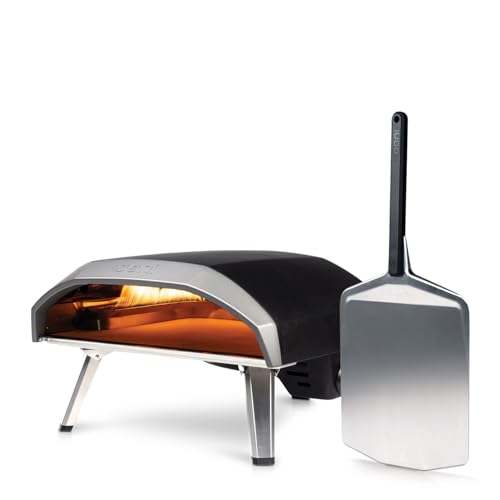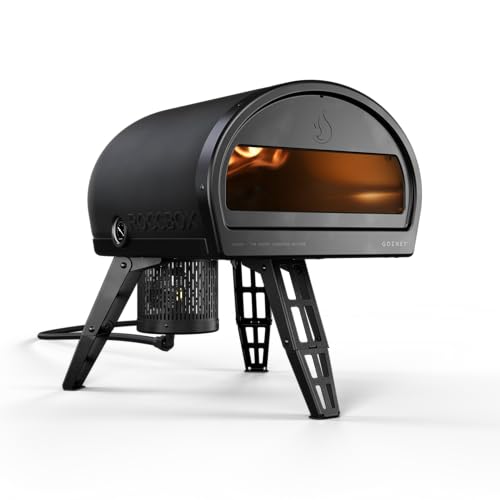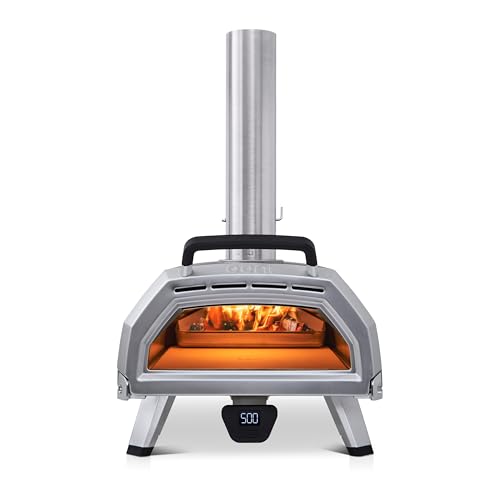
A gas oven for pizzas up to 34 centimetres
The Fat TONY is the larger of two gas pizza ovens that Burnhard sells in its Tony series. It stands on a table, runs on liquid gas from a cylinder, and pizzas up to 34 cm in diameter fit on its stone.
At Burnhard it costs approx. €499 (as of September 2026). Burnhard lists the oven under article number 945613. The Amazon listing we had linked so far was shown by Amazon on 20 October 2026 as the smaller TONY model; we therefore link only the Burnhard shop. The manufacturer is Burnhard GmbH from Düsseldorf.
In our pizza ovens category, the Fat TONY sits at around €450 to €500 among the gas ovens. What separates it from its neighbours is less the burner than the thermometer in the box.
Housing, burner, stone: what the oven is made of
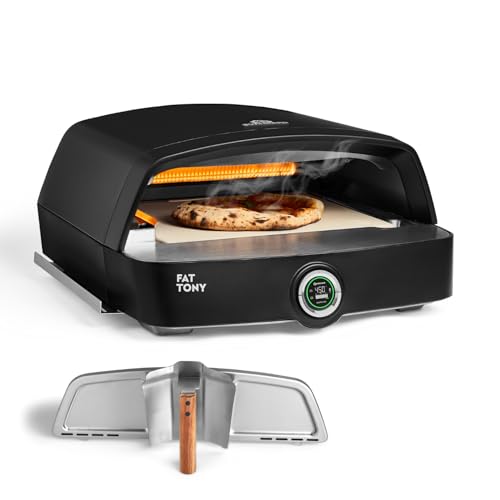
The shell is powder-coated steel, the interior and floor are stainless steel. In the product photo the housing is matt black, with a wide, flat opening at the front and a front panel below it: the lettering on the left, the round thermometer display with a light ring on the right. Burnhard gives the handle as acacia wood. In the picture it sits on the heat shield, a separate sheet metal part with two side wings.
The burner is L-shaped and has a nominal heat input of 8 kW. Burnhard describes long, rolling flames that come from the back and from the side; in the photo it glows at the top of the rear wall. The gas flows through two nozzles of 0.9 mm each. It is controlled with a knob on the side, continuously between HI and LO. Ignition is by piezo. If the burner does not light after three to four attempts, you turn the knob to OFF, close the cylinder valve and wait 5 minutes before trying with a long match. In general, such a pause lets unburnt gas disperse.
The pizza stone is cordierite, 35 × 38 cm and 2 cm thick. For the pizza itself, Burnhard states up to 34 cm in diameter, the insertion height is 14 cm. Besides pizza, Burnhard names quiche, flammkuchen and bread as uses. Anything taller than 14 cm when pushed in, such as a well-risen loaf, does not fit.
Weight according to the product page: 21.5 kg. Burnhard’s documents slightly contradict each other on the dimensions. The product page gives 28.5 × 57.5 × 62.5 cm, the instructions 59 × 63 × 28.5 cm (width, depth, height). The height matches, the other two values are 1.5 and 0.5 cm apart. For the footprint, we would plan with 59 × 63 cm. Amazon lists approx. 28 kg, which in our assessment is the package.
According to the instructions, the box contains the oven with control knob, the bracket and the heat shield (handle, intermediate plate, shield), the thermometer, hose with pressure regulator, the pizza stone, a screwdriver and three M4 × 12 screws. You have to buy a pizza peel separately. During assembly you should wear safety gloves, because the oven may have some sharp edges.
In detail: why a pizza oven needs two temperatures
A pizza gets its heat in two ways. From below through contact with the stone, from above through radiation from the flame and the hot ceiling and through the hot air that flows through the chamber. The two paths heat up at different speeds.
The air is hot after a few minutes. A 2 cm thick ceramic stone takes much longer, because cordierite generally conducts heat poorly and has a lot of mass that first has to warm through. If you only see the air temperature, it is therefore easy to slide the pizza in too early: the rim browns on top, while the base stays pale below. With the third or fourth dough in a row it can run the other way round, then the stone has given heat to the doughs while the air is still hot. That is physics and applies to every stone oven. None of us has measured it on this device.
Burnhard’s answer is a thermometer that, according to the manufacturer, “constantly measures the circulating air temperature in the baking chamber and additionally the heat in the centre of the pizza stone”. You choose one of two programmes or bake without. Neapolitan sets a minimum temperature of 400 °C, Classic 320 °C. The ring around the display lights white while the oven is too cold, green at the right temperature and red when it gets too hot. According to Burnhard, you are ready when the outer ring lights up fully green.
Small details from the instructions: the display has three brightness levels (BL3, BL2, BL1), and a long press on the programme button switches between °C and °F. It switches itself off after 30 minutes once the oven and stone are both below 100 °C. The device itself measures 6.7 × 6.7 × 9.6 cm, weighs 125 g, runs on batteries and is inserted and removed via a magnetic sliding contact. According to the cleaning section, you keep the opening for it and the contacts clean.
Our assessment: the value in the middle of the stone is the useful part. With an infrared thermometer you can also measure the stone surface, but only at the moment you aim it. Here the number sits next to the air temperature while you top the next dough.
How long does the Fat TONY need before the first pizza can go in?
Burnhard states 20 minutes to 650 °C, with the heat shield inserted. Before the very first bake, there is also a one-off hour of burning in without pizza, likewise with the shield. Without the shield it takes longer, a figure for this is missing.
The procedure according to the instructions: take the shield out, ignite, insert the shield and heat up. According to the product page, it keeps the wind off, and between two baking rounds you can use it to turn the flame down without the oven losing much temperature, which saves gas. Burnhard gives the maximum temperature as over 650 °C, the Amazon title speaks of 450 °C to 650 °C.
For the pizza itself, Burnhard states 90 seconds with just one turn. The Amazon text says you can bake up to 5 pizzas in a row. If the stone has become too hot, the instructions advise turning to LO, taking out the shield and switching the oven off so that it cools quickly.
Over time the interior and the heat plate discolour. Burnhard attributes this to heat oxidation and calls it normal.
Gas: cylinder, pressure regulator and what a fill gives you
The Fat TONY is operated exclusively with butane (G30) or propane (G31). The appliance category is I3B/P (50), and an outlet pressure of 50 mbar applies for Germany and Austria. The supplied pressure regulator is fixed, complies with DIN EN 16129 and DIN EN 16436-1 (German and EU standards that apply in Germany and the EU) and lets through at most 1.5 kg/h. The hose is pre-assembled and at most 1.5 m long.
You buy the cylinder separately. Three sizes are approved:
- 5 kg, 420 mm high, 200 mm diameter
- 8 kg, 505 mm high, 229 mm diameter
- 11 kg, 600 mm high, 300 mm diameter
Burnhard advises getting advice from a specialist dealer when buying or renting the cylinder. More on cylinder types, deposit and exchange is in the guide Gas bottle for the grill.
On consumption, the instructions give exactly one value: 582 g/h for the burner at nominal load. From this you can calculate how long a fill lasts at full load. A 5 kg cylinder gives just under 8.6 hours, an 8 kg cylinder around 13.7 hours, an 11 kg cylinder just under 19 hours. That is the worst case. After heating up, the burner often does not run on HI, how much less it then draws we do not know.
For tightness, Burnhard requires a check before first use and after every cylinder change. All sealing points are sprayed with leak detection spray or brushed with soapy water, in a ratio of 1 part soap to 3 parts water. Then open the cylinder valve: bubbles show a leak. Close the valve again, tighten the nuts, repeat the check. If bubbles keep rising, you close the valve and go to a specialist dealer. Before every use you also check the point between pressure regulator and cylinder. Smoking is taboo while doing so, and so is an open flame as a testing aid.
You replace the pressure regulator and hose after 10 years at the latest, even without visible damage. A new hose may also be at most 1.5 m long. Repairs to the gas system are reserved for authorised specialist personnel.
Setting up, cleaning, storing: what the instructions prescribe
The oven may only run outdoors, never in a building, a garage or another enclosed area. For the outdoor spot, the instructions name these points: stand sheltered from the wind, away from moisture, splashing water and electrical cables, at least 1.5 m clearance to all combustible materials and 7.5 m to all flammable liquids, a level, stable and fireproof surface, and the gas cylinder protected from strong sunlight. The ventilation openings of the housing must under no circumstances be covered. What this means for small outdoor spaces is sorted out by our guide Grilling on a balcony.
After every bake, you let the oven burn on HI for 20 minutes so that residues burn off. For the actual cleaning, you first remove the gas cylinder and wait until the oven has cooled enough. You may wash the interior and exterior with water and a mild washing-up liquid, but not with flammable cleaners.
For the stone, the instructions are more precise. You carefully scrape off burnt-on residues from the fully cooled stone, for example with a metal brush or a scraper. If you want to clean it wet, then “exclusively water without any washing-up liquid”, and it must not soak in water. Afterwards it dries for 3 hours at 80 °C or 24 hours in the air. For pyrolysis, you set the oven to the highest setting and insert the heat shield. Why a wet stone can crack during the next heating is explained by the guide Cracked pizza stone.
A thorough cleaning is planned every 3 to 4 months and after longer idle periods, in which you also check the venturi tube with the insect screen. Because of spiders and insects, the instructions also say the burner should be checked at least once a year.
For storage, the oven belongs in a frost-free, dry place. According to Burnhard, the stone tolerates neither moisture nor strong temperature fluctuations and goes indoors. The product page says you can also keep the oven outdoors with weather protection, in which case you take the stone out beforehand. A matching cover is available from Burnhard for an extra charge.
Warranty, and what Burnhard leaves open
Burnhard gives the BURNHARD Premium Warranty of five years from the purchase date on the Fat TONY, without registration. It is voluntary, covers material and workmanship defects and applies in Germany and Austria. In a warranty case, Burnhard repairs, sends spare parts for you to swap yourself, or replaces the appliance. The electronic components are not covered: thermometer, thermometer slot, temperature sensor and cable. The very part that distinguishes the oven from its neighbours therefore falls only under the statutory warranty of 2 years.
The terms list a longer series of exclusions that you should read in full before buying. Three of them particularly concern a pizza oven: lack of maintenance, including of the burner tubes with regard to cobwebs; cosmetic defects such as scratches, surface and flash rust, discolouration and heat stains; and damage caused by moisture or wrong fuels.
Our sources were the product page, the operating instructions from February 2025 and the warranty terms, all read on 20 October 2026. We never had the oven in our hands. The following remain open:
- the material of the burner
- the grade and wall thickness of the stainless steel
- the heat-up time without the heat shield
- the gas consumption per pizza or per evening
- the interior dimensions of the baking chamber apart from the insertion height
- measuring range and accuracy of the thermometer
- whether flame monitoring with a thermocouple is fitted, it does not appear in the instructions
- whether stone and thermometer are available individually as spare parts
- the country of manufacture
These three alternatives are worth a look
| Model | The difference | Price | Our rating | Choose this one if |
|---|---|---|---|---|
| BURNHARD Fat TONY (this one) | 8 kW, pizzas up to 34 cm, thermometer for air and stone included | approx. €499 | 8.6 | you want to see the stone temperature without measuring separately |
| Ooni Koda 16 | L-burner, according to Ooni for pizzas up to 40 cm | approx. €449 | 9.4 | you want your pizzas to be larger than 34 cm |
| BURNHARD TONY | 5.9 kW, pizzas up to 29 cm | approx. €198 | 8.4 | you mostly bake for two people and want to spend half |
| SANTOS O-160 | 7.5 kW, integrated turntable | approx. €450 | 8.7 | you do not want to turn the pizza by hand |
Prices from our price box, as of September 2026, the rating is our editorial assessment and not a measured value. We looked up the technical details for the three other ovens on 20 October 2026 at Ooni and on Burnhard’s TONY page, the details for the SANTOS O-160 come from our review of that oven. The pizza ovens ranking shows all the ovens side by side.
When the Fat TONY fits, and when another oven
First the pizza size. If you shape dough balls for 40 cm, the Fat TONY is wrong for you, because it ends at 34 cm. That leaves the Ooni Koda 16 in our comparison, which is at approx. €449 in our price box, the Fat TONY at approx. €499. If 29 cm is enough for you, for example because for two people usually only two pizzas reach the table, the small BURNHARD TONY at approx. €249 costs exactly half.
The second question is whether you need the measurement. If you already have an infrared thermometer and like measuring yourself, with the Fat TONY you pay for something you already own. If you have your first pizza evenings ahead of you, you benefit most, in our assessment, from the green ring, because it answers the question “is the stone ready yet?” without experience.
Third, turning. The Fat TONY has no turntable, you turn the pizza once by hand with the peel, according to Burnhard. If you do not want that, you need an oven with a turntable. And if you are not yet sure whether it has to be your own pizza oven at all, you can start in the Grill Finder.
Fourth, space. Plan for a footprint of around 59 × 63 cm plus the clearances from the instructions, and for an oven of over 20 kg that you cannot just tuck under your arm. A plastic folding table is ruled out as a base, a fireproof surface is required.
Then the budget. On top of the oven at approx. €499 come the gas cylinder, the four AA batteries, a peel and, if it is to stay outside, a cover that Burnhard lists for an extra charge. Burnhard also lists several sets with accessories; which one is worth it depends on what you already own.
The wrong choice is the Fat TONY for anyone who wants to earn money with it. Burnhard writes that the oven is not intended for commercial use, and it is not meant for installation in or on leisure vehicles and boats. That rules it out for a pizza stall at the weekly market and for fitting out a camper van.