A gas oven for one pizza at a time
The TONY is Burnhard’s small gas pizza oven, item number 945615. On Amazon it is listed at approx. €198 (Amazon page on 20 October 2026: €198.09), in the Burnhard shop the oven on its own costs approx. €249 (as of 20 October 2026), and the larger sister model Fat TONY is in the same range.
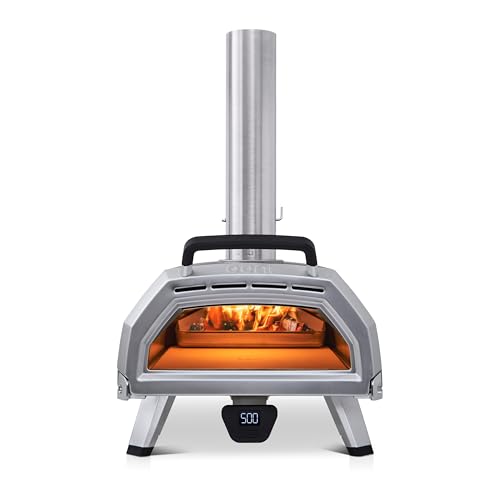
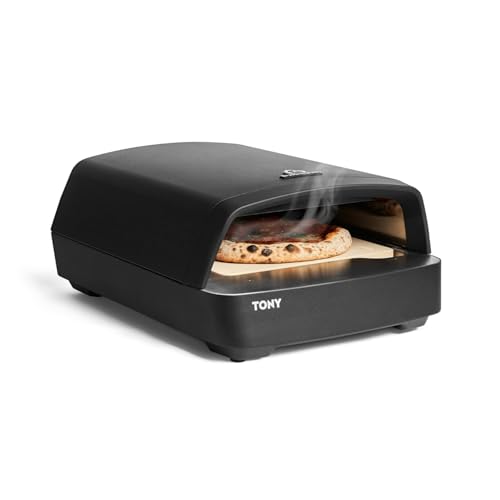
The device does exactly one thing. A gas burner heats a flat baking chamber with a 33 × 33 cm stone on its floor, and on that you bake a pizza up to 29 cm in diameter. The TONY has no grill grate, and wood is off limits: the manual explicitly prohibits charcoal, briquettes and lava stones in the oven. Of the four gas ovens in our table further down, it takes the smallest pizza. How it compares with the other models is shown in our overview of pizza ovens.
For a gas appliance, the paperwork is decent. According to the declaration of conformity in the manual, the oven complies with the EU Gas Appliances Regulation 2016/426 and the standard EN 498:2012. The type-examination certificate ITS-2575-GAR-2440428-R1 was issued there by Intertek Italia (notified body 2575) on 9 July 2024, valid until 18 June 2034. The German manual is dated 2024-08 and is freely available as a PDF, with gas data, clearances and cleaning rules. Most of this page is based on it.
Burner, stone and housing in numbers
For the burner, the manual states a nominal heat input of 5.9 kW, based on the gross calorific value (Hs). It is made of cast metal and built in an L shape. The flames therefore come from the back and the side according to the product page. The nozzle specification is 2 x 0.74 mm, consumption 429 g/h. Butane (G30) and propane (G31) at 50 mbar are approved, appliance category I3B/P (50). Natural gas is explicitly excluded.
Ignition is by piezo. You press the control knob, turn it anticlockwise until the ignition clicks, and then further to HI. After that, any position between HI and LO can be selected, and the control knob is on the side.
The stone is made of cordierite and is 1.5 cm thick. Above it there are 10 cm of insertion height. The shell is made of powder-coated steel, and the interior and control knob are clad in stainless steel.
On the dimensions, the sources differ from each other. The product page gives 24.8 × 47.7 × 58.5 cm without stating an order, the manual gives 50 × 58 × 25 cm as width, depth and height. The product photo shows a flat housing with a domed hood and a wide opening at the front, standing on small feet under the base plate; the roughly 25 cm is therefore the height. For the footprint, we would plan with the larger values from the manual and leave space for the bottle next to it. The weight is given in the manual as 14.5 kg. Amazon’s catalogue lists, converted, approx. 64 × 53 × 35 cm and approx. 16 kg, which looks more like the carton.
What Burnhard leaves open
According to the product page, manual and spare parts list, these points remain without information:
- Material and dimensions of the heat shield, heat-up time with the shield
- Ignition safety device or flame monitoring
- a thermometer on the device
- Gas consumption per pizza or running time per bottle size
- Connection thread of the pressure regulator on the bottle
- Country of production and year of market launch
- a manufacturer’s guarantee beyond the statutory warranty
- a statement on use on a balcony
In detail: stone, flame and the question of temperature
In an oven like this, a pizza bakes from two sides at once. From below, the stone releases its stored heat directly into the base of the dough, from above the flame and the hot hood radiate onto the toppings. Both have to match. If the stone is still cool and the flame is already turned fully up, the crust is dark before the base is done. Before the first pizza goes in, the temperature of the stone therefore counts, not that of the air.
In the manual, Burnhard gives two target values: 400 to 450 °C in the centre of the stone for Neapolitan pizza, 250 to 300 °C for classic pizza. You can only measure that with an infrared thermometer that you bring yourself. According to the manual, wind and outside temperature affect the temperature in the oven, so on a cold, windy evening it takes longer.
The L-shaped burner aims at a familiar problem of small ovens. If the flame sits only at the back wall, the rear half of the pizza gets hotter than the front, and you keep turning it. With flames from the back and the side, a single turn should be enough according to the product page, and Burnhard gives the baking time as 90 seconds. Several pizzas in a row are also said to work without reheating in between. Whether a 1.5 cm thick stone still has the same temperature after the third pizza as before the first has not been published for this oven by anyone, and a look with the thermometer between two pizzas settles that faster than any manufacturer figure.
Cordierite is a ceramic with low thermal expansion and therefore tolerates temperature jumps better than many other types of stone. Against water that helps little: according to the manual, the stone tolerates neither moisture nor strong temperature fluctuations.
On the maximum temperature, Burnhard contradicts itself. The technical data on the product page say up to 500 °C, over 650 °C with heat shield. The highlights of the same page give 450 °C as the baking temperature, its FAQ says over 450 °C, and Amazon’s product title also carries the 450 °C. Whether air or stone was measured is not stated anywhere. Our reading: 450 °C is the baking temperature the oven is designed for, 500 °C the upper limit without the shield. For the Neapolitan target values in the manual, the 650 °C are not needed.
How long does the TONY preheat, and how far does a bottle go?
Without an infrared thermometer, according to the manual you should wait about 15 to 30 minutes. At 429 g/h on full power, a 5 kg bottle theoretically lasts just under 12 hours of burn time, an 8 kg bottle about 18.5 and an 11 kg bottle about 25.5 hours.
That is an upper limit for consumption, because the 429 g/h belong to full output, and after heating up you often turn down. That output and consumption match each other can be checked by calculation: 5.9 kW divided by 0.429 kg/h gives 13.75 kWh per kilogram, and that is in line with the calorific value of butane, which is given in the specialist literature as around 13.7 kWh per kilogram.
A pizza evening uses more gas than just the baking time. After each use, according to the manual, the oven should burn off for 20 minutes on HI. With 30 minutes of heating up, that is already 50 minutes on full power before the baking time even counts. Eight pizzas at 90 seconds each make twelve minutes, with topping and sliding in between more like half an hour. If we assume an evening with 80 minutes on HI, that is around 570 g of gas, and a 5 kg bottle then lasts eight to nine such evenings. If you turn down in between, it lasts longer.
The supplied pressure regulator is rated for a maximum of 1.5 kg/h, a good three times what the burner draws. How you buy, swap and store bottles is covered in our guide to the gas bottle for the grill.
What is in the box and what you buy on top
According to the product page, the scope of delivery includes the oven with control knob, the pizza stone and a gas hose with pressure regulator for 50 mbar. You have to get a gas bottle and a pizza peel separately. You insert the stone yourself during assembly, as the last step: first screw on the gas hose anticlockwise, connect the pressure regulator, fit the control knob in the OFF position, then place the stone in the oven.
The heat shield, which is supposed to make the over 650 °C possible in the first place, is an accessory. In the Burnhard shop it costs €44.90 on its own, the set of oven and heat shield €278.00, so buying both together is €15.90 cheaper than buying them separately in the Burnhard shop (as of 20 October 2026).
The matching 29 cm pizza peel is listed there at €39.90, but was not available on 20 October 2026. The set of oven and peel costs €275.00. Beyond that, the TONY range in the Burnhard shop runs from the Advanced set with three items for €315 through the Pro set (four items, €355) and the Ultra set (five items, €380) to the set with grill side trolley for €699.
Our assessment on budget: in practice, an oven comes with a peel, a bottle and an infrared thermometer, without which the target values in the manual cannot be checked. We would only buy the heat shield later, if the stone heats up too slowly for you or you want to clean it by pyrolysis.
Setting up, connecting, operating: what the manual prescribes
Under the heading intended use, the manual names four points. The oven may only be used outdoors. You never operate it in a building, a garage or any other enclosed area. It is not intended for installation in or on leisure vehicles and/or boats. And parts sealed by the manufacturer must not be modified. Elsewhere, Burnhard excludes commercial use.
For the location, there are five requirements. The oven stands sheltered from the wind. It is kept away from moisture, splashing water and electrical cables. It keeps at least 1.5 m clearance from all flammable materials and 7.5 m from all flammable liquids. It stands on a level, stable and fireproof surface. And the gas bottle is protected from strong sunlight.
When connecting, you place the bottle upright on a safe, level surface and tighten the union nut with a spanner. For the hose, the manual names four conditions: it does not touch hot surfaces, it does not run along sharp edges and corners, hot fats or liquids cannot drip onto it, and it is not twisted or kinked at any point.
Before the first ignition comes the leak check, in five steps. You spray the sealing points with leak detection spray or brush them with soapy water (1 part soap to 3 parts water). You open the bottle valve, and small bubbles show at leaking points. You close the valve again. If there are bubbles, you tighten the nuts by hand and repeat the check; if bubbles keep rising, you close the gas valve on the bottle and go to a specialist dealer. And you repeat the check after every gas bottle change. No smoking while doing this, and an open flame has no place during the check.
You replace the pressure regulator and hose after 10 years at the latest, even if nothing is visible on the outside. A new hose may be at most 1.5 m long. The gas system should be routinely checked at least once a year, and repairs and maintenance on it are reserved for authorised specialist staff.
During operation, you never leave the oven unattended and never lean over it when igniting or baking. The bottle valve is only open while the oven is running, and the ventilation openings of the housing stay clear. Before the first pizza, it should burn in for 1 hour without a pizza, so that production residues do not burn in later. If a pizza catches fire, you pull it away from the burner with the peel or out entirely. In the case of a grease fire, you set the burner to OFF. You never extinguish an oil or grease fire with water, and the manual refers to a grease fire extinguisher or a fire blanket and to informing the fire brigade.
Cleaning and care
After burning off, you remove the gas bottle and wait until the oven has cooled sufficiently. The stone holds the heat clearly longer than the sheet metal. According to the manual, you may wash the interior and exterior with water and a mild washing-up liquid, after every use. Flammable cleaning agents are off limits, and afterwards everything must dry completely.
For the stone there are two ways. Dry, you use a metal brush or a scraper on the cooled stone. Discolouration and black spots from burnt-on ingredients are normal according to the manual. If it has to be wet, you use only water without any washing-up liquid and do not let the stone soak in water. Afterwards it dries for 3 hours at 80 °C in the oven or 24 hours in the air in a warm place. If it has developed a crack after all, our guide cracked pizza stone helps with the question of whether you can keep using it.
Every 3 to 4 months or after a long period of standing, a thorough clean is due. This includes the venturi tube, which has an insect and spider guard grille. You take out the stone, place the oven upside down on a soft cloth, unscrew the base plate and brush out the grille. You check the burner for insects at least once a year. The manual describes discolouration of the interior from heat oxidation as normal.
Three gas pizza ovens to put alongside it
| Model | The difference | Price | Our rating | Choose this one if |
|---|---|---|---|---|
| BURNHARD TONY (this one) | L-shaped burner with 5.9 kW, pizza up to 29 cm Ø | approx. €198 | 8.4 | you mostly bake for one or two people and often carry the oven |
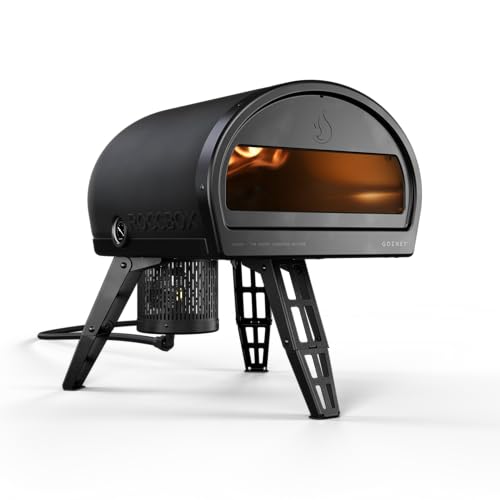
| Santos O-140 | 4.7 kW, pizza up to 35 cm Ø according to Santos | approx. €249 | 8.2 | the bigger pizza matters more to you than burner output and price |
| BURNHARD Fat TONY | 8 kW, stone 35 × 38 cm, pizza up to 34 cm Ø, 21.5 kg | approx. €499 | 8.6 | you often bake for guests and want to spend approx. €499 instead of approx. €198 |
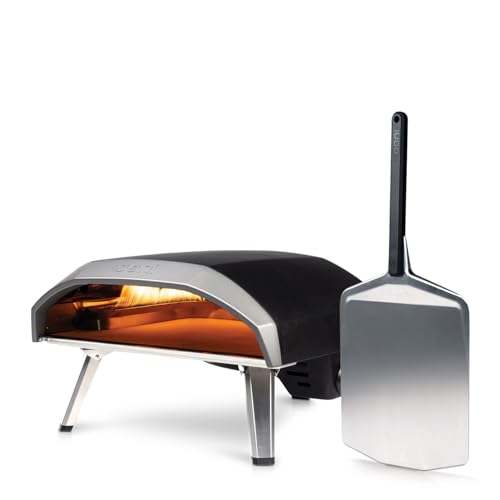
| Ooni Koda 16 | L-shaped burner with 8.0 kW, pizzas up to 40 cm, flame failure valve according to Ooni | approx. €449 | 9.4 | you want large pizzas and plan on approx. €449 instead of approx. €198 |
The prices are guide values from our price boxes and fluctuate, and the rating is our editorial assessment from the manufacturer data and not a measurement result. The technical details of the three alternatives come from the pages of Santos, Burnhard and Ooni.
When the TONY fits and when another oven does
The first fork is pizza size. 29 cm is enough for one pizza per person, but tight for a shared family pizza. According to Santos, the Santos O-140 takes pizzas up to 35 cm, but has a weaker burner and costs approx. €249, while the TONY on Amazon is at approx. €198. If you would rather bake bigger than hotter, it is the obvious alternative in our comparison.
The second fork is the number of guests. At 90 seconds per pizza according to Burnhard, the TONY can manage an evening even for six people, but you stand at the oven the whole time. The Fat TONY bakes larger pizzas with more output, but weighs seven kilos more. If you regularly bake for guests, you are better off there in our assessment; if you carry the oven to the boot of the car, rather with the TONY.
The third fork is safety technology. For the Koda 16, Ooni describes a flame failure valve that shuts off the gas when the flame goes out. For the TONY, nothing comparable can be found in the manual or on the product page. That weighs less heavily than it sounds, because the manual demands in any case that you never leave the oven unattended. If you still value this protection, you pay approx. €449 for the Koda 16 instead of approx. €198 for the TONY on Amazon.
And then the location. 1.5 m clearance from anything flammable is easy to keep in a garden, but often not on a balcony with a privacy screen, awning or wooden floor. What is generally allowed there is decided by your tenancy agreement and house rules; our guide to grilling on a balcony goes through the rules.
The TONY is the wrong choice for anyone who wants wood-fired pizza or an oven for the garage or conservatory. According to the manual, it must not run in enclosed areas, and wood does not belong in it. If you are not yet sure whether it should be a pizza oven at all or a gas grill with a pizza stone, you will find a first sorting in the Grill Finder.