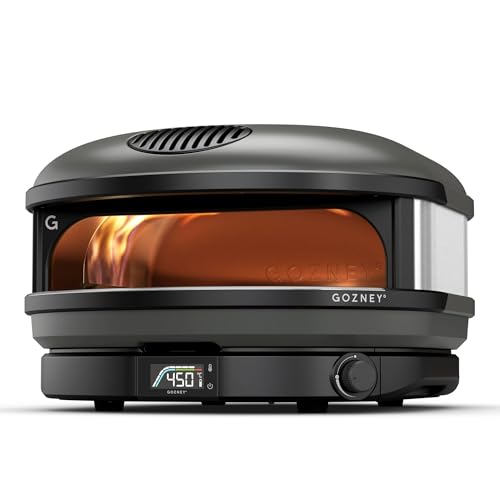
The Gozney Arc XL bakes pizzas up to 16 inches, so around 40 cm. According to Gozney’s help pages it runs on propane only; the oven has no door and belongs outdoors. In the EU shop, Gozney lists it alongside the smaller Arc (14 inches) and the Arc Lite (12 inches). The 51-page manual (DOC-0539-07) applies to the Arc XL and the Arc together; it names Gozney Group Ltd in Bournemouth as the manufacturer, the declaration of conformity says Gozney Limited, and the type designation of the Arc XL is GOZ-1728.
At Santos Grills it appears in our price box at approx. €900 (as of 1 October 2026). That makes it the third most expensive of the 38 pizza ovens in our catalogue. We have not handled the oven; the details come from Gozney’s product page, the manual, the manufacturer’s help articles and the Amazon catalogue, with page numbers for safety topics.
Dimensions, Materials and What’s in the Box
Externally, the Arc XL measures 530 mm in width, 629 mm in depth and 342 mm in height; the dimensional drawing in the manual (page 23) confirms this. The cooking chamber is 427 mm wide, 517 mm deep and 173 mm high. The opening at the front has the same width but only 95 mm of height. There is no door; in the product photo the opening is exposed and the flame is visible. For the cooking chamber area, Gozney gives 2,184 cm².
The floor is a removable cordierite stone, 20 mm thick; Gozney confirms the thickness in a help article. It is not fixed in place and can slide backwards during transport. If a large gap opens in front of the stone, you hook the supplied adjusting tool in at the back and pull the stone forward (manual, page 20).
According to Gozney’s help pages, the interior parts are stainless steel, the outer shell is steel with ceramic coating, and the dock, as Gozney calls the base, is made of high-temperature plastic and powder-coated steel. The comparison table says high-temperature paint instead of ceramic coating; which description is correct cannot be determined from the documents. Insulation is calcium magnesium silicate fibre, which Gozney describes as non-carcinogenic and water-soluble.
The product page gives 26.5 kg without and 33 kg with packaging, and the carton measures 572 × 402 × 697 mm. On page 24 the manual uses 25 kg, there as the load that the surface must bear. According to Gozney’s comparison table, the oven is not portable. In its own shop it arrives on a pallet, as kerbside delivery to the nearest paved surface. If you move it, you grip the handles on the lower edges; the oven opening is not a lifting point (page 22).
According to the product page, the box contains the oven, the dock, a thermometer, a 1.2 m gas hose with regulator, a burner guard, the flue, the stone adjusting tool, a Torx screwdriver, a match holder and the instructions. Nothing needs assembling. Before first use, you insert batteries in the display and igniter, connect the hose, fit the flue and burner guard, and pull out the four blue retaining wedges of the stone along with the rest of the packaging.
Burner, Igniter and Display
The burner sits at the side of the oven; Gozney’s comparison table calls it “Lateral gas burner”, and the manual speaks of the gas burner in the singular. According to page 39 the flame should be yellow and roll along the oven roof, and the product description on Amazon compares this with a wood-fired oven. A wood burner is not intended.
Gozney states the output three times, differently each time. The rating plate table in the manual has 5.5 kW and 390 g/h, the help article on consumption 5.25 kW and 390 g/h, the comparison table 5.25 kW and 375 g/h. We go with the rating plate, because the gas categories are listed there next to the figures.
Ignition is at the control knob on the right of the dock; to its left, according to the product photo, sits the display. On page 39 the manual describes this sequence: push the knob in and turn it to the 9 o’clock position until it clicks and the burner ignites; then turn anticlockwise to 7 o’clock and hold there for up to 30 seconds so that the flame safety device is deactivated; finally push the knob in firmly and release. The retaining wedges of the stone must be removed beforehand.
Two parts need batteries: the display takes two AA cells (drawing on page 25), the ignition module one AAA cell. The module sits inside on the left; to insert it, the thermometer is removed from the front of the oven and the cap unscrewed, and the negative terminal goes in first (page 35). The display clings magnetically to the dock, its probe sits in the oven and plugs into the back of the display with a jack plug. It is switched on with the power button, held for at least 3 seconds; according to the picture, the button with the thermometer symbol switches between °C and °F.
In Detail: Stone, Insulation and the Rolling Flame
A pizza cooks from two sides. Below, the stone it sits on does the work; above, the heat arrives as radiation from the flame and oven roof, and both sides are meant to finish at the same time. Gozney gives 500 °C as the maximum temperature. The comparison table gives 30 to 40 minutes “Time to Heat” for the Arc XL, without a target temperature; the product page speaks only of “quickly” and “within minutes”. For the Arc Lite, with a thinner stone and only one insulation layer, a shorter value is listed there, 20 to 30 minutes. A thick stone stores more heat but takes longer to heat through. In our assessment the difference hardly comes down to mass alone: the Arc Lite is also smaller and has less space to heat.
An open front loses heat. Gozney counters this with the double-layer insulation and the stone, and advertises “pizza after pizza” and “minimal heat loss”. The product page gives no figures for this. For the Arc Lite, Gozney recommends a pause of a few minutes between pizzas so the stone regains temperature. Our assessment: the thicker stone of the Arc XL also cools under a cold pizza, and we would plan in a pause.
How quickly the oven gets hot depends mainly on burner output and on the mass to be heated; how hot it ends up depends on the balance of output and heat loss. Flame routing also plays a part. The Amazon description advertises even heat with hardly any need to turn the pizza. Our assessment: a flame that runs along the roof heats the roof, and the roof radiates back onto the topping; a wood-fired oven works the same way. How often you end up turning anyway depends on flame height and pizza size.
According to the comparison table the probe shows the stone temperature, while the manual on page 26 speaks of the temperature in the oven. For the base of the pizza we consider the stone temperature the more important figure; it says less about the heat under the roof.
No water belongs on the stone, the manual warns (page 8): it can break. How pizza stones crack and what helps is explained in the guide Cracked pizza stone.
Can the Arc XL Go on the Balcony?
Gozney’s documents do not allow a yes. Operation under balconies or roof terraces of apartments is prohibited; for your own balcony there is neither approval nor a ban. It depends on clearances, house rules and building regulations.
The oven explicitly belongs outdoors. “Never use this appliance in enclosed spaces”, the manual says on page 5, naming fires, explosions, damage to buildings and serious or fatal injuries as consequences. One sentence in the rating plate section (page 12) describes the appliance as suitable for indoor and outdoor areas, and page 16 requires installing it under a suitable extractor hood. Both contradict page 5, the product page and Gozney’s help pages, which recognise only outdoor use. The stricter reading applies here: outdoors only.
The manual gives the clearances twice, with different values. Page 5: never closer than 1.5 m to buildings, combustible material or other gas bottles and never closer than 7.5 m to flammable liquids. Page 23 and Gozney’s help pages: at least 30 cm at the back and sides, at least 100 cm at the front from combustible parts of buildings, and never under or on a combustible structure. Around the dock, 50 mm stays free for air supply, otherwise output drops. We would plan with the stricter value, 1.5 m. On a narrow balcony that would hardly be achievable.
According to the manual, the surface must be safe, level, stable and firm and must bear the weight of the oven; as setup height, Gozney recommends elbow height, normally around 120 cm above the ground. According to the manual, you should ask the responsible building control authority whether rules apply to outdoor cooking appliances; if you rent, we advise asking the landlord first. What generally applies on balconies is covered in the guide Grilling on a balcony.
Gas Connection, Country Version and the Amazon Listing
Burner and gas pressure must match, which is why Gozney sells the Arc XL as a country version. In the EU shop you choose between Austria, Belgium, Germany, France and the Netherlands. For Germany, the rating plate table (manual, page 13) gives 50 mbar and a 1.02 mm injector; other country groups have 28 to 30, 30 or 37 mbar with 1.14 or 1.15 mm injectors. The article numbers for Germany and Austria are GAPBNDE1624 (Bone) and GAPOBDE1624 (Off Black).
The Amazon catalogue lists the entry behind our link under part number GAPOBUK1624, and that is not in this list. Gozney’s numbers consist of series, colour abbreviation, country group and size; on that basis UK would stand for a different country group and OB for Off Black. That is our reading, not confirmed. The colour does not fit together either: the catalogue says “bone-coloured”, the code contains the abbreviation OB, and the photo shows a dark oven. Which burner version Amazon supplies therefore remains open. At Santos Grills, the address of our link contains the word “black”; we have not checked the country version there. Before buying, you should ask for the article number and insist on the version for Germany.
Between bottle and oven belongs a pressure regulator to EN 16129 or EN 12864 (EU standards). The manual describes the push-fit connection and the screw thread separately: with the push-fit connection, the lever is horizontal, the button is pressed, the regulator is fitted and the lever is set vertical; with the screw thread, the bottle stays closed and the regulator is screwed on slowly and without tilting. Excessive force is forbidden in both cases.
The supplied hose is 1.2 m long, and the manual allows a maximum of 1.5 m. It must not be twisted and should be kept away from hot surfaces and direct sunlight. Before each use, you check it for cuts, cracks and damage and, in case of heavy wear, replace it with a hose assembly approved by Gozney; replacement intervals are governed by national regulations. The bottle stands outdoors, upright and never under the oven. Which size fits is answered by the first question below; the basics on fill level and storage are in the guide Gas bottle for the grill.
The manual requires a leak test in three cases: before first use, after every refill of the bottle and after every disconnection and reconnection of hose and regulator. Soapy water is applied with a brush to the marked areas and to any cracks in the hose; gas forms bubbles. You never check with an open flame, and the burner stays off meanwhile. If the hose connection at the oven leaks, you tighten it and check again; if it stays leaky, the gas supply is shut off and the oven is not used. If the valve connection at the bottle leaks, the bottle is removed, the oven stays off, and you test again with another bottle.
If you smell gas, you close the bottle valve, set the switch on the Arc to Off and extinguish open flames. If the smell persists, you move away from the appliance and the gas supply and call the fire service or the gas supplier immediately. According to the manual, carbon monoxide is highly toxic, odourless and colourless and can form with inadequate ventilation; prolonged exposure can be fatal. The manual lists the symptoms on page 17, along with the advice to install a carbon monoxide detector if needed. You never cover the oven opening while a fire is burning in the oven.
First Firing, Operation and Cleaning
On first heating, the oven burns for around 30 minutes on a medium to low flame to remove residual moisture, and only then does it go higher (manual, page 40). After a long period of non-use, this is repeated. When switching off, the order matters: first close the bottle valve, then switch off the Arc so the residual gas in burner and line burns off. Three minutes after closing, you remove the regulator and set the control knob to Off.
The manual contains more warnings than are listed here. This selection does not replace it, and a rule that is missing here still applies.
- Never leave the oven unattended during operation (page 5).
- Never disconnect gas connections during operation, and use no additional combustible substances during gas operation (page 33).
- If the flame goes out, you set the control knob to Off, close the bottle valve and wait 5 minutes before relighting.
- If grease ignites, you set the burner knob to Off, close the bottle valve until the fire has gone out, and remove all food. You never extinguish oil and grease fires with water.
- Do not move the oven during operation or while hot. After use it can stay hot for several hours; protective gloves are part of the routine.
- No easily flammable loose clothing and no clothing with easily flammable long sleeves near the oven, no plastic or glass utensils in the oven.
- Keep children and pets away; the oven is not intended for use by children.
- Alcohol and over-the-counter or prescription medication can impair safe assembly and operation.
Inside, according to the manual, burning off is the best method: from 350 °C self-cleaning begins, and baked-on residues burn away within three hours. You loosen stubborn bits only after cooling with a soft brush and little pressure, and vacuum up loose dirt with a long plastic nozzle. For the stone, Gozney’s help pages give 60 minutes of full flame, which burns off residues.
Outside, you clean the cooled oven with a non-corrosive, bleach-free cleaning spray, with a sponge in warm soapy water or with an abrasion-resistant cloth, never with scouring agents. The product page lists Pink Stuff and Bar Keepers Friend as unsuitable. Spray does not belong directly on the thermometer or control knob, and the flue can be removed for cleaning. Discolouration from the open flame is normal according to Gozney’s help pages. When not in use, you protect the oven from rain and cover it, but only once it has cooled down completely.
Accessories, Running Costs and What Gozney Leaves Open
Peel, cover and stand are not included. Gozney sells them separately, and the prices come from the EU shop (retrieved on 12 October 2026): cover (Arc XL Cover) €59.99, Pro Placement Peel pizza peel in 16 inches €109.99, Arc Mantel €119.99, Arc Booster €99.99, Arc Stand €249.99 and the cover for the stand €79.99. According to the manual, the mantel is made of food-grade ceramic-coated aluminium alloy and makes it easier to slide pizzas in and out. The booster raises the oven to working height on a worktop or table and has a shelf; the cover is seawater-resistant, weatherproof and breathable.
The oven costs €899.99 in the Gozney shop. With cover, peel and booster, the total is €1,169.96, and with the stand instead of the booster €1,319.96, in each case without a gas bottle. Spare parts are available in the same shop: replacement stone €94.99, temperature display €29.99, flue €9.99 and a propane gas hose for 50 mbar €34.99.
Gozney’s documents leave these points open:
- Pizzas per hour, stone recovery time and number of pizzas without a pause
- a heat-up time with a reference temperature
- Burn time of a gas bottle (for the Arc Lite Gozney gives hours) and gas quantity per pizza
- Cooling time of the oven, apart from “hot for several hours”
- Length, width and weight of the stone
- Accuracy and measuring range of the probe
- Operation in rain, under an awning or a canopy
- Noise, smoke and soot during operation
- Number of burners and construction of the flame safety device
- Type of regulator (push-fit connection or screw thread) in the German version
- Whether batteries for the display and igniter are included and whether Gozney offers a windbreak as an accessory
What Else Is Worth Considering?
| Model | The difference | Price | Our rating | Choose this if |
|---|---|---|---|---|
| Gozney Arc XL (this one) | Side burner with rolling flame, 20 mm stone, 26.5 kg | approx. €900 | 9.1 | you want to bake pizzas up to 40 cm and leave the oven permanently in a wind-sheltered spot |
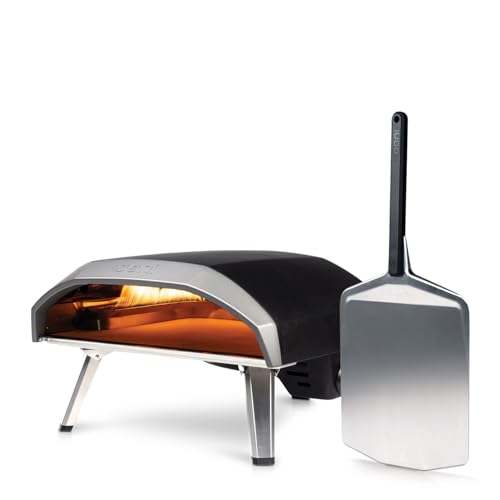
| Ooni Koda 16 | L-shaped burner (8.0 kW according to Ooni), 15 mm stone, 18.2 kg | approx. €449 | 9.4 | you want 40 cm pizzas and must stay under €500 |
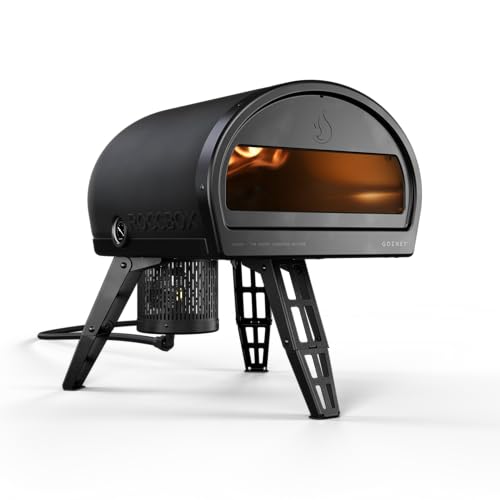
| Gozney Roccbox | Pizzas up to 12 inches, just under 20 kg according to Gozney, removable gas burner | approx. €447 | 9.3 | you bake up to 30 cm and want to put the oven away more often |
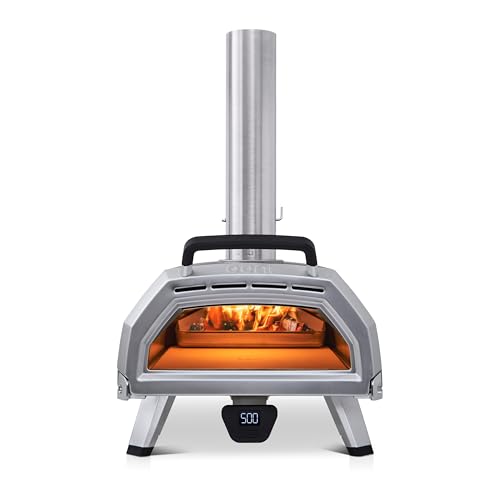
| Ooni Karu 2 Pro | Wood or charcoal, gas only via a separate burner | approx. €799 | 8.6 | you want to bake with wood or charcoal |
The prices follow the price box of the respective page and change constantly. The rating is our editorial assessment based on manufacturer information, not a measurement result. The kW figures are gas input according to the rating plate and say nothing about the baking result. You can find more ovens in the overview of the best pizza ovens.
When the Arc XL Fits and When It Doesn’t
First, the pizzas: two side by side do not fit, because 427 mm of internal width is enough for one 40 cm pizza, not for two. If you bake one each for six people, you slide in six times in a row and plan in between the pause we suggested above.
Then the time to the first pizza. Gozney’s heat-up time is longer than that of the Ooni Koda 16, for which Ooni gives 20 minutes to 500 °C. Both are manufacturer figures and are only a rough basis for comparison. If you want to bake spontaneously after work, you should reckon with the longer time on the Arc XL.
On budget, only Gozney’s design details remain for the Arc XL: double-layer insulation, a 20 mm stone and a flame that rolls along the roof. We have no measured value that justifies the extra cost over the Ooni Koda 16.
An oven without a door needs a spot where no wind blows into the opening. If you only have an open roof terrace, plan in a windbreak. The Arc XL also stays best where you put it: you must not move it while hot, and the cover goes on only once the oven has cooled.
The Arc XL is wrong for tenants whose balcony does not allow 1.5 m clearance from the house wall, and for anyone who only occasionally bakes a single pizza.