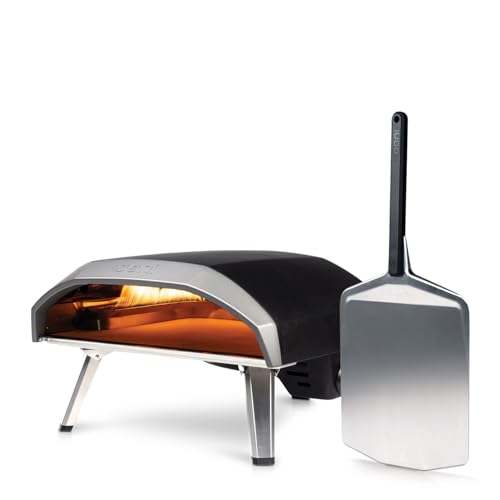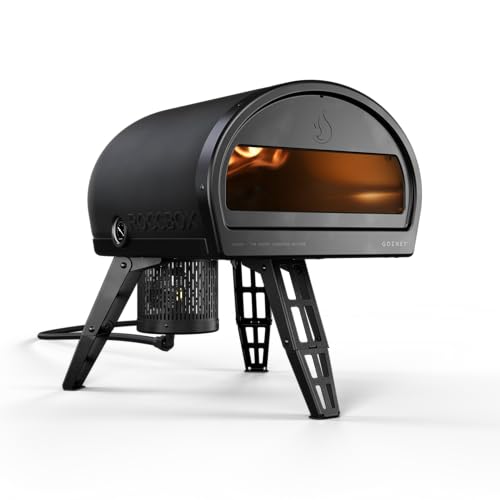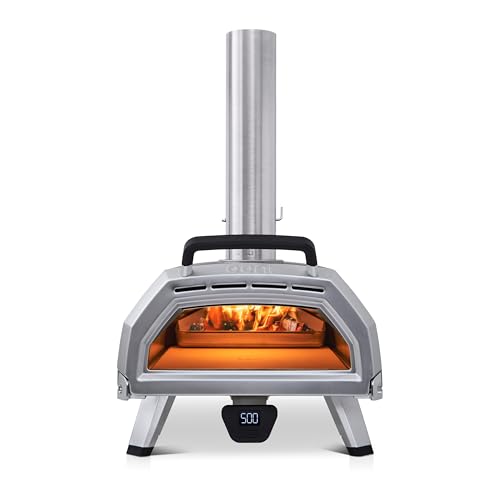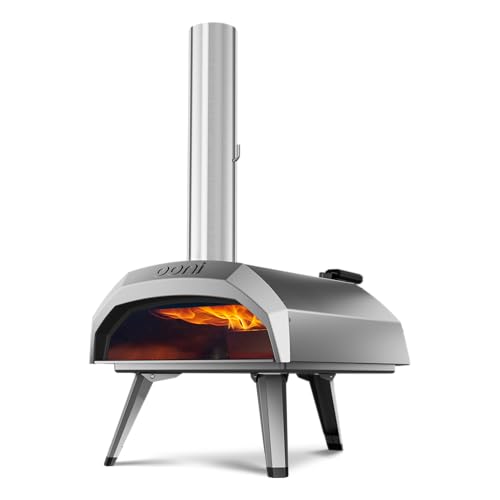
The Ooni Karu 12 is an outdoor pizza oven that runs on wood or lump charcoal out of the box. Gas only works with a burner that Ooni sells separately. In the EU shop, Ooni lists the oven as the 1st-generation Karu 12 for €299.00 (retrieved on 14.10.2026), and in our price box it appears at approx. €299. The Amazon title, by contrast, calls it a gas and wood oven, although the burner is not included.
We have not used the oven ourselves. The details come from Ooni’s product pages, from the manual PA-A00444 (PDF dated 23.05.2023), from Ooni’s Essentials Guide and from the Amazon catalogue; for safety topics, the page is given alongside. In the pizza oven catalogue it is one of 38.
What is in the box, assembly and materials
According to the Ooni product page, the box contains the oven, the pizza stone, the chimney, the door, the fuel tray and the fuel hatch. The parts list in the manual is longer: main body, door, cordierite stone baking board, fuel hatch, draft defender plate, fuel grate, fuel tray, chimney and chimney cap. A pizza peel, infrared thermometer, gas burner and carry cover are not included, according to the Ooni FAQ.
Assembly takes seven steps (manual, pages 5 to 12): unfold the legs, insert the burner tray and grate, insert the pizza stone, insert and lock the chimney, attach the fuel hatch, attach the draft defender plate, insert the door. The draft defender plate is secured but not tightened too firmly. So the stone does not come ready-fitted in the oven; you insert it yourself.
Unpacked, the oven measures 80 × 40 × 77 cm (length, width, height) according to Ooni and weighs 12 kg; in the box it is 72 × 49 × 34 cm and 17.8 kg. The Amazon page differs: one bullet point says 10 kg, and the product data says 34 × 57 × 40 cm. Neither matches any Ooni figure, so we go with Ooni’s numbers.
Ooni contradicts itself on the oven body. The German product page lists powder-coated carbon steel in the materials list, the English page and the Essentials Guide say stainless steel, and the feature text of the German page itself speaks of a stainless steel shell with ceramic fibre insulation. According to both pages, the inner part, base and legs are stainless steel, and the front and rear nose are aluminium. In the Essentials Guide, the main body is fully insulated, the door thickly insulated, and its handle stays cool (page 8).
This has practical consequences. The warranty terms exclude surface rust. As a general rule, painted carbon steel can rust at a scratch, while stainless steel rusts less readily there. The documents do not settle which version is correct.
The pizza stone is made of cordierite and is 15 mm (0.6 inch) thick; Ooni describes it as a baking board with good heat retention. The comparison table lists it at 33 × 33 cm. The oven opening there is 99 mm high and 33.8 cm wide, and a 30 cm pizza fits in. According to the Essentials Guide (page 10), the Ooni peel range in 12 inch or smaller fits as a pizza peel.
In detail: draught, embers and stone
An oven with solid fuel heats through draught. The embers sit on the fuel grate, the chimney carries hot air upwards and draws in fresh air as it does so; the more air flows through the embers, the more strongly they burn. The Karu 12 has a chimney damper for this, which you adjust with gloves. According to the Essentials Guide, open means more draught, stronger flames and more heat, closed means less draught, less heat and a smokier flavour (page 14). If the temperature rises above 500 °C, you stop adding fuel, remove the fuel hatch and/or close the chimney damper. For wood and charcoal, the door stays on permanently and the chimney cap is removed (pages 4 to 5 and 36).
A pizza cooks from two sides: from below via the hot stone, from above via the heat of the flames and the oven roof. For the stone, Ooni gives a target of at least 400 °C before baking. The pizza is turned every 20 to 30 seconds, and before the second one the stone should be back at 380 to 450 °C; the comparison table puts the recovery time at 2 minutes. If the stone is too hot, you place a piece of Ooni cast iron on it for about 30 seconds to absorb heat.
There is no thermometer built into the oven. Ooni recommends an infrared thermometer that you buy separately. Our assessment: for the pizza base, the stone temperature is what counts, and it cannot be checked without a measuring device.
Ooni gives three different estimates of how hot the oven gets in operation. The manual states an approximate operating temperature of 120 to 550 °C (safety point 20), the comparison table 110 to 500 °C, and the Essentials Guide up to 500 °C with wood and charcoal and 250 to 500 °C with gas. It also says that weather and ambient temperature shift the values.
Wood, charcoal or gas
Wood: the manual requires dry, untreated hardwood in pieces up to 20 cm long and 4 cm in diameter. The Essentials Guide is more specific: kiln-dried hardwood, especially beech and oak, pieces of about 15 cm, no treated or varnished wood and no resinous wood such as pine or spruce, because of off-flavours (page 16).
To start, 3 to 6 pieces go on the grate. You add more when the wood has mostly turned to embers and flames are still visible; nothing may stick out over the grate. A maximum of 0.4 kg is allowed per top-up, and never more than 0.7 kg lies in the fuel tray at once. According to safety point 11, fuel is added gradually to reach the desired temperature; too much enlarges the fire and endangers users and the oven. Smoke when lighting is normal according to Ooni. Fuel is stored warm and dry and used within 6 months, as older and damp fuel burns unclean (page 36).
Charcoal: Ooni recommends lump charcoal and advises against briquettes because they clog the holes in the grate and reduce airflow (Essentials Guide, page 18). To start, 2 to 3 pieces are enough. It is ready for cooking when it glows white with a red core; you add a little and often. The manual only requires charcoal that is suitable for cooking. Ooni also recommends combining the two: charcoal for the base temperature, wood for the burst of heat and the flavour. How barbecue charcoal and briquettes otherwise differ is described in the guide Charcoal or briquettes; on the Karu 12, briquettes are ruled out according to Ooni.
Gas: the oven runs on it only via the Ooni gas burner, which also fits the Karu 12G and the Karu 2 and costs €99.00 in the EU shop. It is built for propane and not for natural gas; for Germany, Ooni states 50 mbar and includes a regulator. According to the burner page, the dual venturi burner has 5.3 kW, while the comparison table on the Karu 12 page says 5.0 kW. Solid fuel and gas cannot be used at the same time. On the Karu 12, the door must be removed and the chimney fitted while the burner is running, and use is intended for outdoors only. Before each cook, you check the connections at the propane bottle, hose and regulator for a firm fit and tightness, according to the Essentials Guide (pages 4 to 5). If you switch from solid fuel to gas, let the oven cool down first before the burner is attached.
The manual that comes with the burner describes lighting; we did not find it as a PDF. So we do not know the hose length, the minimum distances for the bottle or the leak check in detail. For bottle size, propane and storage, the guide Gas bottle for the grill gives general advice.
How long until the first pizza?
With wood or charcoal, the figures are 15 to 20 minutes to baking temperature: from 15 minutes to 450 °C according to the Ooni product page, 10 to 20 minutes of preheating according to the manual, 500 °C in 20 minutes according to the Amazon catalogue.
Ooni words the times as best cases (“from 15 minutes”), and the documents differ. The landing page says 500 °C in 15 minutes. The Essentials Guide also says from 15 minutes and advises adding 5 to 10 minutes if there is too little heat; wet weather or extreme cold lengthen the time (page 36). With the gas burner, it is 25 minutes to 450 °C according to Ooni.
The procedure according to the manual (page 14): you take off the chimney cap, open the chimney and roof openings and insert the door. Then you remove the fuel hatch, put a layer of charcoal or a small stack of wood in the burner and light it with a gas torch or a natural firelighter. Once the fire is burning, you slowly add more and put the hatch back; the oven then preheats for 10 to 20 minutes. According to the warning, neither methylated spirits nor petrol may be used for lighting and relighting, only firelighters conforming to EN 1860-3.
Cooking only starts once there is a layer of ash on the fuel. Before the very first cook, you heat for at least 30 minutes and keep the fuel glowing red. For the first use, the Essentials Guide adds: 30 minutes at maximum temperature, let it cool, wipe the inside with dry kitchen paper. According to Ooni, manufacturing oils burn off during this.
Can the Karu 12 go on the balcony?
That depends on your balcony, not on the oven. Ooni advertises the balcony on the product page, while the manual contains no balcony statement and requires use in the open, away from buildings. Your tenancy agreement, house rules and space decide.
Safety point 1 (page 2) requires: outdoors only, always outside and away from structures, never in buildings, garages or near enclosed areas. It is set up on a stable, level, secure and non-combustible surface, free of combustible materials, petrol and flammable vapours and liquids. Safety point 2 refers to local laws that prescribe a minimum distance between outdoor ovens and buildings or restrict open fire in dry conditions or hazardous situations; the manual gives no distance of its own in metres. For draught with solid fuels, the Essentials Guide requires at least 1 m of space all around and recommends the Ooni modular table or sturdy surfaces of wood, steel or stone as a base, and advises against plastic and glass (pages 4 to 6). On wood, the two documents contradict each other, as the manual requires a non-combustible surface. We would follow the stricter version.
As hazards nearby, the manual names dry leaves, wooden decking and other combustible materials, because sparks can ignite them (point 13). A wooden deck covering on the balcony would be such a case.
Then there is carbon monoxide. The manual forbids use in confined or habitable spaces, meaning houses, tents, caravans, motorhomes or boats, and names a danger to life from carbon monoxide poisoning. The oven must not be set up or used on boats or recreational vehicles, and not in strong wind (points 3 and 4). Toxic fumes can accumulate and cause suffocation (point 6). What tenants should clarify beforehand is explained in the guide Grilling on a balcony.
Safety, cooling down and cleaning
The manual lists 21 safety points. Location, wind, vehicles and toxic fumes are covered above under the balcony, topping up under wood, and temperature under the target values. The rest:
Flames can come out of the metal housing at four places: at the back at the fire pit, at the top at the fuel hatch with the lid open, at the front with the door open, and at the top of the chimney. You keep your distance from these openings and warn others. You wear heat-resistant gloves at all times. During operation you do not touch metal parts, only the wooden or plastic handles of the door and fuel hatch, and you never put hot objects on or next to combustible surfaces. Lighters and liquid barbecue lighters do not belong next to the oven, because it radiates heat in all directions.
The oven is never left unattended, not even with the lid open. Only responsible adults may use it; children, pets, combustible objects and power cables stay away. A hot or running oven is not moved, and no parts are removed. It is not intended as a heater. It is operated only fully assembled and with all parts firmly seated. Improper assembly, adjustment, modification or maintenance can lead to injury or property damage, and the manual wants the oven inspected regularly (the German version says “serviced”). With intended use following the safety instructions, the oven is considered safe, and safe operation is your responsibility. Ooni Limited disclaims any liability for consequential damage if the instructions are not followed and in no case is liable beyond the original purchase price.
After baking, you let the fire burn down on its own, which takes about 60 minutes depending on the outside temperature (Essentials Guide). The oven is neither extinguished nor cooled with water. According to the Essentials Guide, you should move or clean it no earlier than one hour after the fire is out; the manual requires at least two hours, even if no flame is visible any more (point 19). We would allow for the two hours. It is not covered immediately, and before putting it away you must be sure that fire and embers in the burner have gone out. You remove ash only once the oven has cooled completely.
For cleaning: the maximum temperature burns off flour and food residue, and on the inside you wipe with dry kitchen paper if needed. On the outside, you wipe the cold oven with a damp cloth, let it dry completely and then use a standard stainless steel cleaner. You never expose warm parts to moisture, and the oven is stored dry only. You clean the stone by running it at maximum temperature, and you remove stubborn residue with the Ooni pizza oven brush; it is not dishwasher-safe. After cooling you can turn it over, as the heat cleans the underside, and colour changes do not affect performance according to Ooni. The grate is cleared of ash with a brush before every cook and never cleaned with water. Why pizza stones crack is covered in the guide Cracked pizza stone.
According to the Ooni FAQ, the Karu 12 can stand outdoors all year, protected by the Karu 12 cover. For longer periods of non-use, Ooni recommends storing it indoors and protecting it from harsh weather.
Accessories, warranty and what Ooni leaves open
The prices come from the Ooni EU shop (retrieved on 14.10.2026): oven €299.00, gas burner €99.00, basic bundle with oven, pizza peel and weatherproof cover €369.00 instead of €389.00, carry cover €40.00. For gas operation, you can count on €398 for oven and burner, or €468 for the basic bundle and burner. On top come an infrared thermometer, whose price we have not recorded, and the fuel. The comparison table gives a consumption of 1.5 kg for 10 pizzas, with no fuel specified. Ooni sells spare parts through a spare parts page in its shop; the model-specific list with prices is not in the page text.
The warranty lasts one year; if you register the oven at ooni.com within 60 days of purchase, it extends to five years according to the Ooni warranty page. According to the warranty terms (T&Cs dated 02.03.2023), you need the proof of purchase, it applies only to domestic or private use and only in the country of purchase, and it stays with the product, including when passed on as a gift with proof of purchase. Modifications to the product void it, and use according to the manual is a precondition. Ooni repairs or replaces at its own discretion, a refund never exceeds the purchase price; consumer rights remain unaffected.
Excluded are normal wear and tear, discolouration from heat, surface rust, water damage, salty air and sea spray, severe weather, user error, minor heat-related deformation without functional impairment, wrong fuels, use outside the country of purchase and improper use. Pizza stones are not listed separately there.
In the documents we read and in our research, the following remains open:
- Gas consumption in grams per hour, burn time of a 5 or 11 kg bottle, fuel consumption with wood and charcoal in kg per hour
- Heat-up time per fuel to 500 °C, temperature fluctuation between two pizzas in degrees
- Material of the oven body (contradictory), chimney and wall thickness; what the borosilicate glass visor in the English materials list is, since Ooni does not describe a glass door for the Karu 12
- Dimensions with legs folded and chimney removed, weight of the stone, weight without chimney, number of legs
- Minimum distance to walls and buildings in metres, a binding balcony statement
- Country of origin and manufacture, declaration of conformity or test mark for the oven (the manual only cites EN 1860-3 for firelighters)
- which version is behind our Amazon link: in its shop Ooni lists the item number UU-P32D00, the 2023 manual UU-P29400, the 2020 one UU-P0A100, and Amazon writes “Karu 12 2026”
- Price of burner, regulator and hose at Amazon
What else is worth considering?
| Model | The difference | Price | Our rating | Choose this if |
|---|---|---|---|---|
| Ooni Karu 12 (this one) | Wood or lump charcoal out of the box, gas only with burner (€99 at Ooni), 12 kg, no thermometer | approx. €299 | 9.0 | you want a wood fire, are fine with one 30 cm pizza at a time and want to add gas later |
| Ooni Koda 16 | Gas-only oven for pizzas up to 40 cm, 18.2 kg | approx. €449 | 9.4 | you bake for several people and can do without a wood fire |
| Ooni Koda 12 | Same 12 inch size, gas-only oven with piezo ignition | approx. €284 | 9.0 | you only want to use gas and do not want the upkeep of wood or charcoal |
The prices follow the price box of the respective page and change constantly. The rating is our editorial assessment based on manufacturer information, not a measurement result. You can find more ovens in the overview of the best pizza ovens.
When the Karu 12 fits and when it does not
First, quantity. The oven takes one 30 cm pizza, never two. If you add up Ooni’s best-case figures, 60 seconds of baking time and 2 minutes of stone recovery time, six pizzas are on the table after about 16 minutes. That assumes the fire is right until then and nobody stops to add toppings in between; we would allow more time. The Ooni Koda 16 bakes pizzas up to 40 cm, whose area is on paper about 1.8 times that of a 30 cm pizza.
Then, fire tending. A wood fire requires you to stay with it: add a little and often, never leave it unattended, read the temperature at the stone instead of guessing. Our assessment: if you are entertaining guests on the side, you are better served with gas, and if you only want gas from the start, go straight to the Ooni Koda 12 and save yourself the burner and conversion.
As for the thermometer, you have to buy one separately for the Karu 12. The Karu 2 costs €399.00 at Ooni, which is €100 more (prices in the EU shop, 14.10.2026). In return, according to Ooni, it has a borosilicate glass door with ClearView and a built-in thermometer, but weighs 15.3 kg instead of 12 kg. According to Ooni, the format, the 15 mm cordierite stone, multi-fuel operation and the five years with registration have stayed the same.
The Karu 12 is wrong for anyone whose outdoor space ends at a house wall or whose landlord forbids open fire. The gas burner changes nothing about that, because even with it the oven is only intended for outdoor use.
If you want a glass door and a thermometer and can pay the extra, look at the Karu 2. You stay with the Karu 12 if a wood fire matters to you, 30 cm is enough and you are going to buy the infrared thermometer anyway.