A Tabletop Grill from the Q Range, Without a Stand and Without Shelves
The Q 2100N is a single-burner gas grill that you put on a table, a wall or a separately bought cart. It has no side tables and no base unit either. Weber lists it under item number 1501088, the Amazon catalogue shows the same number as the model, and it is available only in Midnight Black. Amazon has entered 20 May 2025 as the release date.
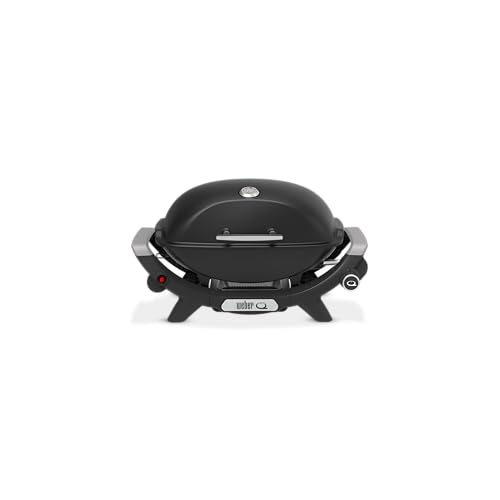
The product image shows an oval black lid with a thermometer on top and a transverse handle. On the left and right, grey brackets stick out of the body that look like carrying handles, and below is a curved black foot frame. At the front left there is a red button, and on the right a control knob.
In Weber’s German Q range, the 2100N sits above the small Q 1100N and Q 1200N models. The Q 2200N next to it puts the same burner on a stand with side tables, and the Q 2800N+ and Q 3200N+ come on the premium rolling cart.
Our price box shows approx. €400 (Amazon page on 20 October 2026: €399.90). Prices change, so check the current price before you buy. In our comparison of gas grills it scores 8.4 out of 10 points.
Cartridge or Gas Bottle: Weber’s Statements Contradict Each Other
This is the question that decides what else you have to buy, and it is exactly here that the sources do not match. The key data on the Weber product page says “Liquefied gas (gas bottle not included)”. The product safety notice on the same page, however, says the appliance may only be used with WEBER Q gas cartridges or other cartridges approved to DIN EN 417 (a standard that applies in the EU), filled with 80 % butane and 20 % propane. The Amazon text resolves this in its own way: connection for gas cartridges, convertible to a gas bottle with the separately available conversion kit 8475. We did not find this kit on weber.com.
The German manual covers a whole series, from the 2100N through both 2200N variants to the 2800N+ and 3200N+ (document 8655661_121724 DE). It describes operation on a gas bottle throughout. The bottle should hold at least 3 kg and at most 13 kg, the grill is fitted with a pressure regulator, and the hose may be at most 1.50 m long and must not be kinked. You may connect only the supplied gas hose, in capital letters: “DO NOT USE ADAPTERS”. Because of the risk of tipping, the bottle belongs behind the grill on the right-hand side. Cartridges appear in the manual only in passing, in the storage section and the cartridge valve section.
What exactly is in the box, regulator, hose or a cartridge adapter, is not stated in any of the sources. We would ask the retailer which gas container the delivered grill fits before you buy cartridges or a bottle. Which bottles exist and how exchanging and buying work is explained in our guide Gas bottle for the grill.
In Detail: 4.1 kW on 2,065 cm², and What a Single Burner Means
For the stainless steel main burner, Weber gives 4.10 kW. The manual specifies this for Germany and Austria (gas category I3B/P, 50 mbar): 4.1 kW with propane and 4.6 kW with butane, with a 0.93 mm nozzle. Weber gives 316 °C as the maximum temperature.
Even so, more kilowatts do not mean more heat per area. If you divide the output by the cooking area, the Q 2100N comes to just under 2.0 watts per square centimetre. According to Weber, the smaller Q 1200N with side tables has 2.93 kW on 1,290 cm², which is around 2.3 W/cm². So the larger grill gains area, not power density. How much heat reaches the food also depends on the heat reflector under the grate, which Weber describes as a component for even heat distribution, and on the lid. We found no measured values for the temperature at different points of the grate for either model.
The single burner is controlled with one knob on the front. It has four positions: OFF, START/HIGH, MEDIUM and LOW.
The most important limitation of this grill follows from that. On a gas grill with two or three burners, you switch one burner off, put the large cut over it and cook it with the lid closed using the heat of the other burners. The Q 2100N has no such switched-off zone, and you can only turn down the whole area. The additional “+ burner” that appears in the series manual is found only on the 2800N+ and 3200N+. For large roasts that need long indirect cooking, we would therefore choose a grill with at least two burners. How the two cooking methods work is explained in our guide direct and indirect heat.
Grate, Lid, Grease Tray: What Sits Above the Burner
The grate is made of porcelain-enamelled cast iron. According to Weber, it stores heat for grilling and searing and can go in the dishwasher. The Amazon title calls it two-piece.
Weber gives the area as 2,065 cm² and speaks of room for up to 12 burgers. The Amazon title gives 53 x 38 cm, which works out at 2,014 cm². We cannot clarify where the difference of a good 50 cm² comes from, so we stick to Weber’s figure. Compared with earlier models, Weber advertises 14 % more cooking area and 37 % more space under the high-domed lid, without naming the comparison model.
There is a thermometer in the lid. On the product page it is the only entry under “what is included”. According to the manual, you should preheat for 10 to 15 minutes on START/HIGH or until the thermometer shows 260 °C. Ignition is electronic at the push of a button.
The grease runs into a system that is accessible from the front and can be pulled out. In the manual it consists of a removable collecting tray and a disposable drip tray.
The grill also has a mount for the Weber Connect Smart Grilling Hub, with which, according to Weber, you monitor the temperature of the food remotely. You buy the hub separately; we have not looked up its price.
There are two figures for the weight. Weber gives 13.5 kg, and the Amazon catalogue lists 39.68 pounds, converted approx. 18.0 kg. Amazon may have entered the shipping weight, but this is not documented. We work with Weber’s value.
How Long Does a Gas Bottle Last on the Q 2100N?
An 11 kg propane bottle lasts, by calculation, around 38 hours at full power, and a 5 kg bottle around 17 hours. The basis is the consumption that the manual gives for the 2100N in Germany and Austria: 288 g of propane per hour.
The calculation is simple. 11,000 g divided by 288 g/h gives 38.2 hours, and 5,000 g gives 17.4 hours. With butane, consumption according to the manual is 332 g/h. On MEDIUM and LOW the burner uses less gas, but the manual gives no figure for that. Nothing can be calculated for cartridges, because content, consumption and running time per cartridge appear nowhere.
Besides gas, there are accessories and wear parts. The premium cover costs €34.99 extra in the Weber shop. Weber lists the premium rolling cart (item 3400857) on the Q 2100N product page as an accessory for €229.99. According to Weber, you should replace the gas hose every five years, national regulations may require shorter intervals, and replacement regulators and hose assemblies must be original parts from Weber-Stephen. You get spare parts from your local retailer or weber.com, and the exploded drawing of the Q 2100N is on page 14 of the manual.
Setup, Cleaning and Warranty According to the Manual
With gas, the wording matters, so here are the setup rules as Weber phrases them: “Use the grill only outdoors in a well-ventilated area.” And: “Do NOT use the grill in garages, buildings, covered walkways, tents, other enclosed areas or under combustible structures.” Keep combustible materials at least 61 cm from the back panel and the side panels while grilling. In a hazard box, the manual gives a radius of 60 cm, with treated wood on a patio or porch as an example. We would plan with the larger value. No flammable liquids may be within a radius of 7.50 m.
During operation, never leave the grill unattended while preheating and grilling, and do not move it. Keep the gas hose and electrical cables away from heated surfaces. Weber requires heat-resistant grill gloves with a contact heat resistance of level 2 or higher according to DIN EN 407 (a standard that applies in the EU). According to the manual, do not place the grill cover or other combustible materials on the grill or in the storage space below it. In the event of a grease fire, switch off the burner immediately and keep the lid closed until the fire has gone out; never extinguish an oil or grease fire with water. If you smell gas, cut off the gas supply, put out open flames and open the lid. If the smell persists, move away from the appliance and call the gas supplier or the fire brigade.
You should clean the grill thoroughly before storing it or at least twice a year. According to Weber, the flakes on the inside of the lid are non-toxic carbon deposits, but they can fall onto the food if you do not regularly loosen them with a stainless steel grill brush. Brush the burner openings across, not lengthwise along the tube, otherwise you only push the dirt from one opening to the next. Clean the heat reflector with a plastic scraper, or take it out and wash it in hot soapy water. Check the grease collection pan and the collecting tray for residue before each use, and do not line either of them or the cooking chamber with aluminium foil. According to the manual, abrasive stainless steel polishes or lacquers, acidic cleaners, white spirit or xylenes, oven cleaners and scouring pads are unsuitable. At the start of each season, Weber recommends a new grill brush with stainless steel bristles, which you check for loose bristles. Check the hose for cracks, porous spots and cuts; if it is damaged, the grill stays off. Do not repair gas-carrying parts, the ignition or load-bearing components until you have consulted Weber customer service.
The warranty is voluntary, free of charge and applies in addition to statutory warranty rights. According to the warranty terms in the manual, it has these durations:
- Grill chamber and lid component: 5 years against rusting through or burning through, 2 years on paint adhesion (fading and discolouration excluded)
- Stainless steel burner tubes and grill grates made of porcelain-enamelled cast iron: 5 years each against rusting through or burning through
- Plastic components: 5 years, excluding fading and discolouration
- all other parts: 2 years
What Weber Leaves Open
These points are stated neither on the product page nor in the manual:
- the material of the lid, grill chamber and frame; the series manual says only that the exterior “may” contain stainless steel, painted aluminium and plastic
- the scope of delivery beyond the lid thermometer, that is, regulator, hose, cartridge adapter and battery
- connection, changing and consumption in cartridge operation, as well as the type and pressure of a cartridge regulator
- price and contents of conversion kit 8475
- the heat-up time to maximum temperature
- the dimensions of the cooking area in centimetres and the number of grate pieces, both of which we know only from the Amazon title
- a warming rack
- the country of origin and a period for which spare parts remain available
What Else Is Worth Considering?
| Model | The difference | Price | Our score | Choose this one if |
|---|---|---|---|---|
| Weber Q 2100N (this one) | 1 burner, tabletop unit without side tables | approx. €399.90 | 8.4 | you have a solid table or a wall as a place to put it and also take the grill with you now and then |
| Weber Q 2200N | same burner and same area, plus stand and side tables | approx. €428 | 8.6 | the grill is going to stand permanently on the patio and you need shelf space next to the grate |
| Weber Q 1200N | smaller burner, smaller grate, side tables | approx. €249 | 8.3 | you mostly grill for two and want to keep budget and weight low |
| Weber Spirit II E-310 | three burners, grill cart | approx. €459.99 | 9.2 | you have a fixed spot in the garden and want to cook large cuts indirectly |
The prices are guide values from our price box and change. The score is our editorial assessment from the data comparison; we did not measure anything on any of the four grills.
When the Q 2100N Fits and When Another Grill Does
If you mostly grill for two, you will rarely use the large area. According to the price box, the Q 1200N is at approx. €249, and Weber gives 11 kg for it.
The place to put it is the second question. Closed, the Q 2100N measures, according to Weber, 42 cm in height, 76 cm in width and 50 cm in depth, and with the lid open 73 cm in height and 60.2 cm in depth. If you add the minimum distance from the manual on the left and right, you need just under 2 m of width with no wooden wall, privacy screen or planter next to it. Behind it on the right comes the gas bottle, if you grill with a bottle.
Weber itself does not name the Q 2100N for the balcony: the product page lists garden and patio, and balconies appear only in the Amazon text. The manual has no chapter of its own on balconies, but the rule on combustible structures above applies there too. Whether you may grill with gas on your balcony is decided by your tenancy agreement and house rules; what matters here is explained in our guide Grilling on a balcony.
For taking it with you, the manual requires you to remove the gas bottle when it is empty, when the grill is transported, when it is stored in the garage and when it is not in use. You never transport or store a disconnected bottle in the grill.
If the grill is to stand permanently on the patio and you need shelf space, the Q 2200N with the same burner is the obvious choice. According to the price box it costs approx. €428. For comparison: the premium rolling cart for the 2100N alone costs €229.99 in the Weber shop.
The Spirit II E-310 is built for large groups and long indirect cooking times: three burners with 7.0 kW, according to the price box for approx. €459.99. In return, it is a grill cart of 44.5 kg that no longer leaves its place in the garden. If you are still undecided between designs, the grill finder helps.
The Q 2100N is the wrong choice for anyone looking for a gas grill to build into an outdoor kitchen: according to the manual, this model must not be placed in a built-in or slide-in construction.