What you get with the Q 2200N
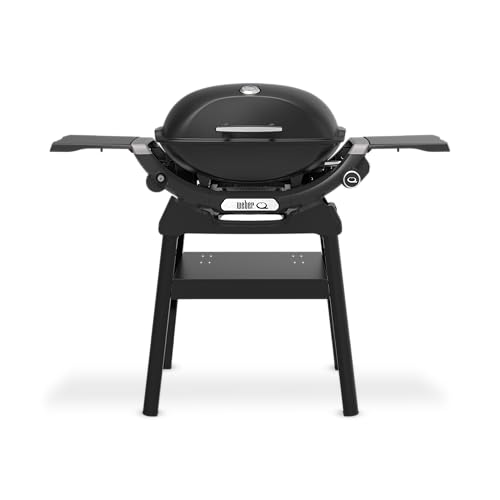
Behind the Amazon number B0FTMJ64SY is the Weber Q 2200N with side tables and compact stand, Weber item 1501100. Amazon lists exactly this number as the model number, so the match is clear. It is a gas grill from the Q range that does not sit on a table but on its own base frame, with one side table on the left and one on the right. Amazon gives the release date as 1 October 2025, and Weber offers it in a single colour, Midnight Black.
In our price box it is listed at approx. €428 (Amazon page on 20 October 2026: €428). Weber itself asks a recommended retail price of €499 in its own shop. In our comparison it scores 8.6 out of 10 points and sits among the gas grills.
We clear up two mix-ups right at the start. First, in Germany Weber sells two versions of the Q 2200N at the same price: this one with the compact stand and one with the premium cart. A pure tabletop version without a frame does not appear in the German Weber range. Second, grate dimensions of 54 x 39 cm are circulating. They belong to the predecessor Q 2200 without the N. For the new model, Weber states only an area in square centimetres.
Burner, grate and lid according to Weber
Under the lid works a single stainless steel burner with 4.10 kW. It heats a cooking area of 2065 cm², on which up to 12 burgers fit according to Weber. The Q 2200N has no warming rack: primary and total cooking area are the same number in the data sheet.
Weber advertises 14% more cooking area and 37% more space under the high-domed lid, each compared with earlier models. It does not say which ones. In any case, this percentage has nothing to do with the smaller Q 1200N.
The grates are made of porcelain-enamelled cast iron. Below them lies a heat reflector that, according to the manufacturer, distributes the heat evenly across the area. The control knobs sit at the front, ignition is electronic at the push of a button, and the ignition needs an AAA battery. In the lid there is a thermometer for the internal temperature.
In addition there are eight utensil hooks, a grease management system that you pull out from the front, and a built-in mount for the Weber Connect Smart Grilling Hub. Weber sells the hub itself separately.
In the product photo the cooking chamber sits under a domed lid with a cross handle and a round thermometer at the top centre. The frame below stands on four legs with a shelf between them. No wheels can be seen in the picture.
How much space does the Q 2200N need?
With both side tables it is 126 cm wide and 50 cm deep according to Weber, and 102 cm high with the lid closed. Open, it grows to 134 cm in height and 60.2 cm in depth. On top of that comes a safety distance from anything that can burn.
The 126 cm is an envelope dimension, and the side tables are included in it. It says nothing about the width of the grate, and a cooking area cannot be derived from it.
For the distance, the manual gives two values that are easily confused. In the hazard notice it says the grill must not be used if combustible materials are within 60 cm, with (treated) wood on a terrace or veranda as the example. In the operation section, combustible materials are to stay at least 61 cm from the back and side panels. We would plan with the larger value and measure from the outer edge of the side tables, because the manual leaves open whether they count as a side panel.
Weber gives the weight as 21.5 kg. On the side tables, Amazon says they are foldable. The manual is more cautious: depending on the model bought, they are removed and stowed under the cooking chamber or folded down at the side of the stand.
Despite the Q in the name, it is not a grill for the boot of a car. The manual prohibits use in a vehicle, in the boot or on the loading area, and according to Weber it is not suitable for installation in or on caravans and boats. You remove the gas bottle when you transport the grill, when it is empty, when the grill is stored in the garage and when you are not using it. A disconnected bottle must never travel in the grill.
In detail: one burner for the whole area
On a gas grill with two or three burners, the indirect zone is easy to create: you turn one burner off and place the food over it, while the flame runs next to it. With a single burner this lever is missing. If you turn it down, the whole area gets cooler, not one half. The additional inner burner, which Weber marks with a plus in the name, is found according to the nozzle table in the manual only on the Q 2800N+ and the Q 3200N+.
Our assessment: for sausages, burgers, steaks and vegetables that lie directly over the heat, the principle is enough. A large joint that is meant to cook for an hour beside rather than over the flame is harder to manage on a single burner. How the two cooking methods work together is explained in our guide to direct and indirect heat.
Now to output. 4.10 kW over 2065 cm² is around 2.0 watts per square centimetre. According to Weber, the Spirit E-210 has 7.8 kW over 2314 cm² of primary area, which is around 3.4 W/cm². That does not automatically make the Spirit hotter. The kW figure describes how much gas burns per hour, not how much heat arrives at the grate. By our reasoning, a smaller cooking space under the lid keeps the heat more compact than a large grill cart, and the reflector in the base sends radiation back upwards. As maximum temperature, Weber gives 316 °C for the Q 2200N. To preheat, according to the manual you set the burner to Start/High, close the lid and wait 10 to 15 minutes or until the thermometer shows 260 °C.
The 4.10 kW applies to propane. For butane, the consumption table lists a higher value, 4.6 kW at 332 g/h instead of 288 g/h. The reason lies in the nozzle: in Germany and Austria the burner has an opening of 0.93 mm, and butane is denser than propane, so at the same pressure more gas mass flows through.
Gas bottle, accessories and running costs
A gas bottle is not included; according to the Q range FAQ, Weber supplies the regulator. The manual requires a bottle with at least 3 kg and at most 13 kg of contents. For Germany and Austria the grill is classified in gas category I3B/P at 50 mbar. The hose may be at most 1.50 m long and must not be kinked, and Weber recommends replacing it every five years; national regulations can set shorter intervals. Replacement regulators and hoses must be original Weber-Stephen parts. What else matters when buying and swapping the bottle is covered in our guide to the gas bottle for the grill.
Before first use comes the leak check, even if the retailer assembled the grill. You mix 20% liquid soap with 80% water and apply the solution to three connections: between bottle and regulator, between regulator and regulator hose, between regulator hose and valve. If bubbles form, there is a leak there. Afterwards you rinse with water. You repeat this after every assembly and every disconnection, always without an open flame. You tighten connections only by hand, because according to the manual too much force can damage the regulator coupling and valve.
Consumption can be calculated because Weber gives it in grams per hour. At 288 g/h of propane at full output, a 5 kg bottle lasts a good 17 hours on paper, an 11 kg bottle a good 38 hours. With a smaller flame it lasts longer. What that costs you in euros depends on the refill price at your dealer.
As accessories, Weber lists on the product page a premium cover for €59.99 and the premium cart (item 3400857) for €229.99. If you calculate at the Weber shop price, with the cover you come to €558.99, not counting the bottle. According to the manual, the cover does not belong on the hot grill, and combustible items also have no place in the storage space beneath.
Cleaning and safety according to the manual
The grill grates are dishwasher safe according to Weber. The grease runs into a system of a removable catch tray and a disposable drip tray. You check both before every use and remove excess grease build-up. The manual prohibits lining with aluminium foil, both for the catch tray and for the cooking chamber.
A thorough clean is done before storage or at least twice a year, quarterly with constant use. The flakes that come loose on the inside of the lid are, according to Weber, carbon deposits and non-toxic; you brush them off with a stainless steel grill brush. You brush the burner across the openings, not lengthways along the tube, and leave the ignition electrode alone. You push residues in the cooking chamber into the grease funnel with a plastic scraper, and wash the removable heat reflector in hot soapy water. You check the brush itself regularly for loose bristles, and Weber advises buying a new one with stainless steel bristles at the start of each season. For the exterior surfaces the manual contains its own list of unsuitable cleaning agents, which you should read before the first deep clean. More on the order of steps is in the guide cleaning a gas grill.
On placement the manual is clear: only outdoors and in a well-ventilated place, not in garages, buildings, covered walkways, tents, other enclosed areas or under combustible structures. Flammable liquids must be at least 7.50 m away, and flammable gases and liquids such as petrol or alcohol have no place in the grilling area.
During use you never leave the grill unattended, not even while preheating, and you do not move it. Weber requires heat-resistant grill gloves with contact heat resistance of level 2 or higher under DIN EN 407 (the standard that applies in Germany and the EU). Gas hose and electrical cables stay away from hot surfaces.
In a grease fire you switch off all burners immediately and keep the lid closed until the fire has gone out. You never extinguish an oil or grease fire with water. If you smell gas, you cut off the gas supply, extinguish all open flames and open the lid; if the smell persists, you move away and call the gas supplier or the fire brigade.
Charcoal, briquettes and lava stones are taboo in this grill. You may not convert it to natural gas, and it cannot be connected to a mains gas line.
What the manufacturer does not state
These details are missing from the product page and manual: a grate dimension in width and depth; the material of the cooking chamber and lid (the manual says only generally that the exterior may contain stainless steel, painted aluminium and plastic); the material of the stand; a heat-up time to a particular temperature, beyond the preheating recommendation; the country of origin; a complete packing list (lid thermometer, regulator and disposable drip tray are documented); regulator type and hose length of the German version; a method for indirect cooking; a rule for balconies; which of the two side table mechanisms is fitted on the compact stand; the meaning of the 12 inch (305 mm) dimension that appears in the manual next to the bottle position in the picture, with no explanation in the text. For the cart version, the Weber page also contradicts itself on the number of castors.
These three alternatives are worth a look
| Model | The difference | Price | Our rating | Choose this one if |
|---|---|---|---|---|
| Weber Q 2200N (this one) | 1 burner, 4.10 kW over 2065 cm², gas bottle needed | approx. €428 | 8.6 | you cook direct on a small terrace for up to six people |
| Weber Q 1200N with side tables and stand | runs on an EN 417 cartridge instead of a bottle according to Weber | approx. €499 | 8.4 | you mostly grill for two and do not want to store a bottle |
| Weber Spirit E-210 | 2 burners, 7.8 kW and 41 kg according to Weber | approx. €389 | 8.9 | you want to cook indirect and have room for a grill cart |
| Weber Spirit II E-310 | 3 burners, 44.5 kg according to Weber | approx. €459.99 | 9.2 | you regularly cater for larger groups in the garden |
The prices come from our price boxes and change constantly. The rating is our editorial assessment from the data comparison; we measured nothing.
When the Q 2200N suits and when another grill does
Start with the number of people. Twelve burgers at once means that a group of six gets two burgers in one go. If you almost always grill for two, the Weber Q 1200N with stand is the smaller choice, but currently not the cheaper one: approx. €499 from marketplace sellers on Amazon (as of 21 October 2026), the Q 2200N approx. €428. There is also a practical difference: it runs on a cartridge, so you do not have to find room for a bottle.
The point at which we would most likely recommend a different grill is the indirect zone. The Weber Spirit E-210 is listed in our price box at approx. €389, the Q 2200N at approx. €428, and it has two burners. In return it is a full-sized grill cart at 41 kg according to Weber. If you have room for that and like to cook roasts or chicken beside the flame, in our assessment you are better off with the Spirit. The Spirit II E-310 has one more burner again, for approx. €459.99.
In the Q’s favour is the footprint. A grill 50 cm deep fits a narrow terrace more easily than a cart, and with the side tables folded or removed it shrinks further. Whether you may run it on a balcony is decided not by Weber but by your tenancy agreement or house rules; what is usual is summarised in the guide grilling on a balcony.
Plan the budget in full. On top of the price box come the bottle with its first fill and, if you leave the grill outside, a cover.
We would not choose the Q 2200N for use in or on a motorhome or on a boat, because the manual excludes use in vehicles and installation in caravans and boats; there is also little in its favour at a campsite, because it needs a gas bottle of 3 to 13 kg. And if you plan long low-and-slow cooking times, you are better served by a grill with several burners. If you are still undecided between gas, charcoal and electric, the grill finder gives you a first shortlist.