The Q 1200N is Weber’s small single-burner gas grill, and this page covers the version that stands on its own stand. Weber calls it the “Q 1200N gas grill with side tables and compact stand”, item number 1501083, colour Midnight Black. The same number appears in the Amazon catalogue as the model number of ASIN B0FTMHKV9R. That field is the only way to check the match, because Weber’s product page never links to Amazon. We list the same grill without a stand separately as the Weber Q 1200N. In our overview of gas grills, it is one of the compact models for cartridge gas.
We have not handled it, and we have not grilled anything on it. What is written here comes from Weber’s German product page (retrieved on 21 October 2026), from the operating manual for the Q 1100N and Q 1200N (document 8655624_092424 DE, twelve pages, explicitly covering the 1200N with compact stand as well) and from the Amazon catalogue. Calculations and ratings from us are marked as such.
Burner, grate, lid and dimensions
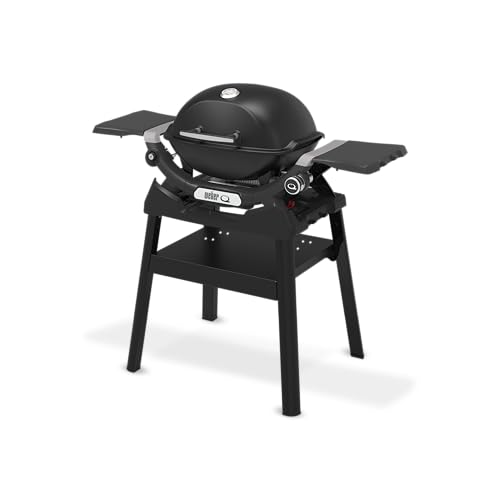
The product photo shows an oval, domed cooking chamber with a round thermometer on top of the lid. The control knob sits at the front right, and the two side tables stand angled outwards to the left and right. Below, a frame with four black legs carries the grill, with a horizontal shelf between the legs. It is not a rectangular box, which is why we do not calculate a grate size from the outer dimensions.
Heat comes from one stainless steel burner, which the product page gives as 2.93 kW. Weber puts the cooking area at 1290 cm², as both the primary and the total area: Weber therefore does not count an additional warming rack. According to Weber, up to 9 burgers fit on it. The grates are made of porcelain-enamelled cast iron; according to Weber’s description they store heat for searing and may go in the dishwasher. The product page gives the maximum grilling temperature as 316 °C.
According to Weber, there is 46% more space under the high-domed lid than on earlier models, intended for large roasts. There is a thermometer in the lid, and the control knobs sit on the front. Fat runs into a drip tray that you pull out towards the front; according to the manual, the system consists of this removable tray and a disposable drip pan inside it. Hooks for barbecue utensils hang on the side tables, and both tables can be stowed for transport and storage.
With the lid closed, the grill measures 99 cm in height, 105 cm in width and 45.5 cm in depth according to Weber. Open, it grows to 125 cm in height and 56 cm in depth. It weighs 19.0 kg. The Amazon catalogue arrives at the same weight after conversion from 41.8 pounds, but for the dimensions it gives about 105 x 44 x 38 cm. That is almost exactly Weber’s dimensions for the version without a stand; for this page we therefore use Weber’s figures. Amazon gives 1 October 2025 as the release date.
Some things cannot be found in any of the sources. Weber does not say what material the lid, cooking chamber, stand and side tables are made of; the manual says only in general terms that the exterior may include stainless steel, painted aluminium and plastic. Also left open are the edge dimensions of the grate, the height of the work surface on the stand, whether the 105 cm is measured with the tables folded out or in, the measuring range and accuracy of the lid thermometer, the regulator’s outlet pressure for Germany, whether the battery and drip pans are in the box, the country of manufacture and how long spare parts remain available. Whether the grill can be taken off the stand and used as a tabletop unit is answered only by some of the customer reviews on weber.com, and we do not evaluate those.
In detail: one burner, one zone
On a gas grill with two or more burners, you can switch one side off and let the food cook gently there with the lid closed while the other side heats. That is indirect grilling. The Q 1200N has one burner and one knob. The manual knows the positions OFF, START/HIGH, MEDIUM and LOW, and each applies to the whole grate at once.
It follows that there is no separately adjustable cool zone. Weber also describes no dedicated method for indirect cooking on this model. How the two cooking methods work in principle is explained in our guide to direct and indirect heat. We would therefore regard the large lid more as room for tall food that you cook on a low setting with the lid closed, and less as a substitute for a second zone. That is our conclusion from the construction.
Output per area is interesting. 2.93 kW on 1290 cm² is, by our calculation, roughly 2.3 watts per square centimetre. The larger Q 2200N, also with one burner, reaches 4.10 kW for 2065 cm² according to Weber, which is just under 2.0 watts. Per area, the small grill is therefore even slightly ahead. How hot the grate actually gets also depends on the lid, the cast iron and the wind, however, and a figure like this is no substitute for a temperature measurement.
The manual describes precisely how you can tell that the burner is working properly: the flames have a yellow tip and pass through a light blue into a dark blue.
Does the Q 1200N with stand fit on your balcony?
If the balcony is open and you can keep a distance from anything combustible, yes. Weber explicitly names the patio and balcony as places of use. The manual requires a well-ventilated spot outdoors and at least 61 cm of clearance between combustible materials and the back or sides of the grill.
The cover page of the same manual gives a round figure, a 60 cm radius, with the example of treated wood on a patio or porch. We work with the larger value. With a width of 105 cm and a depth of 45.5 cm, by this calculation you need a clear area of roughly 227 cm in width and 106.5 cm in depth up to the nearest wooden wall, awning or plant, not counting the space in front of the grill for yourself. Flammable liquids such as petrol or alcohol must not be within a radius of 7.50 m at all.
According to the manual, operation is prohibited in garages, buildings, covered walkways, tents, other enclosed areas and under combustible structures. A loggia with a wooden ceiling falls under the last of these, in our reading. Whether your tenancy agreement or house rules allow a gas grill on the balcony is a question for your landlord; Weber says nothing on this. You will find more in the guide grilling on a balcony.
According to the manual, the grill is not suitable for charcoal, briquettes or lava stones, and it must not be connected to a mains gas supply.
Gas, ignition and preheating
The Q 1200N runs on liquefied gas from the disposable cartridge, which Weber sells separately. The manual permits only disposable butane or propane cartridges with a capacity of 430 g to 460 g, namely Weber Q gas cartridges or other cartridges approved under EN 417 (the standard that applies in Germany and the EU) and marked 80% butane/20% propane. To fit one, you turn the control knob to OFF and close the gas control valve, press the cartridge into the regulator, turn it clockwise until tight and place it in the cartridge holder. Hand-tight only, Weber writes, because excessive force can damage the regulator coupling and the cartridge valve. You check the connection between regulator and cartridge for leaks every time you reconnect it.
On output, the sources contradict each other. The product page gives 2.93 kW without naming a gas type, whereas the consumption table in the manual for the Q 1100N and Q 1200N gives 3.4 kW with butane, with a 0.89 mm nozzle and a consumption of 243 g/h. We report both values as they stand and do not convert one into the other.
Ignition is electronic, powered by an AAA battery, alkaline only according to the manual. The lid stays open when lighting, and you do not lean over the grill. Turn the control knob to START/HIGH, press and hold the igniter button, and it clicks; you can see through the grates whether the flame is lit. If the burner does not light within five seconds, you turn to OFF and wait five minutes before trying again. If the electronics fail, you can use a match held under the match-lighting hole.
According to the manual, you then preheat for 10 to 15 minutes on START/HIGH with the lid closed, or until the thermometer shows 260 °C.
What else is worth considering?
| Model | The difference | Price | Our rating | Choose this one if |
|---|---|---|---|---|
| Weber Q 1200N with stand (this one) | own stand, two side tables, 99 cm high | approx. €499 | 8.4 | you want to grill without a table and one cartridge is enough |
| Weber Q 1200N | the same grill without a stand | approx. €249 | 8.3 | you have a sturdy table or carry the grill in the car |
| Weber Q 2200N | larger cooking area, up to 12 burgers according to Weber | approx. €428 | 8.6 | you often grill for more than four people |
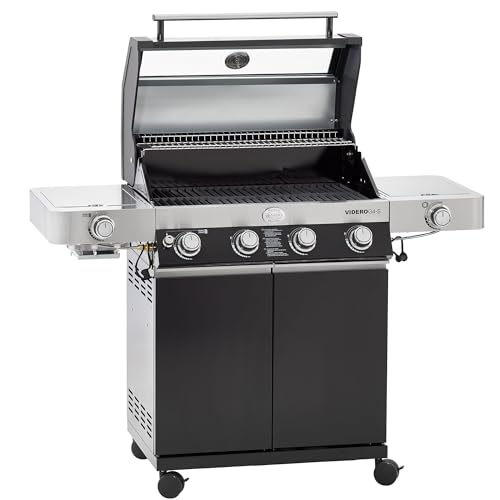
| Rösle Videro G2-P | two separately adjustable burners | approx. €300 | 8.2 | you want to cook indirectly too in a small space |
Prices are guide values from our price boxes and change; the rating is our editorial assessment from data sheets and manuals, and we measured nothing.
When the Q 1200N with stand, and when another
The first question is the stand itself. On Amazon, the price on 21 October 2026 was approx. €499 (Amazon page on 21 October 2026: €499.00). That is the lowest new price from a marketplace seller, because Amazon itself did not offer the grill that day. Our price box lists the version without a stand at approx. €249. If you have a stable outdoor table that stands far enough from combustible walls, the version without a stand is enough in our assessment. If you do not, the stand is the reason to buy exactly this model.
Then the number of people eating. Up to 9 burgers at once means, by our calculation with two burgers per person, four people in one batch, or rather three with vegetables and bread alongside. If you regularly grill for five or more, we would go for the Q 2200N, which stands at approx. €428 in our price box, so below the marketplace price of this grill, and which according to Weber is also available as a variant with compact stand (item number 1501100).
If you want to cook roasts, chicken or ribs indirectly, the construction speaks against the Q 1200N. The Rösle Videro G2-P has two burners and stands at approx. €300 in our price box. Neither it nor the Q 1200N has a side burner.
That leaves the gas. If you already have an 11 kg cylinder in the garden and want to keep using it, a cartridge grill serves you poorly; see the question about the gas cylinder above. If you grill only a few times a month, cartridges are enough, but you have to factor them in.
Cleaning, safety and warranty
According to the manual, the grill should be cleaned thoroughly before storage or at least twice a year, and if used constantly, quarterly where necessary. Before each barbecue, you brush the inserted grates with a stainless steel grill brush; Weber advises buying a new brush at the start of each season and regularly checking the old one for loose bristles. On the burner, you brush across the openings, not lengthways along the tube, otherwise you merely push the dirt from one opening to the next, and you protect the ignition electrode in the process. You clean the spider and insect screen on the burner’s air openings with a soft bristle brush.
You push residue in the cooking chamber into the grease funnel in the base with a plastic scraper. You do not line the drip tray and cooking chamber with aluminium foil, and before each use you check the tray and disposable drip pan for fat so that no grease fire starts. According to Weber, the black deposits on the inside of the lid are carbon and non-toxic, but can fall onto the food if you do not loosen them with the stainless steel brush. You clean painted aluminium and plastic on the outside with warm soapy water and kitchen paper or a cloth, then rinse and dry. The manual lists abrasive stainless steel polishes or lacquers, acidic cleaning agents, white spirit or xylene, oven cleaner and scouring pads as unsuitable.
For gas, the wording applies. If you smell gas, you cut off the gas supply, extinguish all open flames and open the lid; if the smell persists, you move away and call the gas supplier or the fire brigade. In a grease fire, you switch off all burners immediately and keep the lid closed until the fire has gone out. If a fire breaks out, you move away from the appliance and call the fire brigade, and you never put out an oil or grease fire with water. While it is in use, you never leave the grill unattended or move it, and the cover goes on the grill only once it is off and has cooled down.
For the leak test, you mix 20% liquid soap with 80% water and apply the solution to three connections: cartridge and regulator, regulator and regulator hose, regulator hose and valve. Bubbles mean a leak, open flames have no business being nearby, and afterwards you rinse the connections with water because some solutions are slightly corrosive. Weber requires this check before first use, even if the retailer assembled the grill, although according to the manual the connections are checked at the factory. Weber recommends replacing the gas hose every five years, or sooner if national rules require it; cracks, porous spots and cuts are a reason to take the grill out of service immediately. General information on thorough cleaning is in the guide cleaning a gas grill.
The manufacturer’s warranty comes on top of the statutory two-year liability for defects and is graded by component. The cooking chamber and lid have 5 years against rust-through or burn-through and 2 years on paint adhesion, the stainless steel burner tubes and the cast iron grates have 5 years each against rust-through or burn-through, plastic parts have 5 years without fading and discolouration, and all other parts have 2 years. It applies only to the first buyer and only in private households. You do not have to register the grill for it, but you should keep the proof of purchase. Replaced parts inherit only the remaining term, and if Weber sends you a request to return a part for examination, you pay the postage in advance.
Who is it suited to?
For two to four people with an open balcony or a small patio and no garden table, who want to grill steaks, sausages and vegetables directly over the flame and can live with cartridges. For this group the stand is the real argument, because it replaces the table the grill would otherwise need.
It is the wrong choice for three groups. If you like to cook indirectly, one burner gives you no second zone. If you want to stay connected to a large cylinder, you will find no intended way in Weber’s product page and manual; the manual even warns against connecting other gas containers. And if you want to put the grill on Weber’s premium trolley, which the product page lists as an accessory for €229.99, you do not need the stand at all.
The product page also shows the premium cover for €59.99 and the Q and Pulse cleaner for €11.99 as accessories. The cover adds to the price of the grill before you have bought the first cartridge.