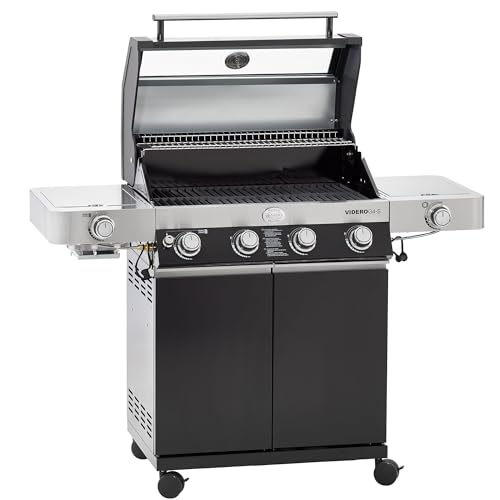
Rösle is based in Marktoberdorf in the Allgäu; the company was founded in 1888 by master tinsmith Karl Theodor Rösle. The VIDERO G4-S is a gas grill station with four main burners under the lid and two heated side tables. On the left sits an infrared burner that Rösle calls the Primezone, on the right a side burner as a gas hob. How it fares against the other models in our gas grill category depends mainly on this left-hand table.
Nero or black: which unit is behind the link
This page was called Vario+ Nero until autumn 2026. The Amazon listing it links to, however, is called “RÖSLE Gasgrill BBQ-Station VIDERO G4-S Schwarz”, and Nero does not appear anywhere in the title. The model number in the Amazon catalogue is 25524. That is the old Rösle number for article 250524, which the manufacturer’s shop lists as “Gasgrill VIDERO G4-S Vario+ schwarz 50 mbar” with EAN 4004293255242. Rösle gives the colour as black, and the housing is made of powder-coated steel.
At Rösle, NERO is a separate special edition “with a matt black look”, for example the G3-S NERO (Art. 250565) and the G4-PIT NERO (Art. 251183). The operating manual lists a G4-S NERO in its equipment overview. No product page for it was available in the Rösle shop on 1 October 2026, and it is missing from the VIDERO series page. How it differs from Art. 250524 cannot be read from the Rösle documents. The only hint is the spare parts offer in the shop: there is a separate Primezone shelf table for the NERO and PRO models of the G3-S, G4-S and G6-S (Art. 270595).
In the product photo, the lid and base cabinet doors are black, the side tables and side walls silver-coloured. Everything that follows applies to Art. 250524.
When ordering, pay attention to the 50 mbar. Rösle also builds the same station as Art. 250531 with 30 mbar, without a pressure reducer and exclusively for EU countries other than Germany and Austria. Conversely, Rösle sells the 50 mbar version only to Germany and Austria.
Burners, grates, housing
Under the lid work four stainless steel main burners at 3.5 kW each, 14 kW together. With the Primezone (3.5 kW) and the side burner (3.0 kW), Rösle arrives at 20.5 kW. The operating manual states gas consumption only for all burners together, at 1489 g per hour. It runs on butane or propane at 50 mbar; the nozzles measure 0.81 mm on the main burners and Primezone, and 0.75 mm on the side burner.
Earlier versions of this page gave 15.5 kW and a grilling area of 76 x 43 cm. Neither appears in any Rösle specification. According to the manufacturer, the main grilling area measures 70 x 45 cm, according to the Amazon catalogue 3,150 cm², with a warming rack of 70 x 16 cm above it. Rösle calculates for 4 to 8 people.
The main grates are made of enamelled cast iron and, according to the Amazon description, are reversible. The spare parts list gives a large cast iron grate of 24 x 45 cm and the Vario+ grate, which the Rösle shop lists as a spare part at 48 x 45 cm. Stainless steel grates sit on the Primezone and side burner. The heat deflectors and grease tray are also made of stainless steel, the fire bowl is porcelain-enamelled.
The lid has a glass insert and a large thermometer with a scale in °C and °F, which according to the manual table runs from 60 to 350 °C, with a stated tolerance of ± 10 °C. You ignite the main burners by piezo with Jetflame, the side burner likewise by piezo, the Primezone electronically; an AA battery sits in the grill for that. The control knobs are illuminated. Underneath are easy-running castors with a brake, and a cutlery holder and a hook rail for tongs and gloves are included too.
Assembled, the station measures 138 x 57 x 118 cm at a working height of 90 cm according to the Rösle shop. The manual table gives 60 instead of 57 cm depth and describes its dimensions as approximate values. If you fold down the side tables, the width shrinks to 102.5 cm according to the Amazon description. On weight, the sources differ widely: 63.8 kg in the shop, approx. 51 kg in the manual, converted about 53.3 kg at Amazon. None of the sources says whether one of the values includes the packaging. According to the shop, the carton measures 81.5 x 65 x 65.5 cm.
Assembly is described by a separate assembly guide for the G3-S and G4-S, almost entirely in pictures. Its pictograms require assembly by two people, without a cordless screwdriver, with protective gloves because of the risk of cuts and without kinking the gas hose. The tools shown are a PH 2 Phillips screwdriver and open-ended ring spanners in 17 and 19 mm.
In detail: the Primezone sits beside the cooking chamber
An infrared burner gives off its heat differently from an ordinary gas burner. The gas burns on a ceramic surface with fine pores, the surface glows, and a large part of the energy goes as radiation directly onto the food. An open gas burner, by contrast, heats mainly through hot combustion gases, which first warm the grate and the air. That is how infrared burners work in general; Rösle itself speaks of ceramic burner surfaces with pores into which no grease may drip.
For the Primezone, Rösle gives approx. 800 °C and recommends it for quick-cooking food such as steaks. It is preheated with the cover open for 5 minutes or until the ceramic glows orange-red. Its grate can be inserted at two heights: low for searing meat, high like an ordinary gas hob for sauces and soups, with pots and pans up to 25 cm base diameter.
On the Primezone you grill at high, medium or low temperature depending on taste and doneness, turning more often if needed. Alternatively, the manual suggests moving the food to the main grate or the warming rack and finishing it slowly with the lid closed at 120 to 160 °C. You never leave anything there unattended: Rösle describes the heat as very intense, and food can burn quickly. When igniting the Primezone, you always keep at least 30 cm away, never lean over the open grill and watch your face, beard, hair and loose or flapping clothing.
Moving the food shows the most important difference from grills where the infrared zone sits between the main burners. The Primezone side table does have its own cover, which can even be removed via a spring pin on the hinge. According to the manual, however, you must not close it while the burner is running or still hot, so it does not form a cooking chamber like the one under the grill lid. If you prefer to sear and carry on cooking on the same grate under the lid, you are better served by an infrared zone in the cooking chamber, for example with the Enders in the table further below.
The manual sets two conditions. The Primezone should stand as sheltered from wind as possible, because strong wind can reduce the output or blow out the flame. And so that hot air can escape, never more than 75% of the grate area may be covered; otherwise oxygen is lacking, flashbacks occur, and repeated occurrences can make the ceramic crack.
How hot does it get under the lid?
Rösle does not state a maximum temperature that the cooking chamber can reach, but it does state a limit: to protect the grill, it should not get hotter than 350 °C. Rösle warns that excessively high temperatures can deform grill parts.
To preheat, according to the manual you turn all main burners to MAX and keep the lid closed for 15 minutes, or until the thermometer shows 250 °C. For the main burners too, Rösle advises a wind-sheltered spot, because the grill reaches higher temperatures and more even heat distribution there.
How much output reaches the area can be calculated. 14 kW on 3,150 cm² gives roughly 4.4 W per square centimetre. The Broil King Regal 590 with 16 kW on the 4,032 cm² that Broil King states comes to just under 4.0 W, the Enders Monroe Pro 4 SIK Turbo with 14.7 kW on 3,182 cm² to roughly 4.6 W, and the SANTOS S-418 Pro with 12 kW on 3,209 cm² to roughly 3.7 W. The calculation is ours, the figures come from the manufacturers’ pages; for the Enders the Turbo Zone counts, for the Rösle the Primezone is left out. The value works as a comparison between grills; it does not replace a temperature at the grate.
For indirect grilling, according to the manual you use the two outer main burners with the lid closed; a drip tray stands in the middle under or on the grate, with the food above it. On the G4-S this leaves the two middle burners off, and the food cooks by convection in the whole chamber without you having to turn it. For pizza stones and griddle plates, the instructions set a limit: you never cover the entire grilling area, whether with food, griddle plates, drip trays, pizza stones or the like. Otherwise heat can build up in the lower area of the combustion chamber.
VARIO+, accessories, spare parts and guarantee
Until now this page said that VARIO+ is a ventilation system in the lid. That is wrong. At Rösle, VARIO+ is a grate system: a round cast iron insert with a diameter of 30.5 cm sits in the grate, usable on both sides according to Rösle, and separately available inserts fit in its place. A supplied VARIO holder takes them up on the grill. In the Rösle shop on 1 October 2026, the Vario pizza stone (Ø 30 cm) cost €34.95, the Vario griddle plate (Ø 30 cm) €64.95, the Vario wok (Ø 36 cm) €99.95 and the Vario Dutch oven (Ø 35 cm) €149.00.
From the same shop, same date: the VIDERO G4 cover in black costs €89.95, the Primezone windshield €39.95. Under the heading “Lebensdauer erhöhen” (extend service life), the manual requires you to protect the cooled grill outdoors from rain and snow with a suitable RÖSLE cover. The G4-S has no rear burner; the shop still lists the Premium rotisserie G4/G6 for €169.00 as an accessory, and according to the shop you then hang the warming rack at the back of the station.
There is a separate spare parts list for Art. 250524 with 59 items, dated 13 March 2026; the pressure regulator is item 9 there (Art. 270489). In the shop on 1 October 2026, a stainless steel main burner cost €19.95, the warming rack €59.95 and the Vario+ grill grate €119.00. The infrared burner of the Primezone is listed in the shop at €65.95, but was not in stock that day.
On the guarantee, only a close look at the documents helps. Rösle’s voluntary grill guarantee, as of 06/2026, lists in the term table of its short version the BLAZEFLAME, EPICFLAME and ALLFLAME lines, the AIR charcoal kettle grills as well as No.1 SPORT F50 and the Smoker No.1 F50-S. VIDERO is not in it. The G4-S manual speaks of the statutory warranty from the invoice date; you direct questions and complaints to the retailer you bought from.
What Rösle does not state
In the documents we evaluated (product page, operating manual, assembly guide, spare parts list), the following is missing:
- where the G4-S is manufactured; only the company headquarters is named
- material and wall construction of the lid
- the material of the side tables
- thickness and weight of the cast iron grates
- the dimensions of the Primezone grate
- how long the cooking chamber actually takes to reach 250 °C; the 15 minutes are a preheating recommendation
- the height of the cooking chamber
- the design of the main burners
- the duration of assembly
- a complete scope of delivery, for example whether a gas hose is included and how long it is; a gas cylinder appears nowhere as part of the delivery
- a market launch: Amazon gives 1 January 2021 as the release date, the spare parts list marks parts with MJ21
- approval marks beyond the CE number 2575-25 of the burner unit and conformity with the EU Gas Appliances Regulation 2016/426
Gas, location and safety according to the manual
The operating manual covers several VIDERO models. Where gas and flame are concerned, we reproduce it closely to the wording.
According to the manual, the grill is intended exclusively for private use and only for grilling grillable food with butane or propane. It must not serve as a fire pit, and conversion to natural gas is dangerous and voids the operating licence.
You may operate it only outdoors. Garages, covered or enclosed porches and terraces, other enclosed places as well as caravans and watercraft are excluded. It must also not run under an unprotected combustible roof, awning or overhang. Within 1.5 m above, below, to the side, in front of or behind the grill there must be no combustible materials during operation; as examples Rösle names treated wooden decks, wooden porches and textiles, expressly without ending the list there. Next to vinyl cladding and large window fronts, Rösle recommends additional distance, as it does from the house facade, which could otherwise be soiled by smoke. The ground must be level, firm and safe, during operation you never place the grill on combustible surfaces, and you store nothing combustible under the grill. These location rules apply to every model in the manual, from the Pure G3 to the G6-S. If you only have a covered spot, the series offers no way out.
And the balcony? The Rösle shop gives “Balkon, Terrasse” (balcony, terrace) as the place of use, and the fold-down side tables are meant to save space there. The manual mentions balconies nowhere. If there is something combustible to the left and right, such as a privacy screen made of wood or fabric, you need 4.38 m of width by our calculation: 138 cm plus twice 1.5 m. The grill must not run folded down; for operation, all fold-down side tables must be locked in horizontally. Whether gas is allowed on your balcony at all is governed by your tenancy agreement and house rules; more on this in the guide Grilling on a balcony.
The gas cylinder, 11 kg filling weight at most, stands upright in the base cabinet, and only one; you do not store spare or unconnected cylinders there. The gas pressure regulator has an integrated hose rupture protection. In operation it monitors the gas flow and shuts it off if the hose is damaged, tears off or comes loose. The pressure regulator must comply with EN 16436 or EN 16129 in the current version and national regulations, and the hose may be no longer than 1.5 m. Rösle recommends replacing the hose every 5 years and the regulator before 10 years have passed since its date of manufacture; national regulations take precedence in each case. You have the cylinder itself checked every 10 years by an authorised specialist company.
Before every start-up you check the gas connections for leaks, even if a retailer or third parties assembled the grill. All control knobs are at OFF while you do so. You connect the pressure regulator, open the cylinder valve with at least two full turns anticlockwise and brush all gas-carrying parts with soap solution, for example half liquid soap, half water, or use a leak detection spray. Fine bubbles show a leak. Then you tighten the screw connection or hose clip or replace the defective part, and check again from opening the valve. If the leak cannot be fixed, you contact the specialist retailer, and the grill must not be operated like that. Because some leak detection agents, soapy water included, can be slightly corrosive, you rinse the connections with water afterwards and dry them. You never look for leaks with an open flame.
If you smell gas, the manual gives this sequence: close the gas supply at the cylinder immediately, extinguish all open flames and turn the control knobs to OFF, open the grill lid, if possible move the appliance away from buildings and combustible objects, keep your distance and call the fire brigade immediately if the smell persists. According to Rösle, escaping gas can cause fires or explosions.
Before you fold down a side table, you close the shut-off valve on the cylinder and uncouple the gas hose at the quick-connect coupling; when uncoupled, it shuts off the gas automatically. You fold down only when cooled, on the Primezone table after removing residues in its grease tray. You close the couplings with their protective covers when not in use, because even slight contamination can lead to leaks.
Cleaning and care
According to the manual, burning off does not replace cleaning, least of all for the lower area of the combustion chamber. After grilling you let the burners run for another 5 minutes so that grease and residues burn off, which could otherwise clog the burner openings. You check the grease deflector plate and grease tray before every start-up and clean them regularly, more often with heavy use. You line neither the grilling chamber nor the plate with aluminium foil or sand, because then the grease can no longer drain away. According to the manual, a fire caused by grease and oil residues voids the warranty.
For the enamelled cast iron grates: not in the dishwasher, let them cool before cleaning and never dip them hot into cold water, because the thermal shock can damage enamel and cast iron. You soak burnt-on residue in hot water. The manual rules out steel wool, wire brush and scouring agents here, because they remove enamel and patina. Afterwards you rinse with clean water, dry thoroughly, never store the grates damp and rub them with a little neutral, heat-resistant cooking oil or vegetable fat, expressly not olive oil; you remove the excess with a cotton cloth.
One page earlier it reads differently. There you are told to loosen deposits on the grates with a grill cleaning brush or a soft stainless steel brush and wipe over with a damp cloth. For the enamelled grates we would follow the stricter rule and avoid metal bristles.
You clean the exterior surfaces with mild detergent and water, rinse with clean water and dry. Abrasive stainless steel polishes or varnishes, oven cleaner, abrasive kitchen cleaners, acidic cleaners, lactic acid cleaners and scouring sponges are taboo there.
For the combustion chamber, the manual contradicts itself on the same page. Under “Wartung der Grillteile” (maintenance of the grill parts) it names oven cleaner or suitable grill cleaners; under “Reinigung Grillkammer / Flächen” (cleaning grill chamber / surfaces) it rules out oven cleaner for cleaning the grill, in a similar list to the one for the exterior surfaces. We would stick to a suitable grill cleaner there, then rinse with clean water and dry. Before thorough cleaning you remove all grill grates, burner covers and burners, and afterwards you dry the grill by heating it up. Neither water nor cleaner may get into the openings of burners and nozzles.
The ceramic of the Primezone is the most sensitive. You keep water from rain, lawn sprinklers or garden hoses away from it, and you never extinguish a flare-up there with water. If the ceramic gets wet while the grill is switched off, it can crack at the next use from the pressure of the water vapour; Rösle then advises removing the burner, laying it upside down and letting it dry thoroughly. Hard objects must not touch the ceramic, so take care when removing and inserting the grate. Large temperature differences in winter use can cause stress cracks. And you never use the Primezone grate as a shelf for finished food, otherwise grease drips into the pores of the ceramic.
You remove the cover regularly in summer and winter so that the grill is ventilated and no trapped moisture forms. It is better not to store it next to road salt.
What else is worth considering?
Three grills from our catalogue where the answer on searing zone and rotisserie differs each time:
| Model | The difference | Price | Our rating | Choose this one if |
|---|---|---|---|---|
| Rösle VIDERO G4-S (this one, Art. 250524) | Infrared Primezone in the left side table plus 3 kW gas hob, no rear burner | approx. €849 | 9.2 | you sear steaks beside the grill and need a pot on the go |
| SANTOS S-418 Pro | Rear burner with 4.0 kW and infrared side burner with 4.5 kW, but no ordinary side hob | approx. €799 | 8.4 | you want to turn roasts on a rotisserie and can do without a gas hob |
| Enders Monroe Pro 4 SIK Turbo | 800 °C Turbo Zone with 4.2 kW as one of the four burners under the lid, plus side hob with 2.9 kW and infrared back burner | approx. €619 | 8.6 | you want to sear and carry on cooking on the same grate without moving the food |
| Broil King Regal 590 | five burners on 80 x 48.8 cm, rear burner with 4.4 kW including rotisserie motor, no infrared | approx. €1,649 | 9.4 | you need a larger main grate and have a permanent spot for it |
The prices are guide values from our price box and change. We checked the technical details for SANTOS and Enders on the manufacturers’ pages on 1 October 2026; those for the Broil King come from broilking.de. Our rating is an editorial assessment from the data comparison; none of the four figures contains a measurement.
Who the G4-S suits and who it does not
None of the three grills in the table has an infrared side table and a normal gas hob together. If you would use neither of the two, the G4-S is in our view the wrong choice: then you pay for two burners in the side tables that stay unused. If you want exactly this combination, you decide within the series mainly by area.
The G3-S has three main burners, a grate of 60 x 45 cm and a width of 127 cm. The G6-S has six main burners on 92.5 x 45 cm, is 157 cm wide, and Rösle sees it for 8 people and up. Like the G4-S, both have a Primezone and side burner. On 1 October 2026, Rösle itself asked €899 for the G3-S and €1,249 for the G6-S in its own shop; the shop listed the G4-S as currently unavailable that day.
Our price box lists the G4-S at approx. €849. With the cover from the accessories section you end up at around €939, with the gas cylinder on top. According to the price boxes of the respective pages, the SANTOS is €50 below the G4-S and the Broil King around €800 above it; its manufacturer also gives the Broil King as 102 kg.
If you are still unsure about the type of grilling, work through the questions in the Grill Finder.