What is behind the number 1501048
Amazon sells the Weber Q 1200N gas grill with side tables under the ASIN B0FTMJ97R1. The catalogue gives 1501048 as the model number, and that is exactly Weber’s own item number. That is unambiguous, and with this range it is worth a look: in Germany, Weber lists three appliances with almost the same name.
The Q 1200N is the middle one of these. Below it sits the Q 1100N, above it the same grill with a compact stand, followed by the Q 2100N, Q 2200N, Q 2800N+ and Q 3200N+. Amazon gives 1 October 2025 as the release date. Weber lists a single colour, Midnight Black.
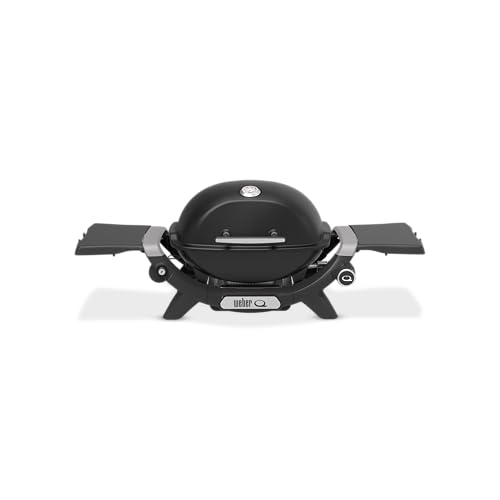
The manufacturer describes the grill as portable and names small spaces such as a terrace or balcony as its place of use. The product photo shows what that looks like: a rounded, highly domed lid with a thermometer on top, a low base underneath, and an unfolded side table on each of the left and right. A base at working height is not included. The Q 1200N stands on a table, a wall or its own trolley. It costs approx. €249 (Amazon page on 20 October 2026: €249). How that compares with the other appliances is shown in the overview of all gas grills.
Burner, grate, lid and dimensions
Under the lid works a single stainless steel burner. Weber gives it as 2.93 kW on the product page, and Amazon takes over the value word for word. It is controlled by one knob on the front with four positions: OFF, START/HI, MEDIUM and LOW. Ignition is electronic at the push of a button. For this the grill needs an AAA battery, according to the manual alkaline only.
According to Weber the cooking area is 1,290 cm², and that is also the whole area; a warming rack is missing from the specification. According to the manufacturer there is room for up to 9 burgers. The grates are made of porcelain-enamelled cast iron and are dishwasher-safe according to Weber. Cast iron has a high heat capacity: a preheated grate passes stored heat directly to the contact points when cold food is placed on it, instead of cooling down at once itself. On this, Weber says only that the grates store heat for grilling or searing.
The lid is highly domed. Weber says it gives 46 % more space underneath than earlier models, without naming the comparison models or a volume. A thermometer in the lid shows the internal temperature; in the shop it is the only entry under what is included. According to the manual, you preheat with the lid closed on START/HI, for 10 to 15 minutes or until the thermometer shows 260 °C.
Grease runs into a system of a removable catch tray and a disposable drip pan, which you pull out from the front. The two side tables can be stowed for transport and storage, the grill tools hang on their hooks, and there are also 4 utensil holders. Weber has made provision for digital thermometers: an integrated mount for the Weber Connect Smart Grilling Hub (available separately), a magnetic surface on the side table for compatible Connect devices, and mounts in the lid for an ambient temperature probe, which is stored at the back of the frame.
Dimensions, weight and where to put it
With both side tables, the Q 1200N measures 105 cm in width. Closed it is 38 cm high and 44 cm deep, with the lid open 64 cm high and 56 cm deep. Weber gives 11.0 kg. Amazon lists different values, converted roughly 38 × 44 × 66 cm and approx. 17.0 kg; where the difference comes from is unclear, and we go with Weber.
For the siting, more than the width counts. The cover page of the manual states that there must be no combustible materials within 60 cm, and Weber gives (treated) wood on a terrace or porch as an example. The safety section then says that combustible materials must be kept at least 61 cm from the back and side panels. For flammable liquids a radius of 7.50 m applies.
If you calculate cautiously and measure the 61 cm from the ends of the unfolded side tables, in front of a wooden wall you need about 2.27 m of free width (105 cm plus twice 61 cm). That is our calculation. Whether the side tables count as side panels is not defined by the manual.
In detail: 2.93 or 3.4 kW, and what a single burner means for zones
There are two figures for the output. The product page gives 2.93 kW. The consumption table in the manual, which applies to the 1100N and 1200N together, lists one outer burner with a 0.89 mm injector, 3.4 kW on butane and a consumption of 243 g/h of butane. That need not be a contradiction. For the larger Q 2100N, the same case is shown openly in the manual: 4.1 kW with propane, 4.6 kW with butane, and the product page takes over the propane value. We suspect it is the same for the Q 1200N. Weber has not documented this for this model, so in the comparison we calculate with the 2.93 kW from the product page, just as Weber states the output for all its siblings.
It gets interesting when you relate the output to the area. 2.93 kW on 1,290 cm² gives about 2.27 W per square centimetre. On the Q 2100N it is 4.1 kW on 2,065 cm², so just under 1.99 W. The small grill therefore has, on paper, more burner output per area than the larger one, and Weber gives both the same maximum temperature of 316 °C. How quickly the surface returns to temperature after food is put on, however, also depends on lid, grate and wind. The calculation is a rough guide, not a measurement.
On direct and indirect zones, Weber says nothing at all for the Q 1200N. Structurally the situation is clear. Grilling indirectly means the food does not lie over the flame but beside it, and cooks in the hot air under the closed lid. On a two-burner grill you switch off one side for this. The Q 1200N has one burner and one knob, and one half cannot be switched off on its own. What remains is the LOW setting with the lid closed and the space under the dome, which Weber advertises as sufficient for large roasts. Whether a roast cooks evenly this way depends on the distance between flame and grate, and Weber does not state it. How the method works on grills with several burners is explained in our guide to direct and indirect heat.
How long does a cartridge last?
On full power, on paper just under two hours. The manual gives a consumption of 243 g of butane per hour, and disposable cartridges of 430 g to 460 g are approved. That gives about 106 to 114 minutes on START/HI.
No burn time appears in any Weber source; the figure above is our own derivation, and it has two catches. The consumption value applies to pure butane, but the cartridges are a mixture. And on MEDIUM or LOW the burner uses less, but how much less is stated nowhere. Part of the gas is also gone before the first sausage: the preheating that Weber requires in the manual costs, by the same calculation, around 40 to 61 g.
Weber prescribes using only WEBER Q gas cartridges or other cartridges approved to DIN EN 417 (a standard that applies in Germany and the EU) that are marked 80 % butane/20 % propane; the valve must be EN 417 compliant. No cartridge is in the box, and Weber lists the cartridge as available separately. We have no documented cartridge price, so a cost calculation per grilling evening is missing.
It is fitted like this: knob to OFF, gas control valve closed, check the seals for presence and condition, press the cartridge into the regulator and screw it tight clockwise, then place it in the cartridge holder. Weber stresses tightening by hand only, because too much force can damage the regulator coupling and cartridge valve. Damaged, dented or rusty cartridges do not go on the grill.
What else comes into question?
| Model | The difference | Price | Our rating | Choose this one if |
|---|---|---|---|---|
| Weber Q 1200N (this one) | 1 burner, cartridge operation, folding side tables | approx. €249 | 8.3 | you put the grill on a table and carry it often |
| Weber Q 1200N with stand | the same grill on a compact stand | approx. €499 | 8.4 | you lack a firm surface at working height |
| Weber Q2100N | larger area for up to 12 burgers | approx. €400 | 8.4 | you regularly grill for more people |
| Burnhard Wayne | two burners instead of one | approx. €239 | 8.0 | you want to grill directly and indirectly side by side |
The prices are guide values from our price box and change; the rating is our editorial assessment based on the manufacturer’s data. For the Wayne, we take over only the two burners from the product name; we did not look up its other data with the manufacturer for this comparison.
When the Q 1200N suits and when another does
The burger count from the technical section describes one layer of food, not a number of people. If you regularly grill for more people, you end up at the Q2100N: 2,065 cm², so about 60 % more area, but approx. €400 instead of approx. €249, and at 13.5 kg according to Weber a good two and a half kilos heavier.
If you lack a stable table, we would look at the variant with a compact stand, which costs approx. €499 (on 21 October 2026 only from marketplace sellers on Amazon, Amazon itself did not offer it), against approx. €249 for the tabletop grill. Burner and grate are identical according to Weber, but it weighs 19.0 kg and is 125 cm high with the lid open. If you later want to put the tabletop grill on wheels after all: on the Q 1200N product page, Weber lists in its own shop a Premium trolley (item 3400857) for €229.99.
If you want to sear meat and let vegetables or a roast cook indirectly beside it, in our assessment you are better served by a two-burner grill. The Burnhard Wayne costs approx. €239 in our price box, the Q 1200N approx. €249.
On a balcony, the clearances above and the siting rules in the safety section further down continue to apply, even though Weber expressly names the balcony as a place of use. Whether gas is allowed on your balcony is governed by your tenancy agreement and house rules, not by the manufacturer; what matters there is summarised in our guide to grilling on a balcony.
For the budget, some context helps: Weber itself lists the grill at €329 RRP (retrieved 21 October 2026), and our guide value is below that. Cartridges come on top and, if you want, a Premium cover, which costs €29.99 in the Weber shop; when you buy the grill there, you get 10 % off the matching cover.
Cleaning, care and safety according to the manual
According to Weber, thorough cleaning is done before storing or at least twice a year, with continuous use possibly quarterly, always with the grill switched off and cooled down, from top to bottom, starting with the inside. On the inside of the lid, lacquer-like carbon flakes form. According to the manual they are non-toxic, but they can fall onto the food if you do not clean the lid regularly, and they can be loosened with a stainless steel brush.
You brush the grates with a stainless steel grill brush. Weber recommends buying a new one at the start of each season and checking the old one for loose bristles. At the burner, you brush across the openings, not lengthwise along the tube, because otherwise you only push the dirt from one opening to the next, and you also protect the ignition electrode. For the burner you never use the brush that has already been used on the grates, and no pointed objects. You clean the spider and insect screen with a soft bristle brush, and the cooking chamber with a plastic scraper that pushes the residue into the grease funnel. You do not line the grease catch tray and cooking chamber with aluminium foil; the manual states this as a hazard warning.
Outside, you clean painted aluminium and plastic with warm soapy water and kitchen towels or a cloth, then rinse and dry. According to the manual, abrasive stainless steel polishes or lacquers, acidic cleaners, white spirit or xylenes, oven cleaners as well as scouring agents and scouring pads are not suitable. Acid rain, swimming pool chemicals and salt water can trigger rust, in which case you clean more often.
For operation the following applies: only outdoors, not in garages, buildings, covered passageways, tents or other enclosed areas, and not under combustible structures. Equally not in a vehicle, in the boot or on the loading area; the manual names cars, lorries, estate cars, minivans, SUVs, caravans and boats. The grill is never left unattended during preheating and grilling and is not moved during operation. When lighting, the lid stays open, and you do not lean over the grill. For handling, Weber requires heat-resistant grill gloves with contact heat resistance of level 2 or higher to DIN EN 407 (a standard that applies in Germany and the EU). The cover goes on the grill only when it is off and no longer hot. Charcoal, briquettes and lava stones are not approved, nor is natural gas, and the appliance must not be modified.
If you smell gas, the manual prescribes four steps: cut off the gas supply, extinguish all open flames, open the lid, and if the smell remains, move away from the appliance and call the gas supplier or fire brigade immediately. You carry out a leak check before first use, even if the retailer assembled the grill, and afterwards every time you reconnect a cartridge. You may store the grill in a building only without the cartridge, and the disconnected cartridge never belongs in a building, a garage or another enclosed area. After a longer break, before the first grilling you check for gas leaks and a blocked burner.
Warranty, spare parts and open points
Weber states the warranty per component. Cooking chamber and lid assembly: five years against rust-through or burn-through, two years on the paint finish, with fading and discolouration excluded. Stainless steel burner tubes and cast iron grates: five years against rust-through or burn-through. Plastic components: five years, with fading and discolouration excluded. All other parts: two years. Normal wear and tear is covered by none of these periods. The banner with up to 15 years in the Weber shop applies to the range in general; for the Q 1200N, the periods above apply. The condition is that the grill is assembled and operated according to the manual.
Spare parts are available from your local retailer or via weber.com, and an exploded drawing of the Q 1200N is in the manual.
These points remain open after the manufacturer’s page, the shop and the manual:
- Dimensions of the cooking area in centimetres; Weber gives only the area in square centimetres. The 43 × 32 cm previously stated here were without a source.
- Material of the cooking chamber, lid and side tables. The manual says in general that the exterior may contain stainless steel, painted aluminium and plastic.
- Gas pressure in mbar for Germany. The manual says only the regulator to BS 3016 with 37 mbar, prescribed for the United Kingdom.
- Whether the AAA battery is included.
- Assembly time, country of production and a number of people.
- The grade of 2.2 from Stiftung Warentest (Germany’s consumer testing foundation) that was previously stated here: it cannot be verified in any source, so it was removed.
Who is it suited to?
For a household that grills directly on a balcony or terrace for itself and a few guests, has a table as a surface and accepts cartridges. If you have the grill by the coast or next to a pool, you should know the warranty conditions: damage from salty air and chlorine sources such as swimming pools or whirlpools is excluded, as is damage from insects, spiders and rodents such as martens, including to burner tubes and gas hoses. Near the coast or at a pool, according to Weber, regular cleaning and rinsing of the exterior is part of maintenance.
The Q 1200N is the wrong choice for anyone who does not use it privately. The warranty applies only to individual private households, not to commercial or municipal use, multi-occupancy buildings, restaurants, hotels or rental properties. If you want to equip a holiday flat with a grill for guests, in our understanding you thereby give up the Weber warranty. And if you buy abroad, check the box: according to the manual, the appliance has a certificate of use only for a specific country, and the country marking is on the outside of the packaging.