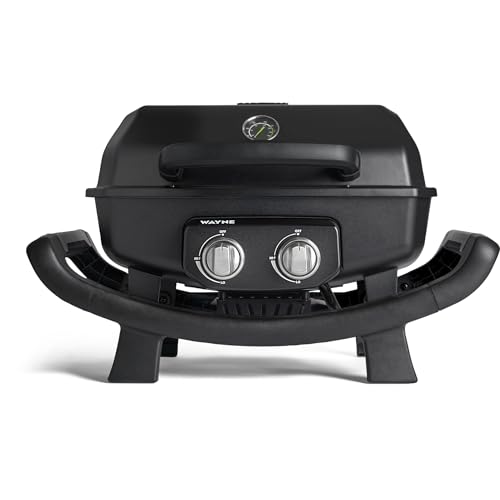
The Wayne is a gas tabletop grill with two burners, a lid and two cast iron grates, which Burnhard sells as a balcony grill. On Amazon the standard version is at approx. €239 (Amazon page on 21.10.2026: €239.20); in the Burnhard shop it costs €269.
Series 2, number 944219: which Wayne this refers to
Burnhard is based in Düsseldorf and lists this grill under item number 944219 in Series 2. The operating manual this text is based on is dated July 2024. Amazon lists the same model number in its catalogue and the variant “Wayne 2.0 2-Brenner 4,4 kW Gasgrill”. That fits together. We still could not cross-check the ASIN B0DMFFGM1Z with the manufacturer, because its product page contains no Amazon link.
In our gas grill category, the Wayne belongs to the tabletop models. Legs, side tables or a chassis are not in the parts list; so it needs a table, a wall or the trolley that Burnhard sells separately. According to the product page, besides the standard version there is a Camper Edition (see the questions below), a version with a reversible cast iron griddle plate for €39.90 extra, and a set with a trolley.
Combustion chamber, burners, grates: how the Wayne is built
In the product photo, the Wayne is a black body with a domed lid. At the top in the middle sits the round thermometer, below it a cross handle, and on the front of the combustion chamber the two control knobs. On the left and right, two plastic side handles swing outwards, and short feet sit underneath.
According to the data table, the combustion chamber is made of die-cast aluminium. That the lid is also die-cast aluminium only appears in the manual’s cleaning chapter, which treats both parts together.
Inside are two stainless steel burners of 2.2 kW each, 4.4 kW together; the manual gives the same figure as the nominal heat input (Hs). On the burner design, Burnhard contradicts itself. The product page’s data table speaks of stainless steel tube burners, the running text above it of ring-shaped O-burners, and the Amazon text also describes curved O-burners. Each burner has its own piezo ignition and its own knob made of stainless steel and plastic, with continuous control between HI and LO. A insect and spider screen sits on the venturi tube, through which air flows to the gas.
Two enamelled cast iron grates lie on the burners, which you can take out and turn over. According to the manual, the side with the wider grill bars is meant for more delicate food such as chicken or fish. The enamel is meant to protect against surface rust and to stop food sticking. Together the grates give a main grilling area of 46 × 37 cm. The Wayne has no warming rack as standard; Burnhard sells one as an accessory for €24.90. Under the burners sits an enamelled, removable grease tray.
With the lid closed, the grill measures 65.8 cm wide, 48.3 cm deep and 39.7 cm high according to the manual; Amazon rounds this to 66 × 47 × 39 cm. For the open lid, the product page gives 70.2 × 65.8 × 56 cm. Following the order that Burnhard also uses there for the closed dimensions (height first), we read this as 70.2 cm height and 56 cm depth. The manual gives the weight as approx. 13 kg; Amazon arrives at the same value with 28.66 pounds.
There is little to assemble: the side handles with two screws each, the lid handle with two spacers, then you insert the knobs, grates and grease tray. Hinges, hose and pressure regulator come pre-assembled. Before the first ignition, you check that both burners sit correctly on their nozzle, and turn the lock by 90°.
In detail: 390 °C at the grate, 320 °C on the scale
Two temperatures appear on the product page, and they refer to different places. Burnhard expressly relates the 390 °C to the grate, that is, to the cast iron directly above the flame. The lid thermometer goes up to 320 °C and, in Burnhard’s own wording, shows the rough cooking chamber temperature, the air under the lid. That is not a contradiction. Air under a lid is generally cooler than a grate lying above a burner, and a scale up to 320 °C says nothing about how hot the metal below gets.
With two burners you have two zones. For direct heat both run. For indirect heat one burns, the food lies over the switched-off one, and the lid stays closed so that hot air cooks the piece all the way round without a flame hitting it from below. Burnhard describes exactly this procedure for steaks: brown first, then let them cook through slowly. According to our reading of the construction, two grates side by side over two burners, each zone keeps a half of around 23 × 37 cm. Why indirect cooking helps with thick cuts is explained in our guide to direct and indirect heat.
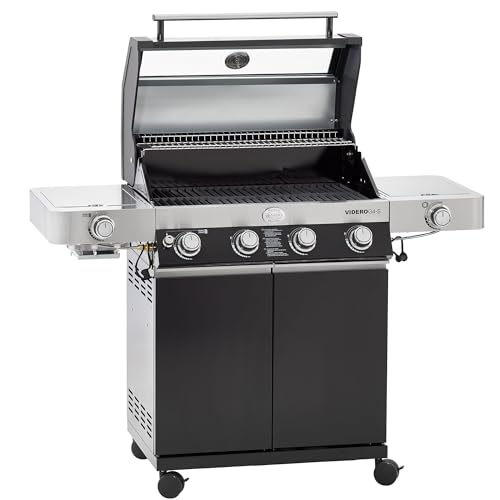
Gas grills can be compared by output per area. 4.4 kW on 46 × 37 cm, so 1,702 cm², gives around 2.6 W per cm². The Rösle Videro G2-P also has 4.4 kW, but a grate of 39 × 32.5 cm, and so comes to around 3.5 W per cm². More output per area generally means that a grate recovers its temperature faster after cold pieces are put on. How hot it ultimately gets cannot be read from this figure.
According to the manual, you should preheat for 10 to 15 minutes with the lid closed. Cast iron absorbs a lot of heat in the process and releases it slowly; Burnhard describes the grates as heat-retaining.
How long does a gas bottle last on the Wayne?
With both burners on HI, by our calculation a 5 kg propane bottle lasts just under 16 hours, an 8 kg bottle a good 25 hours and an 11 kg bottle just under 35 hours. If only one burner runs or both are on a low setting, it lasts correspondingly longer.
The calculation is based on the connection value from the technical data: 315 g/h with propane (G31) and 320 g/h with butane (G30), in each case for both burners together. We divided the hours ourselves; Burnhard does not calculate them. With butane, the values are slightly lower because of the 5 g more per hour.
Bottles of 5, 8 and 11 kg are approved. The Wayne should not run with cartridges: Burnhard expressly does not recommend operation with gas cartridges, because output suffers. So if you cannot fit a bottle on your balcony, this is the wrong grill.
Fitted at the factory is a hose with a fixed-setting pressure regulator to DIN EN 16129 and DIN EN 16436-1 (these standards apply in Germany), operating pressure 50 mbar, designed for a maximum of 1.5 kg/h. The appliance class is I3B/P(50), and the two gas nozzles are 0.63 mm each. You may need to replace the hose if national requirements call for it. When buying or renting the bottle, according to the manual you should get advice from a specialist retailer; which size suits which grilling habits we have written up in the guide Gas bottle for the grill.
What else is worth considering?
| Model | The difference | Price | Our rating | Choose this if |
|---|---|---|---|---|
| Burnhard Wayne 2-burner balcony grill (this one) | 2 burners of 2.2 kW each, cast iron grates 46 × 37 cm | approx. €239 | 8.0 | you want two separate zones on a small footprint |
| Weber Q 1200N | 1 burner on a disposable cartridge, no second zone | approx. €249 | 8.3 | you do not want to store a gas bottle on the balcony |
| Rösle Videro G2-P | also 4.4 kW, stainless steel grate 39 × 32.5 cm | approx. €299.99 | 8.2 | you prefer maintaining stainless steel and can manage with less grate area |
| Broil King Regal 590 | Grill cart with 16 kW across five main burners, rear burner, side burner | approx. €1,649 | 9.4 | you have a garden and often grill for large groups |
The prices are guide values from our price boxes and change constantly. The rating is our editorial assessment based on the data comparison; we have neither grilled with nor measured any of the four devices.
When the Wayne fits and when another one does
First, space, because on a balcony the Wayne quickly becomes larger than it looks. The manual requires at least 100 cm to the rear, 100 cm to the side and 100 cm above, in relation to objects of any kind. Around the 65.8 cm width, you therefore need a good 2.65 m of free width. To the rear, the 100 cm come on top of the 56 cm depth with the lid open, together a good 1.5 m, and at the front you have to stand yourself. Where the 100 cm upwards start, the manual leaves open. If the grill stands on a table of 75 cm, the closed lid is already at just under 1.15 m, and a metre of air above it ends at just under 2.15 m. Under a low neighbouring balcony that can get tight. For combustible materials Burnhard requires 1.5 m clearance, for flammable liquids 7.5 m.
The surface must be level, stable and fireproof; elsewhere the manual requires a flat, non-combustible surface. A wooden table or wooden decking does not meet that in our reading, a stone slab or a metal table does.
The product page advertises the balcony, while the manual speaks only of use outdoors in a well-ventilated place. Whether gas is allowed on your balcony is decided by your tenancy agreement and house rules, not by Burnhard; what is usual is covered in the guide Grilling on a balcony.
According to Burnhard, the Wayne is intended for up to 4 people. Our assessment: with sausages and steaks that go on the grate one after another, that works. If one zone runs indirectly, only one half of the grate is left for direct heat, and then it gets tight for four.
If you do not want a gas bottle at all, the Weber Q 1200N is the obvious choice: one burner on a disposable cartridge, so only one zone, approx. €249 according to our price box, while the Wayne costs approx. €239. We would pick the Rösle Videro G2-P if you prefer a stainless steel grate to enamelled cast iron and the smaller area is enough; it costs approx. €299.99, the Wayne approx. €239.
If you have a garden and regularly grill for many people, a tabletop grill is the wrong approach. The Broil King Regal 590, overall winner in our gas grill ranking, costs approx. €1,649, the Wayne approx. €239, and as a grill cart it needs a completely different footprint.
On budget, it helps that some things are already in the box. According to the product page, the Wayne comes with a cover made of UV-resistant polyester, the hose with pressure regulator, both cast iron grates and the grease tray; the cover is, however, missing from the manual’s parts list. The bottle comes on top. The product page lists the trolley separately for €159 or in a set with the grill for €409, so in the set €19 less than both separately. If you want to fry on a flat surface, you will also find a griddle plate set there for €64.90.
Setting up, connecting, cleaning: what the manual prescribes
This section sets out what Burnhard specifies for operation, connection and care, as close to the wording as possible. Clearances and surface are covered in the previous section; grease fire, gas smell and storage of the bottle are in the questions at the end.
The grill may only be used outdoors and in a well-ventilated place, never in a building, a garage or any other enclosed area. It is not intended for installation in or on leisure vehicles and boats, and parts sealed by the manufacturer must not be modified. Charcoal, briquettes and lava stones do not belong in it, and it must not be run on natural gas. For set-up, the manual also requires that the grill stands sheltered from wind, stays away from moisture, splash water and electrical cables, and never stands directly against glass fronts, walls or plants, because it radiates heat. You protect the gas bottle from strong sunlight.
When connecting, both knobs are at OFF, the bottle stands upright on level ground, and you tighten the union nut with a spanner. If there are ignition sources in the immediate vicinity, you do not connect a bottle, and there is no smoking. The hose must not be twisted or kinked, must not rub, must not run along sharp edges and corners and must not touch hot surfaces, and no hot fats or liquids may drip onto it. Next comes the leak test, which Burnhard always requires and wants repeated after every bottle change: spray all sealing points with leak detection spray or brush them with soapy water (1 part soap to 3 parts water), open the bottle valve, and watch for bubbles. If any appear, close the valve, retighten the nuts by hand and repeat the test. If bubbles still rise, the valve stays closed and you go to a specialist dealer. Never test with an open flame.
Ignition takes place with the lid open, never with an open flame, but with the piezo ignition of the respective burner: press the knob, hold it down and turn it anticlockwise to HI. Before every use you check the hose and pressure regulator for cracks and damage and the burners for dirt. If the pressure regulator, hose or bottle is faulty or leaking, the grill stays off. During operation you do not move it, never leave it unattended, do not lean over the open grill and keep the ventilation openings of the housing clear. You wear protective gloves as soon as hot components exceed the ambient temperature by 50 °C. Before every change of location: switch off, close the bottle valve, unscrew the bottle. After grilling, you close the valve immediately.
Before first use, you wipe the lid and combustion chamber damp on the outside and burn the grill in for 45 minutes without food. For the cast iron grates, the manual specifies a refined oil or fat with a high smoke point, 45 minutes on HI with the lid closed, expressly not olive oil. The product page requires the opposite, an unrefined fat with a low smoke point. We would follow the manual, because it belongs to Series 2.
Cleaning takes place after every use, only once the grill has cooled down enough, the knobs are at OFF and the bottle is removed. Flammable cleaning agents are taboo. You let the grill burn off on HI for 15 to 30 minutes until no more smoke rises, close the valve, brush the grates with a stainless steel brush and empty the cooled grease tray. Burnhard considers brass brushes rather unsuitable for cast iron and stainless steel grates because they are very soft, and according to the manual they promote surface rust. After brushing, you re-oil the cast iron grates. If rust has formed, you scour it off completely with steel wool and burn the grate in again.
Every 3 to 4 months, or after a long period of standing, a thorough clean is due. Empty the grease tray, remove burners and lid, free the die-cast aluminium parts of coarse dirt with a scraper, treat them with grill cleaner, wipe them out and dry them; the recommended contact time of the cleaner must not be exceeded. Before you take out the burners, you unscrew the gas hose and bottle. You clear flame openings with a thin metal needle, never with wooden toothpicks, which can break off and block the opening. A blocked nozzle you clear with a nozzle needle, the venturi tube with a needle or pipe cleaner, the protective screen with a brush. On the outside, you use a soft cotton cloth with warm water and mild washing-up liquid, but not a microfibre cloth, which according to the manual scratches the material. General advice is in the guide Cleaning a gas grill.
Only authorised specialist staff may repair and service the gas system; you change nothing on the grill and pressure regulator. A routine inspection of the gas system is due at least once a year. You replace the pressure regulator and hose after 10 years at the latest, even without externally visible damage. A new hose must not be longer than 1.5 m, regulator and hose must comply with EN 16129, EN 16436-1 and national regulations, and the regulator must be approved for the gas used and set to the correct outlet pressure.
Open points after the product page and manual
After the product page, the guarantee page and the documents for Series 2 printed in 2024, a number of things remain open: the grilling area in cm² (the 1,702 cm² above is our own multiplication), a heat-up time to a given temperature, the accuracy of the lid thermometer, the material of the grease tray beyond the statement enamelled, wall thickness and possible double-wall construction, the country of production, the year in which Series 2 came onto the market, and whether the supplied pressure regulator has a hose rupture safety device. We have not checked spare parts individually, apart from the burner.
Who is it suitable for?
The manual itself narrows the circle. The appliance is not intended for use by children and by persons with reduced ability to operate appliances, and it may only be used by persons who can operate appliances safely. Accessible parts can get very hot; you warn bystanders and keep children and pets away.
The Wayne is the wrong choice for anyone who wants to grill commercially, for example at a snack stand or for catering: according to the manual it is not intended for commercial use.
We find it suitable for a small household with a balcony or terrace where the clearances are genuinely free and a stone or metal table stands, and who wants a second, lower-set zone between steak and vegetables. Whether a tabletop model or a grill cart suits you better, you can play through in the Grill Finder.