A gas oven in which the stone turns
Tefal lists this oven as the Pizza Pronto pizza oven JM4130. The reference is JM413015, and it is listed in the Amazon catalogue under exactly this number, there since 23.01.2024. The instructions name SAS SEB of Groupe SEB in Is-sur-Tille, France, as the manufacturer; it is built in China.
It is a pure gas oven for liquefied gas and intended for outdoor use only. What sets it apart from most gas ovens in our pizza ovens category is a round stone that can be turned while baking. At Amazon it costs approx. €252 (Amazon page on 20.10.2026: €251.99).
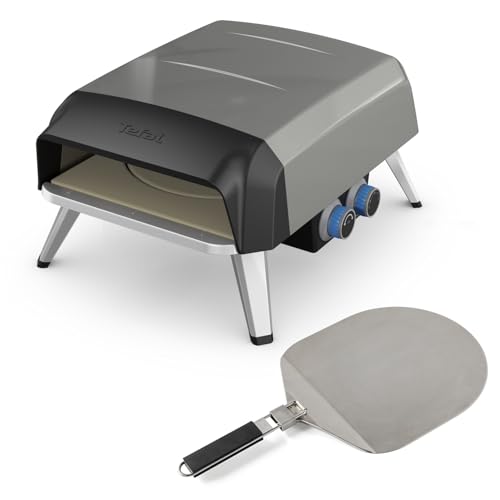
In the product photo, a flat, box-shaped body in grey with a black front sits on four angled legs. Through the wide opening you can see a light stone slab at the front and, behind it, the curved edge of the round stone. On the right-hand side there are two round control knobs with blue accents; which one controls what is not labelled in the picture. Tefal gives the dimensions as 40 x 59 x 27 cm. The Amazon catalogue lists 69.5 x 49.3 x 35 cm, more in every direction, which looks more like the box. We stick to the manufacturer’s values. For storage, the feet fold in.
According to Tefal, the box contains the oven with gas hose, pressure regulator and connector, a pizza peel, a metal match holder as well as a quick start guide, manual and safety instructions. The parts list in the instructions calls the peel a pizza tray and adds “depending on the country” to the regulator. A gas bottle is not included.
Two stones, one knob: what turns on the Pronto
Inside the cooking chamber there are two cordierite plates. The parts list distinguishes a rotating stone and a front stone. When inserting them, the rear, round cooking stone goes in first, then the front one, and afterwards you are meant to use the knob to check “whether they turn properly”. If the two rub against each other, you shift them slightly.
Why a stone should turn at all follows from the design of small gas ovens. The heat comes from a flame and from the ceiling that this flame heats up. The part of the stone closer to the flame gets hotter than the rest, and a pizza that lies still browns on that side first. With a fixed stone, you therefore take it out with the peel, turn it a bit and push it back in, several times per pizza. With the Pronto, the pizza stays where it is, and the base moves beneath it through the hot zone. Where exactly the burner sits is not shown by any manufacturer source. The principle applies regardless.
How it is turned is less clear than it sounds. The product page says “Simply turn the knob”, and elsewhere it speaks of evenly baked pizza “at the push of a button”. A motor, a battery or a mains cable appears neither on the product page nor in the 36-page instructions. We therefore assume that you turn the stone by hand using the knob, and if in doubt we would ask Tefal customer service before buying. For the electric Pizza Pronto JM600TE0, by contrast, the same manufacturer explicitly speaks of an “automatically rotating pizza stone”.
Heat, flame, ignition
Tefal states that the Pronto reaches 400 °C in 15 minutes and that a pizza is done in less than 90 seconds. Whether the 400 °C refers to the stone or the air in the cooking chamber remains open. The technical values come from the instructions: 4 kW total heat output, a burner nozzle of 0.90 mm and a gas consumption of 291 g/h.
It is controlled by a control knob with flame settings. Tefal does not mention a degree scale or a built-in thermometer anywhere. So you bake by time and by eye, as long as you have no measuring device of your own.
A look at the competition is interesting: for the PACO Rotate, Enders gives exactly the same two values in its instructions, 4.0 kW and 291 g/h. Whether both ovens use the same burner, we do not know.
Ignition works via an integrated igniter on the control knob. According to the instructions, you set the knob to off, open the gas bottle valve and wait 10 seconds. Then you hold the gas regulator pressed for 5 seconds so that air can escape from the gas line through the burner, and return it to the closed position. Only then do you press the control knob, turn it slowly anticlockwise until it clicks and the burner ignites, hold it for another 5 seconds, release it and select the flame setting. For versions with match ignition, the instructions describe a second way using the supplied holder: insert a match, light it, hold it over the oven opening at the burner, press the knob and turn it slowly to the high setting. In both cases, keep your face and hands as far from the appliance as possible.
The app from our title is the MyTefal app, a recipe collection. Tefal lists classics such as four cheeses or pepperoni there, plus more unusual creations, vegan options and gluten-free ideas. A connection between the app and the oven does not appear in the documents.
Can I use the Pronto abroad?
No. The product page carries the warning: “Do not use outside Germany, Switzerland and Austria”, and the Amazon listing says the same. If you want to take the oven to Lake Garda or Brittany, according to the manufacturer you may not connect it there.
The reason lies in the technical data. The Pronto is assigned to appliance category I3B/P(50) and runs on butane (G30) or propane (G31) at 50 mbar supply pressure. 50 mbar is the usual connection pressure for outdoor liquefied gas appliances in Germany, Austria and Switzerland. In France, Great Britain and many other countries, such appliances work at 28 to 37 mbar, with different regulators and often different nozzles. That is how we explain the restriction to ourselves; Tefal does not explicitly give a reason. This fits with the fact that the British Tefal page lists a Jamie Oliver by Tefal gas pizza oven, JM4168, with 37 mbar. The instructions also require that an appliance used in a country other than the one where it was bought be checked by an authorised customer service centre because of the differing standards. Which category applies to your unit is shown on the rating plate.
For the connection, the instructions specify standards: the hose must be approved to EN 16436 and the regulator to EN 16129 (these are EU standards and apply in the EU, including Germany). The line may be at most 1.5 m long, must remain visible along its whole length and has to be checked regularly and replaced if necessary. According to the Tefal product page, hose and pressure regulator are included, but the instructions warn that this is not the case in all countries. Neither source says what pressure the supplied regulator delivers or how long the hose is.
Connecting the gas bottle and checking for leaks
Tefal recommends standard propane or butane bottles of 6 kg or 13 kg and a suitable regulator. The bottle must have overfill protection and must never be filled to more than 80 per cent. When connecting, its valve is closed, it stands upright, and the oven is switched off at the control knob. The instructions distinguish two connection types, type 1 as a screw connection and type 2 with an adapter. You tighten the nut on the valve by hand until it stops. A spanner can damage the coupling nut, which according to Tefal increases the risk of accidents. The hose must unwind without twisting or pulling and must not touch hot parts; if it shows cracks or other damage, you replace it immediately. What else you should consider regarding bottle size, fill level and exchange scheme is covered in our guide gas bottle for the grill.
Tefal requires the leak test before every use, even though the connections were checked at the factory before shipping. For this you mix equal parts washing-up liquid and water and need a spray bottle and a brush or cloth. The oven is off at the knob, you apply the solution to all gas connections and open the bottle valve. If bubbles form, there is a leak there. Then you shut off the gas supply immediately, tighten the connections, open the valve again and check a second time. If the leak remains or one appears at another part, the gas supply stays off and you contact customer service. You never use an appliance with a leak. Testing is never done with a flame, you do not smoke while doing it, and you keep away from heat sources such as cigarettes or electrical appliances.
For changing the bottle, the instructions contain a language error: in the German part, this section is partly printed in Dutch. The English version requires, in essence, that control knobs and bottle valve are closed during the change, that you change the bottle in a well-ventilated place away from heat sources (cigarettes, electrical appliances and the like), and that you carry out a leak check after every change.
After baking, you always close the bottle valve. To disconnect, the oven is off, the valve is closed, and you turn the coupling nut anticlockwise; the dust cap belongs on the outlet valve of an unused bottle. You do not store a spare bottle under or next to the oven, and propane bottles in general not in buildings, garages or other enclosed spaces, and always out of the reach of children.
Setting up, cleaning and storing according to the instructions
From combustible structures, the oven keeps at least 600 mm clearance at the sides and at least 900 mm at the back. It stands on a stable, level surface covered with non-combustible material; as examples, Tefal names tiles, flint stones and stainless steel. If it has to stand in the immediate vicinity of a wall, a partition, a kitchen cabinet or a decorative trim, that part must be made of heat-resistant, non-combustible material or be covered with a suitable, non-combustible, heat-insulating material, observing fire protection regulations. It is hot underneath the oven, so it does not belong on a table with a flammable tablecloth, for example a plastic one. The instructions say nothing about balconies, only “outdoors only”. You measure for yourself whether your balcony allows the clearances; whether open flame is permitted there is governed by your tenancy agreement and house rules.
During operation, you protect the oven from wind and do not use it at all in strong wind. It is never left unattended, the gas line keeps away from hot surfaces, and the area around it stays free of combustible materials, including liquids, dirt and vapours such as petrol or barbecue lighters. The housing, stone cooking plate and adjacent surfaces become extremely hot; Tefal requires oven gloves and advises keeping small children and pets away. Loose clothing and wide sleeves are taboo, as are some synthetic fibres, because they ignite easily. The oven is not a heater, it runs only on gas and not on charcoal, and it must not be modified. In case of fire, you move away and call the fire brigade; oil or grease fires are never extinguished with water.
Cleaning is done only with the gas supply cut off, the knob switched off and the oven cooled down. Before every lighting, you check the interior and remove residual oil and deposits so that no flames shoot out of the oven, and you check that the burner outlets are clear. You clean these outlets regularly with a soft wire brush, and you check the burner at least once a year. Because spiders and insects can nest in the burner and disturb the gas supply, you block the gas inlet on the oven while it is not connected.
For the stone, the instructions have a section of their own. It must not come near an open flame, does not tolerate extreme temperature changes, and frozen food does not belong on the hot stone. It is fragile and can burst if it is knocked over or falls. It gets very hot during baking and stays hot for a long time afterwards; you do not use water to cool it. Once it has cooled, you can take out both stones by sliding your fingers along the sides or pressing lightly on one side. It is cleaned with a slightly damp cloth and a hard brush, not in the dishwasher. If you have cleaned it with water, you dry it for 2 hours at 60 °C in the normal oven before the next use. If it cracks despite this, our guide cracked pizza stone helps with the assessment.
The Pronto is stored indoors if possible, especially for longer periods, and not in direct sun. According to Tefal, snow, ice, heavy rain and strong wind are unfavourable conditions to which it must not be exposed. It is intended only for private outdoor use. For professional use (restaurant, kitchen, offices, other work environments, hotels, guest houses or other accommodation), improper use or failure to follow the instructions, the manufacturer accepts no liability.
Accessories, gas consumption and open points
In the Tefal shop on 20.10.2026 there were three accessories with a price: the transport cover XA400000 for €29.99 (RRP €44.99), the digital infrared thermometer XA401000 for €26.99 and the dough cutter XA404000 for €14.99. The shop also lists a cleaning brush XA406000 and, as spare parts, the rotating stone SS-9100054953, the front pizza stone SS-9100054956 and the pizza peel SS-9100056067; we did not look up their prices. According to the instructions, for your own safety you should only use accessories and spare parts that the manufacturer provides for the appliance. In the navigation of its website, Tefal advertises 15 years of repairability; whether and how this applies to this oven specifically, the product page leaves open.
Of the three items, we would buy the thermometer first. With no display on the appliance, it is the only way to know the stone temperature between two pizzas.
You can roughly gauge the gas demand because the instructions give an hourly consumption. At full flame, heating up over 15 minutes uses by calculation around 73 grams of gas, and a single pizza with a 90-second baking time a good 7 grams. These are upper limits from our calculation; turned down, it is less.
Several details are missing from the product page and the instructions. There is no weight; the 2.2 pounds (approx. 1 kg) in the Amazon catalogue are not plausible for a gas oven of this size, so we do not adopt them. Also open are the diameter of the rotating stone and thus the largest pizza, the stone thickness, the material of the housing (Tefal only writes of robust material, stainless steel appears only in the Amazon title), the shape, position and material of the burner, any insulation of the cooking chamber, the height of the oven opening, the design of the igniter and the time the stone needs between two pizzas to get back up to temperature. Tefal does not state a gas consumption per pizza, only per hour.
These three alternatives are worth a look
| Model | The difference | Price | Our score | Pick this one if |
|---|---|---|---|---|
| Tefal Pizza Pronto JM413015 (gas) (this one) | Gas, stone turns by knob, no thermometer mentioned | approx. €252 | 8.4 | you bake in Germany, Austria or Switzerland and don’t want to turn the pizza with the peel |
| Enders PACO Rotate | same output, stone turned by an electric motor with mains plug, side thermometer | approx. €174 | 8.5 | there is a power socket where you set it up and you want to spend approx. €174 instead of approx. €252 |
| Tefal Pizza Pronto Electric | electric, automatically rotating stone, four settings from 250 to 400 °C | approx. €259 | 8.2 | you want to manage entirely without a gas bottle and leak check |
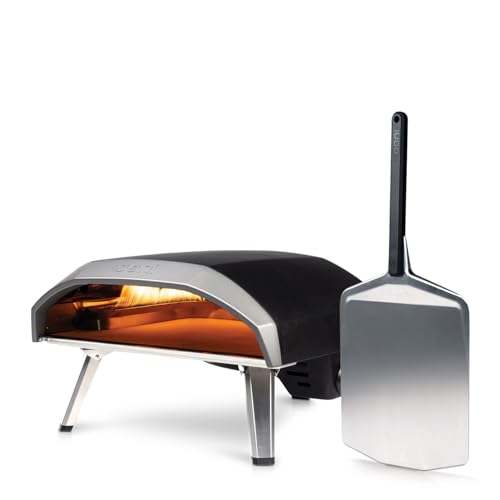
| Ooni Koda 16 | Gas without rotating stone, pizzas up to 40 cm according to Ooni | approx. €449 | 9.4 | you bake large pizzas and accept turning them with the peel |
The prices are guide values from our price box and change constantly. The score is our editorial assessment based on manufacturer and catalogue data; nobody has measured it.
When the Pronto suits you, and when it doesn’t
First, the question of location. The Pronto is an oven for a garden or terrace in Germany, Austria or Switzerland. If you regularly take it on holiday, you are buying an appliance that you may not connect there.
Then the turning. If you want to hand it over completely, the Pronto is not the safe choice according to everything Tefal writes. The Enders PACO Rotate turns the stone with a switchable motor according to Enders, but needs a power socket for that, and it costs approx. €174, while the Pronto costs approx. €252. In our comparison it even sits slightly ahead of the Tefal. The electric Tefal Pizza Pronto is at approx. €300, the gas model at approx. €252, and it does without bottle, regulator and leak check.
Pizza size is the third point, and a gap remains here. Without the stone diameter, you cannot work out whether your favourite size fits. If you want to bake 40 cm for certain, you get this specification from the manufacturer for the Ooni Koda 16, but you pay approx. €449 there instead of approx. €252 and turn the pizza yourself.
With the budget, you include the bottle. With the infrared thermometer and transport cover from the Tefal shop, you end up at around €309 without gas. Still undecided about bottle, fuel and oven type? The Grill Finder narrows down the choice.
The Pronto is the wrong choice for two groups. First, for everyone who often grills or camps abroad. Second, for people with a small balcony: the minimum clearances from the instructions to everything combustible and a non-combustible surface are hard to achieve on a narrow rented balcony with a wooden railing and privacy screen.