A pizza oven with a plug, built for outdoors
The Pizza Pronto with the reference JM600TE0 is Tefal’s electric pizza oven for outdoor use. The pizza oven range on tefal.de has three appliances: this oven, the gas Pizza Pronto (JM4130) and a gas pizza oven under the name Jamie Oliver by Tefal. Only the JM600TE0 is electric. The Amazon catalogue lists the same model number and gives 1 March 2026 as the market launch. In our pizza oven overview it is one of the appliances that heat with electricity instead of gas or wood.
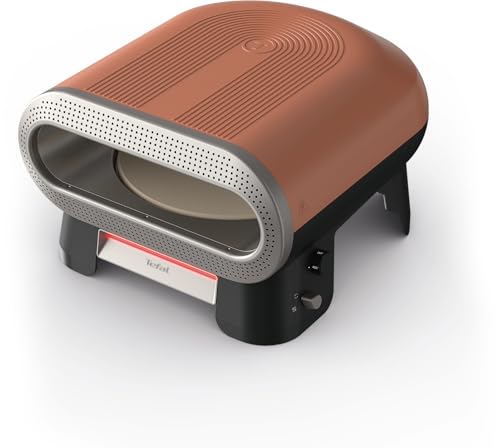
The product photo shows a domed hood with grooves on the top, in the colour Amazon calls copper brown. At the front is an oval opening in a silver, perforated frame, and behind it you can see the round stone. The body stands on black legs. Below the opening a narrow strip glows red, and on the right side there are a dial and a small switch.
Amazon gives approx. 50 x 45 x 30 cm (length x width x height) and approx. 11.0 kg, converted from inches and pounds. These are outer dimensions including the legs; they reveal nothing about the baking chamber. Tefal itself publishes neither dimensions nor weight.
In our price box the oven is listed at approx. €260 (Amazon page on 20 October 2026: €259).
Dial, switch, light strip: how it is operated
Tefal states up to 400 °C, divided into four temperature levels between 250 and 400 °C, intended according to the product page for pizza, flatbread and sweet dishes. You select the level with the temperature control on the right side of the appliance. While the oven preheats, the display on the front flashes white. Once the selected temperature is reached, it lights up red continuously, and a signal tone sounds as well. The red strip in the photo is therefore the ready indicator.
Next to it, also on the right, is the switch for the stone. You press it after the pizza has been slid in, and then the rotation begins. When the pizza is done, according to the manual you slide the pizza tray underneath and switch the rotation off again.
On the scope of delivery, two Tefal documents do not quite agree. The product page lists the pizza oven and a perforated pizza peel, and the quick-start guide additionally lists the rotating cooking stone. Because the manual requires you to use only the supplied stone, we assume it is in the box. Tefal describes the peel as foldable. That it is made of stainless steel appears only in the Amazon text.
Before the first switch-on you remove all packaging, expressly including the foam protection under the rotating mount of the stone. The stone goes centrally on this mount with the smooth surface facing up. For the dough, Tefal points to 50 recipes in the My Tefal app and in the digital recipe book, although according to the quick-start guide the app is available depending on the country.
What Tefal does not state
Several things you would like to know before buying appear neither on the product page nor in the instruction manual or quick-start guide: the power consumption in watts, mains voltage and frequency, the cable length, diameter, thickness and material of the stone, the material of the housing, inner chamber and heating elements, interior height and height of the opening, drive and rotation speed of the stone, a protection rating against splashing water, the country of origin and a replacement stone with part number and price. It also remains unclear what exactly the dual heating zone is. An earlier version of this review spoke of separately adjustable top and bottom heat; that is not substantiated, as the manual describes a single temperature control.
In detail: why the stone rotates
In a pizza oven with an opening at the front, the front area continually loses heat to the surroundings, while the rear part of the baking chamber stays hotter. This is basic physics and applies to gas and electric ovens alike. If you bake on a fixed stone, you therefore turn the pizza from time to time with the peel so that the crust browns evenly all round and doesn’t burn at the back while it is still pale at the front.
On the JM600TE0, the stone turns on its mount instead, as soon as you have pressed the switch. The pizza no longer has to come out of the oven for this. One sentence in the Margherita recipe of the quick-start guide does not quite fit the picture of something that runs by itself, though: it says to bake the pizza for about 90 seconds and to turn it regularly using the button on the side. Whether this means switching the rotation on and off, or whether the stone is moved in steps, is not clear from the text. We read this as a prompt to stand beside it. The manual in any case requires that you do not leave the appliance unattended while baking pizza.
The 90 seconds from the recipe lie within what the product page promises: baking in less than 3 minutes.
Two steps from the manual concern the moment of sliding the pizza in. Durum wheat semolina belongs on the peel instead of flour, because it catches fire less easily. And you slide the tray horizontally in close to the stone surface and then pull it back with a jerk so that the pizza stays put. You should not top it heavily: according to Tefal, food must not touch the heating element, and how much space remains above the stone is unknown.
How long does it take to the first pizza?
The very first time, a good two hours, because the oven is burned in beforehand. After that, according to the product page, it preheats in 15 minutes, and according to the recipe in the quick-start guide in 20 minutes at maximum heat. According to the manufacturer, the pizza itself needs less than 3 minutes.
The instruction manual describes the burn-in like this: before first use you heat the oven for 2 hours at maximum temperature and then clean it. That belongs on the day before the first pizza round, not in the hour before.
On the regular preheating time, the two Tefal documents contradict each other by five minutes. The 15 minutes appear on the product page and identically in the Amazon text, the 20 minutes in the recipe section of the printed guide. We would plan with 20. Another note from the manual fits this: you should protect the oven from wind during operation to optimise cooking performance and preheating time. On a draughty terrace, expect rather more than less time.
Socket, RCD protection and location
For the power connection, the instruction manual summarises these warnings:
- The appliance is suitable only for outdoor use.
- It should not be used indoors.
- The power cable must be checked regularly for damage; if it is damaged, the appliance must not be used.
- The supply must run through a residual current device (RCD) with a maximum rated current of 30 mA.
- The connection must be made to an earthed socket.
According to Tefal, you should not use an extension lead. If you do, it must be in good condition, have an earthed plug and be suitable for the oven’s power consumption. You can hardly judge the last point yourself without a wattage figure, which is why we would prefer an outdoor socket within reach over an extension lead. Also prohibited: operation via an external timer or a separate remote control system. And according to the manual, the appliance’s socket must be dried before it is used again.
On the location, the manual gets precise. Outdoors, the oven belongs on a stable, level, heat-resistant surface covered with non-combustible material; Tefal names tiles, flint and stainless steel. If it stands in the immediate vicinity of a wall, partition, kitchen cabinet or decorative trim, that part must be made of heat-resistant, non-combustible material or be covered with a suitable non-combustible material with thermal insulation. You do not place it under overhangs, under roof projections or near dry vegetation, you do not put anything on the appliance, and according to Tefal special attention must be paid to fire safety regulations. From water such as a pool or pond you keep at least 5 m away.
That also answers the balcony question that our earlier version answered wrongly. It said the oven could be used on covered balconies. According to the wording of the manual, a roof or overhang above the location rules that out. What your tenancy agreement and house rules say about balconies is a separate question, which our guide Grilling on a balcony sorts out.
While the oven is running or plugged in, you do not move it. Before carrying it away, it cools down for at least 1 hour.
What else comes into question?
| Model | The difference | Price | Our rating | Choose this one if |
|---|---|---|---|---|
| Tefal Pizza Pronto (this one) | Electric, stone rotates after switch press, up to 400 °C | approx. €260 | 8.2 | you have an earthed socket with RCD protection outdoors and don’t want to turn the pizza yourself |
| cozze 13-inch electric pizza oven | also electric, 13-inch format according to the product name | approx. €295 | 8.3 | you want to stay electric and our slightly higher rating matters more to you than the rotating stone |
| Tefal Pizza Pronto JM413015 (gas) | Gas instead of electricity, stone can be turned by knob | approx. €251.99 | 8.4 | there is no suitable socket at your location |
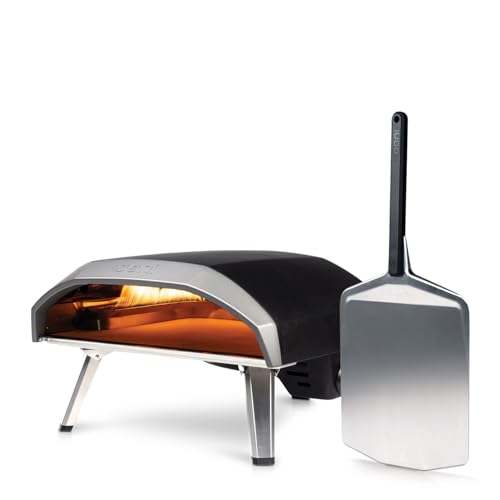
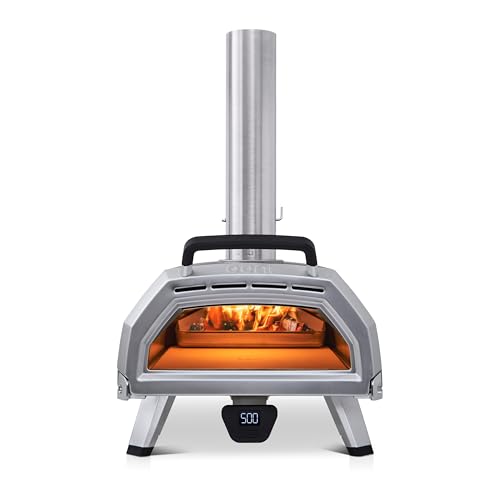
| Ooni Koda 16 | Gas, up to 500 °C, pizzas up to 40 cm | approx. €449 | 9.4 | you regularly bake larger pizzas for several people |
The prices are guide values from our price boxes and fluctuate. The rating is our editorial assessment from the data comparison; we did not measure anything on any of the four ovens.
When the Pizza Pronto fits, and when another oven does
First, the pizza size. The recipe in the quick-start guide works with dough balls of approx. 270 g and states that the diameter should not be larger than 30 cm. This matches the size field at Amazon, which also gives 30 cm. Tefal has not published a measured size for the stone itself. If you want to bake tray-sized pizzas or pizzas for six people in one go, you are better served by the Ooni Koda 16, which according to Ooni is built for pizzas up to 40 cm and reaches 500 °C. It is listed in our price box at approx. €449, the Tefal at approx. €260, and the gas cylinder and space for it come on top.
Then the connection. Without an earthed socket with RCD protection at the location, the electric Pizza Pronto is the wrong choice. For this case Tefal has the gas Pizza Pronto in its range, for which according to Tefal 400 °C also applies. It is listed in our price box at approx. €251.99, the electric model at approx. €259, and in our rating it is ahead with 8.4; for that you need a gas cylinder, and you turn the stone with a knob.
Among the electric ovens the prices are close together. The cozze 13-inch is listed at approx. €295 in the price box, the Tefal at approx. €259; in the rating the cozze is narrowly ahead with 8.3 against the Tefal’s 8.2. In our assessment, what speaks for the Tefal is the rotating stone, provided you don’t like turning the pizza with the peel. Whether the cozze model has a rotation, we did not check against a manufacturer source for this comparison and therefore leave it open.
Optional accessories that Tefal lists on the oven’s product page add to the total price. In the Tefal shop on 20 October 2026, the transport cover XA400000 cost €29.99, the digital infrared thermometer XA401000 €26.99 and the dough cutter XA404000 €14.99. That the cover is expressly made for the JM600TE0 is not stated there; it appears only in the accessories list of that page. The thermometer would be of real use with this oven, because the manual describes only the light strip as feedback, which shows that the selected level has been reached.
Stone, cleaning and safety according to the manual
Cleaning happens only once the oven is switched off and cooled down, at least 1 hour according to the manual. Before cleaning you also pull the plug, as you do before assembly, disassembly and whenever the appliance is unattended.
On the stone, the two Tefal documents are worded differently, which is why both wordings are given here. The instruction manual: “Clean the pizza stone with a dampened cloth and a hard brush. DO NOT CLEAN THE PIZZA STONE WITH WATER.” The quick-start guide: “remove the burnt residue with a damp sponge or a special cleaning brush. Do not moisten the cooking stone.” A damp cloth that is not supposed to moisten the stone can only be reconciled with very little moisture. If in doubt, we would follow the stricter sentence. If the stone has got wet after all, the manual names two ways to dry it: 2 hours at 60 °C in a conventional oven or 48 hours in a dry environment. It does not belong in the dishwasher. Stains that remain after cleaning are treated by Tefal as normal wear.
There are further rules for the stone. It gets very hot during use and stays hot for a long time; you do not use water to cool it. It is fragile and can burst if it is knocked over or dropped. You do not use it outside the pizza oven. It can be removed only after cooling; the manual describes gripping it with your fingers at the sides or pressing lightly down on one side. If it gets a crack anyway, our guide Cracked pizza stone helps with the assessment.
In the baking chamber the rule is: no oils or fats such as olive oil or margarine, to avoid smoke and smoke damage. Before switching on again, you check and clean the interior thoroughly so that residual oil or deposits do not cause flames. According to Tefal, discolouration of the inner chamber can occur during use.
During operation, the accessible surfaces can get hot. You do not touch the inside and the front frame, and you keep children and pets away. The oven is switched off via the thermostat in the Off position, after which you pull the mains plug. When it has reached the end of its life, the appliance belongs at a municipal recycling point.
Who is it for?
According to the manual, the Pizza Pronto is intended only for private household use, and it is a pure pizza and dough oven. Directly on the cooking stone you never bake recipes that are not dough-based, such as greasy or liquid dishes or frozen food. You do not use charcoal briquettes, liquid fuel or lava stones in the oven. If you therefore want to cook vegetables or meat directly on the stone, or add wood for smoke, you should reach for a different appliance.
In our assessment it would suit a household with a terrace or garden, an earthed socket with RCD protection nearby and a dry place indoors where the oven stands between pizza evenings. If you are still unsure whether electric, gas or wood suits your space, the Grill Finder gives you a recommendation after a few questions.