A gas oven for pizzas up to 40 centimetres
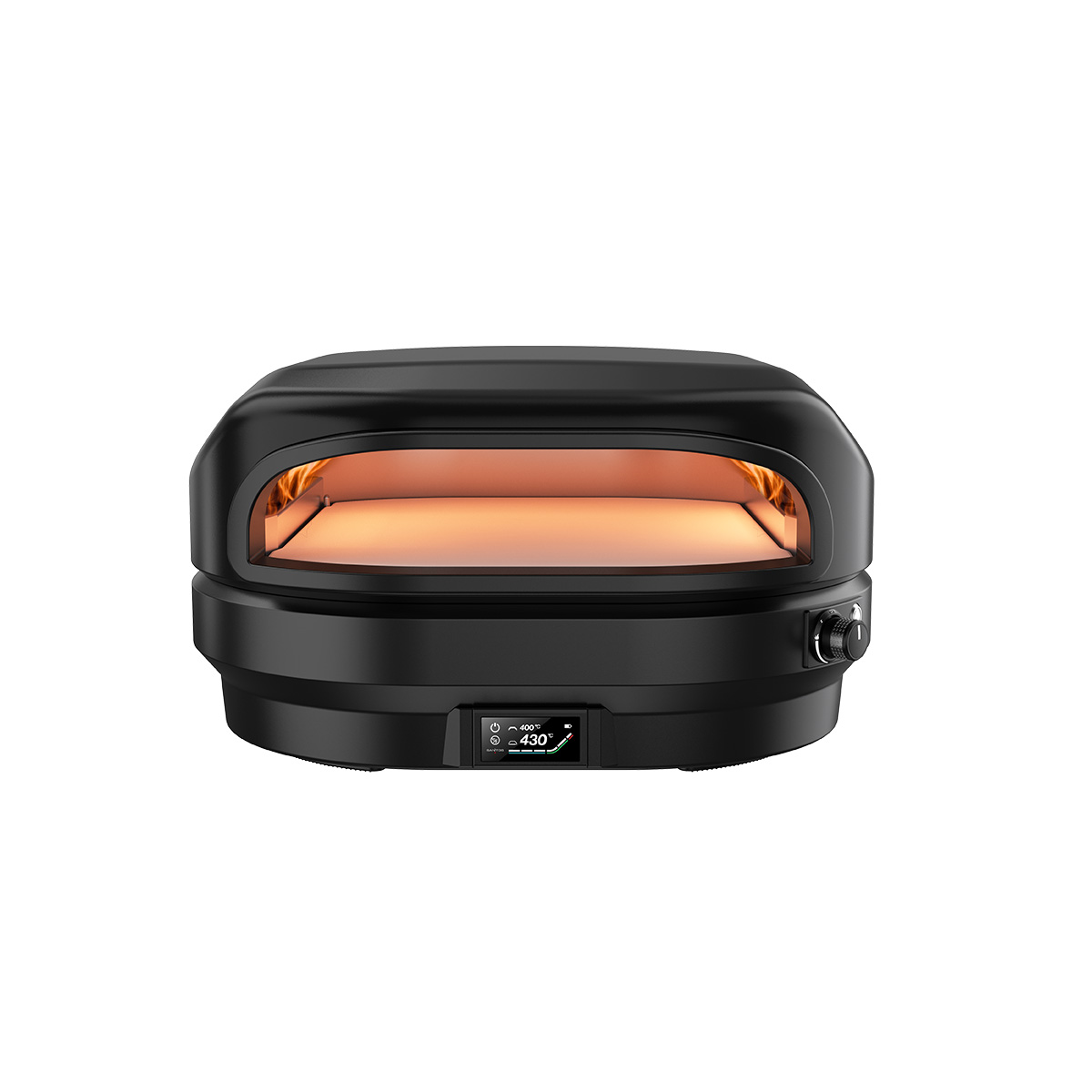
The SANTOS O-160 PRO is a gas pizza oven for outdoor use. Two burners sit at the sides, with a cordierite stone below on which, according to Santos, pizzas up to 40 cm in diameter fit (16 inches). It runs on liquefied gas from a bottle: propane, butane or a mixture of the two.
Santos Grills sells it on its own and as a Pizzaiolo bundle for approx. €499 (on 02.11.2026: €499.00). The bundle also includes a Santos pizza peel, a pizza turner and a pizza dough cutter. Our price box links to the bundle.
In our category pizza ovens it sits among the gas ovens between €450 and €500. It has a built-in display that shows stone and interior temperature at the same time; with the BURNHARD Fat Tony, a separate thermometer comes in the box for that. What speaks against it is covered in the next section on control.
Burner, stone and cooking chamber
The two side burners are made of stainless steel and together come to 8.7 kW. Santos describes a rolling flame that moves from both sides over the dome. Ignition is by piezo. For this the manual shows an impulse ignition box, into which a battery goes during assembly. According to the technical data, the oven belongs to gas category I3B/P(50), the connection pressure is 50 mbar, and the injectors measure 0.87 mm.
On control, it is worth looking at the exploded drawing on p. 5. It shows two burners but only one burner knob (plus a motor knob, more on that below in the FAQ). Separate control of the left and right sides is not mentioned in any document. We therefore assume that one knob controls both burners together. Anyone who hoped to turn one side down and so have to turn the pizza less should know this.
The pizza stone is made of cordierite and is 20 mm thick. In the description text Santos gives a continuous stone of 414 × 478 mm for the classic version; the data table rounds this to 41 × 48 cm. The cooking chamber measures 42 × 48 × 12 cm inside. The opening at the front is 44 cm wide and 9 cm high, and these 9 cm decide what fits: a risen loaf or a cast iron pan has to go through the opening, not through the 12 cm inside.
The housing is double-walled. The outer shell is made of matt black powder-coated steel, the front opening according to the parts list of aluminium, and the list names six insulation covers. The manual gives 599.5 × 545.5 × 343.5 mm (depth, width, height) and 16 kg, weighed without the pizza stone. The product page gives rounded figures of 55 × 60 × 34 cm.
In detail: stone and air on one display
A pizza in a gas oven gets its heat from two directions. From below, the stone conducts heat into the dough by contact; from above, the flame under the dome and the hot ceiling radiate. The air in the cooking chamber heats up quickly. A 20 mm thick ceramic stone takes longer, because cordierite generally absorbs heat slowly and has to heat through first.
Anyone who slides the pizza in by feel or by air temperature therefore risks a dark rim over a pale base. This follows from physics and applies to every stone oven; none of us has measured it on the O-160 PRO.
Santos fits two temperature sensors. In the exploded drawing the sensor for the interior hangs on a blue cable and the one for the stone on a red one, and both run to the display on the front. According to the product page, it shows stone temperature and interior temperature at the same time. For the stone there is also a colour scale: blue stands for still too cold, green for ideal baking temperature, red for too hot. In addition, according to the manual (p. 15), the display has an on/off switch, a switch between Celsius and Fahrenheit and a battery indicator. During assembly you insert the battery and plug the colour-coded connectors of the sensors into the matching sockets.
Our assessment: the stone value is the more useful of the two numbers, because it decides the base. An infrared thermometer also measures the stone surface, but only at the moment you aim it. Here the value is permanently shown next to the air value.
One more thought on the rolling flame, from geometry. If it burns on the left and right, the two side edges of the pizza are closest to the heat. We would expect the edge facing the opening to brown more slowly, so you would turn the pizza anyway. As a guideline, Santos only states that pizzas up to 40 cm are done in under 2 minutes.
How long does a gas bottle last?
At full output the O-160 PRO needs, according to the manual, 627 g of propane or 633 g of butane per hour. An 11 kg propane bottle therefore lasts, on paper, around 17.5 hours at full load, an 8 kg bottle just under 13 hours, a 5 kg bottle just under 8 hours. Turned down, it uses less.
There is a fixed item in every pizza evening. Santos requires that the oven be burned out for 15 minutes on the highest setting before first use and after every use. If you also heat up to 450 °C for 20 to 25 minutes with the full flame, you get up to 40 minutes of full load that do not go towards baking. That is a good 0.4 kg of gas per evening.
Pressure regulator, hose and bottle are missing from the scope-of-delivery list on p. 9. What you need for them is described precisely on p. 16 and 17: a low-pressure regulator (EN61) with 50 mbar outlet pressure and 1.5 kg/h, with thread IG 7/16-28 UNEF on the bottle side and G 1/4 LH-KN on the hose side. Plus a medium-pressure hose line (PS 10 bar) made of plastic or rubber with connection G 1/4 LH-ÜM, at most 1.5 m long. On the oven itself, only hoses with a quick-release coupling can be connected, so any barbecue hose from the cellar may not fit. Which bottle to choose and what to bear in mind when swapping is sorted out by the guide gas bottle for the grill.
For maintenance, p. 18 lists six points. Repairs and maintenance on the gas system are carried out only by authorised specialists; you change nothing on the appliance or the pressure regulator. You replace the pressure regulator and hose after 5 years at the latest, even if no damage is visible. At least once a year you check the gas system for wear; damaged burner nozzles or other parts are replaced immediately. The pressure regulator must be approved for the gas used and set to the correct outlet pressure. A new hose is at most 1.5 m long and meets EN 16436, a new pressure regulator EN 16129, in each case together with the national regulations.
Before every use comes the leak test. The oven is fully assembled and the bottle full. You mix soapy water from washing-up liquid and water in a ratio of 1:1 in a spray bottle or use leak-detection spray, set the regulator to OFF, open the bottle valve slowly and spray all connections up to the burner tube. Bubbles indicate a leak: close the valve, tighten, repeat until no more bubbles appear. If that does not succeed, the oven stays off and you contact customer service. Testing is never done with an open flame, and no smoking during the test.
Setting up, lighting, cleaning: the wording of the manual
The safety notes on p. 7 and 8 are long; they also concern children, clothing, gloves and transporting the bottle. For the location, these are the points listed there:
- use outdoors only
- at least 1.5 m clearance on all sides to all combustible materials
- do not operate in a hollow, because escaping gas can collect there
- do not operate in rain or strong wind
- set up on firm, level ground, on a level, stable and fireproof surface
- do not build in or enclose
- do not operate in motorhomes or boats
- do not move during operation and never leave unattended
On p. 10 a minimum distance of 1 m between oven and gas bottle is added. What that means for small outdoor spaces is covered in the guide grilling on a balcony.
To light it, you set the burner control to OFF, open the bottle valve slowly anticlockwise, press the control and turn it slowly anticlockwise until it clicks. If the burner does not light, the control goes back to OFF and you wait 5 minutes. After that you can also light it with a safety match in the match holder through the oven opening. One point is expressly marked as an explosion hazard: when lighting, the front opening must not be closed by optional accessories such as a pizza oven door.
Cleaning is done after every use. Beforehand you switch off, close the gas valve, remove the bottle and let everything cool down completely. According to p. 18, the following are prohibited: flammable and aggressive cleaning agents, brushes with metal or nylon bristles, sharp or metallic objects such as knives or metal sponges, the dishwasher for appliance and accessories, water hose and pressure washer. You never pour water onto the hot appliance, and you never touch hot parts with unprotected hands. Before the next use the oven dries completely, and before longer storage at least 8 hours open. Santos calls the fading of the outer shell over time normal and without effect on performance.
P. 19 adds: after every cleaning you burn the oven out, and excess grease is removed with a soft plastic or wooden scraper. You wipe the outer shell with warm water and a cloth, with washing-up liquid for heavier soiling, rinse clear and rub dry with a soft cloth; microfibre cloths can scratch stainless steel. Santos stipulates using only SANTOS care and cleaning products and excludes liability for damage caused by other agents. You first try a grill cleaner on a hidden spot, then rinse and dry. For the stone, the product page refers to burning it out at high heat and a quick sweep with a hand brush.
For the pizza stone, the manual gives seven rules. Do not use the stone over an open flame. Do not use it wet, otherwise it can crack. Do not expose it to extreme temperature fluctuations and do not put frozen food on the hot stone. It is fragile and can break from impact or a fall. It is very hot during use and stays hot for a long time afterwards. Do not cool it with water while hot. And if it was cleaned with water, dry it before the next use, for example 2 hours in the oven at 60 °C. Why moisture and temperature jumps endanger cordierite is explained in the guide cracked pizza stone.
Accessories, and what Santos leaves open
On the product page Santos lists matching accessories with prices: the SANTOS cover for pizza oven O-160 PRO for €39.90, the front shelf kit O-160 Pro for €84.90, an aluminium pizza peel for €34.90, a dough cutter for €9.90 and a pizza oven brush for €19.90. For outdoor use the cover is the most important item, because for storage the manual requires removing the bottle and hose and keeping the oven dry and protected from the weather under a suitable cover. For winter it is stored in a dry, closed room. With the brush it is worth checking the bristles before buying, since the manual excludes metal and nylon.
Our sources were the product page and the bundle page at Santos Grills, the Santos category page for pizza ovens and the operating manual 390649_BA_DE_2025-12, all read on 02.11.2026. We have never handled the oven ourselves. Still open:
- a warranty commitment for the pizza oven
- the material of the combustion chamber floor and insulation
- the stainless steel grade of the burners
- the battery type for display and ignition
- the weight of the stone and thus the total weight
- which temperatures stand behind blue, green and red
- the lowest adjustable temperature
- whether a flame failure device with a thermocouple is fitted
- the gas consumption with a reduced flame
- a base or table specifically for this oven
These three alternatives are worth a look
| Model | The difference | Price | Our rating | Choose this one if |
|---|---|---|---|---|
| SANTOS O-160 PRO (this one) | 8.7 kW from two side burners, stone 41 × 48 cm, display for stone and air | approx. €499 | 8.3 | you want to bake 40 cm pizzas and read the stone temperature |
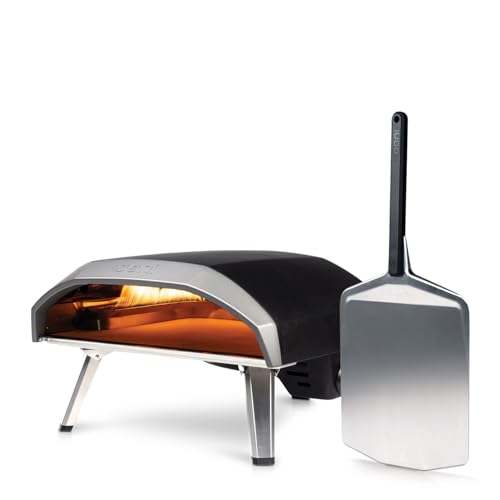
| Ooni Koda 16 | L-shaped burner, up to 500 °C according to Ooni, no built-in thermometer | approx. €449 | 9.4 | the higher manufacturer figure matters more to you than a built-in display |
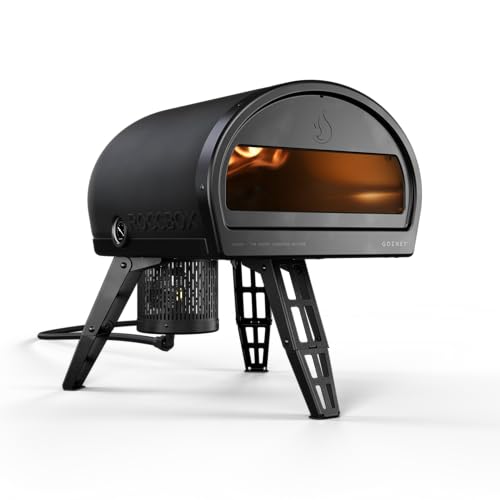
| BURNHARD Fat Tony | Pizzas up to 34 cm, thermometer for baking chamber and stone centre in the box | approx. €499 | 8.6 | 34 cm pizza is enough for you and you want up to 650 °C according to Burnhard |
| SANTOS O-160 | 7.5 kW, integrated turntable, round stone of 37 cm | approx. €450 | 8.7 | you do not want to turn the pizza with the peel |
The prices come from our price box and change; the rating is our editorial assessment and not a measurement result. All pizza ovens side by side are shown in the ranking pizza ovens 2026.
When the O-160 PRO fits, and when another oven does
First, pizza size. For 40 cm, only the O-160 PRO and the Ooni Koda 16 come into question in our table. If you shape smaller dough balls anyway, the BURNHARD Fat Tony at the same price of approx. €499 also has a thermometer for air and stone, but it stops at 34 cm.
Then heat. Santos states 450 °C, Ooni around 500 °C for the Koda 16, Burnhard up to 650 °C for the Fat Tony. For Neapolitan-style pizza, 450 °C is in our assessment no obstacle, but anyone who deliberately wants to bake at the highest manufacturer figure ends up with the other two. The Ooni sits €50 below the bundle in our price box.
Third, turning. With a fixed stone you turn the pizza with the peel, and whether you can turn down one side is, as described above, questionable. Anyone who does not want that takes the SANTOS O-160 with turntable, which at approx. €450 in our price box is €49 below the bundle, with 7.5 kW and a smaller stone.
Fourth, space. Allow a footprint of around 60 × 55 cm on a fireproof surface, plus 1.5 m of air to anything that can burn, and a bottle at least 1 m away. At 16 kg without the stone, you will not carry the oven into the garden shed casually.
Fifth, budget. On top of the oven come pressure regulator, hose with quick-release coupling, a bottle and, if it stands outside, the cover. If you are still unsure whether it should be a gas oven at all, start with the Grill Finder; how pizza works on a normal grill is described in the guide pizza on the grill.
The wrong choice is the O-160 PRO for anyone who wants to earn money with it. The Santos category page for pizza ovens does mention restaurants, cafés and food trucks, but the manual intends the oven for private use or household-type use, exclusively for baking and for bakeable food. For a stall at the weekly market we would look for an appliance whose manual covers commercial use.