Pellet oven for 12-inch pizzas, no longer listed in Ooni’s German oven overview
The Fyra 12 is a portable pizza oven that runs on wood pellets instead of gas or logs. The pellets slide from a hopper at the rear into the fire area, baking happens on a cordierite stone, and the pizza can be up to 12 inch, which is 30 cm. In our price box it appears at Amazon at approx. €339, and the Amazon catalogue showed the same amount on 5 October 2026. Our rating is 8.8.
First, the situation you should know about before buying: on 14 October 2026, de.ooni.com, eu.ooni.com and ooni.com redirected the address of the Fyra product page to the oven overview, and the German overview lists ten items, not the Fyra 12. The only reachable product page, the British one, shows £299, the button “Notify me” and the status not available. None of the pages we read states that Ooni is phasing the oven out. What follows from this for warranty, spare parts and accessories is covered in the section on costs after purchase.
Ooni calls the Fyra the successor to the Ooni 3, which according to Ooni was the first portable pizza oven using wood pellets. A German Ooni care article describes the Ooni 3 as no longer produced. The Fyra’s market year is not stated in any Ooni source; the blog post about the changeover is dated 26 June 2020.
Our sources are the British product page, Ooni’s blog and three Ooni documents held by retailers: the manual in the 2021 version, the safety handbook in the 2020 version and the German guide from 2022. We did not have a manual directly from ooni.com. Where these documents contradict each other, the text says so. You can find the other models in this class in the pizza ovens category; there the Fyra 12 sits in our rating below the three alternatives from the table further down.
Construction and technology
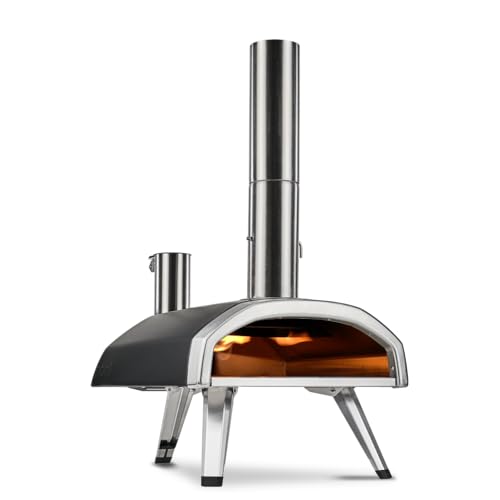
According to Ooni, the shell is made of carbon steel with a weatherproof powder coating on the outside. The material field on the British product page is empty; the information comes from an Ooni blog post. In the product photo, the rear part of the body is dark, and the front opening is an arch with a light metal frame and no door fitted. The chimney consists of two visibly separate pieces, and the pellet hopper sits as a short cylinder behind it at the rear.
According to Ooni, more insulation than on the Ooni 3 brings 16% faster heat-up, and the guide calls the housing fully insulated. According to Ooni, the hopper is 50% larger than on the Ooni 3. The floor is a cordierite stone, 10 mm thick.
The door has a viewing hole through which you see the pizza without removing the door. To slide food in and take it out, you hang the door on a hook, and a recess below the oven opening is meant for setting the door down. You fold out the legs; they have non-slip feet so the surface is not scratched, and they must be fully extended before lighting.
The manual (2021 version) lists eight parts in the scope of delivery: main body, door, cordierite stone baking board, chimney, chimney cap, fuel grate with fuel tray, fuel hopper and Flame Keeper. Assembly takes seven steps: fold out the legs, insert the fuel tray and grate, place the stone, insert and click the chimney in place, fit the hopper, attach the Flame Keeper, and finally the door and chimney cap. The parts list contains no electrical components and no gas connection, so the oven needs neither a socket nor a cylinder. Without a fan, the draught in the chimney remains as the drive for the airflow; that is our own inference from the parts list.
Unpacked, the oven weighs 10 kg according to Ooni. The British page gives dimensions of 74 cm in length and 39.3 and 72 cm, both labelled as width; which number is the height and which the depth is left open there, so we do not assign them. Amazon’s catalogue lists 69 × 48 × 26 cm and 14.8 kg, values that match no Ooni figure. We suspect shipping dimensions.
The following appears in none of the Ooni sources we read:
- Interior dimensions of the baking chamber and dimensions of the stone surface
- Weight of the stone, weight without chimney and hopper, number of legs, dimensions with legs folded
- Material of the hopper, fuel tray, grate, door and handles
- Function of the Flame Keeper; translations of the 2020 version list a rear vent cap at that point, but whether both are the same part is not documented
- Hopper capacity in kilograms or litres and the permitted amount of pellets per refill
- Output in kilowatts or watts
- Noise level and smoke volume as figures
- Assembly time
- Country of manufacture and production site
Does the hopper really fill itself?
No, not without your involvement. The pellets slide into the fire area by gravity, but according to the manual you refill in small amounts after lighting and keep the hopper filled to the top edge. One fill lasts for 15 minutes of burn time.
The Amazon text describes the gravity feed as automatic pellet feeding. The Ooni blog promises up to 20 minutes of baking without refilling once the hopper is full and the oven is hot; we work with the 15 minutes from the manual. If you bake for 90 minutes, as long as Ooni’s fuel consumption comparison assumes, you burn by this figure six hopper fills on paper, which you add in small portions. Pushing pellets down by force is out of the question: it smothers the flame, reduces the airflow and lowers the temperature.
To light it, you remove the grate, fill the fuel tray with about 150 g of pellets, roughly two handfuls, place a firelighter at the front of the grate, light it and push the grate back. Do not use anything that gives the food unwanted flavours. Methylated spirits and petrol are forbidden for lighting and relighting; only firelighters complying with EN 1860-3 are permitted.
According to Ooni, the oven is ready to bake when the flame is rolling; a low flame means it is not ready yet. You can see this through the viewing window in the door. Food goes in only once the fuel is covered with a layer of ash, and the 2020 version also requires at least 30 minutes of heating with red-glowing fuel. The door stays fitted during the whole bake and is only removed for sliding food in and out. The German translation of the 2020 version, by contrast, says it should stay open; the English original and the 2021 version say fitted, and we would follow that reading.
The chimney baffle regulates the draught. Open, it brings more airflow, stronger flames and more heat; closed, less airflow, a smoky effect and less heat. If the oven does not get hot enough, you take off the chimney cap and open the baffle. You must not keep it fully closed for a long time, because the pellets can otherwise swell and block the fuel feed. According to the guide, smoke arises with any wood until the right temperature is reached, and a light layer of soot after use is normal. Dark smoke points to pellets that are not completely dry or that were added in too large an amount at once.
Before the first pizza, you let the oven run for about 30 minutes at maximum temperature, let it cool and wipe the inside with dry paper. This removes oil and residues from manufacturing.
In detail: heat-up time, stone temperature and baking time
There are three values for the heat-up time. The British product page gives 500 °C in 15 minutes in its text, its meta description says 450 °C in 15 minutes, and Amazon writes 500 °C within 20 minutes. For an evening, you are better off planning with the slowest value; what the guide says about starting in the cold is in the questions below.
For baking, Ooni names a stone temperature. For Neapolitan-style pizza it should be at least 400 °C in the centre, measured with an infrared thermometer. Ooni sells that as an accessory; there is none in the oven’s parts list, and an explicit sentence on it is missing. So if you want to check the 400 °C, you buy one separately. Before the second pizza, the stone should be back at 380 to 450 °C, and after each pizza you give the oven time to reheat. The pause has a simple reason: every pizza draws heat out of the stone. Ooni does not state how many minutes it allows for this, and so we would work with the thermometer rather than the clock.
The pizza is turned every 20 to 30 seconds so that it cooks evenly. For baking time, the British product page says “as little as 60 seconds”, Ooni’s beginner page speaks of under 2 minutes, and a beginner article puts 60 to 90 seconds only for lightly topped pizza. With more toppings you are therefore more likely to land at the longer values.
If the pizza burns, Ooni advises: turn earlier and more often, close the chimney baffle, preheat for less time and use less fuel. If the stone is too hot, you place a cast-iron pan on it for about 30 seconds to draw off heat. According to the guide, the oven is designed for operating temperatures up to 500 °C; if it gets hotter, you stop the fuel feed and let it cool by itself. Why pizza stones crack is explained in our guide Cracked pizza stone.
Pellets, accessories and warranty: what comes after purchase
As fuel, the guide requires 100% hardwood pellets and recommends Ooni Premium Hardwood Pellets. The German care article goes further: against creosote build-up it names only Ooni pellets. So whether pellets from other brands are fine depends on which document you ask; we would stick with Ooni pellets while that is open. Ooni pellets cost €25.00 for 10 kg in the Ooni EU shop, which is €2.50 per kilogram (as of 14 October 2026). What a baking evening consumes is not given in kilograms in any Ooni source; the only documented figure is that the Fyra uses 44% less fuel than the Ooni 3 over a 90-minute bake. That is no use for a cost comparison against gas, because the absolute amount is missing and, according to the care article, the Ooni 3 is no longer produced.
The guide lists accessories separately from the parts list: hardwood pellets, infrared thermometer, firelighters, pizza peel, modular tables, cast-iron cookware, pizza oven brush and the Fyra 12 carry cover. According to Ooni, the firelighters are made of 100% natural wood shavings and are free of chemical flavourings. We have not recorded prices for the accessories. On paper, the oven plus a 10 kg sack from the Ooni shop comes to approx. €364 (339 plus 25), still without thermometer, peel, firelighters and cover.
Availability is inconsistent. In the EU shop, the link to the Fyra carry cover redirects to the oven covers overview; on the British page it returns a 404 error. The pellets for the Fyra 12 are still listed in the EU shop. For spare parts, Ooni points to the German spare parts page and to support.ooni.com; the spare parts collections for the Fyra 12 from the UK, Canada and the EU showed no entries on 14 October 2026.
According to Ooni Germany, all Ooni products have a voluntary manufacturer’s warranty of 1 year. For the Fyra 12, Ooni extends it to 5 years if you register it within 60 days of purchase, and the warranty list still includes the oven. This is meant to apply only in Ooni shipping regions. The British page ties the extended warranty to purchases at ooni.com. We do not evaluate the warranty field in the Amazon catalogue because its conditions are unknown. Whether the 5 years also apply to an Amazon purchase cannot be clarified from Ooni’s pages. The imprint of Ooni Europe names Ooni GmbH in Bonn.
Setting up, safety and cleaning according to Ooni’s documents
On safety and care, we stay close to the documents and do not summarise anything that Ooni presents as a list. The safety document in the manual (2021 version) contains 21 points. Here they all are, in their order and reworded in our own words; the manual supplied with the oven is the authoritative one:
- Operate only outdoors, on a stable, level, non-combustible surface and away from buildings, never inside a building, a garage or near enclosed areas. Keep combustible materials, petrol and other flammable vapours and liquids away.
- Observe local laws, which may prescribe minimum distances to structures or restrict open fires in times of drought and danger.
- Do not install or use in or on boats or recreational vehicles.
- Do not use in strong or gusty wind.
- The oven is not a heater and must not be used as one.
- Toxic fumes can accumulate and cause suffocation.
- Flames can escape from the metal housing: at the rear where the fire is, at the front out of the oven when opening the door, and at the top out of the chimney.
- Keep away from the openings and warn other people nearby.
- Improper installation, adjustment, modification, servicing or care can cause injuries or property damage; use the oven only when it is fully assembled and all parts are firmly attached.
- Inspect the oven regularly.
- Add pellets gradually to reach the right temperature; too many enlarge the fire and endanger users and the oven.
- There is a risk of burns to the hands. Never place hot objects on or next to combustible surfaces. During operation, do not touch metal parts, only the wooden or plastic handles with which you open the door and lift the fuel flap.
- Never leave the oven unattended while it is burning, even with the lid open. Watch for hazards such as dry leaves or wooden decking, because sparks can ignite them.
- Keep electrical cables away from the oven.
- Only responsible adults should use the oven.
- Keep children, pets and combustible objects away from the oven at all times.
- Do not remove any parts and do not move the oven while it is hot or during baking.
- Do not place dangerous objects such as lighters or liquid barbecue lighter fluid next to the oven, because it radiates heat in all directions.
- The oven stays hot even after the flames have gone out: let it cool for at least 2 hours and do not cover it immediately after use. Before putting it away, make sure that fire and embers in the burner are completely extinguished.
- The approximate temperature in operation is 120 to 550 °C.
- When used as intended and with the safety rules observed, the oven is considered safe according to Ooni; safe operation is the users’ responsibility.
The warnings on the following page add carbon monoxide: the oven must not be operated in confined or inhabited spaces such as houses, tents, caravans, motorhomes or boats, as there is a danger to life from carbon monoxide poisoning. Ooni calls flames at the rear normal when the convection flow is interrupted, for example because the door has been removed; it refers here to the safety distance of 1 m and the ban in strong wind. There may be sharp edges inside and outside.
The guide sets the clearance at at least 1 m from buildings and combustible objects, ideally in a spot sheltered from wind. The base must carry 30 kg; the assembly page speaks of a table for more than 30 kg. Wood, stone, marble and stainless steel are suitable, and Ooni advises against glass and plastic. Here the documents contradict each other: the safety document requires a non-combustible surface, while the guide also names wood as suitable. We would follow the stricter requirement and choose stone, marble or stainless steel. A beginner article recommends a stable table of metal, stone or wood at waist to chest height; the same applies to wood there. The oven may stay outdoors permanently if it is protected from heavy rain and extreme weather conditions; Ooni recommends storing it indoors or under the Fyra 12 carry cover, and in an enclosed space by the sea or near salt water.
Cleaning and ash
The oven partly cleans itself on the inside: you let it run for 30 minutes at very high temperature, which burns off food residues, and after cooling you wipe it out with dry paper towels. You wipe the housing on the outside with warm soapy water and dry it immediately; abrasives and caustic cleaners are out. Here the guide contradicts itself: its quick-start guide says not to use water to clean or cool the oven, while further back soapy water is allowed on the housing. We would limit it to the outside of the housing and never get it into the baking chamber.
According to the guide, you free the stone of flour and food residues with the Ooni pizza brush; for stubborn stains you turn it over once it has cooled completely. It is not dishwasher-safe, and washing-up liquid does not belong on it. The German care article allows a stone with stubborn dirt to be scrubbed lightly with water, which it says is rarely necessary, and then dried for about 2 hours at 60 °C in a conventional oven. A beginner article says the opposite: Ooni never recommends soap or water on the stone or inside the oven. We would follow the stricter advice and brush the stone dry or turn it over.
You let the fire burn down naturally. Only when the oven has cooled completely do you take out the fuel tray; cooled ash belongs in the fire pit, on the compost or in another environmentally friendly disposal, and you wipe soot off with a dry paper towel. According to Ooni, an oily black substance on the outside of the hopper or chimney is harmless, comes off with soap and warm water, is dried immediately afterwards and indicates incomplete combustion. Against creosote build-up, the care article advises Ooni pellets, a hopper that is not overfilled and an open chimney baffle while cooking. Some parts reach 537 °C and more, and stainless steel can discolour without performance suffering; Ooni explains the chimney discolouration this way and names stainless steel cleaner as a remedy.
What else comes into question?
Three ovens from our catalogue that you will weigh against the Fyra 12:
| Model | The difference | Price | Our rating | Take this one if |
|---|---|---|---|---|
| Ooni Fyra 12 (this one) | Hardwood pellets from the hopper, you refill by hand | approx. €339 | 8.8 | you want to bake with pellets instead of gas or logs and stay at the oven while doing so |
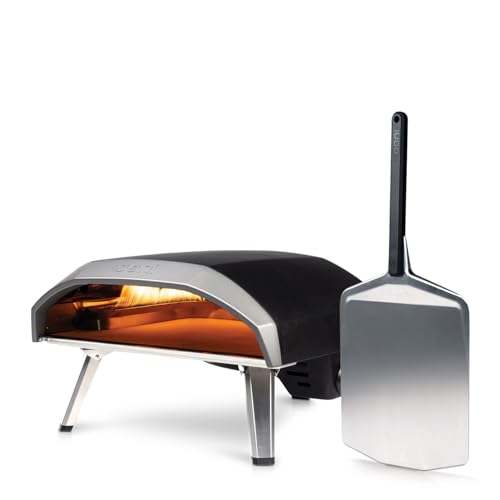
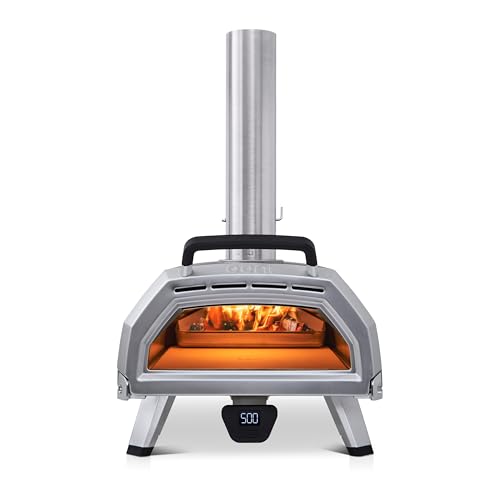
| Ooni Karu 12 | Wood or charcoal by hand, gas only with separate burner, 12 kg | approx. €299 | 9.0 | you have wood or charcoal to hand anyway or want to be able to switch to gas later |
| Ooni Koda 12 | Gas instead of pellets, 9.2 kg | approx. €284 | 9.0 | you do not want to tend a fire and are allowed to connect a gas cylinder |
| Ooni Koda 16 | Gas, pizzas up to 16 inch, 18.2 kg | approx. €449 | 9.4 | you bake for several people and can set up a heavy appliance permanently |
The prices are guide values from our price boxes and change constantly; for the Koda 12 and Koda 16 the table shows the price from Santos Grills, for the Karu 12 and Fyra 12 the one from Amazon. The weights come from Ooni’s British product pages, for the Koda 12 from the New Zealand one. Our rating is an editorial assessment based on manufacturer information; we measured nothing.
Decision guide: Fyra 12, Karu 12 or a gas oven
Start with the fuel, because it determines the effort. With the Fyra 12 you are at the oven for the whole session: you refill and keep an eye on the chimney baffle, and according to the safety document you must never leave it alone while the fire is burning. The Karu 12 also needs a fire by hand, only with wood or charcoal on the grate. If you do not want to tend a fire, take a gas oven: with the Koda 12 and Koda 16 you keep nothing going and refill nothing, but you do need a gas cylinder plus connection.
On price, according to the price box the Karu 12 is €40 below the Fyra 12 and has 9.0 instead of 8.8 in our rating. The Koda 12 costs €55 less than the Fyra 12 at Santos Grills. The Koda 16 is €110 above it and, at 9.4, has the highest rating of the three alternatives. Our assessment: if you accept wood or charcoal, you get on better and more cheaply with the Karu 12 in our comparison. We would buy the Fyra 12 only if you specifically want pellets.
On size, the Fyra 12 bakes one pizza up to 30 cm after another, and Ooni does not put a figure on the pause in between. For several people that means patience. Among these four, only the Koda 16 gives you more area, with pizzas up to 16 inch, and it is much heavier. If you would rather have a gas appliance the size of the Fyra 12, look at the Koda 12.
On the balcony, Ooni itself says nothing; only the Amazon text speaks of garden, balcony or open nature. Ooni’s clearance rules and your house rules are what count. According to the guide, a pellet oven smokes until it has reached its temperature, and you should factor that in with the neighbours. What tenancy agreements and house rules allow is covered in our guide Grilling on a balcony.
When camping, the Fyra 12 is conceivable outdoors on a stable, non-combustible table, with distance from tent, awning and caravan. That is our interpretation of the minimum distance. As a location inside a tent, caravan, motorhome or boat, it is ruled out by Ooni’s warnings. Alternatives for on the road are discussed in the guide Buying a camping grill.
If accessories and spare parts directly from Ooni matter to you, availability speaks for the other three: the Karu 12, Koda 12 and Koda 16 are in Ooni’s German oven overview, the Fyra 12 is not. Amazon also attributes an authentic wood-fired aroma to the wood pellets. That is advertising copy; we have not baked anything and cannot judge whether pellets, logs or gas taste different.
Who is it for?
The Fyra 12 is suitable if you have outdoor space with 1 m of clearance and stay at the oven for the whole session. It is the wrong choice for anyone who would only have room in a tent, caravan or boat, and for anyone who does not want to supervise a fire. For meat and vegetables it only works with accessories: according to Ooni, directly on the stone you cook only dry foods such as pizza and bread, while meat, vegetables and other moist foods belong in a cast-iron pan or other heat-resistant cookware.