The Joe Jr is a ceramic charcoal grill on a cast iron stand. Kamado Joe lists it as model KJ13RH, calls it the brand’s most portable charcoal grill and describes its uses as grill parties, camping and barbecue evenings on the beach. The Amazon catalogue assigns the same grill in red to our ASIN, without cart and without cover, and describes it as a charcoal grill and smoker for high-heat grilling and slow cooking.
We have not held it in our hands and have not grilled anything on it. This page compares data: the German manufacturer pages and shop data records from Kamado Joe (retrieved 06.10.2026), the seven-language operating manual (control number 9804190028, version 250625-GH), the Amazon catalogue (as of 05.10.2026) and the catalogue photo. The German version of the manual differs from the English original in several places; where that matters for you, it is stated in the text. Our own calculations and assessments are marked as such. You can find more ceramic grills from our catalogue in the kamado overview.
Ceramic, stand and grate
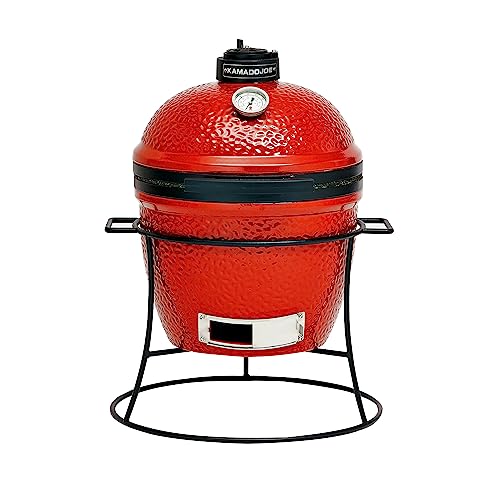
The body is made of ceramic, which the manufacturer calls thick-walled and heat-resistant. In the catalogue photo it is red and round, with an evenly dimpled surface. A black band runs around the joint between dome and base, a round dial thermometer sits in the dome, the upper vent sits on the top, and at the front of the base is the lower vent with a stainless steel flap. Kamado Joe describes the stand as black and cast iron; in the photo you can see black tubular rings with two side grab handles.
According to the specification table, the grill weighs 37.4 kg, is 50.5 cm wide and 69 cm high without a cart. Despite the handles, the manual requires two or more people to lift it. The cooking grate is hinged and made of stainless steel so that charcoal can be added while cooking. The cooking surface has a diameter of 34.3 cm (13.5 inches); the stated grilling area there is 0.1 m² and 150 square inches, while the Amazon catalogue says 148.5 square inches.
According to the image descriptions on the manufacturer’s page, the dome has a spring hinge at the back, a felt gasket runs around the rim of the base, and the temperature gauge shows Fahrenheit and Celsius with the ranges smoking, roasting and searing.
The parts list in the manual names twelve parts: stand, upper vent, dome, base, cooking grate, accessory rack, deflector plate, cast iron fire grate, fire ring, fire box, ash tool and handle. Charcoal is not included. Part 11 is called Aschenbecher (ashtray) in the German manual and in the Amazon title; the English parts list says ash tool, and the exploded drawing shows a long rod with a handle, so a tool. According to the manual, assembly needs an 8 mm spanner and about 30 minutes; it recommends working in pairs and using cardboard as a base to prevent scratches. Some assembly steps may already have been done at the factory, so the delivered product may differ from the illustrations; if you have questions, contact customer service and do not send the grill back to the retailer. The ceramic is fragile: when unpacking, you open the dome and take out all inner parts.
In detail: air, charcoal and the single deflector plate
A kamado controls its heat through air. The lower vent at the front lets fresh air reach the charcoal, and the upper one lets the exhaust gases out. More air means more heat, and the more charcoal is glowing, the hotter it gets; that is how the Joe Jr manual describes it.
To light it, you stir the old charcoal with the ash tool, and loose ash falls through the fire grate. The fresh charcoal goes into the fire box and is lit with one or two firelighters; dome and lower vent stay fully open for 10 minutes. After that the ceramic needs time: the manual allows 20 to 60 minutes for the temperature to stabilise. You only close and adjust the vents once the temperature is less than 10 °C below the target; the manual’s bracket gives 50 °F for this, which as a difference would be about 28 °C, so the two figures do not fit together. Every change only shows its effect after 10 to 15 minutes, so you increase only slightly and slowly: ceramic stores heat, and an overshoot is hard to bring down again.
According to the manufacturer, the temperature range is 107 to 398 °C (225 to 750 °F), and the manual requires that you do not exceed 750 °F (398 °C). Above 175 °C (350 °F), each time you open the dome you first lift it slowly by 5 to 8 cm and wait about 5 seconds; this is meant to prevent a flashback, a sudden surge of heat. As the cause, the English original names a rush of oxygen, while the German version writes of a lack of oxygen and is mistranslated there. How to light and control a kamado is explained in more detail in the guide Using a kamado properly.
A ceramic deflector plate is included for indirect cooking. According to figure 3 of the manual, from bottom to top the fire grate sits in the fire box, then the accessory rack with the deflector plate, then the cooking grate. The plate shields the food from the embers, and the heat travels around it. The parts list has exactly one deflector plate and no two-tier rack system; according to the manufacturer’s page, the Classic II has a two-tier Divide & Conquer. How to divide zones is explained in our guide to direct and indirect heat.
Can the Joe Jr go on the balcony?
According to the manual, rather not (our assessment): it requires 3 m clearance from overhead structures, walls and other structures and prohibits use under roofing. Kamado Joe names grill parties, camping and the beach as places of use, and the manufacturer’s page does not list a balcony; Amazon writes of park and garden.
The setup rules go further than the 3 m suggest:
- Minimum clearance of 3 m (10 feet) from overhead structures, walls, rails (in the English original: rails) or other structures; the clearance graphic measures it from the back, sides and top of the grill.
- Minimum clearance of 3 m from all combustible materials. The text names wood, dry plants, grass, brush and paper, and the graphic additionally petrol and canvas.
- Never under roofing such as roofs, carports, awnings or overhangs.
- Never in enclosed spaces such as patios, garages, buildings or tents, and never in or on motorhomes or boats; for patios the English original says patios.
- Level, non-combustible, stable ground such as soil, concrete, brick or rock. Asphalt may not be permitted, and the grill does not stand on wood or other combustible surfaces.
- A fixed spot with sufficient wind protection, shielded from direct draughts and dripping water such as rain, with the vents kept clear; in strong wind the grill stays off.
On the ground, the manual contradicts itself. On PDF page 57 the grill must stand on the ground and not on tables or counters. On page 60, however, the installation instructions describe installing it in a table made of non-combustible material that is fixed to the floor or wall: the grill stands there on the Joe Jr stand or with an air gap underneath, the lower vent at the front stays clear, and the tabletop does not touch it directly. Kamado Joe also sells a cart for the Joe Jr. Our assessment: ground or cart.
Your tenancy agreement and house rules apply in addition to the manual; see also our guide Grilling on a balcony. The manual itself gives the reason for the ban on enclosed spaces: burning charcoal produces carbon monoxide, which according to the manual is odourless and can lead to death.
Lighting, fuel and hot parts
According to the manual, the Joe Jr is a household appliance for outdoor use, not for commercial use and never a heating device. Only charcoal is intended as fuel. At most 3 lbs, which is 1.36 kg, belong in the main chamber, and you never overfill the charcoal grate.
For lighting, the manual prohibits charcoal lighter fluid, petrol, alcohol and similar volatile liquids because of the risk of explosion. Only firelighters complying with EN 1860-3 are permitted, and you never pour liquid onto burning charcoal. The lid stays open while lighting, and you do not lean over the grill, because loose hair and clothing can catch fire. You may only cook once the charcoal has a layer of ash. PDF page 58 also requires that the grill is heated up and the fuel is glowing hot at least 30 minutes before the first cooking.
During operation and while cooling, the grill, the air vents, the upper vent, the lower flap and the cooking grate are hot. The manual requires protective gloves and advises keeping face and body away from doors and vents because steam and hot air escape. Children and pets stay away from the grill at all times, and you do not let children grill. The grill is not left unattended and is not modified; it is operated in line with local fire protection regulations. During operation you keep a fire extinguisher within reach, of type BC or ABC when cooking with oil or fat. You do not extinguish an oil or grease fire with water; you call the fire brigade immediately.
The manual also prohibits glass, plastic or ceramic cookware in the grill, metal foil over the grates (heat build-up, damage to the grill) and liquids in or on the hot grill. It does not recommend accessories that do not come from Kamado Joe. Before each use you check nuts, screws and bolts for a firm fit.
Costs, accessories and where to buy
On Amazon the Joe Jr cost approx. €467 on 12.10.2026, in the German manufacturer’s shop €599.00 (retrieved 06.10.2026). On the German product pages the button Händler finden (find a dealer) leads to a dealer locator; only the US site has its own shopping basket. Retailer prices may differ; the price on the retailer’s page is what counts.
Accessories according to the German manufacturer’s shop (retrieved 06.10.2026, prices in euros):
- Cover KJ15080420, €49.99: solution-dyed polyester, waterproof, windproof and snow-resistant according to the manufacturer; according to the FAQ it also fits over a Joe Jr on its cart.
- Stainless steel charcoal basket KJ15091121, €49.99: separates charcoal remnants from the ash and is meant to improve airflow.
- Soapstone cooking surface KJ15090720, €99.99: can be cleaned in the dishwasher or by hand, not for the hob and not for the oven’s self-cleaning mode.
- Replacement deflector plate KJ-IHP13, €29.99: a heat deflector plate without a rack that, according to the manufacturer, creates several heat zones and indirect heat.
- Cart with shelves KJ15112524, €249.99.
The shop lists the Essentials Pack (KJ15040126) with cart and cover at €649.00, so €50 more than the grill alone, while cart (€249.99) and cover (€49.99) bought separately come to €299.98 together (our calculation). None of the pages explains why the German difference is so small; the address of the bundle page contains short-cover, and the separately sold cover reaches over the full length according to its product page, so the two need not be the same accessory. In the US shop the bundle under the same number costs $300 more than the grill alone ($799.99 versus $499.99).
Ceramic and metal spare parts for the Joe Jr are in the US shop (prices in US dollars, retrieved 06.10.2026): ceramic base in red $162.99, ceramic firebox $62.99, ceramic fire ring $37.99, thermometer $24.99, stainless steel cooking grate $49.99 and cast iron fire grate $22.99, plus a metal band set for $24.99, a hinge set for $12.99 and the Kontrol Tower Top Vent upper vent for $31.99. The German shop lists none of these, and according to the manufacturer’s FAQ, Kamado Joe ships only within the USA and Canada. The German product page names the stainless steel cooking grate KJ-CG13 and the fire grate KJ-MFG13 as compatible accessories.
Cleaning, care and warranty
After grilling you close the lower vent fully, clean the still-hot grates with a grate scraper or damp cloth and, below 400 °F (204 °C), close the upper vent. You may only cover or clean the grill once the dome has cooled to 115 °F (45 °C). You remove ash as you do when lighting, with the ash tool: loose ash falls through the fire grate, and you vacuum or shovel out the bottom of the base during deep cleaning. Amazon describes a removable ash pan and the manufacturer’s page an ash vent; for ash removal the manual only describes the tool. You wipe the outside with a damp cloth, and you do not scrub the gasket hard, which can damage it; it cleans itself through the heat.
If the deflector plate gets dirty, next time you insert it with the dirty side down; the heat cleans that side itself. For mould or mildew the manual provides this procedure: take out the cooking grates and wash them with mild washing-up liquid, light the charcoal, insert the accessory rack with the deflector plate (dirty side down), open both vents fully and heat to 315 °C (600 °F) with the dome closed. You hold it there for 15 to 20 minutes or until no more smoke is visible, then close the lower vent and, below 204 °C (400 °F), the upper one, and clean the ceramic and plate with a soft brush. Once or twice a year the manual requires a more thorough clean: remove the inner parts, clear the ash between grill body and inner parts, clean the inside of the ceramic with a plastic-bristle brush, vacuum or shovel out the bottom, and wipe the hinge and outside. Against the weather, a grill cover is the best way, according to the manual.
The warranty is tiered by component (manual, PDF pages 64 and 65). The most important ceramic parts carry a lifetime warranty for as long as the original buyer owns the grill, important metal and cast iron parts 5 years, and electronic components 3 years (the heading also names heat deflectors and pizza stones). All other components, expressly thermometers and gaskets, and Kamado Joe accessories run for 2 years. For commercial use, for example by caterers, butchers, rental companies or food trucks, no regular warranty applies, but 1 year for material and workmanship defects.
The period starts with the purchase date and applies only to the first buyer; the grill must be registered on the manufacturer’s product registration page. Kamado Joe replaces or repairs the part at its own discretion and bears the shipping of warranty parts, but not labour. Not covered are misuse, improper assembly, maintenance or installation, accidents, natural disasters, unauthorised modifications, transport damage, normal wear such as scratches and chipping, and changes in appearance that do not affect performance. Anyone who buys from an unauthorised retailer loses the warranty.
What the manufacturer does not state
We did not find this information on the manufacturer’s pages, in the manual or in the Amazon catalogue, or found it only in contradictory form:
- Depth of the grill (width and height are on the manufacturer’s page)
- Weight: 37.4 kg in the specification table, 39.9 kg in the shop data record, 34.3 and 30.8 kg in the Amazon catalogue; we use 37.4 kg, the only value stated as the grill weight
- Grilling area: a circle with a diameter of 34.3 cm (cooking surface) has about 924 cm² by calculation, 150 square inches converts to about 968 cm², and the 0.1 m² looks rounded (our conversions); how the manufacturer arrives at its figure is not explained
- Wall thickness, weight and glaze of the ceramic
- Burn time of a charcoal load and charcoal consumption per grilling session
- Time to searing temperature (the manual only gives the time to a stable temperature)
- Measuring range and accuracy of the temperature gauge
- Number of people or portions (the 8 burgers appear only in the Amazon text)
- Load capacity of the side handles and carrying weight per person
- Cool-down time (the manual only gives the threshold of 45 °C)
- Frost resistance of the ceramic and service life of the gasket
- Assignment of the warranty tiers to individual Joe Jr parts
- Seller status of Amazon and of marketplace sellers
What else is worth considering?
Three kamados from our catalogue that a buyer weighs against the Joe Jr:
| Model | The difference | Price | Our rating | Choose this one if |
|---|---|---|---|---|
| Kamado Joe Joe Jr. (this one) | Cooking surface Ø 34.3 cm, one deflector plate, 37.4 kg with two side handles | approx. €467 | 8.5 | you want to set up a kamado in changing locations and can lift it with two people |
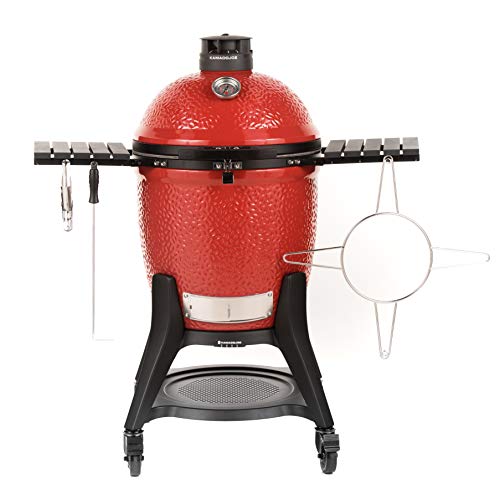
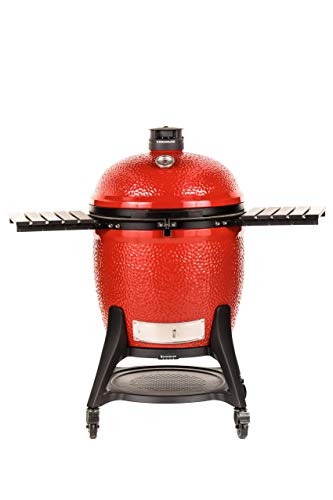
| Kamado Joe Classic II | Grate Ø 45.7 cm (0.16 m²), two-tier Divide & Conquer, 103.3 kg with cart according to the manufacturer’s page | approx. €1,599 | 9.1 | you leave the grill in a fixed spot permanently and want to cook several dishes at different temperatures |
| BBQ-Toro Kamado KURO | Ø 52 cm according to the Amazon listing (grate size not given), base frame with four castors, two of them lockable | approx. €720 | 8.2 | you prefer a larger unit on a rolling frame to a portable kamado |
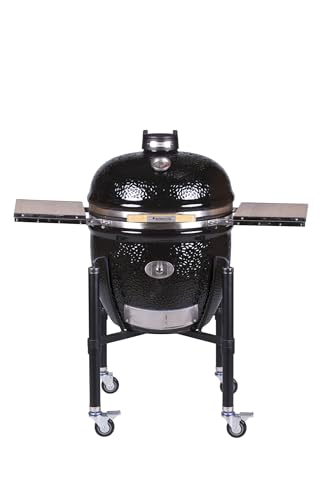
| Monolith Classic (2.0) | Grate Ø 44 cm, frame with side tables, controller-ready adapter for a fan (fan not included); delisted according to our review | approx. €1,849 | 9.5 | you can still find a remaining unit, want to connect a fan later and are looking for a stationary unit with a frame |
The prices are guide values from the price boxes of the reviews, each with the date stated there. The Kamado Joe Classic II costs about €1,130 more than the Joe Jr, the BBQ-Toro Kamado KURO €253 more and the Monolith Classic (2.0) about €1,380 more. The rating is our editorial assessment based on data sheets, not a measurement result, and the table compares neither cooking times nor consumption nor durability, because no reliable data are available for them. More models are shown in the comparison of the best kamados 2026.
When the Joe Jr suits you, and when not
Area comes first. The grate measures 34.3 cm against 45.7 cm for the Classic II, the area according to the manufacturer’s pages 150 against 250 square inches, so two thirds more (our calculation). For a small group we would plan on the Joe Jr; if several guests regularly sit at the table, the Classic II is the better choice, and you pay about €1,130 more for it.
Then the location. On a campsite what counts is that the grill stands outdoors; a tent awning is ruled out by the manual’s tent rules (our inference), and whether the site allows open fire is governed by the site rules, more on that in the guide Buying a camping grill. Anyone who has to load the grill into the car alone needs a helper.
Grilling spontaneously after work is easier with gas or electric in our assessment, because the Joe Jr’s route to a stable temperature alone can take up to an hour; the grill finder helps with the choice. For shoulder or brisket over many hours we would look at a larger kamado, because the manual allows only 1.36 kg of charcoal in the main chamber. And if a fan is to control the temperature later, the grill needs a fan connection, which the table lists only for the Monolith.
On budget: with a cover you come to about €649, with a cart instead of a cover about €849, in each case without charcoal and firelighters complying with EN 1860-3.