Amazon lists the Classic II under the model number KJ23RHC as “Classic II” in red, which is the version with a cart at Kamado Joe. We have not held it in our hands, and we have not grilled on it either. This page is based on Kamado Joe’s German and US product pages, the series comparison and the manufacturer’s warranty terms, as well as the seven-language operating manual 9804200033 (version 250625-GH). We read its German chapter and consulted the English one where the translation falters. You will find the other ceramic grills whose data we compare side by side in the Kamado overview.
Compared with the earlier version of this page, we have corrected several details, among them the weight (there 105 kg, which matches Amazon’s catalogue value), the burn time of one fill (there 10 to 14 hours without a source), the SlōRoller (there reserved for the Classic III) and the cooking grates (there cast iron that should be oiled). We have also deleted the description of a grilling session of our own with ribs using the 3-2-1 method: that never took place.
What the Classic II is made of
According to Kamado Joe’s FAQ page, the body is made entirely of ceramic, on the Classic Joe as on the larger Big Joe. Amazon’s product text describes it as thick-walled and heat-resistant, saying it stores heat and moisture.
The grate has a diameter of 45.7 cm. That is the 18 inches from the Amazon title; the German product page lists the grill as a 46 cm model. On the cooking area, the German product page contradicts itself: its data table says 0.16 m² or 250 square inches, its feature list says 0.2 m² maximum cooking area, and under the keyword cooking area even 61 cm appears, the measurement of the larger Big Joe class. Because the US page explicitly lists the 250 square inches as the maximum cooking area, we regard 0.16 m², so around 1,600 cm², as the reliable value.
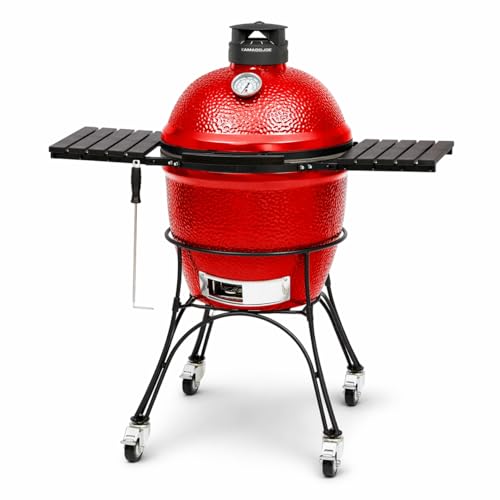
On top of the dome sits the Kontrol Tower, the top vent. The US page describes it as powder-coated cast aluminium, adjustable in two ways and intended for the whole temperature range, from low-temperature smoking to hot searing. According to the German product page, it keeps the air setting steady even when you open and close the dome. Its counterpart is the lower vent opening at the front. The ash falls into a pull-out drawer that the manufacturer calls patented.
According to the product page, the Air Lift hinge considerably reduces the weight of the dome; it does not fall shut and stays in any position you want. Only Amazon’s product text is more concrete, saying the hinge carries 96 percent of the lid weight. From the factory it is set for balance and stability. If you still want to change the spring tension, you need a 7 mm and a 14 mm open-end spanner: turned clockwise the dome opens more easily, anticlockwise it opens harder, and after every full turn you try out the result. The manual warns that the hinge is under high pressure. According to the English chapter, you should only take it apart or loosen the bands with the supplied hinge removal tool kit, and for swapping the dome, base or hinge bands it requires two people, gloves and safety goggles.
Between dome and base there is, according to the manufacturer, a double-thickness gasket of fibreglass with wire mesh. According to the English part of the manual, the stainless steel latch is set from the factory for a very tight seal; it can be readjusted with a small Allen key. In the product photo, the built-in thermometer sits at the front of the dome, below the Kontrol Tower.
Inside, a base, five wall segments and a stainless steel ring form the firebox, which Kamado Joe calls AMP. The charcoal sits on a cast iron grate. You grill on two half-moon stainless steel grates; Kamado Joe sells a cast iron half-moon grate as an accessory.
On the fold-down side shelves, the sources contradict each other. The US product page, the series comparison and the accessory page say HDPE, a plastic, while the German product page speaks of powder-coated steel.
We found no statement in any manufacturer source on these points:
- Wall thickness of the ceramic and type of glaze
- Weight of the dome
- Type, measuring range and accuracy of the thermometer
- Material of hinge and bands, stainless steel grade of the grates
- Height with the dome open and working height at grate level
- Number of people the grill is intended for
- Load capacity of side shelves and cart
- Connection for a fan or temperature controller on the Classic II (the warranty terms mention an iKamand Controller but do not say whether it fits here)
- Frost resistance and leaving it outdoors over winter
- Service life and replacement interval of the gasket (the tenfold lifespan of a felt gasket appears only in Amazon’s product text)
- a spare parts list for the KJ23RHC in the European shop (gasket, ash drawer, Kontrol Tower, latch)
- Country of origin
In detail: Divide & Conquer on two tiers
A kamado is a thick-walled ceramic vessel with air intake at the bottom and a vent at the top. The embers lie in a firebox under the entire grate, so without inserts you grill directly over the charcoal everywhere. Anything that should cook slowly needs shielding.
Kamado Joe solves this with Divide & Conquer, a rack that holds half-moon inserts on two tiers. In the box you get the rack, the two half-moon grates and two ceramic heat deflector plates. If a plate sits under one half of the grate, it intercepts the radiant heat of the embers, and what lies above it cooks indirectly, while the other half stays open to the charcoal. With both plates, the whole grate becomes an indirect zone. The second tier adds distance, and the further a grate is from the embers, the less radiation arrives.
The manufacturer promotes the system by saying that several dishes cook at different temperatures at the same time. Our take: under the closed dome both halves share the same air, and what differs is mainly how much heat arrives from below. You get a hot and a gentle zone, but not two separately controllable cooking chambers.
Our guide on direct and indirect heat explains how to divide zones in general and which food goes where.
How long does the Classic II take before you can grill?
According to the manual’s timings, half an hour to a good hour. The charcoal burns for ten minutes with the dome open and the lower vent open, after which Kamado Joe gives the grill 20 to 60 minutes until the temperature has stabilised and the ceramic is hot.
The charcoal always goes in the charcoal basket and is lit with one or two firelighters. As soon as it is burning, you close the dome. You only touch the vents once the temperature is less than 10 °C from your target, then you close and set the upper and lower vents. According to the warnings, food may only go on the grate once the charcoal has a layer of ash, and the fuel should glow for at least 30 minutes before the first cook.
You control the temperature through the airflow to the fire and through the amount of charcoal: more air means more heat, and so does more burning charcoal. According to the instructions, what you change at the vents only takes effect after 10 to 15 minutes, and because ceramic stores so much heat, Kamado Joe advises raising the temperature only slowly and in small steps. An overshot temperature is much harder to bring back down.
According to the data sheet, the temperature range runs from 107 to 398 °C. The upper limit also appears in the safety section; you must not go above it. When topping up for long cooks, you need, according to the manual, protective gloves or long, sturdy fireplace tools. Kamado Joe gives no figure for the burn time of a charcoal fill in the sources we read, and no more than 2.7 kg of charcoal belongs in the main chamber; the manual describes an overfilled charcoal grate as a risk of serious injury and damage to the grill.
Above 175 °C, you first open the dome only 5 to 8 cm each time and let the grill “burp” for about 5 seconds. This prevents a flashback, a white-hot surge of heat. The German translation gives lack of oxygen as the cause; the English original speaks of oxygen suddenly flowing in. That fits the general explanation of such backdrafts: when air is scarce, unburnt gases collect under the dome, and if oxygen rushes in when you open it, they ignite all at once.
When you have finished grilling, you close the lower vent completely. You can clean the grates straight away with a grate scraper or a damp cloth, but be careful, they are still hot. When the temperature falls below 400 °F (204 °C), the upper vent also closes; for this the manual prints 205 °C on the shutdown pages, and 204 °C for the same 400 °F at the first heat-up. You may only cover or clean the grill itself once the dome has cooled to 45 °C, and the warnings give the same limit for moving and storing it.
Location and assembly
With the cart, the Classic II is, according to the data sheet, 117.4 cm wide and 121 cm high and weighs 103.3 kg. The manufacturer does not say whether the width is measured with the side shelves unfolded, and the depth is missing there. Amazon’s catalogue dimensions of 36 x 18 x 18.11 inches, which convert to around 91 x 46 x 46 cm, match no manufacturer statement and therefore do not work as a substitute.
The manual calls the cart a steel wire cart, the series comparison a powder-coated galvanised steel cart. It stands on four casters, two of which can be locked. You may only roll the grill over smooth ground, never over stairs or uneven surfaces and never while it is in operation.
If a part is missing or damaged, according to the manual the grill does not go back to the retailer; you contact Kamado Joe customer support. For assembly, the manual allows about 30 minutes for two people and recommends gloves; as a tool you need a No. 10 spanner.
Lifting calls for more caution than the screwing. Before the ceramic body comes out of the box, you take out all the interior parts, carefully, because according to the manual the ceramic is fragile, and check that the band and hinge nuts are tight. Two or more people must lift it, and not by the hinge, the band brackets or the handle, warns the English chapter, because otherwise the dome can come out of the band (the manual contradicts itself here: in the section on the lifting method, including in the English chapter, the rear hinge is given as a lifting point, while the warning forbids it; we follow the warning). You should take hold of it at the base surface and at the front lower vent opening.
For the location, the manual requires considerably more space than the grill itself takes up. Under the heading “Structural proximity requirements” there are two clearance rules. The first requires 3 m clearance from the back, sides and top of the grill to all roof structures, walls, rails or other combustible building materials. The second requires 3 m to all combustible materials such as wood, plants, grass, brush, paper, petrol or canvas. According to the manual, this clearance leaves room for proper combustion, air circulation and ventilation. In addition, the grill should not stand on combustible material such as wooden boards.
The warnings add to this. You use the grill only outdoors and well ventilated, never in an enclosed or inhabitable space such as houses, tents, caravans, motorhomes or boats, and never under roofs, carports, awnings or overhangs. It needs a level, non-combustible, stable surface such as soil, concrete, brick or rock; according to the manual, asphalt may not be suitable. In strong wind it stays off. It must also stand on the ground, not on tables or counters, although the same manual contains instructions for building it into a grill table and outdoor kitchen (more on that in the FAQ). In the section on placement, it additionally requires sufficient wind protection and protection from direct draught and from dripping water such as rain.
The manual does not comment explicitly on balconies. Our assessment: 3 m to the house wall and open sky above the grill are not available on most balconies, and a balcony with a roof or awning above it is ruled out by the wording anyway. Whether charcoal is allowed at all where you live is also governed by your tenancy agreement and house rules.
What else is worth considering?
Three ceramic grills from our catalogue are close to the Classic II with grate diameters of 44 to 46 cm:
| Model | The difference | Price | Our rating | Pick this one if |
|---|---|---|---|---|
| Kamado Joe Classic II (this one) | two-tier Divide & Conquer with two heat deflector plates, Air Lift hinge, cart with side shelves | approx. €1,599 | 9.1 | you want to stay around €280 below the Classic III and two grate tiers are enough for you |
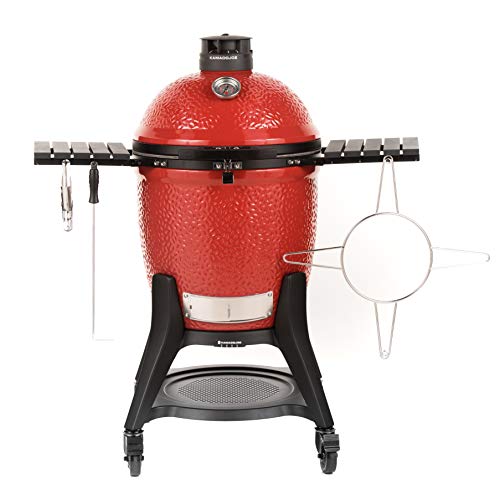
| Kamado Joe Classic III | SlōRoller and three-tier Divide & Conquer from the factory, stainless steel charcoal basket, aluminium side shelves | approx. €1,879 | 9.2 | you want three grate tiers from the factory |
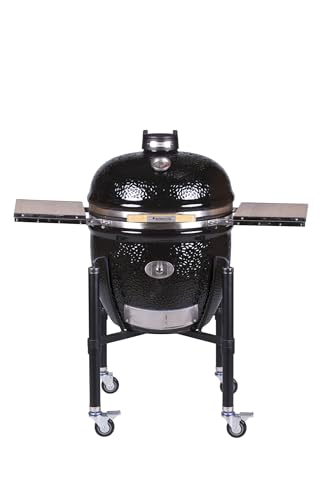
| Monolith Classic (2.0) | adapter for a fan for temperature control (fan and controller extra), 44 cm grate; delisted by the manufacturer, successor is the TWO.55 | approx. €1,849 | 9.5 | you want a fan connection named by the manufacturer, can manage with a 44 cm grate and have settled the retailer question before buying |
| Big Green Egg Large | same 46 cm class, according to Big Green Egg intended for a table, outdoor kitchen or EGG Nest | approx. €1,994 | 9.0 | you are looking for a lighter kamado for a table or nest: 73 kg according to Big Green Egg, 97.3 kg for the freestanding Classic II |
The prices are the guide values from our price boxes, and for the Classic III the price from Santos Grills, and may look different at the retailer by now. Our rating is an editorial assessment from the data comparison, not a measurement result.
The price and rating for the Monolith belong to a model that the manufacturer no longer carries. According to our research of 24.09.2026, the Classic (2.0) is no longer listed at Monolith, and the old product address redirects to the home page. According to its terms, Monolith gives a warranty only for purchases from the manufacturer or an authorised retailer, and whether the Amazon seller belongs to them is unclear.
Classic I, II or III: which suits you?
In the German Kamado Joe shop on 02.10.2026 the Classic range costs this much: Classic Joe I €999, Classic II with cart €1,599 and freestanding €1,499, Classic III with cart €2,399 and freestanding €2,199. These are list prices from the manufacturer.
Compared with the Classic I, you pay €600 more according to the manufacturer’s shop. For that, the series comparison mainly contrasts three components: the Kontrol Tower instead of a cast iron top vent, the Air Lift hinge instead of a standard hinge and the fibreglass gasket with wire mesh instead of a standard felt gasket. Two-tier Divide & Conquer, thermometer, cart and side shelves are on both. If these three components are not worth the extra cost to you, we would go for the Classic I.
To the Classic III it is €800 in the manufacturer’s shop. According to the series comparison, it brings a three-tier Divide & Conquer, a stainless steel charcoal basket, aluminium side shelves, a different powder-coated steel cart and the SlōRoller, a hyperbolic smoking insert. Kamado Joe sells three of these parts separately for the Classic II: the smoking insert with rack (KJ-HYPER, €199.99), the stainless steel charcoal basket in Classic Joe size (KJ-MCC23, €99.99) and the aluminium side shelves (KJ-Alumn, €149.99), together €449.97 at manufacturer prices. You cannot get the third tier and the different cart this way. At retailer prices the gap between the grills shrinks: Amazon lists approx. €1,599 for the Classic II (as of 05.10.2026), Santos Grills approx. €1,879 for the Classic III according to our price box, which is €280. Anyone who only wants the SlōRoller pays around €1,799 with the rack from the Kamado Joe shop (€199.99) and so stays around €80 below the Classic III. Anyone who wants all three retrofit parts from the Kamado Joe shop ends up at around €2,049, so around €170 above the Classic III, and should therefore work out its equipment beforehand.
The freestanding version KJ23NRHC is intended for a built-in outdoor kitchen or a grill table, €100 below the cart version in the manufacturer’s shop.
Accessories and warranty
Charcoal is not included, the manual makes that clear, and neither is a cover. According to the parts list, that belongs only to the version KJ15042621, which the German Kamado Joe shop does not list. Because the manual recommends a grill cover as the best protection against the weather, we list it: the heavy-duty grill cover KJ-GC23BWFS in Classic Joe size made of solution-dyed polyester, according to the manufacturer waterproof, windproof and snowproof, costs €79.99 there, and the dome cover KJ15080520 in Classic Joe size €59.99.
Also in the German shop, each in Classic Joe size: a second set of half-moon heat deflector plates (KJ-HDP, €59.99 for two), half-moon cooking grates (KJ-HCG, €49.99), the cast iron half-moon grate (KJ-HCICG, €69.99) and a ceramic pizza stone (KJ-PS23, €34.99). You can get the Divide & Conquer rack as a replacement under KJ-FCR for €64.99, without a cooking grate. The manual does not recommend accessories that do not come from Kamado Joe, saying they could cause injuries. All euro prices from the German Kamado Joe shop on this page are as of 02.10.2026.
Kamado Joe’s US page links a spare parts list for the KJ23RHC. There the ash drawer KJ-AC23 costs US$49.99, the Kontrol Tower KJ-KT US$74.99 and the stainless steel latch KJ-SSLATCH US$24.99 (as of 05.10.2026).
Kamado Joe tiers the warranty by component. The series comparison on the manufacturer’s page speaks across the board of a lifetime warranty, while the manual and the warranty page restrict it to the ceramic. The most important ceramic parts are covered for as long as the original buyer owns the grill, important metal and cast iron parts for five years. For electronic components the terms give three years; the heading of this section also counts heat deflectors, so the heat deflector plates, and pizza stones among them. Everything else, explicitly including thermometer and gaskets, is covered for two years. All of this presupposes normal household use, starts from the original purchase date, applies only to the original buyer and only if you register the grill. According to the terms, not covered are abusive or misused use, improper use, improper assembly, maintenance or installation, accidents, natural disasters, unauthorised additions or modifications and transport damage, plus normal wear and cosmetic changes without loss of performance. Your statutory warranty rights remain unaffected according to the terms.
For the way you buy, one sentence from the terms counts: if you buy from a retailer without explicit permission from Kamado Joe to sell, the warranty lapses. We do not know whether the provider of the Amazon offer is authorised, and the manufacturer’s pages refer to a retailer search instead of Amazon. Ask the seller about it before ordering, and check from the EAN 811738021447 whether the cart version KJ23RHC really arrives. According to the shop record, the freestanding KJ23NRHC carries 811738021522.
What the manual prescribes for lighting and cleaning
As fuel, the manual allows only charcoal. To light it, you use firelighters complying with EN 1860-3 (a European standard that applies in the EU), never charcoal lighter fluid, petrol, alcohol or similar volatile liquids, because they can explode. The dome stays open during lighting, and you do not lean over the grill while doing so, because loose hair and clothing can catch fire.
At the fire you wear protective gloves, including when adjusting the vents: the upper and lower flaps are hot during operation and while cooling down. Before every grill session you check that all nuts, screws and bolts are tight. You keep a fire extinguisher within reach at all times while grilling, and when grilling with oil or fat one of type BC or ABC. If oil or fat is burning, you never extinguish it with water but call the fire brigade immediately; according to the manual, such a fire extinguisher may be able to contain the fire. You smother flames in the grill by closing the dome and the flaps. You keep children and pets away at all times, and according to the manual children may not use the grill at all. You do not cover the grates with metal foil, because heat builds up underneath that can damage the grill.
You only pull out the ash drawer once ash and charcoal are no longer hot. Cold ash is wrapped in aluminium foil, soaked with water and disposed of in a non-combustible container.
After every grill session, the manual provides five steps. First the grill must be fully cooled down and all charcoal extinguished. Then you stir the remaining charcoal with the ash tool so that loose ash falls through the charcoal grate, and dispose of it as described above. On the outside you wipe the grill with a damp cloth; you do not scrub the gasket too hard, as that can damage it, and it gets clean by itself while grilling. Finally the cover goes over it, and the grill stands in a cool, dry place. If a heat deflector plate is dirty, you put it in next time with the dirty side down, and the heat then cleans it.
For mould or mildew inside, the manual describes a self-cleaning that burns off all residues. The grates come out, are washed with mild washing-up liquid and stay out. Then you light charcoal, insert the accessory rack with the heat deflector plate, dirty side toward the embers, open the upper and lower vents fully and let the temperature rise to 315 °C with the dome closed. You hold it there for 15 to 20 minutes or until no more smoke is visible. Afterwards you close the lower vent, and the upper one as in normal shutdown, and let the grill go out. Before the next grill session you brush the ceramic and heat deflector plate with soft bristles.
Once or twice a year a more thorough cleaning is due: grill cold and charcoal extinguished, interior parts out, remove ash and residues between the grill body and the interior parts, clean the inner ceramic with a plastic-bristle brush, shovel out or vacuum the bottom, wipe the hinge and exterior. Finally you put the interior parts back in (the German version writes “Tauschen Sie alle internen Komponenten aus” here, meaning “swap all internal components”; according to the English original, reinserting is meant).
Who is it suited to?
In our assessment, the Classic II suits you if you plan long cooks at the weekend and stay at the grill during that time. According to the manual, you must not leave it unattended while in operation, and the same goes for hot charcoal and ash.
It is the wrong choice for two groups. Anyone who wants to grill a few sausages quickly after work during the week is, from our point of view, better served with a gas grill, because the half hour to good hour of lead time applies to every fire, not just the first. And anyone who grills commercially is in the wrong place: according to the manual, the grill is intended only as a household item for outdoor use, it rules out commercial use, and caterers, butchers, rental companies and food trucks get only a one-year warranty according to the warranty terms.
If you are still unsure whether it should be a kamado at all, the grill finder suggests suitable grills after four questions about fuel, budget, place of use and number of people.