Which Classic III this is
The Classic III is a charcoal grill with a ceramic body and dome, a kamado of the 46 cm class. Kamado Joe sells it as the Classic Joe III and describes it as a grill with all the features of the Series I and II. In addition there is a powder-coated grill cart, a three-tier Divide & Conquer and the SlōRoller smoking insert.
It comes in two versions. This review covers KJ15040921 with cart and side shelves. KJ15040721 is the freestanding version without either, intended for a table or outdoor kitchen. In spare parts lists the manufacturer also lists the number KJ23RHCI as the Classic III. The kamado category shows where it sits among the other ceramic grills whose data we compare.
On price, the sources are far apart. In the Kamado Joe shop for Germany, the version with cart costs €2,399 and the freestanding one €2,199 (retrieved 1 October 2026). In our price box it is listed at Santos Grills at approx. €1,879, there under model number KJ15040921 (as of 1 October 2026). On Amazon we found only one listing, with model number KJ23RHCI-A, whose description announces pallet delivery to the kerb, possible only on mainland Britain; we do not link there. No link leads from the manufacturer’s product page to Amazon. The buy button and dealer search lead to the manufacturer’s own shop and to retailers.
If you go for an offer well below the manufacturer’s price, have two things confirmed first. One is the model number, which you check on every offer, including those in our price box: KJ15040921 stands for the version with cart, KJ15040721 for the freestanding one, which costs €200 less in the Kamado Joe shop. The other is that the seller is a retailer authorised by Kamado Joe. Without that authorisation, the manufacturer warranty lapses according to the warranty terms.
Dome, firebox, cart
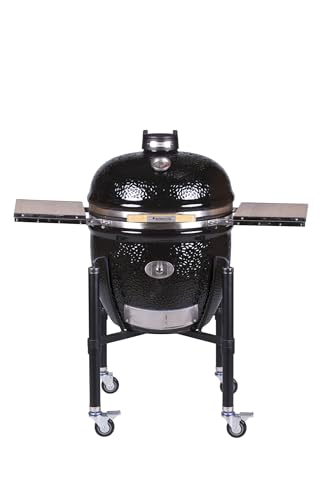
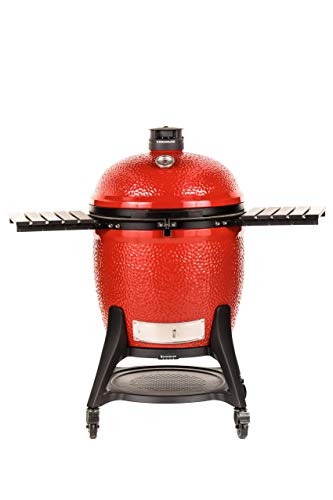
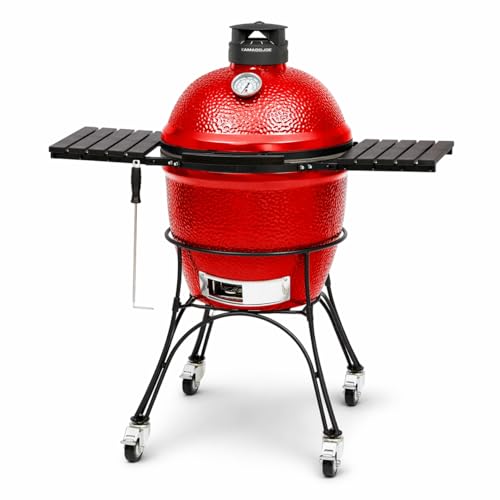
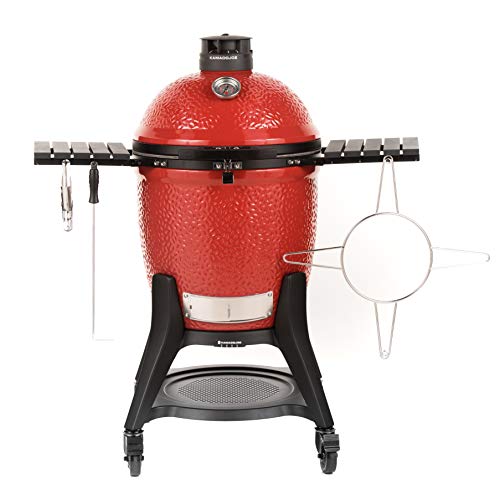
The product photo shows a round ceramic body with a domed lid in a black cart on four casters. The Kontrol Tower sits on top of the dome, the thermometer at the front of the dome. On the left and right, the side shelves extend at the height of the dome rim.
They make the grill wide. Kamado Joe gives 109.4 cm width and 125.8 cm height for the version with cart, and 56.0 cm and 90 cm for the freestanding one. Shelves and cart therefore make it 53.4 cm wider by calculation, and the cart alone makes it 35.8 cm taller. For grill weight, the product pages state 127.3 kg with cart and 108.3 kg freestanding, a difference of 19 kg. We go with the product page value, although the same manufacturer’s shop data record and the Amazon catalogue list around 143 kg.
The cooking surface has a diameter of 45.7 cm. For the grilling area, the same product page gives two values: 0.16 m² in the specification table and 0.2 m² maximum cooking area in the feature list. A circle of this size calculates to 1,640 cm², which matches the 0.16 m² and thus one full grate level.
The dome hangs on the Air-Lift hinge, which according to Kamado Joe considerably reduces the weight when lifting. The manual warns that this hinge is under extreme tension; it is only taken apart with the supplied release tool. How hard the dome is to open, you set with a 17 mm wrench on the adjusting nut at the top of the spring bracket: clockwise for easier, anticlockwise for heavier. A stainless steel latch holds it closed, and it is sealed with a double-thick woven wire fibreglass gasket.
The Kontrol Tower regulates the exhaust, according to the US site made of powder-coated cast aluminium and adjustable in two ways. Kamado Joe credits it with keeping its setting when you open and close the dome. Fresh air comes in through the lower vent.
Inside the body sits the AMP firebox made of five ceramic pieces. According to the parts list, a stainless steel firebox ring and a firebox base belong to it. The charcoal lies in a stainless steel charcoal basket, with which, according to the manufacturer, charcoal remnants can be quickly separated from the ash; the ash falls into a pull-out drawer. Grilling is done on two half-moon stainless steel cooking grates, grade 304 according to the Amazon description. The box also contains two ceramic heat deflectors (called ceramic heat baffles in the parts list), the Divide & Conquer rack, an accessory rack and the SlōRoller. The cart rolls on two lockable and two non-lockable casters. Charcoal and wood chunks are not included.
None of the sources we evaluated (German and US product pages, German manual, warranty and FAQ page of the manufacturer) state:
- the depth with cart and the space needed with the dome open; Amazon gives 30 inches (76.2 cm), but also deviates from Kamado Joe on height and width
- the height of the grate above the floor
- outer diameter, wall thickness and type of glaze of the ceramic
- how the 0.2 m² maximum cooking area comes about
- the material of the SlōRoller
- design and measuring range of the lid thermometer
- burn time of a charcoal load and charcoal consumption
- a number of servings
- what the higher weight in the shop data record stands for
- the load capacity of the cart and side shelves
- a country of production and a market launch year; all that is documented is that Kamado Joe published the product data record in its own shop on 8 August 2019
- how long the gasket lasts and which warranty period applies to the cart and SlōRoller
In detail: ceramic stores, air regulates
A kamado works with little air. With the dome closed and sealed, oxygen only enters through the lower vent and exhaust only leaves through the Kontrol Tower, and the ceramic absorbs heat and releases it slowly again. The manual boils the regulation down to a formula: more air, more heat. Then there is the fire itself, because the more charcoal burns, the hotter the grill can get.
From the storage effect follows a rule that the manual highlights specifically: the temperature is much easier to raise a little than to lower again after overshooting. After every vent adjustment you wait 10 to 15 minutes for the change to take effect. If you want to cook low, you therefore throttle early.
The manual describes the start in seven steps. First you stir up the leftover charcoal from last time with the ash tool (the manual says ash device), pull the drawer and dispose of the loose ash. Then charcoal goes into the firebox, lit with one or two fire starters. Dome and lower vent stay fully open for 10 minutes; once the charcoal has caught, you close the dome. Shortly before the target temperature, you start closing and adjusting the upper and lower vents. Until the temperature stabilises and the ceramic is heated through, Kamado Joe allows 20 to 60 minutes.
How close to the target this should be, the German manual states contradictorily: less than 10 °C, with 50 °F in brackets. A difference of 50 °F corresponds to around 28 °C, though; presumably the difference was converted like an absolute temperature. Our guide Using a kamado properly starts throttling 20 to 30 °C before the target and shows vent positions for each target temperature, in a table up to over 400 °C. On the Classic III, according to the manual, it is already over at 398 °C.
The product page gives a temperature range of 107 to 398 °C. The upper figure is also a limit; the manual expressly prohibits going above it. The charcoal is limited too: a maximum of 2.7 kg in the main firebox, and only charcoal is intended as fuel.
Above 175 °C, an obligation applies when opening. The manual requires that each time you first lift the dome carefully and slowly by 5 to 8 cm and let the grill “burp” for 5 seconds. This is meant to prevent a flashback, which according to the manual is a white-hot rush of heat caused by a lack of oxygen. Where it comes from: with throttled air, combustible gases collect under the dome, and if oxygen suddenly flows in when you open it, they ignite all at once.
Divide & Conquer and SlōRoller
Divide & Conquer is Kamado Joe’s grate system. The grates are half-moon shaped, and on the Classic III the rack holds them on three levels, on the Classic II on two. According to the manufacturer, this lets you cook several foods at the same time at different temperatures.
You know the principle from a kettle grill with two zones. Where a heat deflector lies under the grate, it blocks the radiation from the embers, and the food above cooks indirectly: in the hot air under the dome and in the heat radiated by the ceramic walls. Where nothing shields it, the food lies directly over the embers and gets their radiation in full. That is where the crust forms, while on the other side a large piece cooks through slowly.
The SlōRoller replaces the two heat deflectors when smoking. You take them out, put it in their place, and the rack and grates go on top. Kamado Joe calls it a hyperbolic insert that guides the smoke around the food in rolling, recirculating waves and distributes the heat evenly, with fewer hot spots.
More important than the shape is the range of use. The manual permits the SlōRoller only for smoking and only between 65 and 149 °C; above that it can cause damage to the product. If you want to sear hard after smoking, in our reading you have to take it out beforehand, that is, out of the still hot grill. How that is supposed to work, the manual does not describe. It only generally requires protective gloves for work on the grill. The lower limit of 65 °C is below the 107 °C at which the product page starts the grill’s temperature range.
Is the premium over the Classic II worth it?
In the Kamado Joe shop, the Classic II with cart costs €1,599 (as of 1 October 2026), €800 less than the Classic III. For the difference you get the third grate level, the SlōRoller, the stainless steel charcoal basket and aluminium side shelves.
That is how it appears in the manufacturer’s series overview. For the Classic II it lists a two-tier Divide & Conquer and standard side shelves made of HDPE; stainless steel basket and SlōRoller do not appear in its feature list. The cart is powder-coated on both; on the Classic II it is made of galvanised steel. The Classic II product page does, however, describe the side shelves as powder-coated steel, and its stated 61 cm cooking surface does not fit any 46 cm grill.
The Classic II with cart weighs 103.3 kg according to the manufacturer, 24 kg less than the Classic III. In return it is wider at 117.4 cm, at a height of 121 cm.
Part of the difference can be retrofitted. Kamado Joe sells the SlōRoller for Series I and II grills separately with a rack as KJ-HYPER for €199.99; grates are not included. In the shop, the Classic II and the retrofit kit together cost €1,798.99, around €600 less than the Classic III. The other differences from the series overview remain.
Our assessment: if you only smoke now and then, take the Classic II and retrofit the SlōRoller if you miss it. If you want to use the third level, for example for a second layer of food above the first, the Classic III is the more complete package.
What else comes into question?
| Model | The difference | Price | Our rating | Choose this one if |
|---|---|---|---|---|
| Kamado Joe Classic III (this one) | Three-tier Divide & Conquer, SlōRoller included | approx. €1,879 | 9.2 | you smoke regularly and use three grate levels |
| Kamado Joe Classic II | Two-tier Divide & Conquer, no SlōRoller | approx. €1,599 | 9.1 | you mostly grill directly and want to buy the SlōRoller separately later |
| Monolith Classic 2.0 | Controller-ready adapter for a fan, grate Ø 44 cm | approx. €1,849 | 9.5 | you want to automate long cooks with a fan and controller |
| Big Green Egg Large | Same 46 cm size, 73 kg according to the manufacturer, set up on a table, nest or in the outdoor kitchen | approx. €1,994 | 9.0 | you want to choose the table, outdoor kitchen or stand yourself |
The prices are our reference values from the price boxes of the respective reviews, and the rating is our editorial assessment and not a measurement result. For the Classic III the Santos price is shown here; in the Kamado Joe shop it costs €2,399.
Care, warranty and safety according to the manual
To shut down, you fully close the lower vent after cooking. You clean the cooking grates with a grate scraper or a damp cloth, with care, because they are hot. As soon as the temperature falls below 205 °C (400 °F), you close the upper vent. For the first firing, the manual converts the same 400 °F to 204 °C. You may only cover or clean the grill once the dome has cooled to 45 °C. According to the manual, the same limit applies before you move or store it.
The manual assigns cleaning after grilling to every cook, but in the same section writes that you carry out the steps as needed and that the frequency depends on use and environment. You may only start once the grill has cooled completely and all the charcoal is extinguished. Stirring up leftover charcoal and emptying the drawer works as when lighting; you wrap the cold ash in aluminium foil, soak it with water and dispose of it in a non-combustible container. You wipe the outside with a damp cloth. Do not scrub the gasket too hard, or it can be damaged. According to the manual, the heat cleans it by itself while grilling. Finally the grill cover goes over it, and the grill stands in a cool, dry place.
You turn dirty heat deflectors over for the next cook, with the dirty side down towards the fire, and then the heat cleans them.
Once or twice a year, the manual provides for a more thorough clean. Take out the internal parts, remove ash and residue between the body and internal parts, clean the inner ceramic with a brush with plastic bristles, shovel out or vacuum the base, wipe the hinge and outside, and put everything back. At the same interval, you check the position and fit of the bands. If they need adjusting, you retighten the band connection nut with an 8 mm hex key and a 17 mm wrench.
The warranty is graded by component. According to the warranty terms in the manual, it applies for life to the most important ceramic parts as long as the original buyer owns the grill, for five years to important metal and cast iron parts and for three years to electronic components. The heading of this item in the warranty terms additionally names heat deflectors and pizza stones, while the text below it names only the electronics. All other components have two years, expressly including thermometers, gaskets and the manufacturer’s iKamand controllers. For commercial use, for example by caterers, butchers, rental companies or food trucks, one year applies instead to all parts including the ceramic dome and base. According to the manual, though, the grill is expressly not intended for this use. The prerequisite is registration on the manufacturer’s product registration page with a copy of the proof of purchase; the period starts on the purchase date and applies only to the original buyer. For the retailer question from the price section, the terms supply the definition: any retailer to whom Kamado Joe has not expressly granted permission to sell is unauthorised. The series overview on the website generally speaks of a lifetime manufacturer warranty; the terms are what counts. The warranty does not affect your statutory warranty rights.
Two pages of the manual are warnings, and they begin with carbon monoxide. According to the manual, it is produced when burning wood chips, wood chunks, wood pellets, charcoal and propane, is colourless and odourless and can lead to death. The grill therefore belongs only outdoors where it is well ventilated, never in houses, vehicles, tents, garages, caravans, motorhomes, boats or other enclosed spaces, and it must never serve as a heater. As symptoms of poisoning the manual names headache, dizziness, weakness, nausea, vomiting, drowsiness and confusion. If you develop cold-like or flu-like symptoms while grilling, you should see a doctor. Alcohol and drugs intensify the effect. The gas is particularly toxic for mother and child during pregnancy, for infants, the elderly, smokers and people with blood or circulation problems such as anaemia or heart disease.
For placement, the manual requires 3 m clearance from the back, sides and top of the grill to all roof structures, walls, rails and other combustible building materials. The same distance applies to combustible materials such as wood, plants, grass, brush, paper, petrol or canvas. The grill must not stand on combustible materials such as wooden boards, and it must never be operated under roofs, carports, awnings or overhangs. A sentence on PDF page 76 of the manual, in the German part, claims the opposite, that the appliance is intended for use “near combustible materials”. In the English original of the same manual it says “away from any flammable materials”, so far from them. We consider this a translation error; the distances apply. Among the enclosed spaces in which the grill must never run, the manual lists patios expressly as well, next to garages, buildings and tents.
For lighting, the manual prohibits lighter fluid, petrol, alcohol and similar volatile liquids because they can explode, and permits only fire starters conforming to EN 1860-3 (a European standard that applies in the EU). The dome stays open when lighting, and you do not lean over the grill. You may only cook once the charcoal has a layer of ash, and before the first cook the fuel should be glowing hot for at least 30 minutes. A few lines further on, there is nonetheless a note about lighter fluid that should not be added after the charcoal has been lit. The English original contains the same contradiction; we would stick to the prohibition.
In an oil or grease fire, according to the manual you never extinguish with water but call the fire brigade immediately. A fire extinguisher of type BC or ABC may, in its words, be able to contain the fire under some circumstances, and you should always keep a fire extinguisher within reach when grilling. In general, in the EU: the standard EN 2 lists fires of cooking oils and fats as a separate fire class F, and there are specially designated fat fire extinguishers for it.
Who is it suited for?
Whether the Classic III suits you depends first on the spot: can you keep the distances from the safety section, with no roof or awning over the grill? On a balcony under the next floor or on a covered terrace that is not possible, and then it is the wrong choice, even if you like smoking.
According to the manual, the grill should only be moved on smooth surfaces, never up stairs or over uneven ground and never while it is hot. If there are steps between the garage and the seating area, it therefore needs a permanent place in the garden.
If you smoke pork shoulder or brisket over many hours at low temperature, that is the job the insert is approved for.
Monolith names a controller-ready adapter for a fan for the Classic 2.0 from our table; fan and controller you buy separately there. According to our review, however, Monolith has delisted this model, and the successor is the TWO.55. For the Classic III, Kamado Joe names no fan connection. The warranty terms do list an in-house iKamand controller. Whether it fits the Classic III is not stated on any of the manufacturer pages we evaluated, though. In addition, the manual prohibits modifications to the grill and advises against accessories that do not come from Kamado Joe. As its own digital charcoal grill, the manufacturer sells the Konnected Joe, in the Kamado Joe shop for €2,299 (as of 1 October 2026).
If you want to choose the table or outdoor kitchen yourself, the Big Green Egg Large is also an option: the same 46 cm size, 84 cm high according to Big Green Egg, with table, outdoor kitchen, nest or nest handler named by the manufacturer as setups. According to Kamado Joe, you can use the Classic-size SlōRoller there too, as well as in the Konnected Joe and in other round 46 cm charcoal grills.
If one 46 cm grate level regularly isn’t enough for you, the Classic III is too small. Kamado Joe builds the Big Joe III in the 61 cm class for that, in the Kamado Joe shop for €2,999 (as of 1 October 2026).