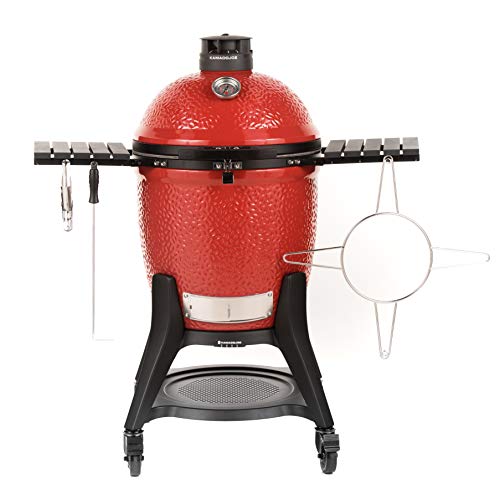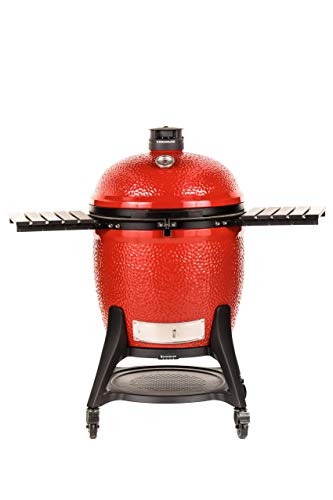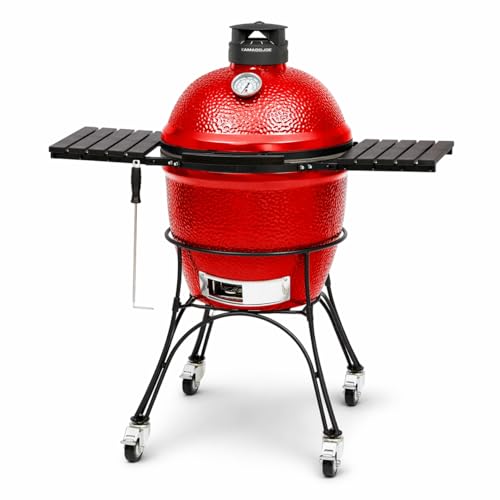
Which grill is behind the Amazon listing
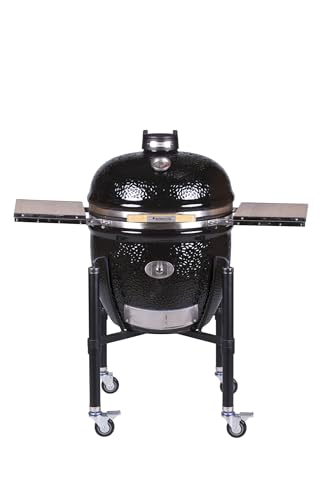
Amazon lists the model number 121001-BLACK under B095HXZPJG. Monolith sold the CLASSIC 2.0 in black under this item number, delivered with stand and side tables, as part of the Classic Pro series 2.0. That is what the manufacturer’s page says, as archived by the Internet Archive on 27 March 2025. It is a kamado: a charcoal grill with a ceramic body and lid, whose temperature you regulate via the intake and exhaust vents.
You can no longer get it new from Monolith. On 24 September 2026, the shop search for 121001 found nothing, and the old product address redirected to the homepage.
The TWO.55 (CLASSIC) with item number 121000.55 has taken its place. Monolith describes it as PRO series 2.0 with a design upgrade and lists four changes: a new stand made of powder-coated, galvanised steel, side tables made of light bamboo that sit directly on the stand, an optimised fit of the clamping bands, and new castors. Without a stand, the TWO.55 cost €1,799.90 in the manufacturer’s shop on 24 September 2026; the matching stand set (item no. 121009.55) is listed in the 2026 catalogue at €290.90. We also retrieved all other Monolith shop prices in this text on that day.
Matthias Otto founded Monolith Grill in 2008, and its headquarters are in Osnabrück. The grills are built in China, in the Yixing region. According to the manufacturer’s FAQ, Osnabrück is the headquarters and back office; nothing is sold there. An earlier version of this page spoke of German manufacturing, and that was wrong.
In our price box, the Classic 2.0 appears at approx. €1,849, the Amazon price from 24 September 2026; only the click shows you what Amazon charges today. You can find the other ceramic grills whose data we compare in the kamado overview.
Ceramic, fire box, stand
The product photo shows a round, upward-curved ceramic body in a black stand with four legs on castors. The side tables extend far out to the left and right at the height of the lid rim. They explain the outer dimensions: Monolith gives 120 x 120 x 71 cm for the grill with stand and side tables, and the 2026 catalogue breaks this down as width, height and depth. According to the same catalogue, a .55 grill without a stand is approx. 55 cm wide; by calculation, that leaves roughly 65 cm of the width for stand and side tables.
On weight, the Monolith sources contradict each other. The product page of the 121001 gives 84 kg with stand, and Amazon’s catalogue value converts to the same figure. The size overview in the 2026 catalogue, by contrast, lists the .55 models with stand at approx. 115 kg. We stick with 84 kg because this figure belongs to the specific item.
As material, Monolith gives ceramic, stainless steel and cast iron, and the fittings are stainless steel. The manufacturer describes the ceramic itself on the page for the TWO, that is, the PRO series 2.0 with the new stand: silicate ceramic with a mineral glaze, resistant to UV light and acid. The grate is Ø 44 cm.
On the lid sits a fibreglass seal with a stainless steel inlay and frame. Monolith considers this system lower-maintenance than a felt seal. At the top, a cast iron lid vent regulates the exhaust. Its slide system is meant to stop the setting from shifting unintentionally. The lid is not removable.
At the bottom of the body sits the fire box made of fireclay and stainless steel with an ash collection system. On the Classic, it is made up of five ceramic elements in a metal frame; according to Monolith, segments have less material stress and a lower risk of cracking. The combustion chamber also includes the fire ring, a cast iron charcoal grate and the split charcoal basket.
According to the archived product page, the box contains the stand, two side tables, the smoking rail with slider, the split charcoal basket, the 2.0 fire box, a grate lifter, an ash shovel and the 2.0 Smart Grid System with metal frame, two half-round drip trays, deflector stones and grates each, plus two SGS lifters. The manual additionally lists the air regulation cap, the fire ring, the charcoal grate, the lid thermometer, a bamboo handle, a fittings bag and the user manual, and on models with a stand also two bamboo side tables. It lists a pizza stone only as an accessory.
None of the Monolith sources we evaluated (product page, manual, FAQ, 2026 catalogue, data sheet) state:
- the wall thickness of the ceramic
- a cooking area in cm²; only the grate diameter is documented
- the interior height under the lid and the weight of the lid
- the measuring range of the lid thermometer
- a heat-up time to a given temperature
- a number of people
- charcoal consumption per hour at high temperature
- the load capacity of the stand and side tables
- a minimum distance in centimetres from combustible materials or hedges; the TWO.55 data sheet only gives, for installation in an outdoor kitchen, at least 520 mm from the back wall to the centre of the grill, without guarantee
- which fans and controllers run on the Classic 2.0’s adapter without the Guru Edition
- a year of market launch; all that is documented is that Monolith published the shop record of the 121001 on 11 March 2024
In detail: two zones from halved parts
Grilling directly means the food sits over the embers and receives their radiant heat from below. That is how you sear. Indirectly, it sits shielded, and the hot air under the closed lid cooks it from all sides, much like in an oven. In a kamado, the heat that the ceramic walls store and radiate back adds to this. Large cuts with long cooking times belong in this zone.
Monolith builds both zones from half parts. According to the manual, you separate the split charcoal basket with the charcoal divider, fill only one half with charcoal and light only that half. Together with a half deflector stone and a half drip tray, you then have a direct and an indirect zone in the grill at the same time. A deflector stone keeps the radiation away from the food above it, and a drip tray catches the fat before it runs onto the stone or embers.
The Smart Grid System holds the half parts in its metal frame, and a ring adjusts the height. Monolith answers how many levels this gives in two different ways: the manual speaks of up to five levels with half grates, four of them variable, the 2026 catalogue of up to four levels and up to three temperature zones.
In our comparison, this system is the Classic 2.0’s strongest point. A typical use for two zones is the reverse sear: a thick steak first cooks slowly on the indirect side to just below the desired core temperature and then briefly gets its crust over the embers. Our guide on direct and indirect heat explains how to split things up by food.
Low and slow: charcoal, vents, fan port
For the low-temperature range, the manual specifies 2.5 to 3 kg of charcoal for up to 24 hours. Monolith also puts consumption at 25 to 50 per cent of a conventional grill. In our assessment, the low demand comes down to the design: because the lid closes against a seal, the embers get only as much oxygen as comes in through the intake, and the ceramic keeps the heat in the cooking chamber.
The manual describes the procedure like this: light the charcoal from the top, close the lid, open the intake and exhaust fully. Once the target temperature is reached, you close the intake down to 1 to 2 cm. For low cooking levels, you do not let the temperature climb too high after lighting, because the ceramic stores the heat and the way from very hot back to low therefore takes time.
The fill height also depends on the goal. Without the basket, you fill the fire box at most up to the joint between fire box and fire ring; that gives the longer burn time for low temperature. In the basket, intended for medium and high temperatures, you fill at most up to below the opening of the smoking rail, and pieces that are too small do not belong at the bottom. A rule that protects the body comes from the manufacturer’s FAQ: if you use the basket, you put the charcoal grate underneath, otherwise stress cracks threaten in the base of the body.
You push wood chips, chunks or smoke pellets with the slider of the smoking rail through a flap directly into the embers with the lid closed, then pull the rail out and close the flap. Our guide smoking on the grill explains which wood suits which food.
For automatic regulation, the Classic 2.0 has an integrated controller-ready adapter to which a fan for temperature control is connected; the data field of the product page says “BBQ Guru: Ready”. Fan and controller are not included. The Monolith shop did not carry a controller when we retrieved it, but it did carry the Pit Viper 10CFM Blower for €79.90 and, for €12.90, a SmartControl Kill Plug for the Guru-Ready port.
The controller list from the Monolith FAQ only takes you so far, because it applies to the permanently installed fan of the BBQ Guru Edition. Named there are DigiQ DX3 BBQ Guru Edition, DynaQ and UltraQ, and externally also Flame Boss 400/500, FireBoard 2 Drive/Pro and Thermoworks Signals & Billows with adapter. Of these, the UltraQ can be controlled via the BBQ Guru app.
The BBQ Guru Edition is a separate model with a fan box on the side that is permanently integrated. According to the manual, you cannot retrofit this box: a fan installation of your own of this kind voids the warranty, and drilling into the ceramic can cause cracks.
Does the Monolith warranty apply when buying through Amazon?
Only if the seller is a dealer authorised by Monolith (section 6 of the warranty terms, list below). We could not document whether the Amazon seller of B095HXZPJG is one of them. Ask the seller or Monolith before ordering.
From its product pages, Monolith does not send anyone to Amazon. Neither the pages of the .55 models nor the archived page of the Classic 2.0 link there; the buy button leads to the company’s own shop in each case. Monolith lists its authorised dealers in a dealer directory on its own website.
The Limited Lifetime Warranty has applied since 1 January 2022. For the ceramic components, it runs for as long as the private first buyer owns the grill, for metal components five years, for grill tools and fold-down side tables one year, for the buggy and teak table two years. Monolith repairs or replaces at its own choice. Your rights are limited to this remedy by repair or replacement, compensation is excluded, and a repaired or replaced part is then covered only for the remainder of the original warranty. The warranty applies only in the EU and is tied to you personally. Your statutory warranty rights of at least two years remain unaffected; they are in principle directed against the seller, which on Amazon means the respective dealer.
Excluded according to section 6 of the terms are:
- commercial use
- wear or damage resulting from normal wear and tear
- consequences of omitted or faulty maintenance
- consequences of excessive or improper use
- wear parts, in particular seals
- consequences of improper storage or cleaning, for example with abrasive or caustic agents or tools
- damage from misuse or use for a purpose other than intended
- consequences of force majeure, vandalism, accidents or comparable events
- consequences of using parts or accessories from other manufacturers
- consequences of faulty installation
- defects in grills that were not bought from Monolith or an authorised dealer
- transport and travel costs as well as costs for assembly and disassembly
- damage that does not occur directly on the product, and other consequential defects
- modifications by which the grill is adapted to the standards of a country other than its original country of destination
The warranty lapses if you or third parties modify the product, if you keep operating the grill despite a functional or usage defect, and as soon as the first buyer no longer owns it.
Spare parts and accessories: what costs money later
Monolith itself recommends a cover in the manual. The cover .55 (CLASSIC) made of Oxford nylon fabric with UV protection costs €89.90 in the Monolith shop.
For the .55 (CLASSIC) spare parts, the range there runs from €29.90 for the bamboo handle to €249.90 for a complete Smart Grid System. In between are the replacement felt seal for €30.90, the thermometer for €37.90, the charcoal grate for €39.90, the smoking rail for €45.90 and the cast lid for €139.90. With the fire box, the segment design pays off: a single ceramic segment costs €36.90, the whole fire box €249.90.
We would order the seal only after checking with the item number 121001-BLACK. According to the shop, the replacement felt seal (item no. 201055-C) is a self-adhesive felt strip, cut to the exact length for body and lid of the .55 (CLASSIC). The archived product page of the Classic 2.0, however, describes the fibreglass seal with stainless steel inlay on the lid, and the manual mentions felt seals under the clamping rings.
Cleaning, care and safety
For the interior, water and other liquids are out: the manual says never to clean it with them. You clean the outside, stand and bamboo side tables only with water and mild detergent.
Inside, you burn the grill out instead (pyrolysis). To do this, you open the intake and exhaust fully, make sure there is enough charcoal in the grill and hold it at 400 °C for 10 minutes. Afterwards, you first lift the lid only a small gap and wait a moment, otherwise a flash fire threatens. The 2025 Quick Start Guide adds that you should take out the Smart Grid System beforehand, not go above 400 °C because the seal between body and lid can otherwise be damaged, and never leave the grill unattended during this. In Monolith’s web FAQ, 450 °C is given for pyrolysis. We stick to the 400 °C from the two instructions because the Quick Start Guide explicitly warns against more.
The cooking grates are stainless steel and, according to the manual, dishwasher-safe. They can discolour permanently from the high heat the grill can reach (temper colours). While hot, you brush them with a grill brush to remove coarse dirt and burnt-on fat, and use only suitable cleaning agents. You brush the charcoal grate and charcoal basket after pyrolysis; you occasionally rub the cast iron charcoal grate thinly with oil so that it does not rust.
The Classic has no ash drawer. After cooling, you shake the ash from the charcoal basket into the ash chamber of the fire box and take it out through the opening with an ash hook or ash shovel. Now and then, you take out all the parts and vacuum or sweep out the grill.
You regularly check the hex socket screws of the metal bands around body and lid and tighten them if needed. The assembly instructions give the reason: the felt seals under the clamping rings can contract during use. Replacing the stainless steel sealing ring is rarely necessary according to the manual. To do so, you lift the clamping tabs slightly without bending them open, take out the sealing strip and insert the new one in reverse order.
Monolith does not treat the inner ceramic darkening over time as a defect. Fine cracks in the glaze (crazing) arise during firing and, according to the manufacturer, are not grounds for a complaint. The manual compares them with glazed oven tiles: the less flexible glaze can thus go along with the ceramic body, which expands more, and the ceramic becomes more robust against breakage from temperature fluctuations. Deflector and pizza stones are open-pored, grease stains on them are harmless, and you may wrap the deflector stone in aluminium foil.
The safety chapter of the manual (PDF page 13), paraphrased and complete except for the paragraph on lids with tension springs, which applies only to the Junior and Icon:
- The grill belongs on level ground that can bear its high weight, and never in the direct vicinity of combustible materials.
- Operation in enclosed spaces is prohibited because there is a risk of suffocation; the location must be adequately ventilated. Because the exhaust air is also very hot, you do not place the grill under awnings, patio roofs or similar.
- To move it, you pull on the stand with both hands instead of pushing, otherwise it can tip. During operation, you do not move it at all. The castors are not designed for lawn, sand or gravel; for rough terrain, Monolith recommends the buggy.
- You keep children and pets away because of the risk of injury, and you do not leave the grill unattended.
- The exhaust vent is not suitable as a peephole, because the escaping air is very hot and can cause injury.
- You never extinguish charcoal with water. You close the intake and exhaust, and the embers suffocate.
- You insert or remove accessory parts only with grill gloves and suitable tools. You do not put hot parts down on combustible or delicate surfaces, and you make sure nobody is injured by them. You do not remove the fire box or charcoal basket with glowing charcoal in it.
- You lift the cooking grate with the supplied grate lifter and wear grill gloves while doing so.
- The outside gets less hot than on steel grills, but you can still burn yourself during operation.
- You do not leave the grill unattended, because flying sparks and hot exhaust air can ignite combustibles.
- Against flashback, you first open the lid during operation only 4 to 5 cm so that oxygen flows in slowly. The further the intake was closed, the stronger the effect. You wear gloves and stand to the side while doing so; if it happens anyway, you close the lid, intake and exhaust.
- Liquid or chemical lighters, petrol and methylated spirits are taboo. They can soak into the open ceramic and give the food a lasting off-taste.
- Before commissioning, you observe the local regulations.
These three kamados are the alternatives
All three have a slightly larger grate; the difference is 1.7 to 2 cm in diameter.
| Model | The difference | Price | Our rating | Choose this if |
|---|---|---|---|---|
| Monolith Classic (2.0) (this one) | Ø 44 cm, split charcoal basket with half deflector stones, smoking rail | approx. €1,849 | 9.5 | you can live with the smallest grate of the four and want to add smoking wood with the lid closed |
| Kamado Joe Classic II | 18 inches (45.7 cm), 2-tier Divide & Conquer, ash drawer | approx. €1,599 | 9.1 | two grate levels are enough for you and you would rather pull the ash from a drawer than shovel it out of the fire box |
| Kamado Joe Classic III | 18 inches (45.7 cm), 3-tier Divide & Conquer, SlōRoller insert | approx. €1,879 | 9.2 | you want the SlōRoller, which Kamado Joe promotes as an insert for smoking |
| Big Green Egg Large | Ø 46 cm, according to the manufacturer 1,688 cm² cooking area for 8 people | approx. €1,994 | 9.0 | a large choice of accessories matters to you (according to Big Green Egg, the largest among Big Green Egg models) |
The prices are the guide values we list in the respective reviews, with different collection dates and not up to date; the shop offers in their price boxes sometimes differ markedly from them. The rating is our editorial assessment; nobody measured it. We checked the grate dimensions and features of the three alternatives on the manufacturer pages of Kamado Joe and Big Green Egg on 24 September 2026.
When the Classic 2.0 fits and when it does not
First, the location decides. If you can only grill under a patio roof or awning, the Classic 2.0 is the wrong choice, because the manual rules that out. In our reading, we count a balcony with a ceiling above it among these coverings. On an open balcony, load capacity and space matter: reckon with the higher of the two weight figures above and with the full width including the tables. Whether structural engineering and house rules allow it is for the landlord or the owners’ association to decide.
Searing and long cooking both work: Monolith gives the temperature range on the page for the TWO and in the 2026 catalogue as 70 to 400 °C, while the manual gives 80 to 400 °C as the usable range. If you want it to hold the temperature itself over many hours, the extra purchase from the section on the fan port goes into the budget. According to the manual, you should not leave the grill unattended even then.
When heating up, the manual requires you to stay nearby: the grill can very quickly exceed 400 °C, and that can damage the seal and other components. Lighting it and mowing the lawn on the side is therefore a poor fit. The Grill Finder shows you grill types where you handle embers and vents less.
That leaves the question of the model, and for it, the dealer question from the warranty section is the precondition. As a reference value, there is €2,090.80, the sum of the TWO.55 and the stand set according to the Monolith prices in the first section; we have not, however, compared the scope of delivery of the two packages point by point. If the Amazon price is below that, the difference is the amount the four changes on the TWO.55 would have to be worth to you for you to go for the successor. If it is above, we would go for the current model, directly from Monolith or from a dealer in its directory.