The large Series III kamado
The Big Joe III is a kamado, that is, a charcoal grill with a ceramic body and dome. Its cooking area measures 61 cm in diameter, and the manual permits only charcoal as fuel. At Kamado Joe it is the large model line; the Classic III from the same series is the smaller one. Where the two sit among the other ceramic grills whose data we compare is shown in our kamado category.
It is sold in two versions. This review applies to KJ15041021, the grill in the powder-coated steel cart with folding aluminium side shelves. The standalone version KJ15040821 comes without the cart and shelves and is meant for a grill table or an outdoor kitchen. In the Kamado Joe shop for Germany and the EU, the price is €2,999 for the version with cart and €2,899 for the freestanding one (as of 1 October 2026). You cannot buy there: where the shopping cart would normally be, a button leads to the retailer search.
In our price box it appears at Santos Grills at approx. €2,999, listed there as KJ15041021 with cart (as of 2 October 2026). At Amazon we found only one listing, BJ24RHCI-A, colour Blaze Red, without a price; we do not link there. The manufacturer’s manual database also assigns BJ24RHCI to the Big Joe III. The Amazon description is puzzling with its galvanised steel cart. According to Kamado Joe’s series overview, galvanised is the cart of Series II, while for Series III it lists powder-coated steel.
If you want the cart, compare the model number on every offer; the EAN of the version with cart is 811738023106 in the manufacturer’s shop data set. Look just as closely at the retailer, because the manufacturer’s warranty depends on it (more on this below).
Assembly and what is included
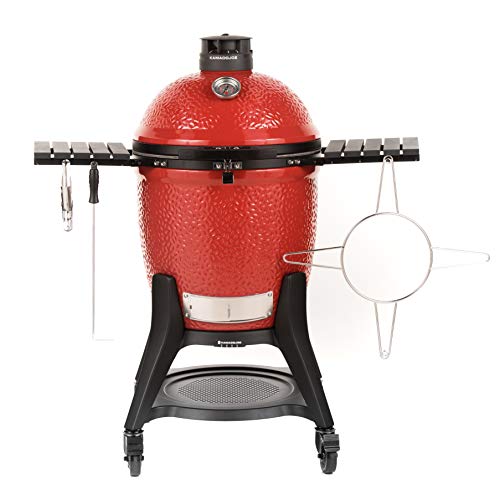
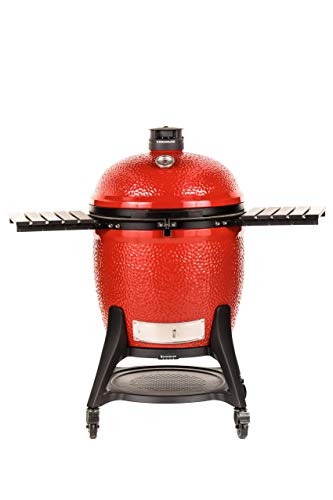
The product photo shows a red, egg-shaped ceramic body in a black cart on four legs with casters, with a round shelf at the bottom. On top sits the Kontrol Tower, at the front of the dome the thermometer, low on the body the cover plate of the ash drawer. At the height of the dome rim, the side shelves extend to the left and right. With them, the grill comes to 131.0 cm wide and 140 cm high according to Kamado Joe; the standalone version to 71.5 cm and 113.5 cm.
On weight, the manufacturer’s figures contradict each other. The product page states 184.3 kg with cart, the page of the freestanding version 183.8 kg. According to that, cart, two shelves and four casters would weigh half a kilo together, which we consider implausible. The same manufacturer’s shop data set says 201,849 g, the Amazon catalogue 445 lb, both around 202 kg. We use the 184.3 kg from the product page, but for transport and helpers we would plan with 202 kg.
The dome hangs on the Air-Lift hinge, which according to the German product page takes a considerable part of its weight off. The Amazon description speaks of 96 per cent and says one finger is enough to lift it. You adjust the spring tension with a 17 mm wrench on the nut at the top of the spring bracket, clockwise for easier opening, anticlockwise for heavier opening. You may only dismantle the hinge with the supplied unlatching tool, because according to the manual the spring is under extreme tension.
The dome is held shut by a stainless steel latch and sealed by a double-thick fibreglass gasket made of wire mesh. The Kontrol Tower regulates the exhaust. The US page describes it as dual-adjustable and made of powder-coated cast aluminium; the German page promises even air adjustment when opening and closing the dome.
The firebox consists, according to the parts list, of six AMP ceramic parts and a firebox base, plus a stainless steel firebox ring. The charcoal sits in a stainless steel basket that, according to the manufacturer, lets you quickly separate charcoal remnants from the ash, and the ash collects in the pull-out drawer. You grill on two half-moon stainless steel cooking grates. The carton also holds two ceramic heat deflector plates, the three-tier Divide & Conquer, an accessory rack, the SlōRoller, an ash tool and the set for unlatching the hinge. The cart consists of four legs, an upper and a lower plate and a front handle, and rolls on two lockable and two non-lockable casters. According to the parts list, only some models include four ceramic feet. You buy charcoal and wood chunks separately.
We looked for the following and did not find it in any manufacturer source (German and US product pages, shop data set, German manual, FAQ and warranty page):
- the depth with cart; Amazon lists 34 inches (around 86 cm) but also deviates from the manufacturer on width and height
- the space needed with the dome open and the height of the grate above the floor
- outer diameter and wall thickness of the ceramic, and the type and thickness of the glaze
- the area of each grate tier and the distance between the tiers
- design, measuring range and accuracy of the dome thermometer
- the material of the SlōRoller and the steel grade of the cooking grates
- burn time of one charcoal load, charcoal consumption per grilling evening and a number of people
- the load capacity of the cart and side shelves
- the dome weight and what the roughly 202 kg in the shop data set stands for
- what the suffix A in the Amazon model number BJ24RHCI-A means
- a connection for a fan or controller
- country of production and market launch; the only thing documented is that the product data set has been online in the manufacturer’s shop since 8 August 2019
- the service life of the gasket and the warranty period for the cart and SlōRoller
In detail: three tiers on 61 cm
For the grilling area, the product page gives two figures, 0.29 m² (450 square inches) in the specification table and 0.3 m² maximum cooking area in the feature list. The first can be checked by calculation: a circle of 61 cm diameter has π × 30.5² ≈ 2,922 cm², rounded 0.29 m². That corresponds to one full grate tier. The 0.3 m² is barely above that, and no more grate is in the carton either: the two half-moon grates together make exactly one circular area, and Kamado Joe expressly calls 0.3 m² the maximum cooking area. The three levels distribute this area over different heights.
The Classic III makes the size jump tangible. Its cooking area has a diameter of 45.7 cm and, according to the manufacturer, 0.16 m². The Big Joe III is a third larger in diameter, and because the area grows with the square of the diameter, you get a good three quarters more grate per tier.
The grate system is called Divide & Conquer. Grates and heat deflector plates are half-moons, the rack carries them on three levels, and according to the manufacturer, you can cook different foods at the same time at different temperatures. Behind this is the same two-zone principle as on a kettle grill. A ceramic heat deflector plate under one half of the grate shields the radiation from the charcoal, and what lies above it cooks in the hot air under the dome and in the heat that the ceramic walls give back. Over the open half, the radiation from the embers hits the food directly. The higher a tier sits, the less of it arrives at the top. Which zone suits which cut is covered in our guide to direct and indirect heat.
For smoking, you swap the two heat deflector plates for the SlōRoller, with the rack and grates on top. Kamado Joe describes it as a hyperbolic insert that guides the smoke around the food in rolling, recirculating waves and distributes the heat with fewer hot spots. For your planning, its approved range matters more: only for smoking and only between 65 and 149 °C; above that, according to the manual, it can cause damage to the product. Searing after smoking means, in our reading, taking the insert out of the hot grill beforehand. The manual describes no dedicated technique for this; for work on the grill and the fire, it requires protective gloves.
Lighting and controlling the temperature
No more than 4.53 kg of charcoal (10 lbs) may go into the main firebox, and you must never overfill the charcoal grate. On the Classic III the limit is 2.7 kg. You light with one or two fire starters, and only with firelighters conforming to EN 1860-3. The manual prohibits lighter fluid, petrol, alcohol and similar volatile liquids because they can explode. A few lines further down, it nevertheless explains how to handle lighter fluid, and the English original does the same. We advise sticking with the prohibition.
When lighting, the dome stays open and you do not lean over the grill. Dome and lower vent stay fully open for 10 minutes; once the charcoal has caught, you close the dome. Until the temperature is stable and the ceramic has heated up, Kamado Joe allows 20 to 60 minutes. You may only start cooking once the charcoal carries a layer of ash, and the fuel should glow for at least 30 minutes before the first cook.
When you begin to throttle back is given in the German manual in two units that do not match: at less than 10 °C from the target temperature, with 50 °F in brackets. As a temperature, 50 °F is indeed 10 °C, but as a difference it is just under 28 °C. The conversion mixed up the two, already in the English text. Our guide using a kamado properly sets 20 to 30 °C before the target.
You regulate through the air. The manual boils it down to two formulas: more air, more heat, and the more charcoal burns, the hotter the grill can get. An adjustment of the vents takes effect only after 10 to 15 minutes. Because ceramic stores heat, you should raise the temperature in small, slow steps; raising the heat slightly is much easier than bringing it back down after overshooting. At the top end, 398 °C (750 °F) is the limit, and the manual expressly prohibits more.
Above 175 °C, every opening has a preliminary step. You lift the dome carefully and slowly by 5 to 8 cm and let the grill “burp” for about 5 seconds. This is meant to prevent a flashback, a white-hot surge of heat. The German version attributes it to a lack of oxygen, the English original to inflowing oxygen, and technically the original is right: with throttled air, unburnt gases collect under the dome and ignite suddenly as soon as fresh air arrives.
When the cook is finished, you close the lower vent completely and clean the still-hot grates with a grate scraper or a damp cloth. The upper vent follows when the temperature falls below 205 °C. Covering, cleaning, moving and storing only come into question below 45 °C.
Which Big Joe suits you: II, III or Konnected Joe?
Our assessment: for a €1,000 premium over the Big Joe II, you get the third tier, the SlōRoller, the stainless steel basket and aluminium shelves. If you rarely smoke, the Big Joe II is the better deal. You choose the Konnected Joe if fan and app matter more to you than the last 27 °C of peak heat.
The Big Joe II (BJ24RHC) costs €1,999 in the Kamado Joe shop (as of 1 October 2026). Kamado Joe states the same values as for the Big Joe III for cooking area, grilling area and temperature range, but its Divide & Conquer has two levels. In its column of the series overview, neither SlōRoller nor stainless steel basket appears, the cart there is galvanised steel and the side shelves are HDPE. Its own product page, by contrast, describes the shelves as powder-coated steel; which statement is correct cannot be decided from the outside. At 148.0 cm, it is according to the manufacturer 17 cm wider and 4 cm lower than the Big Joe III and, at 184.8 kg, weighs practically the same.
The Konnected Joe in Big Joe size (KJ15042525) is listed by the same shop for €2,899. It has an automatic fire starter, a digital Kontrol Board, a digital fan and an app connection via Wi-Fi. According to the manufacturer, its temperature range ends at 371 °C, its Divide & Conquer has two levels according to the FAQ, and at 155 kg it is the lightest of the three.
What else comes into question?
| Model | The difference | Price | Our rating | Choose this one if |
|---|---|---|---|---|
| Kamado Joe Big Joe III (this one) | Ø 61 cm on three tiers, SlōRoller and cart included | approx. €2,999 | 9.1 | you want to cook on three grate heights at once and smoke with the SlōRoller, and do not need to move the grill after assembly |
| Kamado Joe Classic III | Same Series III equipment, but grate Ø 45.7 cm and 127.3 kg with cart | approx. €1,879 | 9.2 | a 46 cm tier is enough for you and you want to move around 57 kg less |
| Big Green Egg XLarge | Also grate Ø 61 cm, 99 kg according to Big Green Egg; further tiers and side tables are available as accessories | approx. €2,799 | 8.9 | you want to set the 61 cm kamado into a table or outdoor kitchen and choose the accessories after your own setup |
| Monolith Classic 2.0 | Grate Ø 44 cm, controller-ready adapter for a fan (fan not included) | approx. €1,849 | 9.5 | a 44 cm grate is enough for you and you want to automate long cooks later with a fan and controller |
The prices are the guide prices from our reviews, for the Big Joe III the price in the Kamado Joe shop (as of 1 October 2026). The rating is our editorial assessment based on the manufacturer’s data; we have not had any of the four grills in our hands.
Spare parts and warranty
For the Big Joe size, the Kamado Joe shop lists spare and accessory parts under their own numbers (prices as of 1 October 2026). The fibreglass gasket BJ-MGA24, fitting Series II and III, costs €79.99, the stainless steel charcoal basket BJ-MCC24 €159.99. Two half-moon deflector plates (BJ-HDP) are available as a set for €94.99, a single half-moon cooking grate (BJ-HCG) for €69.99. The aluminium side shelves (BJ-Alumn) are listed at €169.99, a ceramic pizza stone (BJ-PS24) at €44.99. Parts for the cart, casters and ceramic base of the Big Joe III we found only in the US shop; whether they are also available in Europe remained open. There, the grill base BJ-CB24RCI costs $637.99, and it also lists wheel and leg sets for the cart.
Kamado Joe graduates the warranty by component. We give the terms from the manual; according to the manual they can change, and the current version is on Kamado Joe’s warranty page. The most important ceramic parts are covered for as long as the original buyer owns the grill. For important metal and cast iron parts, five years apply, for electronic components three; the heading of this item additionally names heat deflectors and pizza stones, the text below it only the electronics. All other components and Kamado Joe accessories have two years, expressly including thermometers, gaskets and the iKamand controllers. On the website, by contrast, the series overview speaks across the board of a lifetime manufacturer’s warranty.
It can only take effect if you buy from a retailer authorised by Kamado Joe and register the grill on the product registration page; for that you need a copy of the proof of purchase. It begins on the purchase date and applies only to the original buyer. In a warranty case, Kamado Joe replaces or repairs the part at its own discretion and pays the shipping of the warranty parts; the warranty does not cover labour costs. According to the terms, your exclusive remedy is limited to replacement, and Kamado Joe is not liable for special, incidental or consequential damages. Excluded are damage from abusive or improper use, from improper use, assembly, maintenance or installation, from accidents or natural disasters, from unauthorised additions or modifications and from transport, plus normal wear such as scratches, dents and chipping and cosmetic changes with no effect on performance. Commercial users, which the terms list as caterers, butchers, rental companies and food trucks, get one year on all parts, ceramic dome and base included. The warranty does not affect your statutory warranty rights.
Setting up and caring for it safely
The warnings begin with carbon monoxide. According to the manual, it is produced when wood chips, wood chunks, wood pellets, charcoal or propane burn, is colourless and odourless and can be fatal. The grill therefore belongs only outdoors in a well-ventilated place, never in houses, vehicles, tents, garages, caravans, motorhomes, boats or other enclosed or habitable spaces, and you must never use it as a heater. If you develop cold-like or flu-like symptoms while grilling, the manual sends you to a doctor because poisoning is easily mistaken for them.
Around the site, the manual requires 3 m clearance from the back, sides and top of the grill to roof structures, walls, rails and other combustible building materials, as well as 3 m to combustible materials such as wood, plants, grass, brush, paper, petrol or canvas (the German version says on PDF page 76 by mistake “in the vicinity of combustible materials”, the English original “away from”). It must never burn under roofs, carports, awnings or overhangs. In the warnings section, even patios are listed alongside garages, buildings and tents as enclosed spaces in which the appliance must never run. The ground must be level, stable and non-combustible, such as soil, concrete, brick or rock; asphalt may not be suitable according to the manual, wooden and combustible surfaces are excluded. The grill must stand on the ground, not on tables or counters, with sufficient wind protection and protected from draughts and dripping water such as rain. In strong wind it stays off.
You should always keep a fire extinguisher within reach when grilling, and when cooking with oil or fat, one of type BC or ABC. If oil or fat catches fire, you never extinguish it with water but call the fire brigade immediately; according to the manual, a BC or ABC extinguisher may be able to contain the fire in some circumstances. Independent of the manual, the general rule is: burning cooking oil and cooking fat form fire class F in Europe, for which there are dedicated fat fire extinguishers. According to the manual, you should read all warnings before you assemble and use the grill. Some of them concern the kamado in particular: you do not cover the grates with metal foil, because that traps heat and can damage the grill. Cookware made of glass, plastic or ceramic never goes in, and neither does empty cookware during operation. You do not pour liquids into or onto the hot grill, and you do not put anything hot on the side shelves. You keep children and pets away, and children must not operate the grill.
After every cook, you wait until the grill has cooled completely and the charcoal is fully extinguished. With the ash tool you stir up the remaining charcoal, the loose ash falls through the basket into the drawer, and you pull that out. You wrap cold ash in aluminium foil, soak it with water and dispose of it in a non-combustible container. On the outside you wipe with a damp cloth. You do not scrub the gasket too hard, otherwise it can be damaged; kept clean, it holds the heat in while grilling, according to the manual. Dirty heat deflector plates you turn dirty side down for the next fire. Last, the grill cover goes over it, and the grill stands cool and dry.
Once or twice a year, the manual provides for a more thorough clean. For that, you remove the internal parts and clear ash and residue from between the body and the fittings. You brush the ceramic inside with plastic bristles and shovel or vacuum out the base. You wipe the hinge and the outside, then put everything back in.
Who is it suitable for?
First, space decides. By our calculation, you need a free width of a good 7.3 m: 131.0 cm of grill including side shelves and 3 m clearance on each side. Add 3 m to the back, and nothing may hang above the 140 cm high grill up to around 4.40 m. A balcony under the next floor is ruled out under these rules. Which type of grill fits instead is what the grill finder asks in four questions on fuel, budget, place of use and number of people. If there are steps between the garage and the grilling spot, it needs a place where it can stay permanently, because according to the manual it must not be rolled over stairs.
The standalone version is meant for an outdoor kitchen. The warnings section wants the grill on the ground and not on tables, but the manual describes installation in a separate section. There it requires a table fixed to the floor or wall made of non-flammable materials that withstand high temperatures. The ceramic feet from Kamado Joe belong under the grill so that an air gap remains; it must not sit directly on the tabletop. The ash drawer must be accessible from the front, and the tabletop must not touch the grill. The manual’s dimension table has no unit, so we do not adopt any values from it, and Kamado Joe strongly recommends measuring the built-in grill yourself anyway.
Commercial use is ruled out. The manual intends it only as a household appliance for outdoor use and expressly excludes commercial use, so it is not meant for catering, rental or a food truck. That the warranty part of the same manual nevertheless promises commercial users one year is a contradiction by the manufacturer.
Anyone who likes to modify or retrofit accessories from other brands, such as a fan with a controller, is also wrong here. The manual prohibits any modification of the grill and advises against accessories not made by Kamado Joe because they can cause injuries.