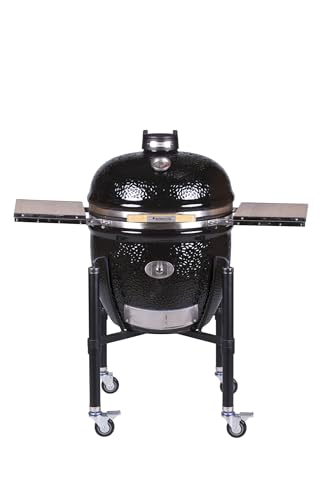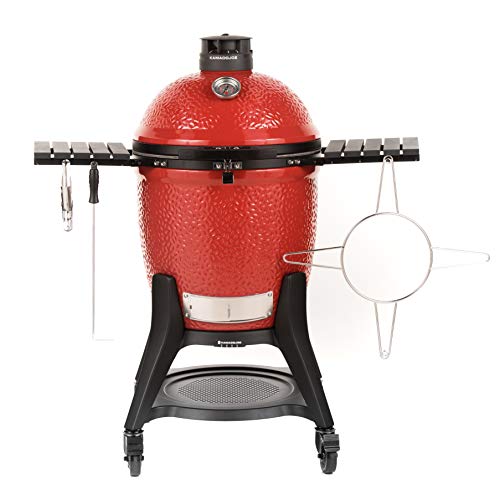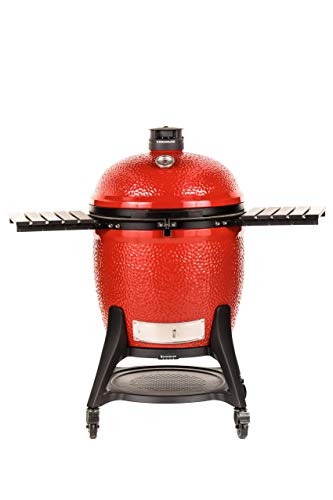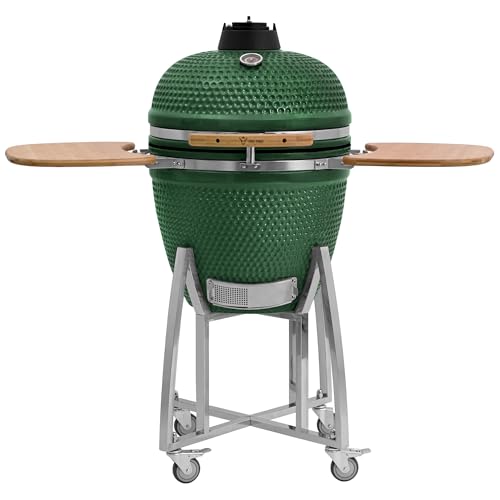
One kamado in four colours
BBQ-Toro sells the KURO with Ø 52 cm as a single product page on which you choose between grey, dark green, red and black. This review covers the green version on Amazon (ASIN B0DFHG9793). Amazon writes “Green”, the manufacturer “Dark green”, and the part number KAMA21GRUE belongs to this colour on both pages. In the manufacturer’s pages that we searched, there is no link to Amazon; we therefore conclude from the title, colour and part number that both mean the same device.
The manufacturer calls it “Kamado charcoal grill KURO, Ø 52 cm, incl. shelf, thermometer”. According to the legal notice, the brand is run by CS-Trading GmbH & Co. KG of Brauneberg, which also operates the manufacturer’s shop. On Amazon, a marketplace seller called CS Trading sells and ships it; the name matches the company behind the manufacturer’s page. About itself, BBQ-Toro writes that it has been active in online retail for several years and now carries more than 100 items under its own brand.
In the kamado range, the KURO sits between the Shiro (Ø 39 cm) and the Yoru (Ø 56 and 62 cm); below that is the HAIIRO with Ø 32 cm. A second KURO with Ø 46 cm is offered by the manufacturer only in grey, red and black.
In our price box, the grill appears at approx. €720 (as of October 2026). Amazon and the manufacturer’s shop asked the same amount on 14 October 2026. What the other colours cost is in the FAQ.
Dimensions, weight and delivery
With both bamboo shelves, the KURO measures 130 cm wide, 70 cm deep and 122 cm high; without the shelves, 70 × 70 × 122 cm. Each shelf is 30 cm wide and 50 cm deep, folding and removable. The manufacturer’s dimension drawing also gives a working height of 88 cm. As the outer diameter, the page gives 49 to 54 cm, and as the nominal size of the kamado Ø 52 cm.
The product photo shows an egg-shaped green body in a stainless steel frame that is joined at the bottom by a cross brace and runs on four castors. The bamboo shelves are attached to the left and right of the body.
According to the manufacturer, the grill weighs approx. 77 kg. Two of the four castors can be locked.
It is delivered by freight carrier to the kerb; the carrier calls beforehand and agrees the appointment. In the manufacturer’s shop, delivery takes 2 to 6 working days, within Germany without shipping costs. You organise the way from the kerb to the spot yourself.
On the manufacturer’s page, the highlights list of the KURO Ø 46 cm repeats the values of the 52 cm model, including diameter and weight. It is not suitable for dimensions, so we stick to the page of the Ø 52 cm model.
Ceramic, grate and lid
Body and lid are made of ceramic, according to the manufacturer a thick-walled shell that stores heat; no wall thickness in millimetres is given. The surface is glazed “with crackle”. This is meant to make the ceramic more robust against temperature fluctuations and less prone to breaking, and to protect it from scratches and knocks; that is how it appears on the page, as a manufacturer claim.
According to the manufacturer, the lid is airtight and spring-loaded, and the handle is made of wood. Ventilation is through vents at the top and bottom. In the photo, we see a black cap on the lid and a metal flap at the front of the lower section for this, in our reading the two vents. The thermometer sits at the front of the lid.
In the lower section there are a removable ceramic bowl and a charcoal grate. Above that goes the stainless steel cooking grate; it is folding, which according to the manufacturer makes adding fuel easier.
In detail: how a kamado holds and regulates heat
Ceramic is a heat store. A kamado therefore heats up more slowly than a kettle grill made of sheet steel, but in return releases the stored heat slowly, and every change in temperature arrives with a delay, both upwards and downwards.
Control is by air. The lower vent lets fresh air to the embers, the upper one lets the hot gases escape; the further both are open, the hotter the charcoal burns. The manufacturer calls this draught the chimney effect. According to the manufacturer, the charcoal burns effectively as a result, and significantly less of it is needed.
The same effect has a downside, which BBQ-Toro warns about: when the lid is opened, the chimney effect can cause flare-ups, and the lid should be opened slowly and carefully. In the kamado scene this is called a flashback. The common explanation: unburnt gases collect in the closed grill, and when it is opened, oxygen rushes in and ignites them. How to lift the lid for this is covered in the guide Using a kamado properly.
Direct or indirect? If the food sits above the embers, it gets the heat from below; this is how you grill steaks. Indirect means a heat shield sits between the embers and the food, and the closed kamado works like an oven. With the KURO, the heat shield is not part of what is in the box. The manufacturer describes its deflector stone as exactly this shield and sells it separately (see accessories below). How to use both zones is explained in the guide Direct and indirect heat.
According to the manufacturer, the lid thermometer shows 10 to 425 °C, in Fahrenheit up to 800 °F. Because it sits in the lid, it measures the air up there, not the food and not necessarily the temperature at grate height. For the core temperature of meat, you need a separate probe thermometer. BBQ-Toro calls the thermometer “reliable”, but gives no tolerance, design or calibration; we treat the display as a guide.
How big is the cooking area?
Ø 47 cm, not 52: that is how the grate is stated on the manufacturer’s page, while 52 cm is the nominal size of the kamado. A round grate of Ø 47 cm works out at around 1,735 cm² (our calculation, not a manufacturer figure).
The page writes “Ø 47” without a unit; we read this as centimetres, because the body is Ø 52 cm. BBQ-Toro does not state a cooking area in cm², nor a number of people. If you plug in the grate dimensions of the alternatives from the table further down, the grate of the Kamado Bono Grande Limited is around a third larger than that of the KURO by circular area, and that of the Monolith Classic (2.0) around 12 per cent smaller. The Grill finder asks, among other things, for the number of people if you want to narrow down models to your group.
What is in the box, accessories and what is missing
According to the manufacturer’s page, the box contains a kamado grill with a stainless steel base frame on four castors, two side shelves, a charcoal grate, a cooking grate and a protective cover. The list does not include a deflector, pizza stone, charcoal, firelighters, gloves or a tool for the ash.
The manufacturer also lists these parts for kamados with Ø 52 cm (prices in the manufacturer’s shop, as of 14 October 2026):
- Deflector stone Ø 36 to 46 cm (RFL1), expressly for the KURO, €34.95. It serves as a heat shield between the food and the embers.
- Cast iron grate, enamelled, 47 × 23.5 cm, 1 cm thick (KAGR1), €34.95.
- Reversible cast iron plate with ribs and a smooth side, 46.5 × 23 cm, 1.5 cm thick (KAGP2), €44.95.
- Glass fibre sealing tape, self-adhesive, 4 m, heat resistant up to 350 °C (GFG21), €34.95. According to the manufacturer, it improves the seal between the grill body and the lid.
- Smoker system with up to three cooking levels (SMOKE8), €109.95; what it includes is in the pizza FAQ.
This information is missing on bbq-toro.de and on Amazon:
- Operating or assembly instructions and data sheet; the site has no download area, and the safety notes appear only as a “Product safety” paragraph on the product page
- Minimum clearances in centimetres or metres to walls, roof and flammable materials; suitability for balcony, covered area, terrace or wooden deck; wind protection
- A manufacturer warranty of its own with duration and scope, including for the ceramic
- Wall thickness and type of ceramic, number of glaze layers, inner diameter, cooking area in cm², number of people
- Maximum operating temperature (the 425 °C is only the scale of the thermometer), heat-up time, burn time per fill, charcoal quantity and consumption
- Accuracy, design and calibration of the lid thermometer
- A seal on the lid rim from the factory, with material and service life
- Ash system, cleaning and care, burning in before first use, overwintering and weather protection beyond the protective cover
- Stainless steel grade, tube thickness and load capacity of the frame, size and material of the castors, suitability for lawn, gravel or wood
- Weight of the lid, height with the lid open, packaging dimensions, assembly time and number of people for assembly and lifting
- Temperatures and times for pizza, smoking and low-temperature cooking
- Permitted fuels in detail (lump charcoal, briquettes), compatibility with third-party accessories and a spare parts list
- The year of market launch and the country of origin; on Amazon it says China, maintained by the seller
Safety and care
The safety notes appear as a “Product safety” paragraph on the product page. There are twelve statements, given here in full:
- The kamado grill is intended exclusively for grilling, cooking and smoking food outdoors.
- Not suitable for use in enclosed rooms or poorly ventilated areas: danger of suffocation and carbon monoxide.
- Before every use, check for an undamaged condition, in particular the ceramic housing, cooking grate, hinges, seals, vent controls and base.
- Operate the grill only on a level, stable, heat-resistant and non-flammable surface and keep sufficient distance from flammable materials.
- During operation, the ceramic, lid, cooking grate and charcoal become very hot: risk of burns.
- Touch hot surfaces only with heat-resistant gloves and suitable grilling tools.
- Be careful when opening the lid: the chimney effect can cause flare-ups; open the lid slowly and carefully.
- Never operate the grill unattended.
- Do not use flammable liquids or unsuitable lighting aids.
- After use, let the charcoal burn out completely and let the grill cool down completely before cleaning, transport or covering.
- Children must not operate the kamado grill and may only be near it under supervision.
- Do not continue to use in case of cracks, chipping of the ceramic, defective seals, unstable stance or other damage.
The page says nothing about care, and we do not transfer the care rules of other kamado makers to the KURO. Before you let water or cleaning agents near the ceramic and glaze, we would therefore ask the manufacturer’s service. By its wording, the cooling note also applies to the cover: the protective cover from the box goes onto the grill only once it has cooled down completely.
What else comes into question?
The Kamado Bono Grande Limited costs €479 more than the KURO, the Kamado Joe Classic II €879 more and the Monolith Classic (2.0) €1,129 more.
| Model | The difference | Price | Our rating | Pick this one if |
|---|---|---|---|---|
| BBQ-Toro KURO Ø 52 cm, green (this one) | Grate Ø 47 cm, castor frame, deflector not included | approx. €720 | 8.2 | you want ceramic for little money and will add the zones yourself later |
| Kamado Bono Grande Limited | Grate Ø 54.5 cm, two-zone system in the base set | approx. €1,199 | 8.3 | you regularly grill for larger groups and have the route for a much heavier grill |
| Kamado Joe Classic II | Divide-and-Conquer grate system with two half-moon grates and two heat deflector plates is part of the set | approx. €1,599 | 9.1 | you want direct and indirect zones without extra purchases |
| Monolith Classic (2.0) | Connection for a fan, grate Ø 44 cm | approx. €1,849 | 9.5 | you want to regulate low-and-slow cooking by fan later and can secure the purchase through an authorised dealer |
The prices are the guide values from the respective reviews, with different recording dates and not up to date to the day; the rating is our editorial assessment and not a measurement result. The grate dimensions of the alternatives come from the manufacturer information that we evaluated for their reviews. The Monolith Classic (2.0) has been delisted by the manufacturer, and the successor is called TWO.55. You can find more ceramic grills in the kamado overview.
When the KURO suits you and when it does not
First ask yourself how much time you have before the meal. A kamado does not heat up at the push of a button; the ceramic needs a lead time. If you want to grill spontaneously after work, you would, in our assessment, be better served by a gas grill.
Next, what goes on the grate counts. Steaks and chops sit directly over the embers, and that works with the KURO straight from the box. For indirect cooking, that is whole ribs or roasts, the heat shield is missing; the manufacturer offers the deflector stone for this. With it, you end up at around €755 for grill and shield, charcoal and firelighters not included.
Running costs cannot be calculated. BBQ-Toro promises significantly less fuel thanks to the chimney effect, but gives no consumption in kilograms per grilling evening. Which charcoal suits which use is explained in the guide Lump charcoal or briquettes.
For the location, weight decides. The castors help with moving it, but if you want to put the grill away after every use, you need a lighter device. If you rent and have no garden of your own, read the balcony FAQ and our guide Grilling on a balcony before buying.
The KURO is wrong for anyone who wants to grill for large groups in one go: with the grate from the section on the cooking area, we would then reach for a larger model. It is also wrong for buyers who expect an explicit manufacturer warranty on the ceramic.
Our assessment: if you have a fixed spot, mainly grill directly and buy the deflector later, the KURO gets you the kamado with the lowest price in the table above.