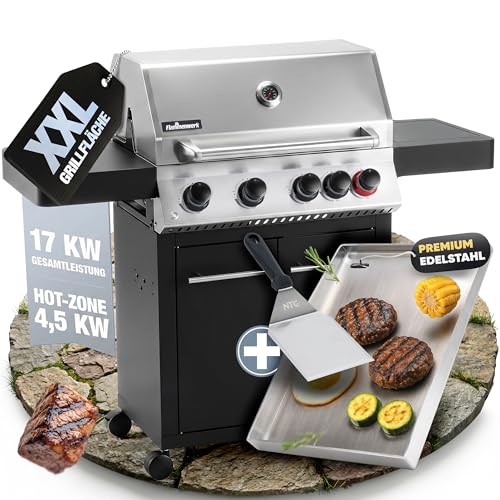
The Flammenwerk Profi 4+1 is a gas grill cart with four main burners under the hood and a fifth burner as a side burner. The brand belongs to NTG Nutzfahrzeug Technik GmbH from Porta Westfalica, a company whose core business is commercial vehicle parts and which sells a small outdoor line under the name Flammenwerk. In our Gas grills category it sits at approx. €450 (Amazon page on 20 October 2026: €449.99).
Our sources are thinner than for the big brands. Everything here comes from the NTG online shop, from the Amazon catalogue (retrieved 5 October 2026) and from the product photo. The addresses flammenwerk.de and flammenwerk.info are parked domains, no data sheet exists as far as our search shows, and neither does an instruction manual. So there is information on burners, grate and features, but next to nothing on safety and care. That determines how we place the grill in the end.
Burners, grate and hood: the details in the manufacturer’s shop
The total output is stated clearly: 17.0 kW from four main burners and one side burner. On the split, however, the shop page contradicts itself. Under the technical data are main burners at 3.5 kW each and a side burner at 3.0 kW, and the Amazon listing says the same. Further up, the same page lists three main burners at 3 kW each, a fourth as a hot zone at 4.5 kW and a side burner at 3.5 kW.
Both calculations add up to 17 kW. The product image at Amazon carries the print “Hot-Zone 4.5 kW” and so supports the second version without disproving the first. This cannot be resolved from the outside, and if you are buying the grill precisely for a stronger searing zone, you should ask the seller.
The grill runs on propane or butane at 50 mbar, the pressure usual for gas grills in Germany. Grilling takes place on modular cast-iron grates measuring 70 x 40.6 cm, which gives around 2,842 cm². Above that hangs a stainless steel warming rack of 67 x 12.5 cm, so another good 838 cm² for bread rolls or finished food. Between the burners and the grate sits an enamelled flame guard: fat drips onto this cover, partly vaporises there and does not reach the burner ports directly.
The hood is built double-layer from #430 stainless steel, with an insulated inner panel. #430 is a ferritic chromium steel without nickel, magnetic and cheaper than the common type 304. It rusts more slowly than plain steel but sooner than 304, especially in salty air or when water stands on the surface for a long time. The side panels and the doors of the base cabinet are powder-coated. The wording “made of stainless steel” in the Amazon listing is therefore true of the hood and only partly true of the cart underneath.
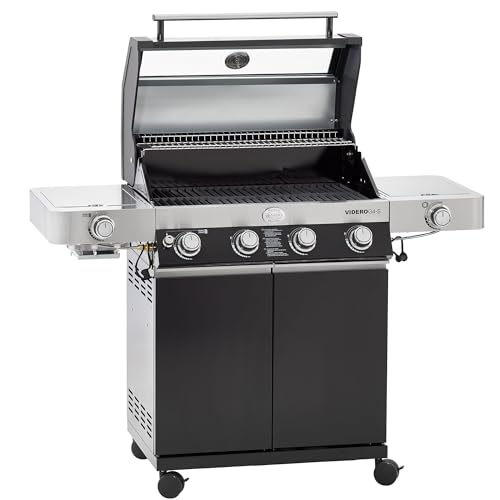
The control panel has continuously variable knobs with switchable blue LED lighting, and ignition is by piezo. The hood holds a thermometer with a °C scale on a black background. On the left and right are fold-down side shelves, and below is a cabinet with two doors in which, according to NTG, the gas bottle and accessories fit. The cart rolls on four castors, two of them with brakes. NTG gives the weight as 51.50 kg, the Amazon catalogue as roughly 50 kg when converted. As dimensions, Amazon gives approx. 138 x 52.7 x 113.6 cm (width, depth, height) and does not say whether that is the assembled grill or the carton. The colour is listed as black, silver.
In detail: what 17 kW means on this grilling area
A kW figure on a gas grill is the nominal heat input: how much energy per hour flows into the burners as gas. It is not a temperature. How hot it gets at the grate also depends on how tight the hood is, how air moves through the cooking chamber and how the flame meets the flame guard.
Still, the number is useful for a comparison if you relate it to the area. Depending on the shop details, the four main burners account for 14 kW or 13.5 kW. Spread over 2,842 cm², that is just under 5 watts per square centimetre. According to Weber, the Weber Spirit II E-310 manages 7.0 kW on 2,314 cm² of main grilling area, which is a good 3 watts. Per area, the Flammenwerk therefore has around 60 percent more burner output.
There is a catch in the type of gas. Weber writes in the Spirit’s manual that the same grill reaches 7.0 kW with propane and 8.4 kW with butane, because butane contains more energy per volume. For the 17.0 kW, NTG does not say which gas the figure refers to. If it refers to butane, the gap to Weber shrinks.
What the four separately controllable main burners bring in practice is the division into zones. If the two outer burners are lit and the middle ones stay off, there is an area between them with no flame underneath, in which a roast cooks indirectly under a closed hood. A double-layer, insulated hood loses less heat to the outside than a single sheet of metal, so the cooking chamber holds its temperature more easily on a small flame. How to work with both zones is explained in our guide to direct and indirect heat. For roasts with a target core temperature you also need a probe thermometer, because the hood thermometer measures the air at the top under the lid and not the meat.
If the hot zone version is correct, one of the four burners has 4.5 instead of 3 kW, so half as much again. That would be the spot for searing steaks hard. NTG names no separate component for it such as an infrared burner; it would be a stronger burner of the same design.
Do you really need the side burner?
If you also work with a pot or pan at the grill, yes. Amazon names sauces, side dishes and pan dishes as the purpose, and the burner has 3.0 or 3.5 kW depending on the source. For plain food from the grate you do not need it, and then you pay for a burner that stays cold.
For comparison: for the side burner of the Monroe Pro 3 SIK Turbo Shadow, Enders gives 2.9 kW, plus a pot diameter of 14 to 24 cm and flame monitoring by thermocouple, which shuts off the gas if the flame goes out. For the Flammenwerk, both details are missing. Whether a wok or a large pasta pot stands safely on the cooktop can therefore only be checked on the unit itself.
The side burner hangs on the same bottle as the main burners. If it runs alongside a fully fired grill, all five burners draw the full 17 kW together, and the bottle empties correspondingly faster.
What NTG leaves open
Here the gaps are in one place, so you do not have to search for them throughout the text. Unresolved are: the maximum temperature and the heat-up time, the gas consumption in grams per hour, the material of the burners and of the side burner, whether the cast-iron grates are enamelled or raw, how the fat is collected (tray, material, position), what the side shelves are made of, the dimensions with the shelves folded and the working height, whether a hose, pressure regulator or a cover are included, the appliance category and the approval under the EU Gas Appliances Regulation 2016/426, the country of origin, the year of market launch, a manufacturer warranty and whether spare parts can be bought. Some of these sound minor. Raw cast iron, however, rusts without oiling, and without a known appliance category you do not know for certain whether the nozzles are designed for propane and butane alike.
Setting up, connecting, cleaning: without a manual
Because we found no manual, we do not quote any manufacturer rule here. What follows are general rules for gas grills, and they do not replace the manual. Before you connect the grill for the first time, we would ask the manufacturer for the assembly and operating instructions. The EU Gas Appliances Regulation requires that a gas appliance is delivered with instructions and safety information in the language of the country where it is sold.
In general: a gas grill belongs outdoors, not in a garage, tent or conservatory. After every bottle change and after a long period of standing, you check the connections with leak-detection spray or soapy water; if bubbles form, the valve stays closed. The bottle stands upright, the hose must not kink and must not rest against hot parts. A porous or cracked hose is replaced. Which bottle sizes exist and what matters with the regulator is covered in the guide Gas bottle for the grill.
When cleaning, a lot depends on a detail that is missing: you burn off raw cast-iron grates after grilling, brush them and oil them lightly, while enamelled ones do not tolerate harsh treatment that makes the enamel chip off. Until you know which kind you have, a brass brush is the more careful choice. You wipe the #430 hood dry after it has cooled so that no water stays on it. A cover only goes over the cold grill. The steps for burners and grease tray are described in our guide to cleaning a gas grill.
What else comes into question?
| Model | The difference | Price | Our rating | Choose this one if |
|---|---|---|---|---|
| Flammenwerk Profi 4+1 (this one) | Side burner and a lot of burner output per area, but no manual online | approx. €450 | 8.7 | you want a side burner and a large area and can manage without a manufacturer manual |
| Weber Spirit II E-310 | 3 burners, no side burner listed, 10-year voluntary warranty | approx. €459.99 | 9.2 | warranty and spare parts matter more to you than a fifth burner |
| Weber Spirit E-410 | 4 stainless steel burners, 2,761 cm² main grate, manual with clearance and gas rules | approx. €548 | 8.9 | you want four burners and need a documented setup rule |
| Enders Monroe Pro 3 SIK Turbo Shadow | Turbo zone with infrared mesh, infrared back burner, side burner | approx. €599 | 8.8 | you are looking for a documented high-output area for searing |
The prices are guide values from our price boxes and change. The rating is our editorial assessment based on the manufacturer data; we have not measured anything on any of these grills.
According to our price box, the Weber Spirit II E-310 costs approx. €459.99, the Flammenwerk approx. €450. The Weber has one burner fewer and about half as much output on the main burners. In return you get a manual with gas consumption and safety rules and a voluntary warranty, which Weber staggers by component. That explains why it ranks ahead in our rating even though it looks smaller on the data sheet.
The Weber Spirit E-410 costs approx. €548. Its 4 burners reach 8.21 kW, and Weber prescribes a 61 cm minimum distance to the back wall and side panels, a figure you simply do not have for the Flammenwerk. The Enders Monroe Pro 3 SIK Turbo Shadow costs approx. €599 and is the only one in this round whose searing zone is documented with temperature and design.
When the Flammenwerk suits you and when it does not
The area is the strongest argument. The grate is somewhat larger than on the Spirit E-410 and clearly larger than on the Spirit II E-310, and with the warming rack above it, that is enough for gatherings where many sausages, skewers and vegetables are meant to be on at the same time. If you mostly grill for two, that is more area than you want to heat. Then you use one or two burners and leave the rest off, which works without problems with separate controls.
For the location, the width from the Amazon catalogue, approx. 138 cm, helps as an upper limit. Whether the grill gets narrower with the shelves folded is not stated, so allow for the full width and for clearance on all sides. That rarely fits on a small balcony. What tenancy law and house rules say about gas grills on the balcony is covered in the guide Grilling on a balcony.
When budgeting, allow for more than the approx. €450. You need a gas bottle anyway, probably a cover too, and whether the hose and regulator are included must be clarified before you buy. If you want the plancha, look at the bundle in the NTG shop (details in the questions below).
Our assessment: the Flammenwerk is the right choice if you want a lot of grate area and a real cooking burner for under €500 and are willing to request the missing documents yourself. It is the wrong choice for anyone who wants to use a grill for ten years or more and therefore depends on replacement burners, replacement grates and a manufacturer warranty. For them, the Weber Spirit II E-310 at almost the same price is the safer choice. If you are unsure which size fits at all, you can use the Grill Finder.