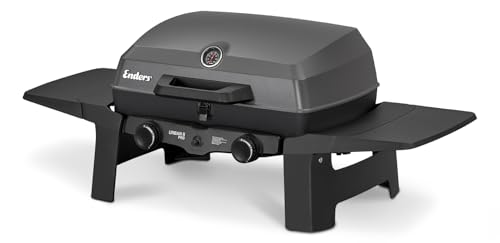
The Urban II Pro is a gas table grill from Enders with two burners, pot stands for cooking and a cooking hood made of cast aluminium. On Amazon it is listed at approx. €179 (Amazon page on 21.10.2026: €178.90). Enders’ recommended retail price is €249.00.
Number 2062: where the Pro sits in the Urban range
Enders Colsman from Werdohl sells the grill under article number 2062 and describes it as a further development of the Urban series. Around it are five variants of the same basic unit. Closest is the Urban II (art. no. 2070): same output, same grilling area, same weight, but a hood made of powder-coated steel and an overall height of 33.5 instead of 36 cm. Then there are two versions on a mobile base, the Urban II Pro Trolley (206272) and the Urban II Trolley (207072), and two caravan versions for leisure vehicles.
The Pro itself is a tabletop unit. It needs an existing surface to stand on, and the gas bottle goes beside it. In our gas grills category it therefore sits next to grill carts, which have more grate area but also take up much more floor space.
None of the six Urban II pages from Enders links to the Amazon listing with the ASIN B0DGTP9JG8. That the 2062 is sold there is based on the Amazon title with the addition #2062 and on the model number 2062 in the catalogue.
Burners, grate and hood: the construction
Under the grate are two stainless steel burners of 2.2 kW each, 4.4 kW together. Each has its own control knob. Ignition is by piezo: press the control knob, turn it anticlockwise to the highest setting, then operate the piezo igniter. The burners can be lit independently of each other. If the first knob is on full power, the second burner also starts by itself according to the manual. After that you adjust the heat to any position between the highest and lowest setting.
The grate is an enamelled cast iron grate in two halves, right and left, with integrated flame covers. Together they measure 49 x 32 cm, and Enders states 1,568 cm² of grilling area. Fat runs into a removable drip tray.
The housing and cooking hood are made of powder-coated cast aluminium, and a thermometer sits in the hood. In the product photo the hood is rectangular with rounded edges, the round thermometer sits at the top in the middle, with a transverse handle below it. At the front of the combustion chamber are the two control knobs, with the ignition button between them. The feet are two plastic frames with a carrying handle, left and right under the body.
Assembled, the Pro is 94 cm wide, 42 cm deep and 36 cm high. The plastic side shelves can be removed and stored compactly, which leaves 68 cm of width. Enders states a weight of 12 kg. Amazon’s catalogue lists 33.77 pounds, so approx. 15.3 kg, presumably including packaging; we stick to the manufacturer’s figure. Enders gives the working height as 23 cm.
In detail: two zones, reversible grate and the cooking spot
Two separately adjustable burners mean two zones. For direct grilling, according to the manual you switch both to full power and preheat the grate with the cooking hood closed, approx. 10 to 15 minutes depending on outside temperature and wind. After that you grill with the lid open or closed. For indirect grilling the food lies over the switched-off burner, the other one burns, and the hood stays closed. Hot air then cooks under the hood without a flame hitting the piece from below. That is the usual way for thick pieces that should not char on the outside before they are cooked through. How the two cooking zones differ in principle is explained by our guide to direct and indirect heat.
With two burners side by side, each zone gets roughly half the grate area. That is our reading of the construction; Enders does not describe the division.
One figure you can use to compare gas grills is output per area. For the Pro it is 4.4 kW over 1,568 cm², around 2.8 W per cm². The Weber Spirit E-210 delivers 7.8 kW over 2,314 cm² of main grate, around 3.4 W per cm². More output per area generally means a grate returns to temperature faster after cold food is put on. How hot it can get under the hood, however, cannot be read from this figure.
The grate halves have two usable sides. One is intended for grill marks, Enders speaks of sharp branding. Turned over, it becomes a flat pan, called the frying function in the manual; the right and left halves swap places in the process. Prawns or diced vegetables that would slip between bars also stay put on the flat side. According to Enders, the cast iron grate stores heat and distributes it evenly. As a general rule, cast iron absorbs a lot of heat and releases it slowly, and the enamel protects it from rust as long as it does not flake off.
For cooking you take out both grates and put the pots on the pot stands. The manual recommends diameters of at least approx. 16 and at most approx. 20 cm. A saucepan therefore fits, a 28 cm pan is well above that.
According to the manual, baking only works with the cooking hood closed. You preheat the pizza stone, Enders accessory art. no. 2110, for a quarter of an hour or a little less at approx. 180 to 200 degrees.
How long does a gas bottle last on the Urban II Pro?
By our calculation, a 5 kg bottle lasts a good 15 hours with both burners on full, an 11 kg bottle a good 34 hours. Turned down or with only one burner, as in indirect grilling, it lasts correspondingly longer.
The basis is the connected load from the technical data: 2 x 2.2 kW, approx. 321 g/h. Enders does not say whether the gram figure applies per burner or for both together. If you convert 4.4 kW into grams per hour using the calorific value of liquefied gas, you land almost exactly on this value. We therefore read the 321 g/h as the consumption of both burners.
According to the manual, bottles of 5 or 11 kg fit, and they stand beside the table. Enders supplies the dimensions: the 5 kg bottle is approx. 49.0 cm high with a diameter of approx. 23.5 cm, the 11 kg bottle approx. 59.0 cm high by approx. 30.0 cm. Neither is included in the delivery. A hose length of 0.8 m is recommended, so the route from the bottle to the connection must not be long.
For the bottle, the connection accessories are in the box: a 50 mbar pressure regulator to DIN EN 16129 (a German and European standard), type 694, with integrated hose rupture protection EFV, and a hose to DIN EN 16436-2. The Pro is designed for propane (G31) and butane (G30), appliance category I3B/P for Germany and Austria, nozzle 0.65 mm. According to the manual, the appliance is approved to DIN EN 498:2012 and DIN EN 484:2020, product identification number 0085CQ0040.
Instead of the bottle, a screw-on cartridge of approx. 450 g to DIN EN 417:2012 with a 7/16 inch thread also works; as the original, Enders names its gas cartridge art. no. 6322. This requires its own pressure regulator, type 794 to DIN EN 16129, and it is missing from the box. Amazon says the regulator for the screw-on cartridge is not included and gives art. no. 2071. Under the same number the manual lists the cartridge holder set, which Enders sells on the product page for €34.95. Which bottle size suits which grilling habits we have worked through in the guide gas bottle for the grill.
What else is worth considering?
| Model | The difference | Price | Our rating | Choose this one if |
|---|---|---|---|---|
| Enders Urban II Pro table grill (this one) | Cast aluminium hood, 2 burners of 2.2 kW each, pot stands | approx. €179 | 8.1 | you want to grill at the table and occasionally put a pot on |
| Enders Urban II table grill | Powder-coated steel hood, otherwise same key data | approx. €169.90 | 8.2 | the cast aluminium hood is not worth the extra to you |
| Weber Q 1200N | 1 burner of 2.93 kW on the disposable cartridge, no second zone | approx. €249 | 8.3 | you cannot store a gas bottle and can manage with one heat zone |
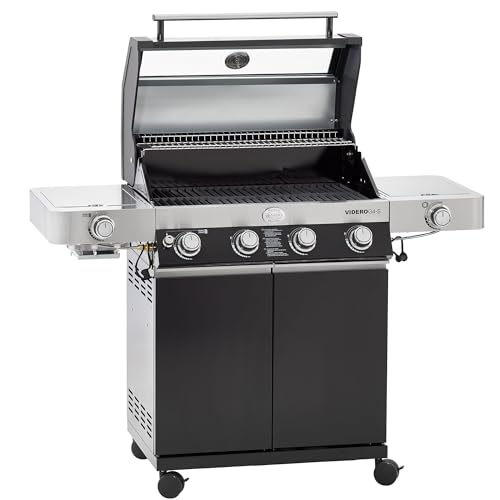
| Weber Spirit E-210 | Grill cart with 7.8 kW and 2,314 cm² main grate | approx. €389 | 8.9 | you have room for a grill cart and often grill for larger groups |
The prices are guide values from our price boxes and can change at any time. The rating is our editorial assessment from the data comparison; we have not measured or grilled anything.
When the Urban II Pro fits and when another one does
Height first. With a working height of 23 cm, the Pro belongs on a table, a wall or the trolley, not on the floor. If it stands on a dining table of around 75 cm, the grate sits just under a metre. The table needs at least 68 x 42 cm of space, 94 cm in width with the shelves attached, and it must meet the requirements for the surface, which are given further down verbatim.
How many people the area is enough for, Enders does not say. Our assessment: 49 x 32 cm suits a household of two to four people. For eight guests we would take a grill cart, such as the Weber Spirit E-210, which in our price box stands at approx. €389 against approx. €179 for the Urban II Pro.
Enders explicitly names the balcony as a place of use on the product page. The manual requires use outdoors and fixed clearances to the side and upwards. If you have a balcony ceiling or your neighbour’s balcony above you, measure this clearance before you buy. Whether gas is allowed on your balcony at all is governed by your tenancy agreement and house rules; what is usual is covered in our guide grilling on a balcony.
The Urban II costs approx. €169.90 according to our price box against approx. €179 for the Pro. By RRP the two are €50 apart, €199 against €249. The only difference is the hood. Aluminium does not rust, while steel stays rust-free only as long as the powder layer is intact. According to the manual you should store both frost-free and dry. But if the grill stays on the balcony during the season and gets rained on there, in our assessment the cast aluminium hood is the safer choice. If you put it under a roof after every grilling evening, you save money with the Urban II.
If you want no gas bottle at all, only cartridges, the Weber Q 1200N is the alternative: one burner, so one zone, for approx. €249 against approx. €179 for the Pro. On the Enders, by contrast, you need accessories for cartridge use.
If the grill should not stand on a table, there are two ways. Either you buy the trolley separately, RRP €99.90, with more height and storage space according to Enders. Or you go straight for the Urban II Pro Trolley with art. no. 206272, RRP €329: 88 cm working height, 20 kg, and the 5 kg bottle may stay in the lower cabinet during operation. By RRP the package is €19.90 cheaper than grill and trolley separately, which together would come to €348.90. For the table grill alone you should also plan for the weather cover, RRP €19.99, and a bottle if you do not have one at home.
Setting up, connecting, cleaning: the manual’s wording
The Pro’s manual has several pages of safety notes. Here the points on setup, operation, connection, maintenance and cleaning are given as Enders words them; grease fires and gas bottle storage we cover in the questions above.
Setup and operation: Use the gas grill only outdoors and make sure it is set up sheltered from wind. According to Enders, the housing design does protect the burners against gusts, but you should still set it up sheltered from wind. Keep it away from moisture and splashing water and place it on a level, stable and fireproof surface. The distance to flammable and heat-sensitive materials must not be less than 0.5 m. Above the grill there must be no objects or parts of buildings below a height of 1 m, measured with the hood open from its highest point. The ventilation openings stay clear. During operation the appliance is not moved and not left unattended. You check the hose and pressure regulator for cracks and damage before every use, and if the pressure regulator, hose or gas bottle are defective or leaking, the grill stays off. The bottle valve is open only while the grill is running. After use and before every change of location: grill off, valve closed, bottle removed, so that the pressure regulator and hose line are protected. The grilling surface must not be completely covered with aluminium foil or the like, otherwise overheating is a risk. No smoking when handling the gas system, and the bottle does not stand near open fire. You protect bottle and cartridge alike from strong sun; the bottle must not get warmer than 40 °C, the cartridge not warmer than 50 °C. In the event of a gas leak or a fault, you close the bottle valve immediately.
Connection: The grill may only be operated with a pressure regulator; the one supplied is set at the factory for liquefied gas. When connecting or changing the bottle, no ignition sources or open fire may be nearby. The union nuts have a left-hand thread. At the bottle valve you tighten the regulator’s nut by hand only, without tools, so the seal stays intact; at the grill’s connection, by contrast, with a spanner while a second spanner holds against the flats of the pressure regulator. The hose must not be kinked or chafe and must be accessible along its whole length. Afterwards you check all sealing points with leak detection spray or soapy water (1 part soap, 3 parts water), open the bottle valve and watch for bubbles. A leak test with an open flame is strictly forbidden. If everything is tight, you clean the connections with water.
Maintenance: You make no modifications to the grill and the pressure regulator, and repairs to gas-carrying parts belong to authorised specialist personnel. The hose must be serviced after 5 years, and the manufacturing date is printed on it. You replace the pressure regulator and hose after 10 years at the latest, even without visible damage. The new regulator must be approved for your country and the gas used and set to the correct outlet pressure, and a new hose must not be longer than 1.5 m. Nothing is changed on components that Enders has sealed. Never make stiff valves and control knobs move with oil or penetrating oil: gas forms an explosive mixture with oil.
Cleaning: before every use and after every use, but only once the grill has cooled down enough. Before use, pay particular attention to grease on the inside of the fire box and in the grease tray. Flammable, abrasive and chlorine-containing cleaning agents are excluded. You pull out the grease tray and dispose of the fat in an environmentally responsible way. After every grilling session you clear residues from the inside of the cooking hood and the cast iron grates, with a mild cleaning agent if needed, rinse with water and dry with a microfibre cloth. Food scraps you push through the perforation at the burner into the grease tray, and you wipe the inside of the housing with warm soapy water. You clean plastic parts with warm water, painted surfaces with mild cleaner and warm water and dry them with a soft cloth; solvents, stainless steel cleaners and abrasives are taboo for both, and for paint oven cleaner as well. For the burners you use a soft brush, not a metal brush. If a burner tube is exceptionally blocked, you clear it with a needle or a pipe cleaner. To remove it, you undo the nut on the underside of the burner, lift it up out of the fire box and clean its openings. Before the next use everything must be completely dry. The appliance is stored frost-free and dry, with the hood closed and covered.
Warranty, accessories and the open points
Enders grants the first buyer a voluntary manufacturer’s warranty for grills marked with a warranty symbol (for example on the packaging), which runs for different lengths per component: cooking hood unit and combustion chamber unit 10 years against rusting through or burning through, grease tray 3 years against rusting through and burning through, stainless steel burners and enamelled cast iron grates 3 years against rusting through or burning through, plastic elements 3 years, all other parts such as the ignition bridge, screws and thermometer 2 years. The period begins on the purchase date. For the extended term you register the grill on the Enders website within three months of purchase. The warranty applies only in Europe and supplements the statutory warranty without restricting it.
Excluded are normal wear such as rust formation, colour fading, scratches or dents that do not affect function, as well as damage from improper use, improper assembly, misuse or neglected maintenance, damage from extreme weather conditions, salty air, chlorine sources, acid rain or other environmental influences, and damage from non-original parts or unauthorised repairs and conversions. In no case does the warranty cover more than the original purchase price.
The manual prints a spare parts list with article numbers, including cast iron grate (130004109), pot stand (130004016), hood (130004105), thermometer (130004144), control knob (130004111) and gas pressure regulator and hose (130001045). As accessories, besides the trolley, cover and cartridge set, the product page lists a cast plate 1/2 and a pizza stone for €34.95 each, a stainless steel grill pan with bowls for €59.90, a stainless steel wok for €29.95 and covers for the 5 kg and 11 kg bottle for €14.99 and €17.99.
Still open after the product page and 24 pages of manual are these points: the maximum temperature under the hood, the height of the cooking chamber, the stainless steel grade and construction of the burners, the weight of the cast iron grates, the country of manufacture (Werdohl is, according to Enders, the development site), the year of market launch, the length of the supplied hose, and the warranty period for anyone who does not register. A burn time per bottle or cartridge is also missing; the values above are our calculation.
Who is it suitable for?
The manual itself limits the group of users. The grill may only be used for grilling outdoors, it is not intended for children or for persons with a reduced ability to operate appliances, its surfaces can get very hot, so you warn bystanders and keep children away, and you wear protective gloves on hot components.
The wrong choice is the Pro for anyone who grills in a club, a communal facility or commercially: the Enders warranty explicitly applies only to grills used privately.
We find it suitable for a small household with an outdoor table that would also like to make a side dish in a pot or a flammkuchen (Alsatian-style thin tart) at the grill and can put the grill under a roof between uses anyway. Whether a tabletop unit or a grill cart suits you better, you can play through in the grill finder.